
The Deep State’s Dirty Laundry: How the U.S. Government Became the World’s Most Corrupt Machine—and Why Trump Terrifies Them

For decades, the United States has cloaked itself in the sanctimonious garb of “defender of democracy,” wagging its finger at tin-pot dictators and third-world kleptocrats while its own intelligence apparatus—the CIA, NSA, and their shadowy cousins—ran roughshod over sovereign nations like a geopolitical wrecking crew. The evidence isn’t buried in conspiracy forums; it’s strewn across the historical record, plain as day. In 1953, the CIA orchestrated the overthrow of Iran’s democratically elected Prime Minister Mohammad Mossadegh, installing the Shah to secure oil interests for Western elites. A year later, they toppled Guatemala’s Jacobo Árbenz over fears his land reforms threatened United Fruit Company’s profits—capitalism’s sacred cow. Fast forward to 2011: the NSA’s mass surveillance fingerprints were all over the Arab Spring, destabilizing regimes under the guise of “spreading freedom,” while CIA black sites waterboarded their way through the War on Terror. From Chile to Ukraine, the playbook’s the same—subvert, manipulate, install. Rinse, repeat.
This isn’t noble statecraft; it’s a global power grab dressed up as patriotism. And here’s the rub: what starts as foreign meddling doesn’t stay foreign. Power, as Lord Acton warned, corrupts—and absolute power? That’s the Deep State’s calling card. Somewhere along the line, the unelected bureaucrats in Langley and Fort Meade stopped seeing themselves as servants of the Constitution and started acting like its overlords. Elected leaders, meanwhile, caught the scent of the grift. Why settle for a congressional salary when you can funnel billions in taxpayer dollars to murky NGOs—nonprofits with no oversight, staffed by cronies, and flush with cash for “consulting” gigs? Just look at the Biden family’s Ukraine adventures or the Clintons’ foundation empire—public office became a ATM, and the PIN was plausible deniability.
Enter Donald J. Trump, the brash billionaire who crashed the party in 2016. To the Deep State and their political puppets, he wasn’t just an outsider—he was a five-alarm fire. Trump didn’t play by their rules. He didn’t genuflect to the intelligence community’s sacred cows or rubber-stamp the endless wars that keep the machine humming. Worse, he started asking questions—about NATO’s bloated budgets, about foreign aid slush funds, about why the U.S. was bankrolling half the planet while its own borders crumbled. For a system built on secrecy, self-enrichment, and global dominance, this was existential kryptonite.
The Deep State’s response was predictable: neutralize the threat. Politicians saw Trump as a buzzsaw to their money-laundering rackets—those sweet, untraceable streams of cash flowing through “humanitarian” NGOs and defense contracts. The intelligence brass saw him as a wrecking ball to their unaccountable fiefdoms, where they—not the President—call the shots. Exhibit A: the Russia collusion hoax. The CIA and FBI didn’t just spy on Trump’s campaign; they fabricated a narrative with forged dossiers and leaked it to a compliant press. Exhibit B: the 2020 election, where Big Tech—cozy as ever with NSA data pipelines—suppressed the Hunter Biden laptop story, a move that polling later showed could’ve swung the outcome. Exhibit C: January 6, where murky federal informants and a militarized Capitol response turned a protest into a cudgel to smear Trump and his supporters as domestic terrorists.
The media, of course, is the Deep State’s megaphone. CNN, MSNBC, and the New York Times didn’t just cheerlead the takedown; they were active players, laundering lies from anonymous “senior officials” into front-page gospel. When Trump railed against “fake news,” he wasn’t wrong—he was just late to the party. The press has been in bed with spooks since Operation Mockingbird, when the CIA infiltrated newsrooms to shape narratives. Today, it’s less infiltration than symbiosis: anchors and editors know their bread’s buttered by the same hands that pull the levers in D.C.
From a constitutional conservative lens, this is a betrayal of everything America’s supposed to stand for. The Founders didn’t bleed at Valley Forge so a cabal of unelected suits could run the show. They gave us checks and balances, not shadow governments. Trump, for all his bombast, threatens to drag that original vision back into the light—less global empire, more national sovereignty; less insider grift, more accountability. That’s why the Deep State and their political lapdogs want him gone. He’s not perfect, but he’s a middle finger to a system that’s spent decades picking our pockets and subverting our will.
Texas knows this fight better than most. We’ve seen D.C.’s overreach firsthand—whether it’s federal land grabs or ATF gun grabs. The Lone Star State’s a microcosm of what’s at stake: a people who’d rather govern themselves than bow to a corrupt leviathan 1,500 miles away. Trump’s their nightmare because he’s ours—a bull in the china shop of a government that’s forgotten who it answers to. The Deep State can’t stand that. And they’ll burn it all down before they let him win again.
The rot of the Deep State doesn’t just fester in the marble corridors of Washington—it’s seeped into the red dirt of Texas, where the battle lines between constitutional liberty and centralized corruption are drawn sharper than a Bowie knife. The Lone Star State, a bastion of self-reliance and skepticism toward federal overreach, has become a proving ground for the clash between Donald Trump’s outsider insurgency and a system desperate to cling to power. Here, the stakes aren’t theoretical—they’re as real as the oil rigs dotting the Permian Basin. And the Deep State, alongside its Democratic allies in Congress, is pulling every lever to stop Trump from dismantling their racket.
Back in D.C., the CIA and NSA’s history of global manipulation—toppling Mossadegh in Iran, Árbenz in Guatemala, and greasing the skids for chaos in the Middle East—set the stage for a domestic power grab that’s now in full bloom. Power corrupts, and the federal trough has turned elected officials into pigs with snouts buried deep. Take the Biden family’s Burisma dealings or the Clinton Foundation’s pay-to-play schemes—public funds siphoned through NGOs with less oversight than a West Texas honky-tonk on a Saturday night. The Deep State, convinced it’s the real government, doesn’t just tolerate this; it thrives on it. Trump’s pledge to drain the swamp threatens not just the politicians’ slush funds but the intelligence community’s untouchable dominance. That’s why they’ve weaponized the media—from CNN’s breathless Russia hoaxes to the New York Times’ stenography for anonymous спooks—to take him down.
Nowhere is this fight fiercer than in Texas, where the state’s 38 congressional seats make it a linchpin in the battle for the House. Top Democrats, sensing Trump’s momentum after his 2024 victory, are scrambling to erect roadblocks, and their Lone Star delegation is leading the charge. Here’s how they’re doing it:
- Rep. Al Green’s Impeachment Gambit: On February 5, 2025, Houston’s Rep. Al Green—a Democrat with a flair for the dramatic—filed articles of impeachment against Trump over a supposed plan to “take over Gaza.” Green called it “ethnic cleansing,” a charge as wild as a Longhorn stampede, given Trump’s actual focus on domestic priorities like border security. Reported by The Guardian, this move reeks of political theater, a stunt to tie Trump up in legal knots and rally the progressive base. Green’s history of failed impeachment bids against Trump—three during his first term—shows he’s less interested in winning than in gumming up the works.
- Rep. Lloyd Doggett’s Funding Freeze Fiasco: Austin’s Rep. Lloyd Doggett, a grizzled veteran of the House, has been pushing to freeze federal funding to Texas agencies that might align with Trump’s agenda. In late February, Doggett joined a coalition of House Democrats to block Department of Defense grants, citing Trump’s “militarization” of the border—an echo of 2019, when he and others filibustered Pentagon funds over the border wall, as noted by AP News. This isn’t about principle; it’s about starving Texas of resources to enforce immigration laws Trump champions, laws that resonate with voters from El Paso to Tyler.
- Rep. Joaquin Castro’s Media Blitz: San Antonio’s Rep. Joaquin Castro has taken to the airwaves, partnering with MSNBC and local outlets like the San Antonio Express-News to amplify claims of Trump’s “authoritarian” bent. In a February 14, 2025, NPR report, Castro backed a new House Democratic “rapid response task force” to counter Trump’s executive orders, framing them as an assault on democracy. His real game? Keeping the narrative alive that Trump’s a threat to Texas values, even as San Antonians chafe at federal overreach on everything from gun rights to energy policy.
These Texas Democrats aren’t lone wolves—they’re pack animals, coordinating with national figures like Senate Minority Leader Chuck Schumer and House Minority Leader Hakeem Jeffries. Schumer’s been vocal, telling The Guardian on February 9 that Democrats will “do everything in their power” to block Trump’s agenda, while Jeffries has leaned on the House’s slim GOP majority—now 217-215 after resignations—to stall Trump-backed bills. Add in lawsuits from the Democratic National Committee, filed in late February against Trump’s executive orders on election integrity (Politico), and you’ve got a full-court press to cripple his administration before it can hit stride.
For Texas, this isn’t just politics—it’s personal. The state’s economy, from oil to agriculture, thrives when Washington stays out of the way. Trump’s promise to slash regulations and secure the border aligns with that ethos, which is why he carried Texas by over 5 points in 2024. But the Deep State and its Democratic proxies see that as a threat to their globalist gravy train. They’d rather see Texas kneel than prosper—whether it’s Doggett choking off funds, Green grandstanding, or Castro playing media marionette.
The irony? Texas has seen this before. In 2021, state Democrats fled to D.C. to block a voting bill, only to watch it pass anyway (Al Jazeera). Now, their congressional kin are trying the same playbook against Trump, betting they can outlast him with procedural tricks and press conferences. But Texans don’t bend easy. From the Alamo to the present, we’ve fought bigger bullies than this—and won. Trump’s their champion because he’s ours: loud, unpolished, and unwilling to let a corrupt machine dictate terms. The Deep State can scheme all it wants, but in Texas, we still believe the people—not the spooks or the suits—call the shots.








Austin
Texas GOP Wants Closed Primaries. New Secretary of State Robert Howden Is Preparing to Fight Them.
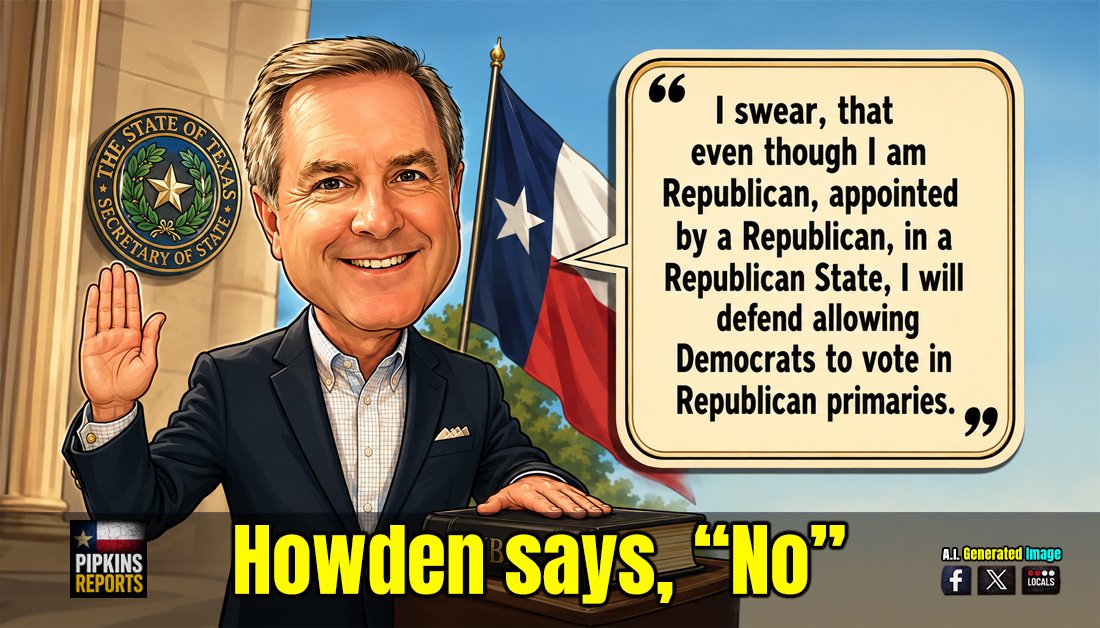
Austin, TX – Texas Republicans spent years demanding control of their own primary. Now they have a new Secretary of State, Robert S. Howden, appointed by Republican Governor Greg Abbott, and the man taking over the state’s election machinery is inheriting a lawsuit in which his office is expected to defend the very open primary system the GOP wants to dismantle.
The Republican Party of Texas filed the federal lawsuit in September 2025, arguing that Texas’ open primary system violates the party’s First Amendment right of association. Under the current system, Texas voters do not register by party and may choose which party’s primary to vote in during an election cycle. The GOP wants only registered Republicans participating in Republican primaries.
The case is pending in federal court in Amarillo before U.S. District Judge Matthew Kacsmaryk.
And Robert S. Howden has now inherited it.
Howden Steps Into the Fight
Gov. Abbott appointed Howden as Texas’ 116th secretary of state on July 17, effective July 18. Howden previously served as Abbott’s senior adviser and director of legislative affairs and has worked in the administrations of four Republican governors. As secretary of state, he is Texas’ chief elections officer.
Abbott has been quite clear about where he stands.
At the 2026 Republican Party convention, he said Texas would eventually make clear that “only Republicans vote in Republican primaries.” Abbott has also said lawmakers “can and should be more responsive to Republicans than a judge may be,” indicating that he expects the Legislature to address the issue during the 2027 session.
But that doesn’t mean the Secretary of State’s office is supposed to simply surrender in court.
That was the position taken by Howden’s predecessor, Jane Nelson.
Nelson argued that changing Texas’ primary system was a job for the Legislature, not a federal judge. In an October 2025 statement, she said it was her responsibility to defend existing election laws and that she would implement whatever changes the Legislature lawfully enacted.
The Attorney General’s office took the opposite position.
Attorney General Ken Paxton sided with the Texas GOP, asking the federal court to strike down portions of the Texas Election Code governing open primaries. According to reporting by The Texas Tribune, Nelson’s lawyers said Paxton’s office gave them less than an hour’s notice before taking the opposing position.
So the Republican Party sued the Republican-controlled state government. The Republican Attorney General joined the plaintiffs. And the Republican Secretary of State fought the lawsuit.
That’s not exactly the tidy party unity politicians like to advertise.
The Real Fight Is Over Who Controls the Nomination
The GOP argues that crossover voting allows Democrats and independents to influence Republican nominations, potentially helping candidates who are less conservative than the party base.
The lawsuit specifically pointed to the 2024 Republican primaries involving former House Speaker Dade Phelan and Rep. Gary VanDeaver. Both won their races by fewer than 800 votes, and the party argued that crossover voters helped determine the outcomes.
The party has already made closing primaries an official priority. Republicans adopted rules supporting closed primaries in 2024 and renewed that push at their 2026 convention.
But changing the system is not as simple as flipping a switch.
Texas has more than 18 million registered voters, and the state’s registration system was never designed around party registration. Moving to closed primaries could require new registration procedures, computer-system changes and a method for existing voters to establish party affiliation.
The GOP wants the courts to clear the way, preferably in time for 2028.

San Angelo, TX – San Angelo’s battle over massive data centers has moved from City Hall chambers to the ballot box, and two council members could soon have to defend their seats before voters angry about how the city has handled the projects. What began as a fight over water, power, development and transparency is now a full-blown political revolt, with recall efforts targeting Council Members Harry Thomas and Joe Self.
And the controversy comes at an interesting moment for Texas. Gov. Greg Abbott has ordered state regulators to conduct a comprehensive audit of data centers moving through the state’s electric grid interconnection process, saying the review must be completed before any data center project moves forward. ERCOT subsequently told Fox News Digital that Abbott’s directive “effectively pauses all data center projects” while the state reviews their demands on the grid.
That means the questions being shouted at San Angelo City Hall are no longer merely local complaints from residents opposed to a particular development. Texas officials are now asking some of the same questions.
Abbott directed the Public Utility Commission of Texas and ERCOT to examine pending data center projects and gather information, including projected annual and peak electricity demand, water consumption, water sources, and whether facilities intend to generate some of their own electricity. ERCOT reported that roughly 90 percent of the 474 gigawatts of large-load interconnection requests currently under review are associated with data centers, more than five times Texas’ record peak electricity demand.
Back in San Angelo, the San Angelo Data Center Citizen Coalition has been pushing its own accountability campaign.
A petition seeking the recall of Council Member Harry Thomas, who represents Single Member District 3, was submitted July 15 with more than the required signatures. The city clerk later certified the petition after determining 53 signatures were sufficient, clearing the way for a recall election.
Following public comment, the City Council voted 6-1 to call the recall election.
Thomas has maintained that he has no intention of resigning.
“I weigh every decision I’ve ever made on behalf of the 100,000 citizens in San Angelo,” Thomas said after the petition was submitted. “Every time I vote, I vote for all the citizens. I have no plans to resign from my position.”
Self is now facing his own recall effort.
The coalition submitted an affidavit seeking Self’s recall and subsequently collected the signatures necessary to move forward. On Aug. 6, Self issued a statement saying he supports residents’ right to seek a recall but rejected what he described as misinformation about his involvement with data centers.
“I have not signed any non-disclosure agreements,” Self said. “I have not benefited financially. I have not voted in favor of a data center.”
Self said the council has instead voted on regulations that would apply if a data center is established in San Angelo.
That distinction between approving a specific project and approving regulations governing potential projects has become one of the central arguments in the political fight. San Angelo officials have considered rules addressing land use, water and wastewater issues as the city confronts proposals for large-scale data center development.
The proposed Skybox project has become particularly contentious. City officials have described it as a potential $7.2 billion investment, while opponents have raised concerns about water consumption, electricity demand, infrastructure, noise and transparency surrounding the development process.
The political consequences are spreading beyond San Angelo.
Residents in Temple and Granbury have also launched recall or charter efforts amid disputes over data center development. In Temple, opponents have cited concerns about land, water consumption and heat generated by facilities. In Granbury, activists gathered signatures seeking recalls involving the mayor and most members of the City Council.
Election
Texas Senate Hopeful James Talarico Shared Pride Event Stage With 11-Year-Old Child Drag Performer

Federal Court Upholds State Limits on Minors at Adult Drag Shows
Taylor, TX – A federal appeals court has just upheld a Florida law restricting minors from attending certain adult live performances, including some drag shows. Within hours of that ruling, renewed attention was focused on Texas Democratic U.S. Senate candidate James Talarico after reports resurfaced showing he headlined a 2021 Pride fundraiser featuring an 11-year-old child drag performer promoted as one of the event’s main attractions.
On Tuesday, the U.S. Court of Appeals for the 11th Circuit ruled in HM Florida-ORL, LLC v. Secretary of the Florida Department of Business and Professional Regulation, allowing Florida to enforce its law restricting minors from attending certain adult live performances. Florida Attorney General James Uthmeier announced the decision, calling it a victory for protecting children. The ruling does not prohibit drag performances for adults, but it recognizes that states may impose limits when minors are involved.
The timing has drawn renewed scrutiny to Talarico’s record as he campaigns for the U.S. Senate against Texas Attorney General Ken Paxton.
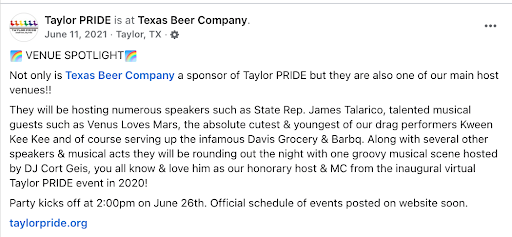
According to promotional materials first highlighted by the Washington Free Beacon, Talarico was a featured speaker during Taylor PRIDE’s June 26, 2021 fundraiser in Taylor, Texas. The event was organized to raise money for “rural LGBTQ communities” and included live music, Drag Story Hour, adult drag performers, and an 11-year-old performer using the stage name “Kween Kee Kee.”
Taylor PRIDE advertised the child as “the absolute cutest & youngest of our drag performers.” Promotional posts stated the child would perform a drag routine and host “Kee Kee Storytime,” where children would participate in Pride-themed craft activities. The event was held at Texas Beer Company.
Photographs published from the event show Talarico addressing attendees from the stage and posing with participants. Additional photographs and video posted publicly show Kween Kee Kee, a local preteen named Keegan, performing in a shimmering blue dress, platinum blonde wig, and theatrical makeup during what organizers described as a Youth Drag Show. One attendee shared video of the child performing the splits before the audience.
The fundraiser also featured several adult drag performers, including Brianna Brinxx, Belladonna Dior, Felecia Enspire, and a performer using the stage name Sedonya Face.
Following criticism from conservative activists who protested the event, Taylor PRIDE defended the festival on social media. The organization rejected claims that the event was sexually explicit or exploitative and encouraged the public to review photographs from the event and decide for themselves.
Talarico’s campaign did not respond to requests for comment from the Washington Free Beacon regarding his participation.
The resurfaced event adds to a broader record that Republicans have highlighted throughout Talarico’s political career. While serving in the Texas House, Talarico opposed legislation restricting drag performances in the presence of children and argued lawmakers should avoid harming what he described as Texas’ drag performers. He has also opposed Republican-backed legislation restricting certain transgender medical treatments for minors and has frequently spoken in support of LGBTQ causes.
More recently, however, Talarico has attempted to present himself as a more moderate statewide candidate. He has described previous remarks, including referring to God as “nonbinary,” as “cringey” and has removed some progressive messaging from campaign materials as he seeks to broaden his appeal beyond Democratic primary voters.
The renewed attention comes as cultural debates surrounding children and drag performances continue playing out both politically and legally. Florida’s appellate court victory represents one of the most significant recent rulings supporting a state’s authority to restrict minors from attending certain adult-oriented live performances, even as litigation over similar laws continues elsewhere.
You must be logged in to post a comment Login