
Connect with us

Published

on

How Fate registered a developer’s project domain after seeing it in official plans, then fought to keep that fact hidden

FATE, TX – Cities are expected to regulate development, not steal its name.

Records obtained by Pipkins Reports show the City of Fate registered the domain name of a private development, lafayettecrossing.com, while actively working with the developer who had already claimed that name in official plans. The move, made quietly during a heated approval process, raises serious questions about whether Fate’s city government crossed from partner to predator, taking digital ownership of a project it was supposed to oversee with neutrality and good faith… and depriving the developer of their rights to domain ownership.

What followed, attempts to conceal the purchase, shifting explanations from city officials, and a documented pattern of advocacy on behalf of the developer, suggests the domain registration was not an accident, but part of a broader effort to control the narrative around one of the most divisive projects in the city’s history.

A site plan submitted by the developer, D-F Funds GP, LLC, led by Robert Yu, shows the project title “Lafayette Crossing” clearly identified in the title block on December 20, 2023. The document was part of the city’s official development review for the controversial project at the corner of I-30 and Highway 551.
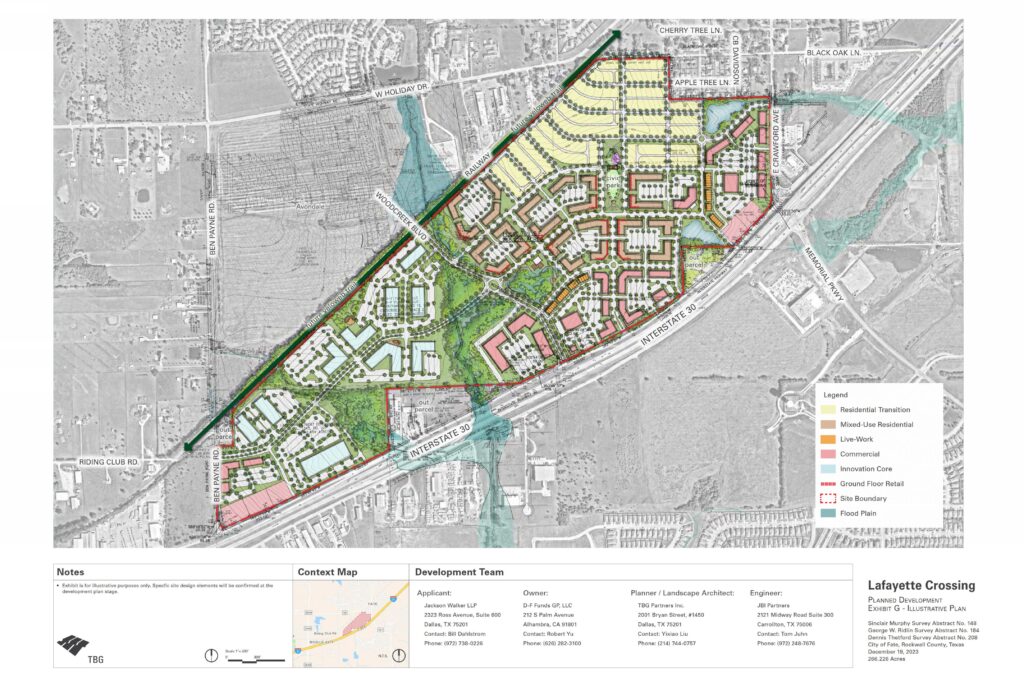
Plan Submitted December 20, 2023 to Fate Planning and Zoning

Less than two months later, on February 7, 2024, the City of Fate registered the domain lafayettecrossing.com, Invoice #116953461, for $12.

Domain records confirm the registration date, with the domain set to expire on February 7, 2027. By that point, Lafayette Crossing was already the established name of the project, used by the developer and embedded in official plans circulating within City Hall.

This was not a coincidence. The city had the plans from the developer. Their were extensive talks regarding the project. Then the city registered the domain without the knowledge of the developer. This is known in the industry as, “Cybersquatting.”

The development, originally referred to as the “Yu Tract,” became known as Lafayette Crossing as it moved through the approval process. The project ignited intense public opposition over density, traffic congestion, infrastructure strain, and the long-term direction of Fate’s growth. Despite sustained resistance and packed council chambers, the city council approved the project.

The political fallout was severe. In the elections that followed, four council members and the mayor were replaced, an extraordinary level of turnover that reflected deep voter dissatisfaction. Two members from that Council, Councilman Mark Harper and Councilman Scott Kelley, remain, but are up for reelection this May.

That context matters, because the domain registration did not occur in isolation. It occurred amid a broader, documented pattern of city officials actively working to shape public perception in favor of the developer.

In February 2024, Pipkins Reports, then operating as the Fate Tribune, published an exposé based on internal city emails showing City Manager Michael Kovacs discussing strategies to “educate” the public about Lafayette Crossing. In those emails, Kovacs suggested deploying what he referred to as “Fire Support,” a term used to describe both paid and unpaid advocates brought forward to counter citizen opposition and astroturf public support for the project.

That reporting revealed a city government not merely responding to public concerns, but actively attempting to manage and counter them.

In a later publication, Pipkins Reports (Fate Tribune) documented the City of Fate’s hiring of Ryan Breckenridge of BRK Partners, engaging in what records showed to be a coordinated public relations effort aimed at improving the project’s image and swaying public sentiment. The campaign was presented as informational, but residents viewed it as advocacy on behalf of the developer, funded with public resources.

It was within this environment, where city staff had already aligned themselves publicly and privately with the developer’s interests, that the city registered the lafayettecrossing.com domain. Yet that fact remained hidden until PipkinsReports.com submitted an Open Records Request on September 30, 2025, seeking a list of all domains owned by the city.

Rather than comply, the City of Fate objected. On October 14, 2025, officials asked the Texas Attorney General’s Office for permission to withhold the records, citing “cybersecurity” concerns.

On January 6, 2026, the Attorney General rejected that claim and ordered the information released. The city complied on January 20, 2026.

In addition to the lafayettecrossing.com domain, the records revealed the city owns numerous domains tied to redevelopment and branding initiatives, including:

  • FateTX.gov
  • DowntownFate.com
  • FateFoodHaul.com
  • FateMainStreet.com
  • FateStationHub.com
  • FateStationMarket.com
  • FateStationPark.com
  • FateStationSpur.com
  • OldTownFate.com
  • TheHubAtFateStation.com
  • TheSpurAtFateStation.com
  • ForwardFate.com

Most clearly relate to city-led initiatives. LafayetteCrossing.com stands apart because it mirrors the established name of a private development already proposed, named, and publicly debated.

When questioned via email, Assistant City Manager Steven Downs initially suggested the domain purchase occurred long before his involvement and downplayed any potential issues. When we revealed documents to show Downs was actively engaged with the project at the same time the Lafayette Crossing name entered the city’s official workflow, his story changed.

In follow-up correspondence, Downs acknowledged he was aware of the project name, while placing responsibility for the domain purchase on former Assistant City Manager Justin Weiss. Downs stated he did not know whether the developer was aware of the purchase and said he was not concerned about potential liability.

What remains unexplained is why the city registered the domain at all, knowing it belonged to a private project, and why it attempted to keep that information from the public.

Opinion

Viewed in isolation, a $12 domain purchase might seem trivial. Viewed in context, it is not.

When a city that has already worked to astroturf support, hire public relations firms, and counter citizen opposition also quietly registers a developer’s project domain, then attempts to conceal that information from the public, the line between regulator and advocate disappears.

The question is no longer whether the city knew the name. The record shows it did.

The question is why a city government so deeply invested in selling a controversial project to its residents felt the need to take ownership of the project’s digital identity as well.

Control of messaging, control of perception, and control of narrative are powerful tools. Sometimes it is equally as important to control what is not said.


Michael Pipkins focuses on public integrity, governance, constitutional issues, and political developments affecting Texans. His investigative reporting covers public-record disputes, city-government controversies, campaign finance matters, and the use of public authority. Pipkins is a member of the Society of Professional Journalists (SPJ). As an SPJ member, Pipkins adheres to established principles of ethical reporting, including accuracy, fairness, source protection, and independent journalism.

Council

Caught on Her Own Tape: Codi Chinn Secretly Recorded David Billings Phone Call

Published

on

Chinn's secret recordings

Chinn and Billings Bash Senator Bob Hall

Fate, TX – The political firestorm over secret recordings inside Fate City Hall just took a sharp and deeply ironic turn. Pipkins Reports has obtained an audio recording that appears to show former Fate City Councilwoman Codi Chinn secretly recording a private telephone conversation with former Mayor David Billings, despite her later public criticism of the practice.

The recording, verified through multiple sources familiar with the matter, predates the recent controversy involving Mayor Andrew Greenberg‘s recorded conversation with Chinn and Councilman Mark Hatley‘s recording of a discussion with City Manager Michael Kovacs. The discovery raises uncomfortable questions about consistency, credibility, and whether Chinn’s outrage over recorded conversations has been driven more by politics, than principle.

Pipkins Reports received a copy of a 32-minute audio recording from an anonymous source who said it originated from a recording obtained through an Open Records Request submitted to the City of Fate.

Pipkins Reports has reviewed documentation related to that request and separately confirmed the recording’s authenticity through sources with knowledge of the file maintained by the city.

Much of the conversation centers around mundane talk about MUD districts. Pipkins Reports has edited the recording to a 2-minute, 47-second excerpt focusing on the discussion involving Texas Sen. Bob Hall because it is directly relevant to matters of public interest.

During the conversation, Chinn expresses frustration with Hall’s reluctance to support legislation to strengthen child protection in schools. Stating that he is, “not interested in having that conversation.” She continues, “He is interested in getting people all riled up, but when it comes time to actually do the work, and his job, he’s nowhere to be found.

Billings echoes that frustration, and opines how he says Bob Hall, “fights dirty“, and how he has voted against cities 9 times. The conversation paints a picture of two local political figures who believe the longtime senator was not sufficiently responsive to their legislative priorities.

The policy disagreements themselves are not especially unusual. Elected officials often criticize one another behind closed doors. What makes this recording different is the hypocrisy of Chinn, stirring up outrage about “secret recordings” when she herself has been a proponent.

The Hall recording is not the only documented instance in which Chinn appears to have secretly recorded a conversation. Through a separate Open Records Request submitted by Pipkins Reports, this publication obtained a city copy of a recorded interview between Michael Pipkins and Chinn concerning her involvement in the dismissal of former Fate Department of Public Safety Chief Lyle Lombard.

That recording also predates the controversy that would inevitably follow.

According to the records produced by the City of Fate, Chinn recorded that interview without disclosing it during the conversation. The existence of multiple recordings attributed to Chinn adds additional context to the current debate over undisclosed recordings by public officials and further raises questions about the consistency between her past actions and her more recent public criticism of the practice.

But according to the evidence reviewed by Pipkins Reports, Chinn appears to have engaged, multiple times, in the very conduct she later condemned.

Texas is a one-party consent state under state law, meaning only one participant in a conversation generally must consent to its recording. If Chinn initiated or participated in the call, recording it would not necessarily violate Texas law. The issue presented here is not primarily a legal one.

It is political.


Opinion

Politics has a funny way of exposing selective outrage.

For months, Fate residents have heard lectures from Codi Chinn about how secret recordings destroy trust, poison relationships, and undermine good government. Fair enough. Those are arguments reasonable people can debate.

But what legitimate purpose would have been gained by Chinn recording a conversation with the Former Mayor?

Given this revelation, it’s possible that the recordings by others that followed Chinn, may have been a defense mechanism (even unconsciously), over a situation that they could feel was off. Couple that with the deceptions that we now know were taking place by Chinn, and other council members, as well as the city manager, and it appears that there might have been a valid justification for both Greenberg and Hatley to take the actions that they did.

There’s another layer here which is important to understand as to why Pipkins Reports chose to clip this section of the audio. Chinn and Billings were not merely venting about Sen. Hall. They were criticizing an elected state senator over legislation affecting Fate, as well as Rockwall County in general, and discussing his approach to measures involving child safety in schools. Voters deserve to hear how public officials truly feel about those issues, and how they discuss those issues when they believe no one else is listening.

This recording doesn’t settle every argument currently consuming City Hall. It does, however, remove any illusion that only one side has participated in private recordings.

Sometimes the loudest critics leave behind the clearest evidence.

Continue Reading

Fate, TX

City of Fate’s Law Firm Abruptly Resigns

Published

on

Richie Resigns

Fate, TX – The City of Fate is about to lose the law firm that has represented it for years.

On July 9, Andrew Messer of Messer Fort, PLLC formally notified Mayor Andrew Greenberg and the City Council that it would terminate its legal representation of the City effective July 20, giving the City just eleven days to secure new legal counsel. The brief resignation letter offers no explanation beyond stating the firm “can no longer continue to represent the City.

That single sentence is already fueling questions inside City Hall.

According to sources familiar with the matter, the firm’s departure may help explain why longtime City Attorney Jennifer Richie was absent from the July 6 City Council meeting. Instead, founding partner Andrew Messer personally attended the meeting, an unusual move that several observers immediately noticed. Sources within City Hall say the transition away from the City had already begun.

The resignation itself is remarkably concise.

In the letter dated July 9, Andrew Messer thanked the City “for the opportunity to serve as the City Attorney for the City of Fate,” before stating that the firm could no longer continue its representation and would assist with transitioning matters to new legal counsel through July 20. No reason for the departure is provided.

Under the City’s own published description of the City Attorney’s responsibilities, legal counsel serves in one of the most influential roles in municipal government. Those duties include advising the City Council and staff on Texas open meetings law, ethics requirements, public information requests, contracts, development agreements, employment law, litigation, municipal court matters, utilities regulation, and land use issues.

The City Council is ultimately responsible for selecting legal counsel, although municipalities commonly contract with outside law firms rather than employ an in-house attorney.

While neither the City nor Messer Fort has publicly announced why the relationship is ending, multiple sources told Pipkins Reports that concerns over recent legal advice may have contributed to the firm’s decision to withdraw.

One issue concerns the City’s handling of secret audio recordings that became the subject of disputes under the Texas Public Information Act.

In recent months, Messer Fort submitted two separate requests to the Texas Attorney General seeking permission to withhold portions of audio recordings requested under the Public Information Act. According to documents previously reviewed by Pipkins Reports, the Attorney General issued different rulings for the two requests.

Sources familiar with those proceedings contend the firm chose to apply the more restrictive interpretation to both rulings rather than favoring disclosure, despite Texas law generally presuming government records are public unless an exception clearly applies.

Another dispute centered on allegations that Mayor Andrew Greenberg improperly disclosed personal medical information concerning a City employee contained within one of the recordings.

According to sources, Messer Fort argued the information should remain confidential when requesting an Attorney General ruling. However, the request allegedly failed to disclose what those same sources describe as a significant fact: the employee had died before the recording was released.

Under Texas law, privacy protections that apply to living individuals may not continue in the same manner after death, depending on the information involved and the applicable legal standards. The omission of that fact, according to sources familiar with the dispute, may have affected the Attorney General’s review of the matter.

The issue has reportedly been returned to the Attorney General’s Office for further consideration regarding what information, if any, must ultimately be withheld and what must be released to the public.

Neither Messer Fort nor Jennifer Richie has publicly commented on those allegations, and Pipkins Reports has not independently confirmed whether those matters played any role in the firm’s resignation.

For now, the City must move quickly to retain replacement counsel before July 20.

Opinion

Government attorneys occupy a unique position. They don’t represent politicians. They don’t represent bureaucrats. They represent the municipal corporation, and ultimately the public interest within the bounds of the law.

That’s why transparency matters so much.

Texas didn’t write the Public Information Act to help governments hide embarrassing records. The Legislature deliberately built the law around a presumption that public records belong to the public unless a clearly established exception applies, and governments must seek permission to withhold information.

When legal advice appears to lean toward secrecy instead of disclosure, public confidence inevitably suffers, people begin wondering whether lawyers are protecting the law, protecting city hall, or protecting chosen politicians.

Of course, none of this proves why Messer Fort resigned. It would be irresponsible to claim otherwise.

But the timing is difficult to ignore. A law firm that has represented Fate for years suddenly announces it “can no longer continue” representing the City without explanation, just days after its lead attorney is absent from a council meeting and amid ongoing disputes over public records. Texans are entitled to ask questions.

And those questions deserve answers.

Whether the resignation stems from disagreements over legal strategy, internal business decisions, or something else entirely, residents should expect the City Council to explain how it intends to move forward, who will advise the City next, and whether the legal approach to transparency will change with new counsel.

The people of Fate deserve nothing less.

Continue Reading

Fate, TX

Exclusive: Text Messages Reveal Former Fate Mayor Continued to Receive Inside Access to City Hall After Leaving Office

Published

on

Billings - Kovacs Texts

Private conversations between former Mayor David Billings and City Manager Michael Kovacs raise new questions about influence, transparency, and who really had access to City Hall.

Fate, TX – Text messages obtained between former Fate Mayor David Billings and City Manager Michael Kovacs reveal a relationship that continued well after Billings left elected office—one in which the former mayor was regularly discussing active city business, asking for information unavailable to the public, and at times appearing to direct or advise the city’s chief executive officer.

The conversations, which span numerous topics, occurred between May 1, 2025 and December 31, 2025, paint the picture of a former elected official who maintained extraordinary access to City Hall without submitting Open Records Requests required of ordinary citizens.

While former elected officials frequently maintain friendships with city staff, these exchanges raise broader questions about whether Billings continued to wield informal influence over municipal operations after voters had elected a new city council.

Direct Access Outside the Open Records Process

Throughout the messages, Billings repeatedly asks Kovacs questions regarding ongoing city matters and receives prompt responses.

Rather than directing Billings to publicly available records or suggesting he submit an Open Records Request, Kovacs routinely answers questions directly, provides updates, and discusses city operations.

For residents seeking similar information, the City of Fate has frequently required formal Public Information Act requests, and in many instances has asserted legal exceptions to disclosure of city business.

The contrast between the public process and the private communications is likely to invite scrutiny.

Discussions of Active Public Safety Matters

Among the more striking conversations are discussions involving registered sex offenders.

Billings questions Kovacs about individuals living within the city and asks whether Fate has anyone violating local sexual offender restrictions.

According to the texts, Billings asks:

“Are you sure we have no one in violation of the Fate sexual offenders laws.”

Rather than declining to discuss an active law enforcement matter, Kovacs responds with detailed information about multiple individuals, explaining that one suspect had fled, another was moving away, and describing the status of investigations.

Kovacs also tells Billings that police were reviewing maps to determine whether additional offenders might be hiding within prohibited areas.

The conversation continues with Billings asking follow-up questions about which offender local residents were monitoring and commenting that he would remain silent regarding information not yet known publicly.

Later in the exchange, Billings promotes the value of automated license plate readers, noting from his own experience that they quickly tracked down criminals.

Whether any of this information was confidential under Texas law would ultimately depend on the status of the investigations and applicable law enforcement exceptions. Regardless, the exchange demonstrates that Billings was being briefed on ongoing public safety matters despite no longer serving in elected office.

A Former Mayor Giving Direction

The conversations also show Billings offering more than casual opinions.

On multiple occasions he appears to instruct or advise Kovacs regarding city operations.

Among the examples:

  • Billings tells Kovacs, “You should get Codi educated and onboard.”
  • Billings advises that the police chief “needs to take threats more seriously,” adding that he would explain later.
  • Billings offers recommendations regarding technology and law enforcement practices.
  • He regularly asks follow-up questions that resemble those of an active policymaker rather than a private citizen.

While city managers routinely receive advice from many individuals, these exchanges suggest Billings occupied a uniquely influential position long after his term ended.

The Discovery Warning

Perhaps the most revealing exchange comes when the discussion turns to Department of Public Safety matters.

Kovacs informs Billings that the text messages involving DPS (ie: Chief Lyle Lombard) will be captured during the discovery process.

Following that warning, the conversations regarding those subjects effectively stop.

For observers familiar with litigation, the significance is difficult to ignore.

Discovery is the legal process through which communications and documents become subject to production in lawsuits.

Whether Kovacs was simply acknowledging that the communications would eventually become public or signaling that sensitive discussions should no longer occur by text is open to interpretation.

What is evident is that once the prospect of discovery is raised, the subject matter changes.

For journalists, that transition may prove one of the more noteworthy portions of the exchange.

Access Not Available to Ordinary Citizens

Perhaps the broader issue raised by the messages is one of unequal access.

Residents seeking information from City Hall generally must:

  • Submit formal Open Records Requests.
  • Wait statutory response periods.
  • Potentially pay production fees.
  • Sometimes litigate withheld records.

Billings, by contrast, appears simply to send a text message directly to the City Manager.

The exchanges suggest that information concerning city operations, policing issues, development, and other municipal matters flowed privately between the city manager and a former elected official without the formal transparency mechanisms available to the public.

Whether that arrangement was appropriate is ultimately a matter for residents to decide.

Questions Raised

The messages raise several questions deserving public answers:

  • Why was a former mayor receiving updates on active city business instead of obtaining information through public channels?
  • What role, if any, did Billings continue to play in influencing municipal decisions after leaving office?
  • Were other former elected officials afforded similar access?
  • Were any discussions conducted outside the public record to avoid future disclosure?
  • Should communications between city leadership and former elected officials concerning municipal business be subject to greater transparency?

None of the texts, standing alone, establish wrongdoing.

However, they do provide an unusual window into the continuing relationship between the City’s top administrator and a former mayor whose official authority had already ended.

For a community that has increasingly questioned transparency at City Hall, the messages are likely to fuel renewed debate over who truly had access to the decision-makers—and whether some voices carried more weight than others.

Read the entire conversation of text messages we have obtained here:


(Edited: Higher Resolution File Uploaded: )

Edited: Additional pages that were corrupted from above:

*Edited: Meanwhile, if you are a citizen, you get this:

Continue Reading