
Fate Election 2025: The Plot to Keep the Status Quo at the City Council.

PAC Cash, Secret Alliances, and a Stack of Signs: Fate City Council Candidates Raise Eyebrows and Questions
Fate, Texas—In the small town of Fate, TX, where community events, neighborly chats, and local Facebook groups typically shape civic life—the 2025 City Council elections have taken a sharp turn toward big-money tactics, behind-the-scenes alliances, and political intrigue more befitting of Austin than a quiet Dallas suburb.
Candidates Emily Camacho and Brett Bushnell have emerged as the subjects of growing controversy, following campaign finance disclosures, reports of political coordination with a deeply unpopular outgoing mayor, and the visible backing of a local political action committee known for its heavy-handed tactics. Camacho faces off against Rick Maneval and George Lewis for Place 4, while Bushnell is challenging Martha Huffman for Place 6. Both seats are open due to incumbents who will not seek re-election.
What has historically been a low-cost, volunteer civic race has turned into a full-blown political operation—with all the red flags that come with it.
A Curious Entrance and a Pseudonymous Past: The Camacho Conundrum
Emily Camacho’s campaign is under scrutiny for how it began—before she even filed. Under the alias “Emily Schmuker,” she quietly joined a private Facebook group called “Fate May 2025,” a digital strategy room created for the explicit purpose of recruiting and promoting candidates who would oppose the current city council. The group had one goal: to flip the council in the next election. Camacho joined, stayed silent, and remained anonymous until after she officially filed to run.
Once discovered, she was promptly removed from the group—reportedly the only candidate to be ousted. The move sparked backlash and suspicion, especially after Camacho posted a self-serving, and defensive explanation on Facebook, complaining about her being removed from the group.

In her response, Camacho confirmed that the group was created to recruit candidates and acknowledged joining for that very purpose, albeit under a different name tied to her “personal” Facebook account. She claimed she sat quietly to avoid drama, used the alias only for privacy, and “had no hidden agenda.” She further insisted her involvement was motivated by a desire for “transparency,” though the use of a pseudonym, combined with her sudden appearance as a candidate, has led many to question whether that transparency was ever truly intended.
Denials, PAC Money, and the Mayor’s Garage
Perhaps more concerning than her online identity are Camacho’s repeated denials of any political association with outgoing Mayor David Billings. Billings, who took office unopposed and without receiving a single vote, quickly became a deeply unpopular figure for his enthusiastic support of the “Strong Towns” development agenda—a framework that favors dense housing projects, including apartments, and centralized planning. Faced with mounting public pressure, Billings chose not to run for re-election.
Camacho has attempted to distance herself from him, stating plainly that she is not associated with the mayor. But campaign finance disclosures, along with local eyewitness accounts, paint a very different picture.
Both Camacho and Bushnell are endorsed by a local political action committee known as “Keep Fate Great,” a group formed by outgoing Councilman Lance Megyesi – Place 6. Not only is Billings a major donor to the PAC, but multiple residents have reported seeing stacks of Bushnell and Camacho campaign signs stored in the mayor’s garage. Reports also indicate Billings has been actively promoting both candidates and campaigning on their behalf.
Camacho claims her candidacy is powered by “grassroots support,” but the visible and financial backing of a PAC tied to Billings and Megyesi makes that assertion increasingly difficult to defend. Her denial of these connections has only fueled further distrust among voters.
Bushnell’s Big Spending: Six Loans, National Consultants, and a Question of Motive
Even more puzzling is the campaign finance report filed by Brett Bushnell, an attorney affiliated with investment firm Hudson Advisors. In the latest reporting period covering the first three months of 2025, Bushnell disclosed six separate personal loans to his own campaign, totaling over $7,750. This isn’t pocket change—it’s a significant financial commitment for a seat on a mostly, volunteer city council.
Unlike a donation, a loan implies an expectation of repayment. If Bushnell’s campaign raises funds from supporters, those donations could be used to pay himself back—raising ethical questions about how campaign dollars are being used and whether donors are truly aware that their money might be going straight back into the candidate’s wallet. Then there is the question of who are the clients of Hudson Advisors? Do they have any investors interested in Fate? These are valid questions.
Bushnell’s campaign spending has also raised eyebrows for its professional scope. He’s hired Battlefield Consulting, a political firm run by longtime GOP strategist Cindy Horne, who claims to have worked with the campaigns of George W. Bush and John McCain. This is the same exact firm hired by the “Keep Fate Great” PAC, run by Councilman Megyesi, and supported by Mayor Billings. Additionally, Bushnell retained JLK Political Strategies, a Virginia-based firm with national-level experience, including congressional and gubernatorial races.
The involvement of these high-dollar, political consultants for a city council race in Fate—a city whose councilmembers receive only $100 per month in salary—has sparked concerns among voters. What outside interest finds such value in controlling a small-town government?
Missing Agendas and the Elephant in the Room
Despite the political machinery supporting them, neither Bushnell nor Camacho has publicly detailed a policy platform. Their campaigns remain largely void of specifics and more on slogans: “Voices be heard”; “Safe neighborhoods”; “Local businesses thrive”; “Together we build”, yada, yada, yada. Instead, both have stuck to vague, feel-good language about “serving the community”, but nothing about plans on how to accomplish the “vision” or what they will do if actually elected.
Their opponents, by contrast—Huffman, Maneval, and Lewis—have offered clear and concrete proposals. Huffman, is fighting to preserve Fate’s suburban charm, pushing back against dense development. Maneval has called for a return to traditional zoning and fiscal government transparency. At a recent town hall meeting, when the candidates were asked who would have supported the widely unpopular development known as “LaFayette Crossing”? Two hands went up, Bushnell and Camacho. Indicating that if elected, Fate will get more of that.
The silence from Camacho and Bushnell on substantive issues is growing louder. It leaves many asking: Why are these campaigns spending so much money to say so little? It appears that their goal is to keep the status quo.
A Pivotal Election with Outsized Implications
The 2025 elections in Fate may prove to be the most consequential in the city’s history. At stake is not only the ideological direction of the city council, but also the question of whether Fate’s governance will be shaped by its citizens—or by a network of PACs, consultants, and political operatives with goals far removed from the concerns of everyday residents.
The aggressive political spending, shadowy alliances, and lack of transparency surrounding Camacho and Bushnell’s campaigns stand in stark contrast to the small-town values Fate voters hold dear.
Trust, once lost, is hard to regain. In this election, voters will decide whether they want representatives who are of the people—or candidates who answer to political strategists, silent financiers, and the legacy of a failed mayor.
With ballots set and early voting just around the corner, the future of Fate is in the hands of its citizens. And this year, that choice may matter more than ever.









Fate, TX
Fate Council Approves Settlement in Former DPS Chief Lyle Lombard’s Wrongful Termination Dispute

Fate, TX — The Fate City Council voted Monday night to approve a proposed settlement with former Department of Public Safety Chief Lyle Lombard, bringing what has been a months-long wrongful termination dispute one step closer to resolution.
The vote of 4 to approve and 2 abstentions followed an executive session in which council members met privately with legal counsel to discuss the arbitration matter. Returning to open session, the council approved the settlement, though the financial terms and other provisions of the agreement were not disclosed during the public meeting.
The settlement resolves Lombard’s wrongful termination claim, which has been proceeding through arbitration following his separation from the City of Fate. Unlike traditional court proceedings, arbitration generally occurs outside public view, leaving many details of the dispute undisclosed unless the parties choose to release them or disclosure is otherwise required by law.
As of publication, the City has not released the settlement agreement, and it remains unclear whether the document contains confidentiality provisions or other restrictions governing what information may become public. It is also unknown whether the agreement includes any admission of liability by either party, the amount of any monetary payments, or other negotiated terms.
Lombard served as the City’s Department of Public Safety Chief before his separation from the City, a decision that ultimately resulted in the arbitration proceedings. The dispute drew considerable public attention as questions surrounding the circumstances of his departure remained largely unanswered because of the confidential nature of the arbitration process.
Monday night’s vote concludes the council’s role in approving the negotiated resolution, but it may not immediately answer many of the questions residents have asked throughout the dispute. Depending on the terms of the agreement and applicable provisions of the Texas Public Information Act, some portions of the settlement could eventually become public, while other details may remain confidential if protected by law.
Pipkins Reports has submitted requests for records related to the settlement and will review any documents released by the City. Those records may provide additional information regarding the financial impact of the agreement, the obligations of each party, and the extent to which the dispute has been fully resolved.
Neither the City of Fate nor Lombard publicly commented on the settlement during Monday night’s meeting.
While the approval brings the arbitration to a close, it also marks the end of one of the most closely watched employment disputes in recent City history. Whether additional information becomes available will likely depend on the release of public records, the language of the settlement agreement, and any future statements made by the parties.
Pipkins Reports will continue following the story and will publish updates as additional records become available.
Fate, TX
Exposed: City of Fate Withholds Documents from Disclosure Without Permission From Attorney General

Ethics Investigation Raises New Questions About Fate’s Response to Open Records Request
Fate, TX — An ethics investigation into former Fate City Councilwoman Codi Chinn has uncovered evidence suggesting the City of Fate possessed at least one employee complaint against former Department of Public Safety Chief Lyle Lombard that it never disclosed in response to an Open Records Request submitted by Pipkins Reports.
The newly released investigative report also raises additional questions about whether City Manager Michael Kovacs fully described his receipt of employee complaint letters during his interview with the City’s outside investigator.
The documents establish the following timeline.
On November 25, 2025, Pipkins Reports submitted a Texas Public Information Act request seeking four categories of records related to Chief Lombard’s employment. Item No. 3 requested:
“Copy of any written complaints against Chief Lombard within the last 12 months prior to termination.”
On December 11, 2025, the City responded by producing Chief Lombard’s performance evaluations, termination documents, and the investigation initiated by City Manager Michael Kovacs. However, the city produced no employee complaint letters.
Because no complaint letters were produced, Pipkins Reports immediately contacted the City for clarification. The follow-up specifically noted that an anonymous employee complaint concerning Lombard had already become publicly known and requested that letter, along with any other anonymous or signed complaints concerning the former chief.
On December 16th, after Pipkins Reports challenged the City’s original response, Associate Attorney Paige Goins of Messer Fort acknowledged that one document—the anonymous letter already known to exist—had been inadvertently omitted and she sent that document to Pipkins Reports.
Then, on December 18, the City supplemented its response again by producing awards and commendations received by Lombard.
At the time, Pipkins Reports did not pursue the matter further. New information obtained through a subsequent ethics investigation has now renewed serious questions about whether the City’s response complied with the Texas Public Information Act.
Under the Texas Public Information Act, governmental bodies generally must either promptly produce responsive public records or seek a ruling from the Texas Attorney General if they believe the requested information falls within an exception to disclosure. If a governmental body fails to timely request an Attorney General ruling, the requested information is generally presumed to be public unless a compelling reason exists to withhold it. See Texas Government Code §§ 552.221, 552.301, and 552.302.
In this case, the City did not seek an Attorney General ruling authorizing its withholding of any documents.
Ethics Investigation Reveals New Information
Seven months later, in July of 2026, an unrelated ethics investigation would reveal information that casts new light on the City’s response.
The investigation originated from an ethics complaint filed by Fate resident Darcy Gildon, who alleged former Councilwoman Codi Chinn improperly involved herself in personnel matters by directing city employees to prepare written complaints concerning Chief Lombard.
Attorney Laura Mueller of Baker Robertson & O’Brien ultimately concluded that Chinn violated Section 2-309(10) of the city’s Code of Ethics by directing employees to provide information to her in writing. Pipkins Reports reported on that story … here.
More significant for purposes of this investigation, however, were the interviews conducted with the individuals involved.
According to the investigative report, Chinn told investigators that city employees approached her seeking assistance. She stated that she instructed them to put their concerns in writing so they could be presented to the City Council. Instead, according to her interview, the employees compiled a letter addressed to the entire City Council, after which she instructed them to deliver the letter to City Manager Michael Kovacs.
The investigative report summarizes Kovacs’ interview as follows:
“In my interview with Mr. Kovacs, we discussed his conversations with then Councilmember Chinn and the employees. Mr. Kovacs stated that he received the letter outlining the employee issues directly from an officer, but with the understanding that the information was given to him at the direction of Ms. Chinn. Mr. Kovacs also stated that Ms. Chinn kept him informed of the conversations she was having with the employees, but that he warned her against such communications.”
The report, however, does not discuss the original anonymous complaint letter that Pipkins Reports previously reported had been delivered to Kovacs through Councilwoman Chinn.
Taken together, the report’s statements—and its omissions—appear to indicate that Kovacs possessed at least two written employee complaints that would have been responsive to Pipkins Reports’ November 2025 Public Information Act request.
Two Letters, One Unanswered Question
Pipkins Reports has independently obtained copies of both complaint letters from sources outside City Hall. One anonymous letter begins with the words, “To Whom It May Concern.” The second letter is addressed to the entire City Council and was reportedly transmitted through Councilwoman Chinn.
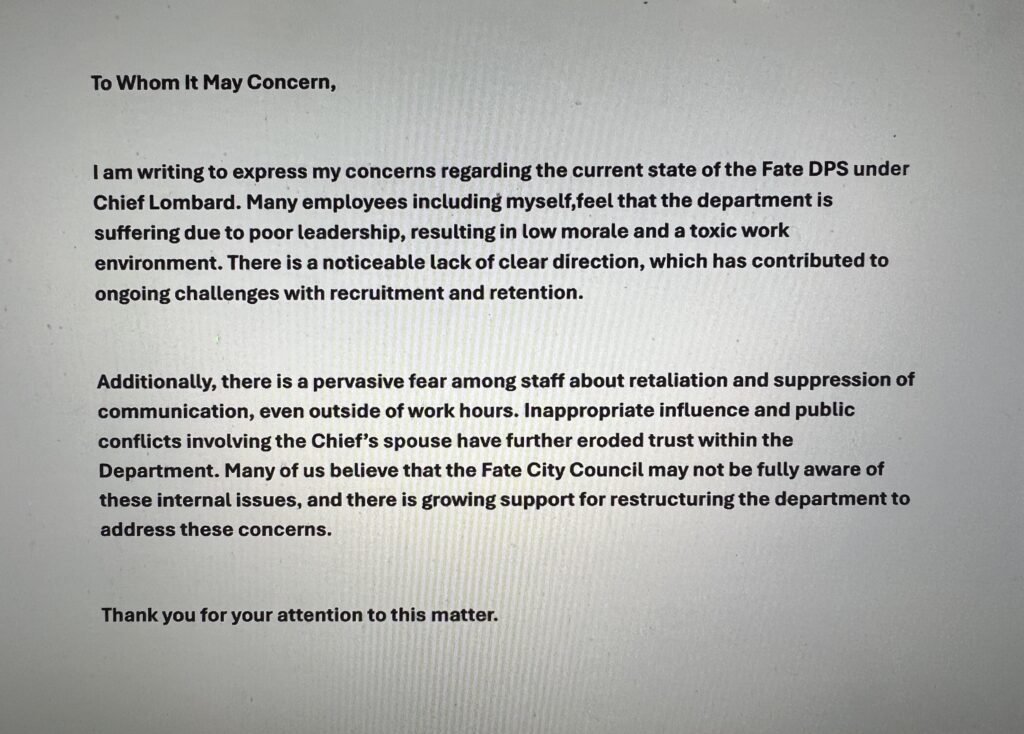
Their existence, however, does not resolve whether the City complied with the Texas Public Information Act. The central question is whether the City properly disclosed responsive records in response to a lawful request.
As of this publication, the City still has not disclosed the separate complaint letter that Kovacs later acknowledged receiving directly from a police officer. By his own admission, City Manager Michael Kovacs is the person responsible for the dissemination of records per State Law, and therefore he is the person who should be held accountable.
If Kovacs’ statement to investigators is accurate, that second complaint letter would have existed when the City’s response to the November 2025 Public Information Act request was prepared.
A New Public Information Request
In light of the newly disclosed information, Pipkins Reports has submitted another Texas Public Information Act request seeking all written complaints concerning Chief Lombard, including the complaint letter Kovacs acknowledged receiving from an officer, the complaint letter transmitted through Councilwoman Chinn, and any additional written complaints in the City’s possession.
The request states, in part:
“On 11/25/2025, as part of Open Records Request #R001735-112525, I requested ‘Copy of any written complaints against Chief Lombard within the last 12 months prior to termination.’ The City failed to provide any responsive documents, even though it was publicly known that at least one anonymous complaint letter existed.
During the ethics investigation conducted by Baker Robertson & O’Brien, Michael Kovacs stated that he received a complaint letter from a police officer. This admission indicates the City possessed an additional responsive document that was not disclosed.
The City did not seek an Attorney General ruling authorizing the withholding of either complaint letter. This request seeks both documents, together with any additional written complaints concerning Chief Lombard.”
Whether the City ultimately produces the records—or explains why they were not disclosed nearly eight months ago—may determine whether this story ends as an administrative oversight or raises more significant questions regarding the City’s compliance with the Texas Public Information Act.
This remains an ongoing investigation. Pipkins Reports will continue to report on developments as additional records become available.

Fate Council Dropped Case Before Reviewing
Fate, TX — An ethics investigation commissioned by the City of Fate concluded that former Councilwoman Codi Chinn violated the City’s Code of Ethics before the City Council voted earlier this month to discontinue the matter, according to documents obtained by Pipkins Reports through an Open Records Request.
The report, prepared by attorney Laura Mueller of the law firm Baker, Robertson & O’Brien, found that the allegation against Chinn was “substantiated, but with mitigating factors.”
The Executive Summary states:
“After investigation, my determination is that allegation of a violation of the Ethics Code is substantiated, but with mitigating factors.”
The report concludes that Chinn violated Section 2-309(10) of the City’s Code of Ethics after directing City employees to provide their concerns to her in writing.
“After reviewing the Charter, the Code of Ethics, and reviewing all of the evidence, my conclusion is that Ms. Chinn violated Section 2-309(10) of the Code of Ethics when she directed employees to provide information to her in writing.”
Mueller also concluded that mitigating circumstances should be considered because Chinn immediately informed City Manager Michael Kovacs about the employee concerns and because the employees ultimately submitted their written complaints directly to the City.
Council Ends Investigation
The ethics complaint summary report was scheduled to appear on the July 6 City Council agenda for executive session discussion.
Instead of going into Executive Session, the Council waived deliberative privilege and discussed the matter in open session where they ultimately voted to discontinue the ethics proceedings and drop the matter, before being presented with the findings from Mueller.
The Council did not impose any sanction against Chinn.
The following day, Pipkins Reports requested a copy of the complaint and the investigative report, and received it through an Open Records Request.
Investigation Details
According to the report, investigators interviewed Chinn, Councilman Mark Harper, City Manager Michael Kovacs, and other witnesses.
Regarding the allegations, Mueller wrote:
“In my interview with Ms. Chinn and Mr. Harper, we discussed the allegation. I questioned Ms. Chinn about her conversations with city employees and with Mr. Kovacs.”
According to the report, Chinn stated that city employees approached her seeking assistance and that she intended to present their concerns to the City Manager after compiling the information.
However, the report states that employees instead prepared a letter addressed to the City Council. Chinn then instructed them to provide the letter directly to the City Manager.
The report also summarizes Kovacs’ account of the events.
“Mr. Kovacs stated that he received the letter outlining the employee issues directly from an officer, but with the understanding that the information was given to him at the direction of Ms. Chinn.”
Previously, it was reported that Chinn provided a copy of an, “anonymous letter”, that she claims was provided by DPS officers to her. Chinn further states that she sent the letter to Michael Kovacs … who then forwarded it on to the rest of the Council. This report also states that Kovacs told investigators he had warned Chinn against communicating with employees in that manner.
Pipkins Reports continues to investigate this aspect of the situation … as the conditions shed new light on the events that have transpired with regard to the termination of DPS Chief Lyle Lombard.
Meanwhile, the city council’s decision effectively ended the ethics proceeding against Chinn without imposing any sanction or issuing any formal determination of its own regarding the investigator’s findings. While the Council possessed the authority to discontinue the matter, the decision also brought the ethics process to a close despite an independent investigation concluding that a violation of the City’s Code of Ethics had occurred.
For the complainant, Darcy Gildon, the Council’s action marked the end of a process that resulted in no public accountability beyond the release of the investigative report which Pipkins Reports has now provided.
You must be logged in to post a comment Login