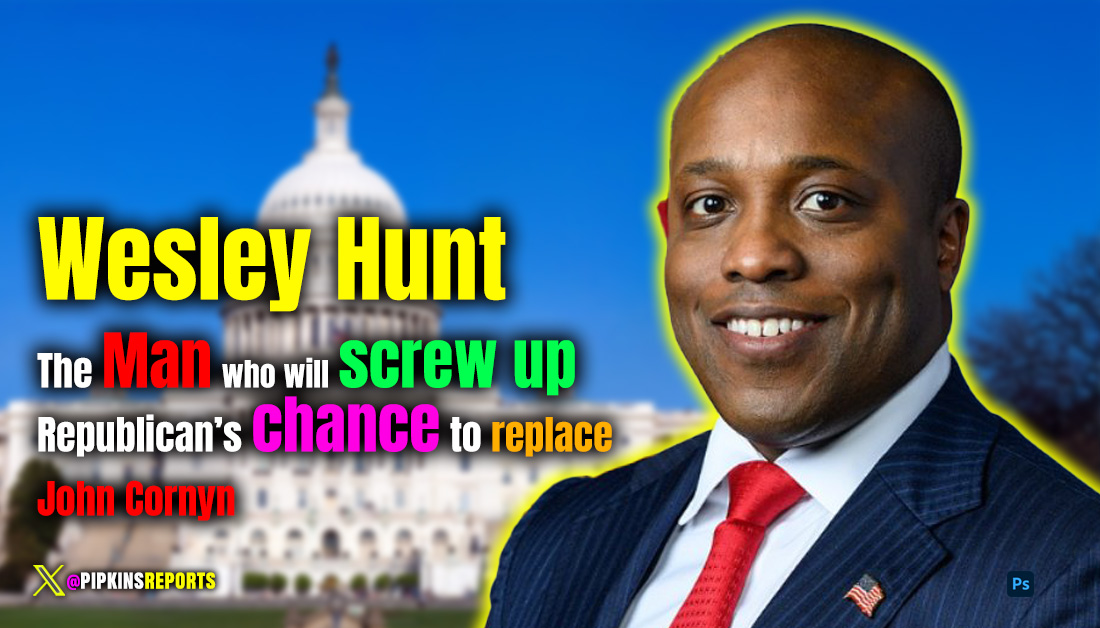
Wesley Hunt Enters Texas Senate Race, Complicating GOP Primary Challenge to Cornyn
Rep. Wesley Hunt’s entry into the 2026 Republican primary for U.S. Senate in Texas introduces a new contender to an already contentious field, potentially dividing the anti-establishment vote and bolstering Sen. John Cornyn’s position despite widespread base frustration with the incumbent.
Hunt, a second-term congressman from Houston’s suburbs, announced his candidacy on Monday, positioning himself as a Trump-aligned conservative ready to take on Cornyn and state Attorney General Ken Paxton.
The move comes after months of speculation and despite pleas from national GOP leaders, including the National Republican Senatorial Committee, to stay in his safe House seat and avoid fracturing the party.
Paxton entered the race in April, framing it as a direct challenge to Cornyn’s leadership within the Senate GOP and instantly became a favorite of the Conservative (anti RINO) wing of the party.
Hunt’s decision adds complexity to a primary that has pitted the party’s populist wing against its institutional core. Conservatives have long criticized Cornyn for his close ties to Mitch McConnell and perceived reluctance to fully embrace former President Trump’s agenda. Paxton, with his record of battling federal overreach on issues like election integrity and border security, has emerged as the base’s preferred alternative. Yet Hunt—himself a vocal Trump supporter—could siphon votes from Paxton, creating a scenario where Cornyn advances on a plurality.
This dynamic raises questions about the race’s origins. While Hunt has cited personal motivations, including family priorities and a desire to address national challenges like the border crisis, his ties to Texas’s GOP establishment merit scrutiny. In 2020, as a candidate in the district once represented by George H.W. Bush, Hunt publicly honored the former president’s birthday on Facebook, praising Bush’s journey “from the Halls of Congress to the Oval Office.“
That district, TX-07, remains a touchstone for the Bush network’s influence in Houston politics, where establishment figures have historically shaped Republican primaries.
Further connections link Hunt to Cornyn directly. The two co-sponsored the Project Safe Childhood Act in April 2023, a bipartisan measure aimed at combating child exploitation—a rare point of collaboration amid broader GOP tensions.
Such alliances, while policy-driven, underscore Hunt’s navigation of both populist and institutional lanes. In a state where Bush-era influencers—consultants, donors, and operatives—still wield significant sway, it’s not implausible that surrogates from this network quietly encouraged Hunt’s bid. Reports indicate Cornyn’s reelection team has been aggressive in defining the field, including efforts to highlight Paxton’s legal vulnerabilities.
A divided primary would align with that strategy, allowing Cornyn to conserve resources while opponents expend energy on each other.
Hunt brings strengths to the race: his military background as a West Point graduate and Army veteran, his appeal as a Black conservative in a diversifying party, and his record of viral advocacy on conservative issues.
He has positioned himself as a bridge between Trump’s base and broader GOP coalitions. But his candidacy is not without vulnerabilities that could blunt his momentum.
Foremost among them is an ethics probe from June 2024, when the Office of Congressional Ethics referred Hunt to the House Ethics Committee for potentially misusing campaign funds on private club memberships totaling over $74,000. The expenditures included dues to a Houston social club and a shooting range, which investigators questioned as personal rather than campaign-related.
Though cleared in December 2024 due to ambiguities in federal rules, the episode fueled accusations of fiscal laxity—ironic for a candidate who campaigns on reining in government spending.
On that front, Hunt has drawn fire from fiscal hawks for supporting multiple continuing resolutions that raised the debt ceiling since entering Congress in 2023. Detractors, including online conservative commentators, have labeled him a “RINO” for these votes, arguing they contradict his pledges to cut waste and align with Trump’s economic vision. His attendance record has also come under scrutiny, with recent reports noting an uptick in missed roll calls as he weighed a Senate run.
Foreign policy stances add another layer. Hunt’s strong support for Israel, including sponsorship of bills like the Antisemitism Awareness Act backed by the American Israel Public Affairs Committee, has earned him plaudits from pro-Israel donors but criticism from those who view it as prioritizing foreign lobbies over domestic concerns.
In Texas, with its sizable Arab-American community, this could prove a liability.
As the primary unfolds—filing deadline in December, early voting in March—polling will clarify the splits. Early indicators suggest Paxton leads among hardline conservatives, but Hunt’s entry could narrow that gap by 20-30 points, per anecdotal assessments from GOP insiders. A fragmented field risks handing Cornyn a narrow victory, much like past Texas primaries where vote division favored incumbents.
For constitutional conservatives seeking a Senate voice uncompromised by Washington habits, this race tests the party’s resolve. Paxton’s prosecutorial edge offers a clear path to reform; Hunt’s polish might dilute it. Whether this is organic ambition or orchestrated disruption, the outcome will shape Texas’s role in a GOP Senate majority—and the broader fight to restore limited government.
* Correction. We removed reference to Mitch McConnell as Minority Leader.
Election
Texas Voters Accept VATREs — But Local Politicians Expose Themselves
In a wave of school-district elections across North Texas and beyond this week, voters approved a number of Voter-Approval Tax-Ratification Elections (VATREs) — allowing independent school districts to raise their maintenance-and-operations (M&O) tax rates above the state-determined caps.
While the results reflect a clear willingness by taxpayers to fund local schools, they also expose a troubling pattern: the very officials who champion themselves as conservative guardians of the public trust now appear to be embracing tax increases and new spending. Pipkins Reports has been taking notes and when those elections come to pass, we will be reminding voters which politicians had their hands deep into taxpayers pockets.
Below is a summary of the key VATRE outcomes, followed by a discussion of the political implications and which public officials are already showing up in voters’ crosshairs.
VATREs That Passed – What Voters Approved
Here are the key districts where VATREs passed, with what was on the line and what the approval means.
- Rockwall Independent School District (Rockwall ISD)
Voters approved the district’s VATRE: 10,864 voted “For” (54.08 %) and 9,226 voted “Against” (45.92 %), in a total of 20,090 votes. Difference ≈ 1,638 (≈ 8 %). - Garland Independent School District (Garland ISD)
Voters approved the district proposal (Proposition A) to raise the tax rate to $1.1709 per $100 valuation. That represents a 12-cent increase over the previous rate of $1.0509. - Carroll Independent School District (Carroll ISD)
Voters approved the VATRE with 4,941 votes in favor and 3,625 opposed. The new tax rate change is expected to generate up to $4 million in additional revenue. - Hurst‑Euless‑Bedford Independent School District (HEB ISD)
Voters approved a 3-cent rate increase (via the VATRE), generating about $12 million in new operational funding. - Denton Independent School District (Denton ISD)
Voters approved the VATRE, which will generate approximately $26 million annually in additional revenue for the district. - Peaster Independent School District (Peaster ISD)
Voters approved the VATRE, authorizing three “Golden Pennies,” providing about $280,000 in new local tax revenue. - Taylor Independent School District (Taylor ISD)
Voters approved the VATRE (Prop B) alongside a bond (Prop A). Both passed. The VATRE will be used to generate operational revenue for student programs and corporate partnerships. - Liberty Hill Independent School District (Liberty Hill ISD)
Voters approved the VATRE designed to provide $10.7 million for student programs ($7.2 m), safety & security ($1.3 m), and teacher/staff retention ($2.2 m).
VATREs That Did Not Pass – Rejections
- Manor Independent School District (Manor ISD)
The district placed three propositions (Prop A: $359.5 m for renovs & security; Prop B: $8.5 m tech; Prop C: $16.5 m performing arts), but the VATRE was rejected by voters. - Coupland Independent School District (Coupland ISD)
VATRE (Prop A) would have generated approx. $240,939 for M&O, staff payments, supplies — rejected by voters. - Hays Consolidated Independent School District (Hays CISD)
VATRE (Prop A) to increase M&O tax rate by 12 cents (~$26 m additional revenue) was rejected by voters. - Blanco Independent School District (Blanco ISD)
Two-cent M&O rate increase rejected by voters.
What This Means — And What We Are Watching
From a constitutional conservative vantage point, several observations emerge:
- The Positive Side: Voters in many districts clearly were willing to approve higher taxes to fund education operations rather than just bond debt. That responsiveness suggests local communities see a need and are willing to step up.
- Inflation Predicted: These tax increases are ongoing revenue commitments. They are not one-time bonds, but continuous operational funding. Once the tax rate is increased, there is no mechanism to ever lower it back down. It is essentially eternal.
- Political Accountability: Many board members, superintendents, and district trustees who positioned themselves as fiscally prudent or conservative were seen as leading the charge for higher taxes. That reveals a mismatch between rhetoric and reality. The same goes for councilmen and mayors who chose to side with an increase in taxes. Excuses of, “It’s for the children” or “It’s for the teachers” will fall on deaf ears in future elections.
- The Power Players to Note:
- In Garland ISD, the Board of Trustees and district leadership backed the 12-cent rate hike that will bring in ~$56 m annually. Voters and watchdogs (including us) will remember who voted for that.
- Rockwall ISD’s trustees, various Rockwall County Mayors, nudged voters into approving a rate increase while trying to pretend they were ‘neutral’ . But we see them for who they are, and we will remind voters in future elections.
- In Denton, HEB, Carroll, Peaster and Liberty Hill, local boards quietly advanced VATREs — again with minimal fanfare but major tax implications. We were watching. Changes will be made.
- The Contrast With Other Districts: Some districts rejected VATREs. Others such as Fair Independent School District, recently adopted lower tax rates for 2025-26 — a rarity worth highlighting.
- The Election Implications: For the upcoming school-board races and local council elections (many of which overlap with these districts), voters will evaluate not only candidates’ rhetorical conservatism but their tax-and-spending votes. At Pipkins Reports, we’ll publish scorecards of who supported VATREs and how their financing stacks up. We WILL do our part to inform the community and help remove the frauds in our local governments.
Conclusion: Clarity.
Texans are willing to support public education funding…for now. The approval of several VATREs around the state sends a signal: yes, we the taxpayers will step up — but what is going to happen in the next 2-3 years when taxpayers are hit with a huge dose of reality that the promised “insignificant” raise to fund teachers and students turns into a gigantic financial burden, on the order of thousands of dollars a year?
The real-world effects of all the VATRE’s cannot be hidden. The platitudes given during this campaign will soon sink to the bottom of the reality jar. The betrayal citizens will feel when election time comes back around will be immense … and we will be here to remind them of whom it was that put them in that position.
See you at the next election in May … thank you for your cooperation.
Election
The Chilling Truth Behind Rockwall ISD’s Prop A: Tax Hike Far Higher Than District Claims
Rockwall County, TX – Rockwall County voters are being asked—once again—to approve a property tax increase for the Rockwall Independent School District (RISD). The proposal, known as Proposition A, appears on the November 2025 ballot as part of a Voter-Approved Tax Rate Election (VATRE). District officials are promoting the measure as a modest, four-cent bump to the local Maintenance & Operations (M&O) tax rate, claiming it’s necessary to raise teacher pay and keep up with growth.
But a closer examination of the district’s own efficiency audit reveals a very different story. According to the audit conducted by Weaver and Tidwell, LLP and released July 31, 2025, the actual increase is nearly triple what the district is telling voters. The proposed M&O rate of $0.7869 per $100 valuation, up from $0.6692 in fiscal year 2024, represents an increase of $0.1177, or roughly 17.6%.
The Four-Cent Illusion
So how can the district claim this is only a “four-cent” increase when the audit clearly shows an 11.77-cent jump? The answer lies in the complicated world of tax compression—a system originally meant to lower school tax rates as state funding grew.
Under Texas law, as local property values rise, the state automatically “compresses” a district’s M&O rate downward to offset the windfall from higher valuations. For 2025, Rockwall ISD’s rate was scheduled to automatically drop by around seven to eight cents due to this compression formula.
Instead of allowing that reduction to occur, RISD is asking voters to override the compression, effectively freezing the rate at a higher level. By comparing the proposed rate not to last year’s rate, but to the lower compressed rate that would have automatically taken effect, the district is able to advertise the hike as a “four-cent increase.”
In plain terms: if voters say yes to Prop A, they’re not merely forgoing a reduction—they’re authorizing a permanent 11.77-cent increase per $100 valuation over what they actually paid last year. It’s an accounting sleight of hand that makes a substantial hike sound like spare change.
The Real Numbers
Rockwall ISD’s total proposed ad valorem tax rate for 2025–2026 is $1.0669 per $100 valuation. The district insists that taxes are “still going down” because homestead exemptions have risen and the overall rate is lower than in prior years. But that claim blurs the distinction between the debt service rate—which pays for bonds—and the M&O rate, which funds salaries, operations, and daily expenses.
According to the audit, the tax increase would generate an additional $16.5 million in local revenue—an 8.3% increase in operating funds—even before accounting for future property appreciation. The average Rockwall County home, now valued at $394,000, would see a $4,268 annual tax bill, up roughly $160 per year. But if property values continue their steady climb—over 40% growth in the past five years—this “small” increase compounds quickly. Within five years, that same homeowner could pay hundreds more annually even without another rate hike.
A District in Strong Financial Health
RISD’s own financial data doesn’t suggest a district in crisis. The audit shows that for fiscal year 2024, Rockwall ISD spent $10,483 per student, well below both its peer district average ($11,641) and the state average ($12,944). On the revenue side, the district collected $10,067 per student, again below both peer and state averages, but with healthy margins and a substantial surplus.
The audit also confirmed that RISD earned a “Superior” rating in the School Financial Integrity Rating System of Texas (FIRST), the state’s highest financial management score. The district holds an unassigned fund balance of $56.4 million, plus another $20 million in assigned funds—well above the state’s recommended three-month operating reserve. In fact, the district’s unassigned fund balance exceeds that benchmark by 27.3%, meaning it already has ample reserves to handle short-term needs or moderate cost increases without new taxes.
Teacher Pay and Staffing
RISD’s leadership justifies Prop A as essential to “retain and recruit quality teachers,” citing pay gaps between Rockwall and its peers. The audit, however, paints a more nuanced picture. The average teacher salary in Rockwall ISD is $63,142—slightly below the peer district average ($64,033) but above the statewide average ($62,463). The average administrative salary sits at $95,892, below peer levels but still above the state’s $94,609 average.
The district’s payroll accounts for 79.3% of all spending, slightly higher than both the peer average (78.9%) and state average (77.8%). Importantly, teacher turnover in Rockwall ISD is lower than its peers—19.3% compared to 20.3%—suggesting that retention may not be primarily a salary issue.
The district already employs a merit and performance-based pay system, and has made market adjustments within the last two years. These policies demonstrate an ongoing effort to stay competitive without necessarily increasing the tax rate.
Academic and Operational Efficiency
Academically, the district performs well. It earned a “B” rating (88/100) in the latest TEA accountability report, with 11 campuses rated “A” and eight rated “B.” Attendance rates exceed both the state and peer averages, while the district’s student-to-teacher ratio of 16.1 to 1 is slightly higher than the state’s 14.7 to 1, indicating efficient use of personnel.
Even in athletics and extracurriculars—areas that often draw criticism for overspending—RISD allocates a lower percentage of its budget to non-academic programs than many comparable districts.
Why Ask for More?
If Rockwall ISD spends less per student, holds strong reserves, and already pays competitive salaries, what’s driving the push for higher taxes? According to district officials, the answer lies in growth. Rockwall’s student population has increased by roughly 2.5% annually over the past five years, and new campuses are on the horizon. The district argues that additional funds are needed to hire teachers, expand facilities, and meet state-mandated safety requirements.
But skeptics point out that those costs could be absorbed through existing fund balances or internal reallocations, especially given the district’s consistent operating surpluses. Voters may reasonably wonder why a district with one of the healthiest balance sheets in the region needs to raise taxes now—particularly when the requested increase is being marketed with misleading math.
Long-Term Implications
The real burden of Prop A lies not in the immediate increase, but in its compounding effect. If property valuations continue to rise by a conservative 5% annually, a home valued at $394,000 today could reach roughly $503,000 by 2030. At the proposed rate of $0.7869, that homeowner’s M&O taxes alone would rise from $3,095 to nearly $3,960—an increase of 28% without another election or additional rate change.
When debt service (I&S) is factored in, total school taxes could easily surpass $5,000 per year within five years.
A Matter of Trust
Rockwall ISD has, by nearly every measure, managed its finances responsibly. It ranks high in fiscal integrity, demonstrates prudent budgeting, and maintains solid academic outcomes. Yet Proposition A’s framing raises serious questions about transparency.
By advertising a 4-cent increase when the audit clearly documents a nearly 12-cent rise, the district risks eroding the very public trust it depends on. For voters, the decision is no longer just about education funding—it’s about honesty in government and whether officials are willing to present the true cost of their proposals.
In the end, Proposition A is less about whether Rockwall values its teachers—clearly, it does—and more about whether taxpayers can trust the numbers being placed before them. As voters head to the polls, they’d do well to remember that in public finance, as in politics, what’s left unsaid often costs the most.
Election
Eric Bott’s Open Letter on Rockwall ISD’s VATRE and Recapture Controversy
Rockwall, TX – Rockwall resident Eric Bott has issued an open letter to Rockwall ISD Superintendent Dr. Villarreal, CFO David Carter, Trustee Grant DuBois, Trustee Stan Britton, and the full Board of Trustees. Dated in the wake of explosive reporting from The Texan (October 27, 2025), Bott’s letter exposes what he describes as a pattern of misleading public statements, selective data, and potential coordination with a pro-VATRE political action committee ahead of the Voter-Approval Tax Rate Election (VATRE).
Citing direct confirmation from Texas Education Agency (TEA) officials—who used Rockwall ISD’s own estimates—Bott reveals that passage of the VATRE would trigger recapture (or “netting”) of approximately $3.5–$4 million in local revenue, effectively sending taxpayer dollars out of the district despite repeated assurances to the contrary. The letter demands immediate retractions, full disclosure of PAC communications, and a commitment to neutral, factual messaging.
As PipkinsReports.com shares this letter in full, it underscores a critical community debate: With teacher raises achievable through existing budgets and new state funds, was the VATRE truly necessary—or has it risked long-term financial harm through recapture? Read Bott’s complete open letter below, complete with verified sources, and join the conversation on local education governance.
Subject: Open Letter: Rockwall ISD Recapture, Transparency, and Leadership
Dear Dr. Villarreal, Mr. Carter, Mr. DuBois, Mr. Britton, and Members of the Rockwall ISD Board,
This correspondence will be shared with local media and community stakeholders in the interest of full transparency and public accountability.
As a resident and taxpayer of Rockwall ISD, I am deeply concerned by the continuing pattern of incomplete and misleading information presented to the public regarding the financial impact of the Voter-Approval Tax Rate Election (VATRE).
The most recent reporting from The Texan confirms what many citizens have questioning for months: under the proposed VATRE, Rockwall ISD will enter recapture.
According to The Texan (October 27, 2025):
“Officials from the Texas Education Agency (TEA) walked through the VATRE scenario using Rockwall ISD estimates with The Texan, indicating that the district will be subject to recapture should the VATRE pass.”
TEA calculations, based on the district’s own submissions, show roughly $3.5 to $4 million in excess local revenue that must be offset through a Chapter 49 netting agreement. The state will reduce the district’s aid by that amount. Whether called “netting” or “recapture,” the effect on taxpayers is the same: those dollars leave Rockwall.
Leadership and Communication Failures
1. False public statements about recapture
During multiple board meetings and in several public forums, David Carter, the district’s Chief Financial Officer, has repeatedly stated that Rockwall ISD would not enter recapture under the VATRE. While he carefully worded those statements to avoid saying “no way,” his phrasing consistently led the public to believe recapture was not possible.
In one particular meeting, while Mr. Carter was at the podium presenting to the board, Grant DuBois turned the discussion into what appeared to be a coordinated pitch for the VATRE. In that exchange, Mr. DuBois stated, “If we don’t pass this, I don’t see any other way – there’s no other way,” and then asked Mr. Carter to confirm whether he saw another option. Mr. Carter did not respond, allowing the implication to stand that passing the VATRE was the only possible way to fund district operations and pay raises.
Both the statements and the silence in that setting reinforced a misleading narrative that directly conflicts with TEA data and the agency’s confirmation to The Texan. These public misrepresentations must be corrected immediately.
2. Misuse of terminology and selective information
The district has relied on outdated TEA summaries that exclude the additional copper-penny revenue created by the VATRE. Once that revenue is included, the district’s local share exceeds its entitlement and triggers recapture. Continuing to cite incomplete figures misleads voters.
3. Coordination with a political action committee
The “Vote Yes for Rockwall ISD” PAC appears to have an open door to district information, receiving details and district-generated materials quickly and using very specific talking points in its campaign messaging. This creates the appearance of coordination between the district and a political organization during an election, undermining public trust and potentially violating election-communication rules.
4. Conduct unbecoming of a trustee
Stan Britton has repeatedly made public posts on his personal Facebook page and within teacher forums that repeat inaccurate district claims about recapture and the financial impact of the VATRE. While every citizen has the right to personal opinions, statements from a sitting trustee carry the weight of official authority. When those statements are inaccurate, they mislead voters and damage public confidence. I respectfully request that Mr. Britton publicly retract his statements or that the Board consider appropriate action.
5. Failure of transparency
Despite repeated citizen requests for clarity, the district has avoided direct answers about recapture, choosing instead to host selective meetings and private briefings promoting passage of the VATRE. That is not open governance; it is controlled messaging. Independent research by a citizen advocate with the Restore Conservative Roots Coalition reached the same conclusion: Rockwall ISD will enter recapture under the VATRE.
Furthermore, The Texan reached out to David Carter for comment in both of its recent articles, and he declined to respond. District spokesperson Renae Murphy also declined to comment when asked about recapture. When pressed to explain the roughly $4 million gap between the $20.4 million in new M&O revenue stated on the ballot and the $16.4 million reflected in the district’s own budget documents, Ms. Murphy was unable to give a clear answer. Her explanation did not reconcile the difference and only added to public confusion about where those missing funds would go. That lack of clarity once again underscores the district’s unwillingness to communicate transparently with taxpayers.
Required Corrective Actions
- Retract and correct all public statements claiming that Rockwall ISD “is not subject to recapture.”
- Acknowledge that the VATRE’s copper-penny tax rate triggers recapture under TEA’s calculations.
- Disclose all communications between district officials and the “Vote Yes for Rockwall ISD” PAC.
- Commit that all future district messaging during elections will be neutral and factual.
Verified Sources
- The Texan, “Rockwall ISD ‘Netting’ Agreement Would Offset Recapture Payments by Reducing State Aid,” Oct 27, 2025
https://thetexan.news/issues/education/rockwall-isd-netting-agreement-would-offset-recapture-payments-by-reducing-state-aid/article_c7bd96d9-07c9-48b8-9d8c-98eeb0d50b66.html - TEA Summary of Finances and Chapter 49 documentation obtained through Public Information Requests (available upon request)
This situation represents a serious failure of leadership and communication. Rockwall ISD’s credibility depends on honesty, not wordplay. The community deserves full transparency and an immediate correction of the public record.
It is also important to note that teacher raises could have been achieved within the district’s existing budget and recent state funding allocations. The VATRE was not necessary and has instead risked placing Rockwall ISD into recapture.
Sincerely,
Eric Bott
Rockwall Resident
** Eric Bott has lived in Rockwall since 2005 and runs his own consulting business specializing in technology operations. He is also a longtime grassroots activist dedicated to local accountability and representing Rockwall’s taxpayers and families.
You must be logged in to post a comment Login