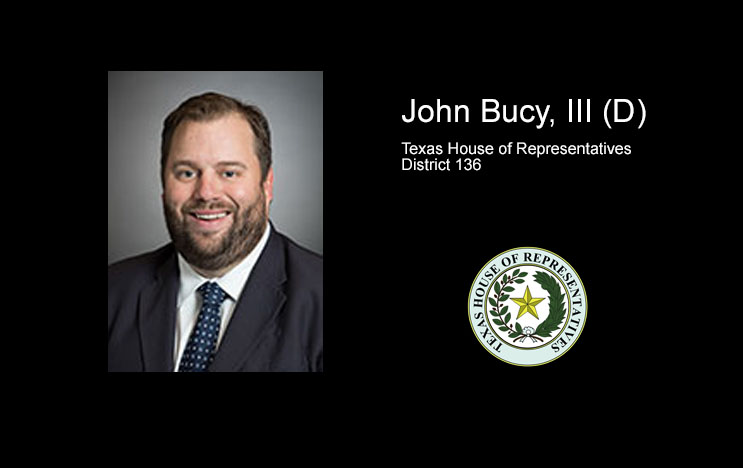
Texas Rep. John Bucy, III will Oppose Texit Bill
John Bucy, III (D) states he will not support the proposed legislation for a Texit referendum to be placed on the November ballot.

Speaking with the editor of the Texit Times, a spokesperson for Texas State Representative John Bucy, III (D) has stated that Rep. Bucy will not support the proposed legislation for a Texit referendum to be placed on the November ballot.

John H. Bucy III serves District 136, which includes western Williamson County, including Northwest Austin, Cedar Park, Leander, and the Brushy Creek area. He is a native Texan, small business owner, and former chair of the Williamson County (party) Party, Elected in 2018.
John was appointed to the House Committee on Elections and the House Committee on Culture, Recreation & Tourism for the 86th Legislative Session. He is chair of the Young Texans Legislative Caucus and was honored by his peers as House (party) Caucus Freshman of the Year.
Bucy is the author of HB 400. Filed in 2020, just after the November election, which if passed, would allow for, “Any qualified voter is eligible for early voting by mail or personal appearance.” In essence, Bucy authored a bill that would permit the same fraudulent activity witnessed in other States to occur here in Texas.
Rep. Bucy’s legislative intent to alter the State of Texas’ election laws is fairly evident by the bills that he has authored. He has authored HB 844, relating to the method of returning a ballot to be voted by mail; HB 845, Relating to the electronic transmission of a ballot to a voter voting early by mail on the ground of absence from the county of residence; HB 856, Relating to the registration of voters at a polling place and related procedures; HB 857, Relating to the procedures for voting after changing residence to another county.
None of Rep. Bucy’s bills have made it out of committee as of the date of publication.


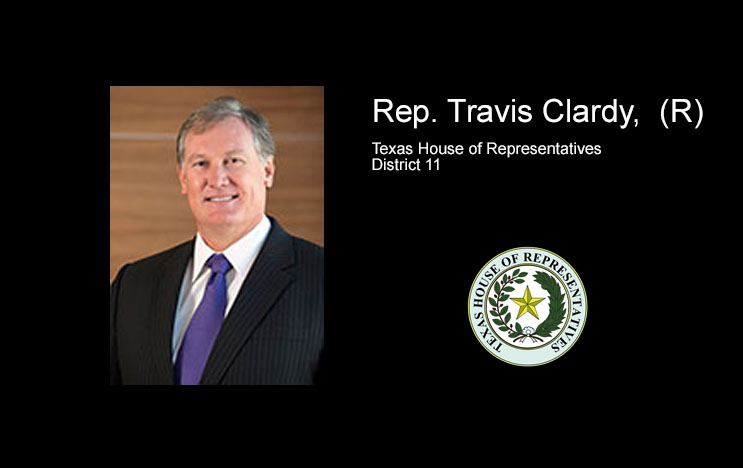

How Fate registered a developer’s project domain after seeing it in official plans, then fought to keep that fact hidden
FATE, TX – Cities are expected to regulate development, not steal its name.
Records obtained by Pipkins Reports show the City of Fate registered the domain name of a private development, lafayettecrossing.com, while actively working with the developer who had already claimed that name in official plans. The move, made quietly during a heated approval process, raises serious questions about whether Fate’s city government crossed from partner to predator, taking digital ownership of a project it was supposed to oversee with neutrality and good faith… and depriving the developer of their rights to domain ownership.
What followed, attempts to conceal the purchase, shifting explanations from city officials, and a documented pattern of advocacy on behalf of the developer, suggests the domain registration was not an accident, but part of a broader effort to control the narrative around one of the most divisive projects in the city’s history.
A site plan submitted by the developer, D-F Funds GP, LLC, led by Robert Yu, shows the project title “Lafayette Crossing” clearly identified in the title block on December 20, 2023. The document was part of the city’s official development review for the controversial project at the corner of I-30 and Highway 551.
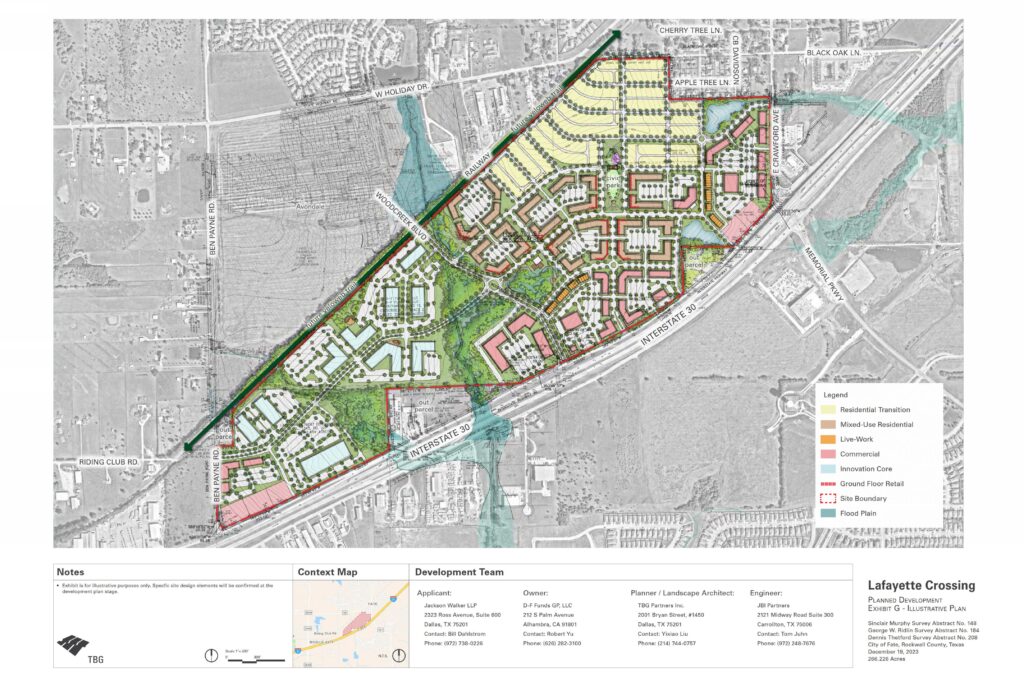
Less than two months later, on February 7, 2024, the City of Fate registered the domain lafayettecrossing.com, Invoice #116953461, for $12.
Domain records confirm the registration date, with the domain set to expire on February 7, 2027. By that point, Lafayette Crossing was already the established name of the project, used by the developer and embedded in official plans circulating within City Hall.
This was not a coincidence. The city had the plans from the developer. Their were extensive talks regarding the project. Then the city registered the domain without the knowledge of the developer. This is known in the industry as, “Cybersquatting.”
The development, originally referred to as the “Yu Tract,” became known as Lafayette Crossing as it moved through the approval process. The project ignited intense public opposition over density, traffic congestion, infrastructure strain, and the long-term direction of Fate’s growth. Despite sustained resistance and packed council chambers, the city council approved the project.
The political fallout was severe. In the elections that followed, four council members and the mayor were replaced, an extraordinary level of turnover that reflected deep voter dissatisfaction. Two members from that Council, Councilman Mark Harper and Councilman Scott Kelley, remain, but are up for reelection this May.
That context matters, because the domain registration did not occur in isolation. It occurred amid a broader, documented pattern of city officials actively working to shape public perception in favor of the developer.
In February 2024, Pipkins Reports, then operating as the Fate Tribune, published an exposé based on internal city emails showing City Manager Michael Kovacs discussing strategies to “educate” the public about Lafayette Crossing. In those emails, Kovacs suggested deploying what he referred to as “Fire Support,” a term used to describe both paid and unpaid advocates brought forward to counter citizen opposition and astroturf public support for the project.
That reporting revealed a city government not merely responding to public concerns, but actively attempting to manage and counter them.
In a later publication, Pipkins Reports (Fate Tribune) documented the City of Fate’s hiring of Ryan Breckenridge of BRK Partners, engaging in what records showed to be a coordinated public relations effort aimed at improving the project’s image and swaying public sentiment. The campaign was presented as informational, but residents viewed it as advocacy on behalf of the developer, funded with public resources.
It was within this environment, where city staff had already aligned themselves publicly and privately with the developer’s interests, that the city registered the lafayettecrossing.com domain. Yet that fact remained hidden until PipkinsReports.com submitted an Open Records Request on September 30, 2025, seeking a list of all domains owned by the city.
Rather than comply, the City of Fate objected. On October 14, 2025, officials asked the Texas Attorney General’s Office for permission to withhold the records, citing “cybersecurity” concerns.
On January 6, 2026, the Attorney General rejected that claim and ordered the information released. The city complied on January 20, 2026.
In addition to the lafayettecrossing.com domain, the records revealed the city owns numerous domains tied to redevelopment and branding initiatives, including:
- FateTX.gov
- DowntownFate.com
- FateFoodHaul.com
- FateMainStreet.com
- FateStationHub.com
- FateStationMarket.com
- FateStationPark.com
- FateStationSpur.com
- OldTownFate.com
- TheHubAtFateStation.com
- TheSpurAtFateStation.com
- ForwardFate.com
Most clearly relate to city-led initiatives. LafayetteCrossing.com stands apart because it mirrors the established name of a private development already proposed, named, and publicly debated.
When questioned via email, Assistant City Manager Steven Downs initially suggested the domain purchase occurred long before his involvement and downplayed any potential issues. When we revealed documents to show Downs was actively engaged with the project at the same time the Lafayette Crossing name entered the city’s official workflow, his story changed.
In follow-up correspondence, Downs acknowledged he was aware of the project name, while placing responsibility for the domain purchase on former Assistant City Manager Justin Weiss. Downs stated he did not know whether the developer was aware of the purchase and said he was not concerned about potential liability.
What remains unexplained is why the city registered the domain at all, knowing it belonged to a private project, and why it attempted to keep that information from the public.
Opinion
Viewed in isolation, a $12 domain purchase might seem trivial. Viewed in context, it is not.
When a city that has already worked to astroturf support, hire public relations firms, and counter citizen opposition also quietly registers a developer’s project domain, then attempts to conceal that information from the public, the line between regulator and advocate disappears.
The question is no longer whether the city knew the name. The record shows it did.
The question is why a city government so deeply invested in selling a controversial project to its residents felt the need to take ownership of the project’s digital identity as well.
Control of messaging, control of perception, and control of narrative are powerful tools. Sometimes it is equally as important to control what is not said.

Texas Senate Primaries Show Early Leads for Crockett and Paxton
AUSTIN, Texas – A new poll released by The Texas Tribune indicates that Jasmine Crockett and Ken Paxton are leading their respective primary races for the U.S. Senate seat in Texas. The survey, published on February 9, 2026, highlights the early momentum for both candidates as they vie for their party nominations in a closely watched election cycle. The results point to strong voter recognition and support for Crockett in the Democratic primary and Paxton in the Republican primary.
The poll, conducted among likely primary voters across the state, shows Crockett holding a significant lead over her Democratic challenger James Talarico, while Paxton maintains a commanding position among Republican contenders John Cornyn & Wesley Hunt.
According to the poll, Ken Paxton leads with 38 percent of likely GOP primary voters, pulling ahead of incumbent John Cornyn, who trails at 31 percent, while Wesley Hunt remains a distant third at 17 percent. The survey indicates Paxton would hold a commanding advantage in a runoff scenario and currently outperforms Cornyn across nearly every key Republican demographic group, with Latino voters the lone exception, where Cornyn maintains a seven-point edge.
Among Democrats, the poll shows Jasmine Crockett opening a notable lead, capturing 47 percent of likely primary voters compared to 39 percent for James Talarico—a meaningful shift from earlier polling that had Talarico in the lead. While still early, the numbers suggest momentum is consolidating ahead of primaries that will determine the general election matchups.
Jasmine Crockett, a sitting U.S. Representative whose district lines were redrawn out from under her, has responded to political extinction with a desperate lurch toward the U.S. Senate. Her campaign, widely criticized as race-baiting and grievance-driven, has leaned heavily on inflaming urban Democratic turnout while cloaking thin policy substance in fashionable slogans about healthcare and “equity.”
By contrast, Ken Paxton enters the race with a long, battle-tested record as Texas Attorney General, earning fierce loyalty from conservatives for his aggressive defense of state sovereignty, constitutional limits, and successful legal challenges to federal overreach. Though relentlessly targeted by opponents, Paxton’s tenure reflects durability, clarity of purpose, and an unapologetic alignment with the voters he represents—qualities that define his standing in the contest.
The Texas U.S. Senate race draws national attention, as the state remains a critical battleground in determining the balance of power in Congress. With incumbent dynamics and shifting voter demographics at play, the primary outcomes will set the stage for a potentially contentious general election. The Texas Tribune poll serves as an initial benchmark, though voter sentiment could evolve as campaigns intensify and debates unfold in the coming weeks.
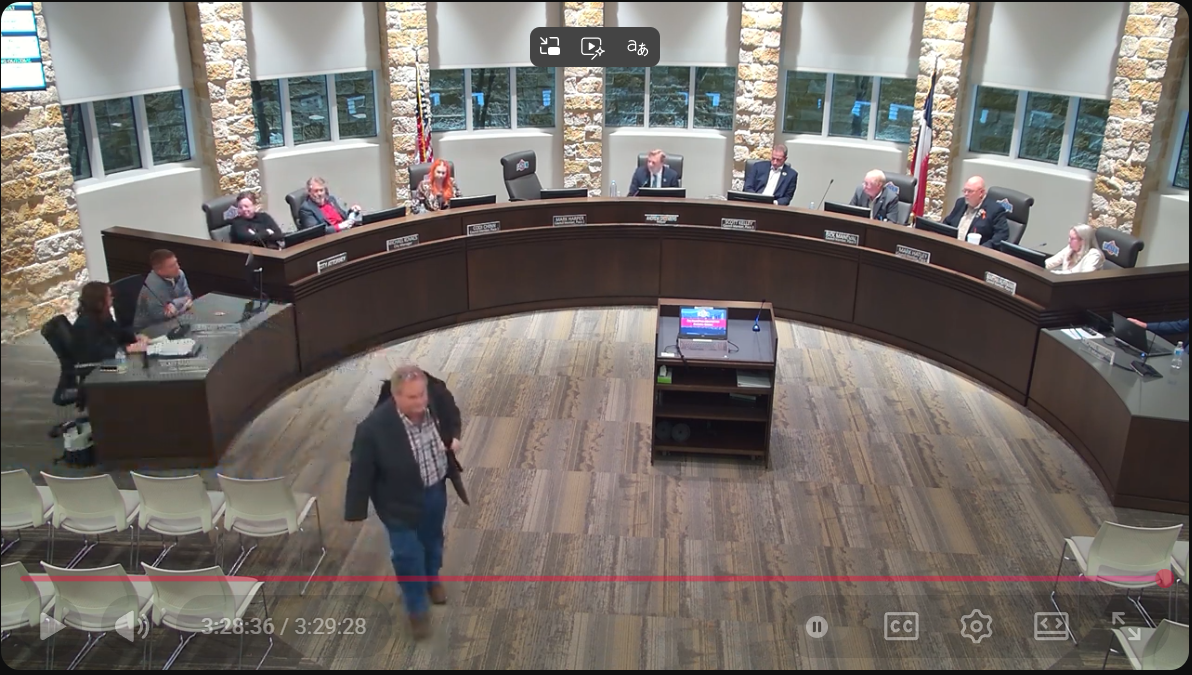
Councilman Mark Harper walks out of meeting before adjournment.
FATE, TX – The Fate City Council voted late Monday night to waive deliberative privilege, opening the door to the public release of secret audio recordings that may have driven a recall election against Councilwoman Codi Chinn. The decision came after hours of public criticism, procedural friction, and a lengthy executive session with legal counsel.
The meeting, held Monday, February 2, was streamed live by the city and is available on YouTube at: https://www.youtube.com/live/zQVN0i-d8C0 (Embedded Below)
(Source: City of Fate, official meeting broadcast)
Timeline for Readers
- 00:33:52 – Public comments begin, largely focused on the recall election of Councilwoman Codi Chinn.
- 00:56:10 – Councilman Harper interrupts public Comment.
- 00:57:00 – Councilman Harper interrupts public Comment.
- 00:58:00 – Councilman Harper interrupts public Comment.
- 02:21:00 – Executive Session – Council enters closed session to consult with legal counsel.
- 03:22:52 – Council reconvenes in open session.
- Primary motion – Council votes to “waive deliberative privilege”, allowing release of disputed audio recordings.
Public Comment and Visible Strain
Public comments began just after the 33 minute mark and quickly centered on the recall election. Speaker after speaker questioned the conduct of city officials and demanded transparency regarding audio recordings that have circulated privately but remained unavailable to the public.
During one speaker’s remarks, critical of Councilwoman Chinn, procedural tension became visible. Three separate times, Councilman Mark Harper interrupted to remind Mayor Andrew Greenberg that the speaker had exceeded the three-minute time limit. Each time, Mayor Greenberg thanked Harper for the reminder, then directed the speaker to continue.
The exchange stood out. While council rules clearly limit speakers to three minutes, the mayor’s repeated decision to allow the speaker to proceed suggested an effort to avoid the appearance of silencing criticism during a highly charged meeting.
Clarifying the Recordings
Contrary to some early assumptions, the audio recordings at issue were not recordings of executive sessions. Instead, they are one-party consent recordings, the existence of which has been previously reported and alluded to on Pipkins Reports. Their precise origin has not been publicly detailed, but their contents have been referenced repeatedly by both supporters and critics of the recall effort.
Behind Closed Doors
Following the public meeting, the council entered executive session to consult with legal counsel. After about an hour, members returned to open session at approximately 3:22:52 .
The primary motion coming out of that session was to “waive deliberative privilege“. The effect of the vote was to remove a legal obstacle to releasing the secret audio recordings that have been at the center of the controversy.
No excerpts were played, and no conclusions were announced. The council did not rule on the legality of the recordings, nor did it weigh in on the merits of the recall election itself.
Why the Vote Matters
The decision does not resolve the recall of Councilwoman Chinn. It does not validate or refute claims made by either side. What it does is shift the debate away from rumor and secondhand accounts.
According to guidance from the Texas Municipal League, governing bodies may waive certain privileges when transparency is deemed to serve the public interest, particularly when litigation risk is balanced against public trust (Texas Municipal League, Open Meetings Act resources).
Opinion and Perspective
The council’s action was a necessary step. Secret recordings, selectively referenced and strategically leaked, undermine confidence in local government. So does a refusal to confront them directly.
Transparency is not about protecting officials from embarrassment. It is NOT the job of the council to assist the city in concealing information that may be used against it in legal proceedings when the City Manager, or Councilmen, may have done bad things. It is about protecting citizens from manipulation. If the recordings exonerate those involved, their release will restore credibility. If they raise concerns, voters deserve to hear them unfiltered before making decisions in a recall election.
Monday night in Fate did not end the controversy. It ended the excuse for keeping the public in the dark.
Byron smith
January 27, 2021 at 4:33 am
Let’s vote it in and see how Texans feel about it. I say yes