
Solutions in Comprehensive Zoning
We do have the ability to eliminate multi-family zoning, if we have the will. Here is the blueprint.

The citizens of Fate have made their views known time and again to our City Council that they do not want any increases in multi-family construction. Legitimate reasons include increased traffic, crime and strains on infrastructure that will inevitably lead to increases in taxes.
We are told that change is coming whether we like it or not. We are told that there is nothing we can do about it. And we are told that property owners have the right to sell their property to developers who have the right to build whatever they want.
So the time has come to explain why all these excuses are false and to provide a solution. But to get there we must first discuss what zoning laws are, and how they came to be.
The Origin of Zoning
The first zoning law was enacted in 1916 in New York City and marked a pivotal moment in urban planning history, setting a precedent that would reverberate across cities and towns worldwide. The zoning law, known as the New York City Zoning Resolution, was a response to the rapidly changing urban landscape and the need to regulate land use in a more systematic and organized manner.
Prior to 1916, New York City was experiencing the effects of rapid industrialization and population growth. Skyscrapers were becoming a prominent feature of the cityscape, and concerns were arising about the effects of these towering structures on public health, access to sunlight, and the overall quality of life. Additionally, the haphazard mix of land uses in close proximity was causing conflicts between residential, commercial, and industrial activities.
Then, in 1915, when the 42-story Equitable Building was erected in Lower Manhattan, the need for controls on the height and form of all buildings became clear. Rising without setbacks to its full height of 538 feet, the Equitable Building cast a seven-acre shadow over neighboring buildings, affecting their value and setting the stage for the nation’s first comprehensive zoning resolution.
The 1916 New York City Zoning Resolution introduced several groundbreaking concepts that laid the foundation for modern zoning laws:
- Use Districts: The law divided the city into different use districts, each with specific regulations governing the types of activities allowed. These districts included residential, commercial, and manufacturing zones. This segregation of land uses aimed to prevent incompatible activities from coexisting in close proximity.
- Height and Setback Regulations: One of the most notable features of the law was its establishment of height and setback regulations for buildings. To address concerns about overshadowing streets and blocking sunlight, the law required buildings to be set back from the street after a certain height was reached. This provision aimed to ensure that adequate light and air reached the street level.
- Bulk Regulations: The law introduced restrictions on the bulk of buildings, including factors such as the ratio of building area to lot size. This was intended to prevent the construction of overly massive structures that could overwhelm their surroundings.
- Open Space Requirements: The zoning law mandated the provision of open spaces, such as plazas or courtyards, in certain types of developments. This provision aimed to enhance the quality of urban life by providing residents with communal spaces for relaxation and recreation.
- Non-Conforming Use: The law also addressed existing buildings and uses that did not comply with the new zoning regulations. This introduced the concept of “nonconforming use,” allowing pre-existing uses to continue even if they didn’t conform to the new zoning requirements. However, changes to non-conforming buildings often had to adhere to the new regulations.
The 1916 New York City Zoning Resolution had a profound impact on urban planning and development practices worldwide. It served as a model for other cities grappling with similar challenges, and the concepts it introduced became integral to the formation of zoning laws in various municipalities.
As cities around the globe faced the complexities of urban growth and development, they recognized the need for similar regulations to manage land use effectively, encourage orderly growth, and ensure the well-being of their citizens.
Today, zoning laws remain a cornerstone of urban planning, providing a framework that shapes the physical layout of cities, towns, and communities. While the specifics of zoning regulations vary from place to place, the principles established by the 1916 New York City Zoning Resolution continue to guide urban planners, architects, developers, and policymakers as they seek to strike a balance between progress and preservation.
The Laws of Texas
Zoning laws in Texas, like those in many other states, are designed to regulate land use and development to promote orderly growth, protect property values, and ensure the health, safety, and general welfare of communities. However, the basis and structure of zoning laws in Texas can vary due to the state’s unique legal framework and historical background.
Home Rule Cities vs. General Law Cities:
One key aspect of zoning laws in Texas is the distinction between Home-Rule cities, like Fate, and general law cities. Home-Rule cities, typically those with a population of over 5,000, have more autonomy in creating and implementing their own zoning ordinances. General law cities, on the other hand, have zoning authority granted by the state and are subject to state-imposed limitations.
Dillon’s Rule and Zoning:
Texas follows the legal principle known as Dillon’s Rule, which means that local governments (cities and counties) only have the powers that are explicitly granted to them by the State. This impacts zoning in Texas because local governments must derive their zoning authority from specific state statutes. As a result, the establishment and structure of zoning laws in Texas are largely influenced by state legislation.
Zoning Enabling Acts:
Zoning authority in Texas is granted through what are called “Zoning Enabling Acts.” These are state laws that outline the framework under which cities and counties can create and enforce zoning regulations. There are different versions of these acts, one for general law cities and one for home rule cities, reflecting the distinction in their regulatory powers. Let’s just stick to the Home-Rule cities, because that is where our City abides.
Zoning Ordinances:
In home-rule cities, zoning ordinances are passed by the city council. These ordinances define different zoning districts (residential, commercial, industrial, etc.) and specify the types of activities allowed in each district, along with regulations for building heights, setbacks, lot sizes, and other factors.
Variances and Special Exceptions:
Like many states, Texas zoning laws often include provisions for variances and special exceptions. A variance allows property owners to deviate from certain zoning regulations due to specific hardships or unique circumstances. Special exceptions, also known as conditional uses, permit specific uses within a particular zoning district if certain criteria are met.
Public Input and Due Process:
In line with democratic principles, Texas zoning laws usually require public hearings and community input during the zoning process. This allows residents and stakeholders to voice their opinions, concerns, and suggestions before zoning changes are finalized. Due process ensures that property owners are given the opportunity to contest zoning decisions if they believe their property rights are being unfairly restricted.
The Fate Town Charter
The Town Charter of Fate outlines the creation of the Planning and Zoning (P&Z) Commission and stipulates their duties and powers. Among these powers is the directive to: “Make proposals to the City Council to amend, extend and add to the Comprehensive Plan for the physical development of the City”. However it must not be understated that the capacity of the P&Z is only as an “advisory” role to the Council, where all final decisions are made.
The P&Z was originally created with 5 members and now stands with 7 members; All appointed by the City Council and serve for terms of 2 years. The current members of the P&Z Commission as of publication are: Karen Kiser, Aaron Jackson, Steve Dann, Tyler Bushman, Jeffrey Tathje, Kerry Wiemokly, and Daryell Harmon.
Here’s the really important part… Under Sec. 7.03 (2) The commission shall have the full power to:
(A)Exercise the authority of the Commission as provided by State law, this Charter and City ordinances; and
(B)Make reports and recommendations relating to the Comprehensive Plan and development of the City. [Emphasis added]
In short, this means that the P&Z doesn’t need to wait for the Council to give them directions or instructions; the Commission can start their own inquiry into the Comprehensive plan on their own and if they choose to make a recommendation to the Council for changes, they have every right to do so under Texas Law and our own Town Charter.
Recommended Recommendations
Too often, Town Commissions simply follow directives given to them by the Council. They very rarely take matters into their own hands. Often because they don’t understand that they have the right to do so… and that ignorance is just fine with the Council. But they have every right to take matters into their own hands if they have strong leadership and the guts to rub against the City Council … who appointed them.
The Fate Planning & Zoning Commission should take it upon itself to begin a top-down review of the Comprehensive Plan and evaluate how this plan meets the desires of the community of citizens… which is quite clear. End New Multi-Family Zoning.
Once the Commission has come to the rational decision to end Multi-Family Zoning, they can make a recommendation for the City Council and place the item on their agenda whether they like it or not.
The Mayor and Council are the Problem
Being realistic, this is where the initiative is likely to die. Mayor David Billings has demonstrated time and again that he is in full support of the urbanization of Fate. He is a grand proponent of StrongTowns.org, a leftist-run organization whose stated goals are to urbanize small towns.
The mayor is supported by the City Manager, Michael Kovacs, who is also a leftist who follows the Strong Towns philosophy and has hired a leftist Planning and Development Director named Ryan Wells. All of these individuals support the expansion and urbanization of Fate.
None of this is a secret. Even the town’s website displays a near-carbon copy of the Strong Towns agenda…word for word. The town even pays for the membership of a couple of employees to Strong Towns.
The Solution
The ultimate solution to the problem is simple, but extremely difficult to accomplish.
It begins with the systematic removal of Councilmen and replacing them with individuals who have the courage and will to change the Comprehensive Plan. Ultimately, they all must go because none of them has shown the courage to do what is right. This will take two years as it encompasses the removal of four councilmen to gain a majority.
The next Councilmen that are up for re-election, and must be removed are:
- Heather Buegeler – Place 1 – Expires in May 2024
- Jim DeLand – Place 5 – Expires in May 2024
- Allen Robbins – Place 4 – Expires in May 2025
- Lance Megyesi – Place 6 – Expires in May 2025
Also, Mayor David Billings, who walked in to office without spending a single nickel and getting a single vote from a citizen, and whose term expires in May 2025, must be replaced without question.
With the removal and replacement of these individuals with persons who are willing to represent the will of the people, they can legally amend the Comprehensive Plan to eliminate all future Multi-Family Zoning. That’s it … it’s just that simple.
I would also recommend going a step further and would recommend replacing the City Manager with someone who shares the values of the citizens of Fate. Someone who knows how to budget a town without future growth to cover the cost of their poor decisions. There are plenty of other reasons to replace the City Manager, which I will not delve into in this article.
Conclusion
So this is the solution. Henceforth, anytime comments are made on social media about how “we can’t do that” or “What’s your solution?” I will direct their attention here. The law says that we can do this. We have every right to do this. The question is, do we have the will to do this?


Fate, TX
Fate Council Approves Settlement in Former DPS Chief Lyle Lombard’s Wrongful Termination Dispute

Fate, TX — The Fate City Council voted Monday night to approve a proposed settlement with former Department of Public Safety Chief Lyle Lombard, bringing what has been a months-long wrongful termination dispute one step closer to resolution.
The vote of 4 to approve and 2 abstentions followed an executive session in which council members met privately with legal counsel to discuss the arbitration matter. Returning to open session, the council approved the settlement, though the financial terms and other provisions of the agreement were not disclosed during the public meeting.
The settlement resolves Lombard’s wrongful termination claim, which has been proceeding through arbitration following his separation from the City of Fate. Unlike traditional court proceedings, arbitration generally occurs outside public view, leaving many details of the dispute undisclosed unless the parties choose to release them or disclosure is otherwise required by law.
As of publication, the City has not released the settlement agreement, and it remains unclear whether the document contains confidentiality provisions or other restrictions governing what information may become public. It is also unknown whether the agreement includes any admission of liability by either party, the amount of any monetary payments, or other negotiated terms.
Lombard served as the City’s Department of Public Safety Chief before his separation from the City, a decision that ultimately resulted in the arbitration proceedings. The dispute drew considerable public attention as questions surrounding the circumstances of his departure remained largely unanswered because of the confidential nature of the arbitration process.
Monday night’s vote concludes the council’s role in approving the negotiated resolution, but it may not immediately answer many of the questions residents have asked throughout the dispute. Depending on the terms of the agreement and applicable provisions of the Texas Public Information Act, some portions of the settlement could eventually become public, while other details may remain confidential if protected by law.
Pipkins Reports has submitted requests for records related to the settlement and will review any documents released by the City. Those records may provide additional information regarding the financial impact of the agreement, the obligations of each party, and the extent to which the dispute has been fully resolved.
Neither the City of Fate nor Lombard publicly commented on the settlement during Monday night’s meeting.
While the approval brings the arbitration to a close, it also marks the end of one of the most closely watched employment disputes in recent City history. Whether additional information becomes available will likely depend on the release of public records, the language of the settlement agreement, and any future statements made by the parties.
Pipkins Reports will continue following the story and will publish updates as additional records become available.
Fate, TX
Exposed: City of Fate Withholds Documents from Disclosure Without Permission From Attorney General

Ethics Investigation Raises New Questions About Fate’s Response to Open Records Request
Fate, TX — An ethics investigation into former Fate City Councilwoman Codi Chinn has uncovered evidence suggesting the City of Fate possessed at least one employee complaint against former Department of Public Safety Chief Lyle Lombard that it never disclosed in response to an Open Records Request submitted by Pipkins Reports.
The newly released investigative report also raises additional questions about whether City Manager Michael Kovacs fully described his receipt of employee complaint letters during his interview with the City’s outside investigator.
The documents establish the following timeline.
On November 25, 2025, Pipkins Reports submitted a Texas Public Information Act request seeking four categories of records related to Chief Lombard’s employment. Item No. 3 requested:
“Copy of any written complaints against Chief Lombard within the last 12 months prior to termination.”
On December 11, 2025, the City responded by producing Chief Lombard’s performance evaluations, termination documents, and the investigation initiated by City Manager Michael Kovacs. However, the city produced no employee complaint letters.
Because no complaint letters were produced, Pipkins Reports immediately contacted the City for clarification. The follow-up specifically noted that an anonymous employee complaint concerning Lombard had already become publicly known and requested that letter, along with any other anonymous or signed complaints concerning the former chief.
On December 16th, after Pipkins Reports challenged the City’s original response, Associate Attorney Paige Goins of Messer Fort acknowledged that one document—the anonymous letter already known to exist—had been inadvertently omitted and she sent that document to Pipkins Reports.
Then, on December 18, the City supplemented its response again by producing awards and commendations received by Lombard.
At the time, Pipkins Reports did not pursue the matter further. New information obtained through a subsequent ethics investigation has now renewed serious questions about whether the City’s response complied with the Texas Public Information Act.
Under the Texas Public Information Act, governmental bodies generally must either promptly produce responsive public records or seek a ruling from the Texas Attorney General if they believe the requested information falls within an exception to disclosure. If a governmental body fails to timely request an Attorney General ruling, the requested information is generally presumed to be public unless a compelling reason exists to withhold it. See Texas Government Code §§ 552.221, 552.301, and 552.302.
In this case, the City did not seek an Attorney General ruling authorizing its withholding of any documents.
Ethics Investigation Reveals New Information
Seven months later, in July of 2026, an unrelated ethics investigation would reveal information that casts new light on the City’s response.
The investigation originated from an ethics complaint filed by Fate resident Darcy Gildon, who alleged former Councilwoman Codi Chinn improperly involved herself in personnel matters by directing city employees to prepare written complaints concerning Chief Lombard.
Attorney Laura Mueller of Baker Robertson & O’Brien ultimately concluded that Chinn violated Section 2-309(10) of the city’s Code of Ethics by directing employees to provide information to her in writing. Pipkins Reports reported on that story … here.
More significant for purposes of this investigation, however, were the interviews conducted with the individuals involved.
According to the investigative report, Chinn told investigators that city employees approached her seeking assistance. She stated that she instructed them to put their concerns in writing so they could be presented to the City Council. Instead, according to her interview, the employees compiled a letter addressed to the entire City Council, after which she instructed them to deliver the letter to City Manager Michael Kovacs.
The investigative report summarizes Kovacs’ interview as follows:
“In my interview with Mr. Kovacs, we discussed his conversations with then Councilmember Chinn and the employees. Mr. Kovacs stated that he received the letter outlining the employee issues directly from an officer, but with the understanding that the information was given to him at the direction of Ms. Chinn. Mr. Kovacs also stated that Ms. Chinn kept him informed of the conversations she was having with the employees, but that he warned her against such communications.”
The report, however, does not discuss the original anonymous complaint letter that Pipkins Reports previously reported had been delivered to Kovacs through Councilwoman Chinn.
Taken together, the report’s statements—and its omissions—appear to indicate that Kovacs possessed at least two written employee complaints that would have been responsive to Pipkins Reports’ November 2025 Public Information Act request.
Two Letters, One Unanswered Question
Pipkins Reports has independently obtained copies of both complaint letters from sources outside City Hall. One anonymous letter begins with the words, “To Whom It May Concern.” The second letter is addressed to the entire City Council and was reportedly transmitted through Councilwoman Chinn.
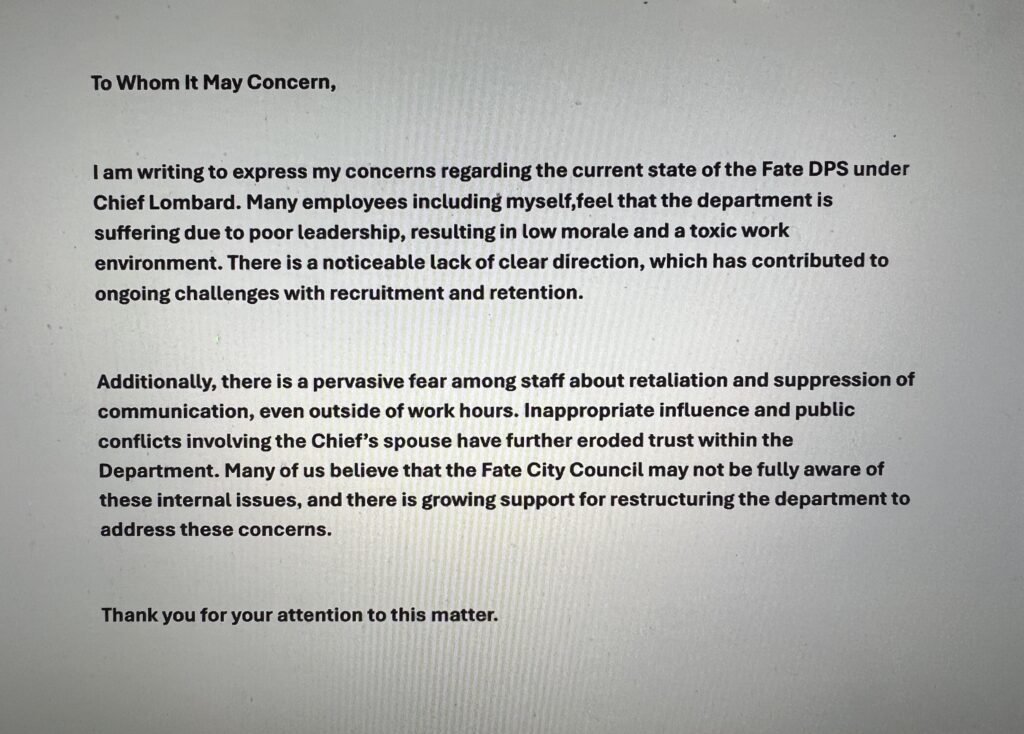
Their existence, however, does not resolve whether the City complied with the Texas Public Information Act. The central question is whether the City properly disclosed responsive records in response to a lawful request.
As of this publication, the City still has not disclosed the separate complaint letter that Kovacs later acknowledged receiving directly from a police officer. By his own admission, City Manager Michael Kovacs is the person responsible for the dissemination of records per State Law, and therefore he is the person who should be held accountable.
If Kovacs’ statement to investigators is accurate, that second complaint letter would have existed when the City’s response to the November 2025 Public Information Act request was prepared.
A New Public Information Request
In light of the newly disclosed information, Pipkins Reports has submitted another Texas Public Information Act request seeking all written complaints concerning Chief Lombard, including the complaint letter Kovacs acknowledged receiving from an officer, the complaint letter transmitted through Councilwoman Chinn, and any additional written complaints in the City’s possession.
The request states, in part:
“On 11/25/2025, as part of Open Records Request #R001735-112525, I requested ‘Copy of any written complaints against Chief Lombard within the last 12 months prior to termination.’ The City failed to provide any responsive documents, even though it was publicly known that at least one anonymous complaint letter existed.
During the ethics investigation conducted by Baker Robertson & O’Brien, Michael Kovacs stated that he received a complaint letter from a police officer. This admission indicates the City possessed an additional responsive document that was not disclosed.
The City did not seek an Attorney General ruling authorizing the withholding of either complaint letter. This request seeks both documents, together with any additional written complaints concerning Chief Lombard.”
Whether the City ultimately produces the records—or explains why they were not disclosed nearly eight months ago—may determine whether this story ends as an administrative oversight or raises more significant questions regarding the City’s compliance with the Texas Public Information Act.
This remains an ongoing investigation. Pipkins Reports will continue to report on developments as additional records become available.

Fate Council Dropped Case Before Reviewing
Fate, TX — An ethics investigation commissioned by the City of Fate concluded that former Councilwoman Codi Chinn violated the City’s Code of Ethics before the City Council voted earlier this month to discontinue the matter, according to documents obtained by Pipkins Reports through an Open Records Request.
The report, prepared by attorney Laura Mueller of the law firm Baker, Robertson & O’Brien, found that the allegation against Chinn was “substantiated, but with mitigating factors.”
The Executive Summary states:
“After investigation, my determination is that allegation of a violation of the Ethics Code is substantiated, but with mitigating factors.”
The report concludes that Chinn violated Section 2-309(10) of the City’s Code of Ethics after directing City employees to provide their concerns to her in writing.
“After reviewing the Charter, the Code of Ethics, and reviewing all of the evidence, my conclusion is that Ms. Chinn violated Section 2-309(10) of the Code of Ethics when she directed employees to provide information to her in writing.”
Mueller also concluded that mitigating circumstances should be considered because Chinn immediately informed City Manager Michael Kovacs about the employee concerns and because the employees ultimately submitted their written complaints directly to the City.
Council Ends Investigation
The ethics complaint summary report was scheduled to appear on the July 6 City Council agenda for executive session discussion.
Instead of going into Executive Session, the Council waived deliberative privilege and discussed the matter in open session where they ultimately voted to discontinue the ethics proceedings and drop the matter, before being presented with the findings from Mueller.
The Council did not impose any sanction against Chinn.
The following day, Pipkins Reports requested a copy of the complaint and the investigative report, and received it through an Open Records Request.
Investigation Details
According to the report, investigators interviewed Chinn, Councilman Mark Harper, City Manager Michael Kovacs, and other witnesses.
Regarding the allegations, Mueller wrote:
“In my interview with Ms. Chinn and Mr. Harper, we discussed the allegation. I questioned Ms. Chinn about her conversations with city employees and with Mr. Kovacs.”
According to the report, Chinn stated that city employees approached her seeking assistance and that she intended to present their concerns to the City Manager after compiling the information.
However, the report states that employees instead prepared a letter addressed to the City Council. Chinn then instructed them to provide the letter directly to the City Manager.
The report also summarizes Kovacs’ account of the events.
“Mr. Kovacs stated that he received the letter outlining the employee issues directly from an officer, but with the understanding that the information was given to him at the direction of Ms. Chinn.”
Previously, it was reported that Chinn provided a copy of an, “anonymous letter”, that she claims was provided by DPS officers to her. Chinn further states that she sent the letter to Michael Kovacs … who then forwarded it on to the rest of the Council. This report also states that Kovacs told investigators he had warned Chinn against communicating with employees in that manner.
Pipkins Reports continues to investigate this aspect of the situation … as the conditions shed new light on the events that have transpired with regard to the termination of DPS Chief Lyle Lombard.
Meanwhile, the city council’s decision effectively ended the ethics proceeding against Chinn without imposing any sanction or issuing any formal determination of its own regarding the investigator’s findings. While the Council possessed the authority to discontinue the matter, the decision also brought the ethics process to a close despite an independent investigation concluding that a violation of the City’s Code of Ethics had occurred.
For the complainant, Darcy Gildon, the Council’s action marked the end of a process that resulted in no public accountability beyond the release of the investigative report which Pipkins Reports has now provided.
You must be logged in to post a comment Login