Exposed: Fate City Council Candidate’s Secret Society Ties!

Candidate John Hamilton’s Shadowy Affiliations Cast Doubt on Transparency
As Fate gears up for its upcoming council elections, the candidacy of John Hamilton for Place 5 has stirred a whirlwind of debate and scrutiny, especially in light of his past affiliations and allegiances. Hamilton, a staunch Democrat, presents himself as a figure of experience and forward-thinking leadership, drawing upon his previous role as a councilman and his professional background. However, recent revelations regarding his involvement with secretive organizations have cast doubt on his commitment to transparency and accountability.
In addition to his political affiliations, Hamilton’s ties to the secretive cult, or fraternity, known as the Fate Masonic Lodge #802 have raised eyebrows among Fate residents. Hamilton holds the esteemed position of Junior Warden (3rd in charge) within this organization and has been granted the level of “Master Mason”, which was bestowed upon him by the enigmatic “Knights of Mecca”. The nature of these secretive groups, operating in the shadows, has prompted speculation about Hamilton’s intentions and the potential implications for his candidacy.

Some residents fear that Hamilton’s association with the Masonic Lodge could signify a willingness to bring the culture of secrecy and elitism associated with such organizations into the realm of municipal governance. The clandestine rituals practiced by groups like the Freemasons and the “Knights of Mecca” stand in stark contrast to the principles of openness and transparency that are integral to effective democratic governance. The Freemasons of today are far removed from those of 1776. Concerns have been raised that Hamilton’s allegiance to these secretive organizations may compromise his ability to represent the interests of all Fate residents fairly and transparently.
Despite Hamilton’s campaign rhetoric emphasizing community engagement and fiscal responsibility, the shadow of his affiliations with secretive organizations looms large over his candidacy. Hamilton has refused to engage with the Fate Tribune to answer questions for our readers… ever more secrecy. While he may present a vision of progress and prosperity for Fate, questions remain about the extent to which his allegiances to organizations like the Masonic Lodge may influence his decision-making and governance style.
Hamilton, previously served as a councilman from 2019 to 2022, and has positioned himself as a leader advocating for innovation, community collaboration, and forward-thinking governance. However, his past actions and policy decisions have come under scrutiny, particularly in relation to the Fate Comprehensive Plan and the contentious issue of multi-family housing.
During Hamilton’s previous term, he played a pivotal role in the establishment of policies that facilitated the construction of thousands of apartments in Fate. This influx of multi-family housing has had a profound impact on the community, altering its very fabric and leading to widespread discontent among residents who oppose such developments. Despite vocal opposition, Hamilton remained steadfast in his support for these initiatives, effectively disregarding the will of the people he was elected to represent.
Furthermore, Hamilton’s decision to resign from his position in 2022, ostensibly to allow for the early commencement of a newly elected council member, Lance Megyesi, raises questions about his commitment to fulfilling his responsibilities as a public servant, as well as potential collusion with a coordinated Council succession. While his resignation may have been framed as an act of deference to his successor, it also conveniently absolved him of any further accountability for the policies he helped implement.
As Fate residents prepare to cast their votes on May 4, 2024, they must carefully consider the implications of Hamilton’s shadowy affiliations, his unwillingness to engage is civil debate, and what these actions may portend for the future of their community. Transparency and accountability are paramount in municipal governance, and residents must weigh whether Hamilton’s ties to secretive organizations align with these principles or represent a potential threat to the democratic process.
For those seeking further information about John Hamilton or his campaign, he states that he can be reached via Facebook. That’s what he says, however, if you are associated with the Fate Tribune or you are an opponent of his policies, it’s unlikely that he will acknowledge you. Perhaps that’s the Masonic way?
Fate residents are urged to scrutinize Hamilton’s candidacy closely and to consider the broader implications of his affiliations with secretive organizations on the future of their community.



Montgomery, AL – The woman who spent years telling America which organizations were dangerous has now been arrested by the federal government in a fraud case involving secret payments, extremist informants, alleged shell companies and donor money.
Heidi Beirich, former director of the Southern Poverty Law Center’s Intelligence Project and former chief financial officer, was arrested Wednesday in California as the Justice Department’s criminal investigation into the SPLC widened. Beirich faces charges of wire fraud conspiracy, conspiracy to make false statements to a federally insured bank and conspiracy to conceal money laundering.
That’s quite a turn for someone whose professional career was built around exposing other people’s alleged extremism.
According to federal prosecutors, the case involves an SPLC informant identified in court documents as “F-9,” who operated inside the National Alliance, a white supremacist organization. The Justice Department alleges the SPLC secretly funneled approximately $1.2 million to F-9 over more than two decades as part of its intelligence-gathering operation.
The indictment does not name Beirich. Instead, it identifies a former senior SPLC employee as “Employee-2,” describing that person as someone who would later become director of the organization’s Intelligence Project. Multiple news organizations, including The Associated Press, have identified Employee-2 as Beirich. Her attorney, Michael Proctor, confirmed Wednesday that she had been charged in the federal case.
And the allegations get considerably stranger from there.
Prosecutors allege Beirich and F-9 were romantically involved and shared a residence and two bank accounts. Between 2015 and 2021, roughly $140,000 in SPLC donor money allegedly flowed into those joint accounts. The indictment says that money accounted for about 66 percent of the deposits into the accounts and was used to pay the couple’s personal living expenses.
Federal prosecutors also allege that SPLC officials helped establish bank accounts using fictitious company names to disguise the source and purpose of payments to informants.
This wasn’t simply a matter of paying someone for information. According to the indictment, the government believes the financial arrangements were deliberately structured to conceal what was happening from banks and donors. The original federal indictment against the SPLC alleges that, between 2014 and 2023, the organization secretly funneled more than $3 million to people associated with violent extremist groups, including the Ku Klux Klan, Aryan Nations and the National Socialist Party of America.
The SPLC itself was indicted in April on 11 counts involving wire fraud, false statements to a federally insured bank and conspiracy to commit concealment money laundering. The FBI investigated with assistance from IRS Criminal Investigation.
Beirich’s attorney has rejected the prosecution as politically motivated, saying that the justice system should not be used against political opponents. The SPLC has also maintained that its informant program was legitimate intelligence work designed to gather information about extremist organizations.
Beirich left the SPLC after leading its Intelligence Project from 2012 through 2019. She later co-founded the Global Project Against Hate and Extremism and continued to appear publicly as an expert on political extremism.
Austin
Texas GOP Wants Closed Primaries. New Secretary of State Robert Howden Is Preparing to Fight Them.

Austin, TX – Texas Republicans spent years demanding control of their own primary. Now they have a new Secretary of State, Robert S. Howden, appointed by Republican Governor Greg Abbott, and the man taking over the state’s election machinery is inheriting a lawsuit in which his office is expected to defend the very open primary system the GOP wants to dismantle.
The Republican Party of Texas filed the federal lawsuit in September 2025, arguing that Texas’ open primary system violates the party’s First Amendment right of association. Under the current system, Texas voters do not register by party and may choose which party’s primary to vote in during an election cycle. The GOP wants only registered Republicans participating in Republican primaries.
The case is pending in federal court in Amarillo before U.S. District Judge Matthew Kacsmaryk.
And Robert S. Howden has now inherited it.
Howden Steps Into the Fight
Gov. Abbott appointed Howden as Texas’ 116th secretary of state on July 17, effective July 18. Howden previously served as Abbott’s senior adviser and director of legislative affairs and has worked in the administrations of four Republican governors. As secretary of state, he is Texas’ chief elections officer.
Abbott has been quite clear about where he stands.
At the 2026 Republican Party convention, he said Texas would eventually make clear that “only Republicans vote in Republican primaries.” Abbott has also said lawmakers “can and should be more responsive to Republicans than a judge may be,” indicating that he expects the Legislature to address the issue during the 2027 session.
But that doesn’t mean the Secretary of State’s office is supposed to simply surrender in court.
That was the position taken by Howden’s predecessor, Jane Nelson.
Nelson argued that changing Texas’ primary system was a job for the Legislature, not a federal judge. In an October 2025 statement, she said it was her responsibility to defend existing election laws and that she would implement whatever changes the Legislature lawfully enacted.
The Attorney General’s office took the opposite position.
Attorney General Ken Paxton sided with the Texas GOP, asking the federal court to strike down portions of the Texas Election Code governing open primaries. According to reporting by The Texas Tribune, Nelson’s lawyers said Paxton’s office gave them less than an hour’s notice before taking the opposing position.
So the Republican Party sued the Republican-controlled state government. The Republican Attorney General joined the plaintiffs. And the Republican Secretary of State fought the lawsuit.
That’s not exactly the tidy party unity politicians like to advertise.
The Real Fight Is Over Who Controls the Nomination
The GOP argues that crossover voting allows Democrats and independents to influence Republican nominations, potentially helping candidates who are less conservative than the party base.
The lawsuit specifically pointed to the 2024 Republican primaries involving former House Speaker Dade Phelan and Rep. Gary VanDeaver. Both won their races by fewer than 800 votes, and the party argued that crossover voters helped determine the outcomes.
The party has already made closing primaries an official priority. Republicans adopted rules supporting closed primaries in 2024 and renewed that push at their 2026 convention.
But changing the system is not as simple as flipping a switch.
Texas has more than 18 million registered voters, and the state’s registration system was never designed around party registration. Moving to closed primaries could require new registration procedures, computer-system changes and a method for existing voters to establish party affiliation.
The GOP wants the courts to clear the way, preferably in time for 2028.
Election
Texas Senate Hopeful James Talarico Shared Pride Event Stage With 11-Year-Old Child Drag Performer

Federal Court Upholds State Limits on Minors at Adult Drag Shows
Taylor, TX – A federal appeals court has just upheld a Florida law restricting minors from attending certain adult live performances, including some drag shows. Within hours of that ruling, renewed attention was focused on Texas Democratic U.S. Senate candidate James Talarico after reports resurfaced showing he headlined a 2021 Pride fundraiser featuring an 11-year-old child drag performer promoted as one of the event’s main attractions.
On Tuesday, the U.S. Court of Appeals for the 11th Circuit ruled in HM Florida-ORL, LLC v. Secretary of the Florida Department of Business and Professional Regulation, allowing Florida to enforce its law restricting minors from attending certain adult live performances. Florida Attorney General James Uthmeier announced the decision, calling it a victory for protecting children. The ruling does not prohibit drag performances for adults, but it recognizes that states may impose limits when minors are involved.
The timing has drawn renewed scrutiny to Talarico’s record as he campaigns for the U.S. Senate against Texas Attorney General Ken Paxton.
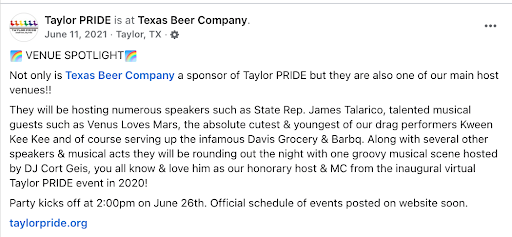
According to promotional materials first highlighted by the Washington Free Beacon, Talarico was a featured speaker during Taylor PRIDE’s June 26, 2021 fundraiser in Taylor, Texas. The event was organized to raise money for “rural LGBTQ communities” and included live music, Drag Story Hour, adult drag performers, and an 11-year-old performer using the stage name “Kween Kee Kee.”
Taylor PRIDE advertised the child as “the absolute cutest & youngest of our drag performers.” Promotional posts stated the child would perform a drag routine and host “Kee Kee Storytime,” where children would participate in Pride-themed craft activities. The event was held at Texas Beer Company.
Photographs published from the event show Talarico addressing attendees from the stage and posing with participants. Additional photographs and video posted publicly show Kween Kee Kee, a local preteen named Keegan, performing in a shimmering blue dress, platinum blonde wig, and theatrical makeup during what organizers described as a Youth Drag Show. One attendee shared video of the child performing the splits before the audience.
The fundraiser also featured several adult drag performers, including Brianna Brinxx, Belladonna Dior, Felecia Enspire, and a performer using the stage name Sedonya Face.
Following criticism from conservative activists who protested the event, Taylor PRIDE defended the festival on social media. The organization rejected claims that the event was sexually explicit or exploitative and encouraged the public to review photographs from the event and decide for themselves.
Talarico’s campaign did not respond to requests for comment from the Washington Free Beacon regarding his participation.
The resurfaced event adds to a broader record that Republicans have highlighted throughout Talarico’s political career. While serving in the Texas House, Talarico opposed legislation restricting drag performances in the presence of children and argued lawmakers should avoid harming what he described as Texas’ drag performers. He has also opposed Republican-backed legislation restricting certain transgender medical treatments for minors and has frequently spoken in support of LGBTQ causes.
More recently, however, Talarico has attempted to present himself as a more moderate statewide candidate. He has described previous remarks, including referring to God as “nonbinary,” as “cringey” and has removed some progressive messaging from campaign materials as he seeks to broaden his appeal beyond Democratic primary voters.
The renewed attention comes as cultural debates surrounding children and drag performances continue playing out both politically and legally. Florida’s appellate court victory represents one of the most significant recent rulings supporting a state’s authority to restrict minors from attending certain adult-oriented live performances, even as litigation over similar laws continues elsewhere.
You must be logged in to post a comment Login