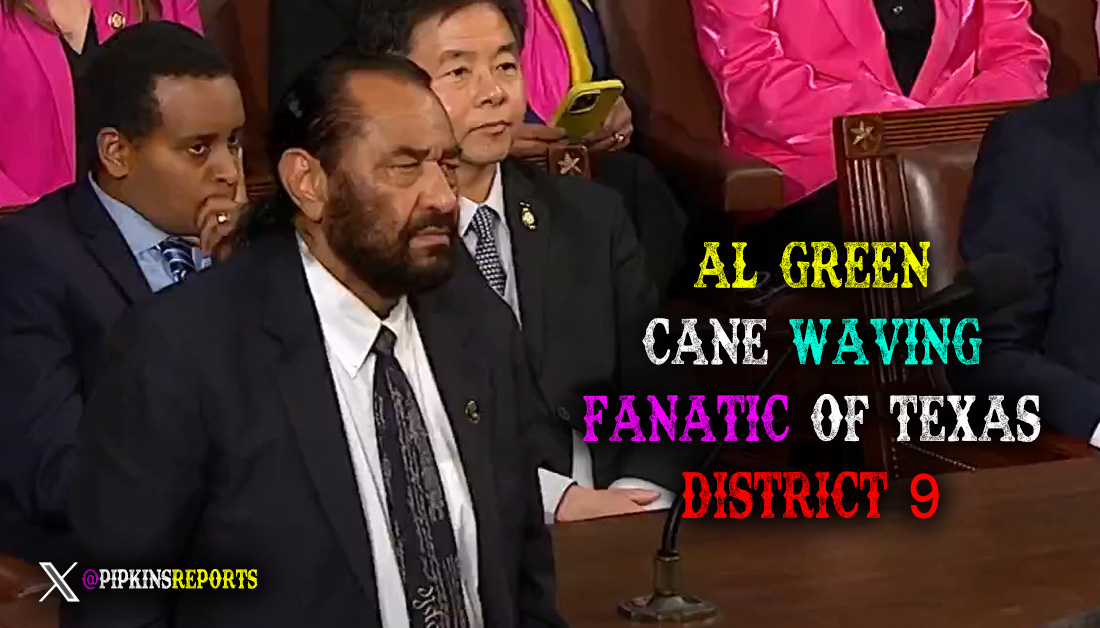
Al Green’s Disgraceful Outburst: A Constitutionalist’s Take on Democrats’ Descent into Chaos

HOUSTON, TX — On Tuesday, March 4, 2025, the hallowed halls of Congress bore witness to a spectacle that would make the Founding Fathers recoil in disgust. Representative Al Green (D-TX), the long-serving voice of Texas’ 9th District south of Houston, turned President Donald Trump’s joint address into a personal soapbox, erupting in a tantrum that ended with his forcible removal from the chamber. Two days later, on Thursday, March 6, the House delivered a rare and deserved censure, with a 224-198 vote that saw ten Democrats break ranks to join Republicans in condemning Green’s antics. What followed was a screaming match on the House floor—a fitting capstone to the Democrats’ descent into petulant disorder.
Green’s outburst was no spontaneous act of passion. It was a calculated middle finger to decorum, tradition, and the very principles that undergird our constitutional republic. As President Trump spoke of his electoral mandate—a mandate secured by the American people in November 2024—Green leapt to his feet, brandishing his cane like a prop in some low-budget melodrama. “You have no mandate!” he bellowed, his voice cutting through the chamber as he railed against Trump’s supposed plans to “cut Medicaid.” House Speaker Mike Johnson (R-LA), a man tasked with maintaining order in an increasingly fractious body, issued stern warnings. Green ignored them. The Sergeant at Arms was summoned, and the 77-year-old congressman was escorted out to a chorus of Republican cheers—and, tellingly, Democratic silence.
This wasn’t Green’s first rodeo. The veteran lawmaker, who’s clung to his seat since 2005, has a history of grandstanding that stretches back to his early pushes to impeach Trump in 2017. A self-styled “civil rights advocate,” Green’s resume boasts arrests for protests outside embassies and a decade-long stint leading Houston’s NAACP chapter. But Tuesday’s stunt wasn’t noble dissent—it was a cheap shot at a president addressing a joint session, a moment meant to reflect the unity of our governing institutions. Instead, Green gave us a glimpse of the Democrats’ true face in 2025: unhinged, undisciplined, and utterly incapable of rising above their partisan bile.
The House’s censure vote on Thursday was a necessary rebuke, though it barely scratches the surface of what’s wrong with Green and his ilk. The resolution, spearheaded by Rep. Dan Newhouse (R-WA), passed with bipartisan support—a rarity in these polarized times. Two members voted “present,” one of them Green himself, who couldn’t even muster the dignity to stand by his own disruption. Speaker Johnson read the censure aloud as Green, surrounded by fellow Democrats, launched into a rendition of “We Shall Overcome”—a civil rights anthem cheapened by its use as a prop in this circus. What followed was pure chaos: a screaming match between Democrats and Republicans that turned the House floor into a scene more befitting a barroom brawl than the people’s chamber.
Let’s not mince words: Green’s behavior, and the Democrats’ tacit endorsement of it, is an affront to the Constitution itself. Article I vests Congress with the power to govern, not to grandstand. The House isn’t a stage for personal vendettas or theatrical protests—it’s a place where representatives are duty-bound to uphold order and reason, even in disagreement. Green’s refusal to heed Johnson’s calls to sit down wasn’t just a breach of decorum; it was a rejection of the very framework that keeps our republic from sliding into mob rule. And the Democrats’ response—singing hymns while the chamber dissolved into anarchy—only underscores their contempt for that framework.
The broader context makes this episode even more galling. Trump’s address came five months after a decisive electoral victory, one that handed Republicans the House, the Senate, and the popular vote—a trifecta not seen in decades. Democrats, still licking their wounds, had been urged by their leadership to show restraint during the speech. Green ignored that directive, as did others who walked out or heckled in quieter tones. Reps. Maxwell Frost (FL), Jasmine Crockett (TX), and a handful of others staged their own mini-rebellions, but Green’s was the loudest—and the most shameful. This wasn’t resistance; it was a tantrum from a party that’s lost its moorings.
Conservatives, of course, aren’t surprised. Green’s track record—impeachment crusades, cane-waving histrionics—reads like a playbook for the modern Left: when you can’t win at the ballot box, disrupt the process. But what’s truly abhorrent is how this behavior erodes the trust Americans place in their institutions. The House isn’t a sandbox for overgrown children; it’s a bulwark of liberty, a place where the people’s will is meant to be hashed out with grit and grace. Green and his Democratic cheerleaders forgot that—or, worse, they don’t care.
The censure itself is a slap on the wrist—a symbolic condemnation with no real teeth. But it’s a start. Ten Democrats crossing the aisle to support it signals that even some in their ranks are fed up with the clown show. For constitutionalists, though, the stakes are higher than party lines. We’re watching a slow-motion assault on the norms that keep our government functional. If Green’s outburst goes down as just another blip in the news cycle, we’re one step closer to a Congress where shouting matches replace debate, and the rule of law bows to the rule of the loudest.
Texas’ 9th District deserves better than Al Green. So does the nation. On March 4, he didn’t just embarrass himself—he embarrassed the republic. And on March 6, when the House rightly censured him, the Democrats’ screaming response proved they’re more interested in theater than governance. The Constitution demands more. We should, too.


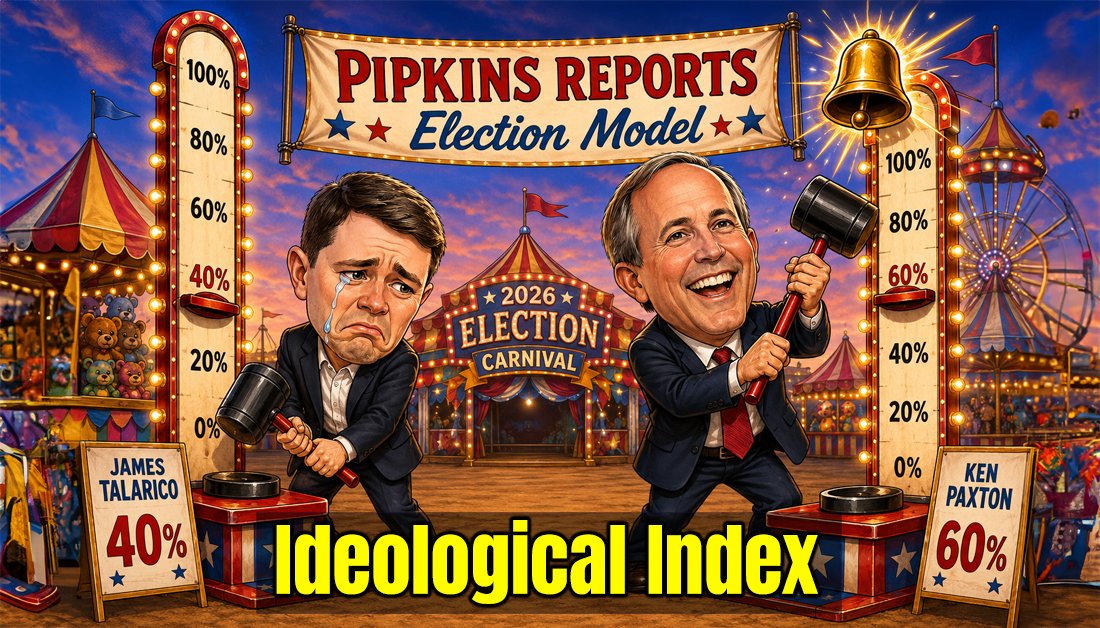
Austin, TX – If the Texas Senate election were decided by ideology, turnout, and the assumptions laid out in the Pipkins Reports election model, Ken Paxton wouldn’t just beat James Talarico, he would beat him badly.
Our model projects a 59.4% to 40.6% victory for Paxton, a Republican margin of approximately 18.8 percentage points.
We’ve been making this claim for months. Now we can explain why.
This is not a polling forecast. It isn’t based on a collection of survey respondents being asked what they might do months before an election. It is an election model, built from the ideological composition of the Texas electorate, a projected increase in turnout and a defined set of assumptions about how voters divide between the two candidates.
Those assumptions can be debated. The math can not.
The Pipkins Reports Ideological Index
To build the model, Pipkins Reports established an ideological index using 0 as the political center, with candidates moving toward -10 on the left and +10 on the right.
The scores are analytical, not official government ratings. They are based on the candidates’ public records and positions on major political questions, including taxation, government spending, abortion, guns, immigration, transgender policy, health care, education, criminal justice, energy, federalism and cultural issues.
The historical comparison looks like this:
| Year | Democratic nominee | Ideological score, Democrat | Republican nominee | Ideological score, Republican | Total ideological difference | GOP margin of victory |
|---|---|---|---|---|---|---|
| 2002 | Ron Kirk | -2.0 | John Cornyn | +5.0 | 7.0 | 11.97 pts. |
| 2008 | Rick Noriega | -3.5 | John Cornyn | +5.0 | 8.5 | 11.98 pts. |
| 2012 | Paul Sadler | -3.0 | Ted Cruz | +8.0 | 11.0 | 16.18 pts. |
| 2014 | David Alameel | -3.0 | John Cornyn | +5.0 | 8.0 | 27.20 pts. |
| 2018 | Beto O’Rourke | -6.5 | Ted Cruz | +8.0 | 14.5 | 2.56 pts. |
| 2020 | M.J. Hegar | -5.5 | John Cornyn | +5.0 | 10.5 | 9.64 pts. |
| 2024 | Colin Allred | -4.0 | Ted Cruz | +8.0 | 12.0 | 8.49 pts. |
| 2026 | James Talarico | -8.5 | Ken Paxton | +9.0 | 17.5 | TBD |
The historical margins are based on Texas election results.
The most striking number in the table may be the ideological difference in the upcoming race.
Talarico is scored at -8.5, substantially farther left than Beto O’Rourke at -6.5 and Colin Allred at -4.0.
Talarico has rejected the label “democratic socialist,” and Pipkins Reports does not assign that label to him. However, his policies nevertheless contains substantial overlap with modern progressive and social-democratic positions.
Paxton, meanwhile, is scored at +9.0, making the ideological distance between the two nominees 17.5 points, the largest gap in our historical comparison.
For context, the largest previous gap was the 2018 Cruz-O’Rourke race at 14.5 points. Cruz won that election by only 2.56 points, demonstrating that ideological distance by itself doesn’t determine an election.
What We Believe the Texas Electorate Looks Like
The model begins with an ideological breakdown of Texas voters derived from Texas Public Opinion Research‘s survey of registered voters.
TPOR found that, among the Texas electorate, approximately 43% are conservative, 34% are “moderate”, and 24% are liberal. Because those rounded numbers total 101%, Pipkins Reports normalized the figures to 100%.
Then comes the key assumption. We assign all conservative voters to Paxton and all liberal voters to Talarico. The moderate electorate is divided exactly 50/50.
That produces a theoretical statewide vote of: Paxton: 59.406%, Talarico: 40.594%
The model isn’t claiming that every conservative Texan will vote for Paxton or every liberal Texan will vote for Talarico. Those are simplifying assumptions designed to create a baseline model. And there is another assumption.
Five Percent More Voters
Texas recorded approximately 8.1 million voters in the 2022 midterm election. For purposes of this model, we assume 2026 turnout increases by 5%.
That produces approximately 8.51 million voters.
We then assume the additional voters have the same ideological distribution as the existing electorate and that the new moderate voters also split 50/50.
Under those conditions, the model produces:
| Candidate | Projected vote | Projected votes |
| Ken Paxton | 59.41% | 5.05 million |
| James Talarico | 40.59% | 3.45 million |
| Margin | 18.81 pts. | 1.60 million votes |
Again, this is an election model, not a polling forecast.
We’re not claiming to know what 500 or 1,000 randomly selected Texans say they intend to do. We’re asking what happens if the electorate actually looks like the ideological distribution we’ve established and behaves according to the assumptions we’ve specified.
Under those conditions, Paxton wins by approximately 18.8 percentage points.
OPINION: Here’s Why I Think This Matters
I’ve spent enough time watching Texas politics to know that campaign consultants love a good poll. They love it even more when the poll tells them exactly what they want to hear.
But elections aren’t conducted by polling firms, they’re conducted by actual voters.
And voters don’t walk into a polling place carrying a survey questionnaire. They walk in carrying years of accumulated opinions about government, taxes, crime, immigration, schools, guns, abortion, religion and the direction of the country.
That is why I find the ideological comparison more interesting than the latest political horse race narrative.
Talarico isn’t simply another Texas Democrat.
By our methodology, he is farther left than O’Rourke and considerably farther left than Allred. Paxton, meanwhile, is the polar opposite and is positioned well to the right of the political center.
That creates a 17.5-point ideological canyon between the two candidates.
Could Talarico cross it? Maybe…but unlikely.
Texas voters have surprised political professionals before. Beto O’Rourke came within 2.56 points of defeating Ted Cruz in 2018 despite a very large ideological gap. Candidate quality, campaign organization, money, national political conditions and the personalities of the nominees can overwhelm simple ideological arithmetic.
I believe that the electorate will remain roughly as conservative as the available ideological data suggests, and if the moderates really do split evenly, Talarico has a very steep hill to climb.
Our model says Paxton wins 59.4% to 40.6%.
That’s an 18.8-point victory…. for the sake of conservatism (small “c”) I am only predicting a margin of 10 points. You heard it here first, folks.
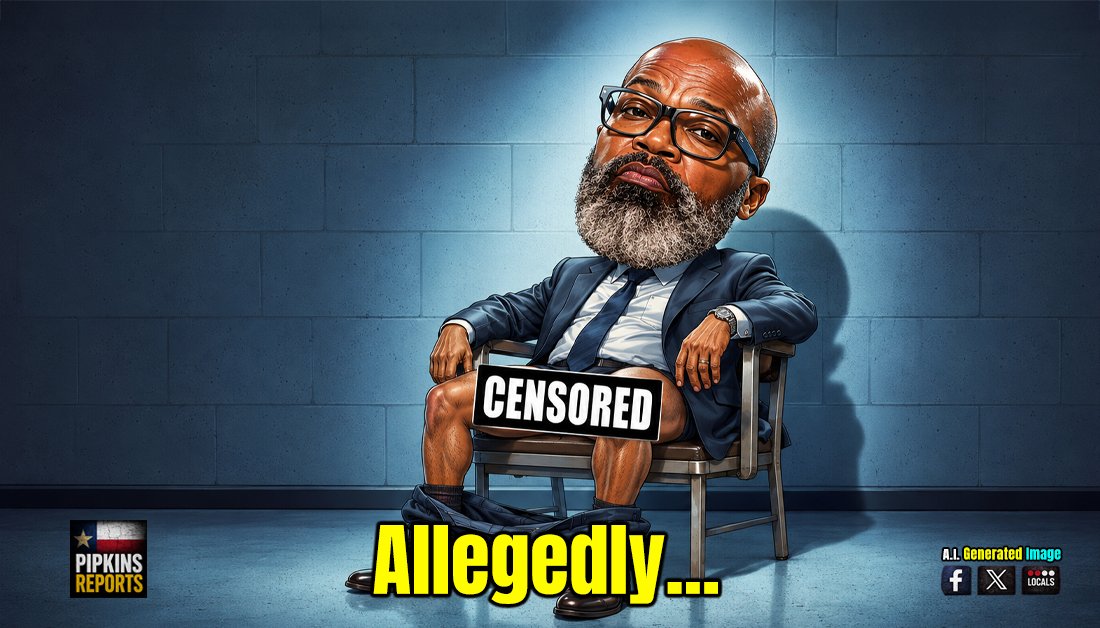
La Marque, TX – Keith Bell, 53, the mayor of La Marque, was arrested Friday in Angleton on a warrant charging him with indecent exposure, a Class B misdemeanor. He was released Saturday after posting a $75,000 bond, with a judge ordering him to have no contact with the woman who reported the incident, stay away from her residence and stay away from the school she attends.
According to the Houston Chronicle, Bell was allegedly seen masturbating in the lobby of an office building in Angleton on Friday morning. A woman, whose identity is being withheld, reportedly witnessed the incident and contacted authorities, prompting Brazoria County Sheriff’s deputies to respond. The Chronicle reported that Bell was taken into custody and booked into the county detention center.
Those are allegations, not a conviction. Bell has not been found guilty of the charge, and the publicly available reporting does not identify an attorney representing him or provide a statement from Bell disputing the accusation.
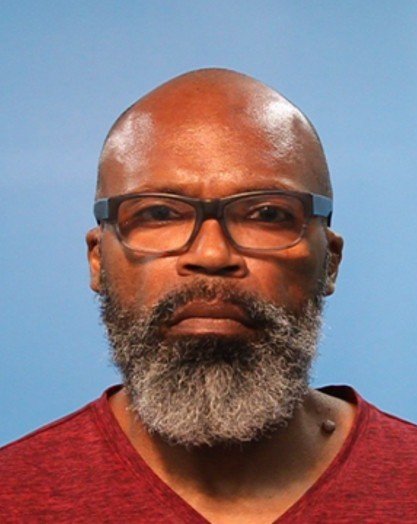
The City of La Marque confirmed the arrest Friday, in a statement where they stated, “To the residents of La Marque, we recognize that this is a shocking and disheartening development during a period that has already brought significant uncertainty and challenges to our community. We understand and share your concerns.” City officials also emphasized that the alleged conduct occurred outside Bell’s official duties as mayor and said the city would follow its charter and applicable law while gathering verified information.
Bell’s arrest does not automatically remove him from office. The city said Saturday that Bell remains mayor unless he resigns or is removed through the procedures established by the city charter and Texas law. City leadership said it had not communicated with Bell following his release, and Bell had not contacted city staff at the time of reporting.
This isn’t Bell’s first trip with controversy.
Bell has been involved in La Marque government for years. He served on the council for 17 years before becoming mayor, and he was sworn into the mayor’s office in January 2021. He was reelected in May 2024, defeating Joel Camacho with 63.57 percent of the vote, according to official Galveston County election results.
Bell also survived a 2022 recall election. More recently, he faced another recall effort in 2025, which Bell disputed as based on false allegations. That political history doesn’t establish anything about the current criminal case, but it does mean La Marque’s mayor has never exactly been a stranger to controversy.
Under Texas Penal Code §21.08, indecent exposure involves exposing the anus or genitals with intent to arouse or gratify sexual desire while being reckless about whether another person is present who will be offended or alarmed. A first offense is generally a Class B misdemeanor.

Kentucky, USA – Mitch McConnell has been out of public view for 71 days. No speech. No interview. No video. No public appearance. Not even a short phone recording of the 84-year-old senator telling Kentucky voters, in his own voice, that he’s doing OK.
For a man who spent nearly two decades at the center of American political power, that is an extraordinary silence. And it has created a vacuum, as every vacuum eventually does, that the internet has been more than happy to fill.
McConnell’s last confirmed in-person Senate vote came June 11, when he voted on a cloture motion involving judicial nominee Justin D. Smith. He had also been present during the Senate’s marathon June 4 vote-a-rama, which ran into the early morning hours, and Senate records show him presiding over a Defense Appropriations subcommittee hearing June 9.
Three days after that last confirmed Senate appearance, McConnell was hospitalized following a fall at his Washington residence that left him “briefly unconscious”. His office later said he suffered a mild case of pneumonia and was undergoing rehabilitation.
On July 12, McConnell allegedly addressed Kentuckians in a written statement, saying he was recovering from the fall and pneumonia. His office released a photograph showing him sitting beside his wife, Elaine Chao, holding that day’s Washington Post.
That photo did not end the questions. It multiplied them.
A second photograph, released July 27 and reportedly dated July 26, showed McConnell again with Chao. Neither image included video or audio of McConnell speaking.
McConnell was discharged from a rehabilitation facility Aug. 6 and said he would continue intensive physical therapy at home while remaining engaged with Senate business remotely. His office has not announced when, or whether, he will return to the Capitol.
Republican colleagues have said they have spoken privately with him. Former McConnell adviser Scott Jennings described a lengthy conversation in which he said McConnell sounded alert and discussed politics and world affairs. But those conversations remain private.
And that is the heart of the problem.
Kentucky Gov. Andy Beshear, a Democrat, has repeatedly called for McConnell to provide a direct public update. Beshear recently said he had received “absolutely nothing” back from McConnell despite reaching out.
Meanwhile, social media has gone full Texas-sized conspiracy mill.
Benny Johnson on X wrote July 7 that McConnell’s family should answer demands for “proof of life,” while raising questions about Chao’s China connections and travel. Laura Loomer on X went considerably further, claiming without publicly established evidence that McConnell was “brain dead” and being kept alive by machines.
There is no actual evidence establishing those claims.
But dismissing every question as a conspiracy theory is equally lazy. The public record really is unusual: an elderly senator suffers a serious fall, spends weeks hospitalized and in rehabilitation, releases two questionable photographs and written statements, and remains completely absent from public view.
If he were truly coherent, a 30-second video would solve the issue … speculation grows that this is simply not possible and that is the reason they haven’t provided one.
There is now a natural deadline looming over this strange saga: September 14, 2026. That is the date the Senate is scheduled to return to regular business after its August recess, meaning McConnell will have been absent from public view for 95 days since his last confirmed appearance on June 11.
By then, a photograph and another written statement attributed to McConnell simply won’t cut it. If he is healthy enough to continue serving, his constituents should be able to see and hear him. If he isn’t, Kentucky voters deserve to know that, too.
September 14 shouldn’t necessarily be a literal deadline for his medical recovery, but it is a reasonable public accountability deadline: when the Senate comes back to work, the senator whose name appears on the roll should be able to demonstrate, in his own voice and on camera, that he is alive, aware and capable of carrying out the job for which Kentucky elected him.
If the nation doesn’t hear from him by September 14th, a criminal investigation should take place.
You must be logged in to post a comment Login