Connect with us

Published

on

After forty-one days of furloughs, stalled paychecks, and shuttered government offices, the U.S. Senate late Monday finally passed H.R. 5371, the Continuing Appropriations and Extensions Act, 2026, ending the longest government shutdown since 2018. But hidden deep inside the stopgap spending bill that reopens Washington lies a provision that may devastate one of America’s fastest-growing agricultural and manufacturing industries—the hemp market.

What was meant to keep the lights on in D.C. may soon snuff out the livelihoods of hundreds of thousands of farmers, processors, and small business owners across the country.

A Hidden Sting in a Lifeline Bill

The Senate approved the measure by a 60-40 vote just before midnight on November 10, ensuring that federal agencies would receive temporary funding through January 30, 2026. On paper, the legislation restores pay to federal workers, secures funding for food assistance programs, and prevents further disruptions to air travel and the military.

But tucked among those spending provisions is language that rewrites federal hemp law—with implications few Americans realize. The so-called “hemp loophole,” which since 2018 has allowed hemp-derived THC products such as delta-8 and delta-10 to be sold legally in most states, has now been effectively closed.

Under H.R. 5371, any consumable product exceeding 0.4 milligrams of total THC per serving, a threshold so low that it disqualifies nearly every existing hemp-derived THC product, will be banned nationwide. The restriction applies to edibles, beverages, tinctures, vapes, and even topicals marketed for personal or household use. Only non-intoxicating CBD and industrial hemp for fiber or seed will remain exempt.

“This Isn’t Regulation—It’s Eradication”

Within hours of passage, hemp producers across the country flooded social media with outrage. Jim Higdon, co-founder of Cornbread Hemp, called the bill “a declaration of war against an entire American industry.” Farmers in Kentucky, Tennessee, Texas, and North Carolina—many of whom had transitioned from tobacco or cotton to hemp after the 2018 Farm Bill—now face the prospect of bankruptcy.

This isn’t regulation,” said one Texas grower, J. L., who runs a small hemp processing facility near Waco. “It’s eradication. The federal government just made my business illegal overnight.

Industry analysts estimate the decision could wipe out more than $10 billion in annual economic activity and eliminate up to 400,000 jobs, many of them in rural communities that have few other viable cash crops… all for nothing more than a two and a half month continuing resolution. Poof. It’s all gone.

A Battle Between the Bluegrass and the Beltway

Ironically, the most heated debate came not from Democrats but from within the Republican Party. Senator Rand Paul (R-KY) staged a procedural delay to block the bill, warning that the hemp provision would “obliterate” Kentucky’s hemp farmers—many of whom had relied on federal assurances since 2018 that hemp was a lawful, profitable crop.

But Paul’s effort failed. His amendment to strike the ban was tabled 76–24 after intense lobbying from Senate leadership, including Mitch McConnell, the same Kentucky senator who had shepherded hemp legalization into the 2018 Farm Bill.

McConnell, once hailed as the industry’s patron, has since become one of its fiercest critics. He now argues that the “unintended consequences” of hemp legalization—chiefly the unregulated sale of psychoactive THC derivatives in gas stations and convenience stores—have created a public health crisis.

Paul, in floor remarks before the vote, shot back that McConnell’s about-face “betrays the very farmers he once claimed to champion.”

The Texas Angle: Cruz and Cornyn Back the Ban

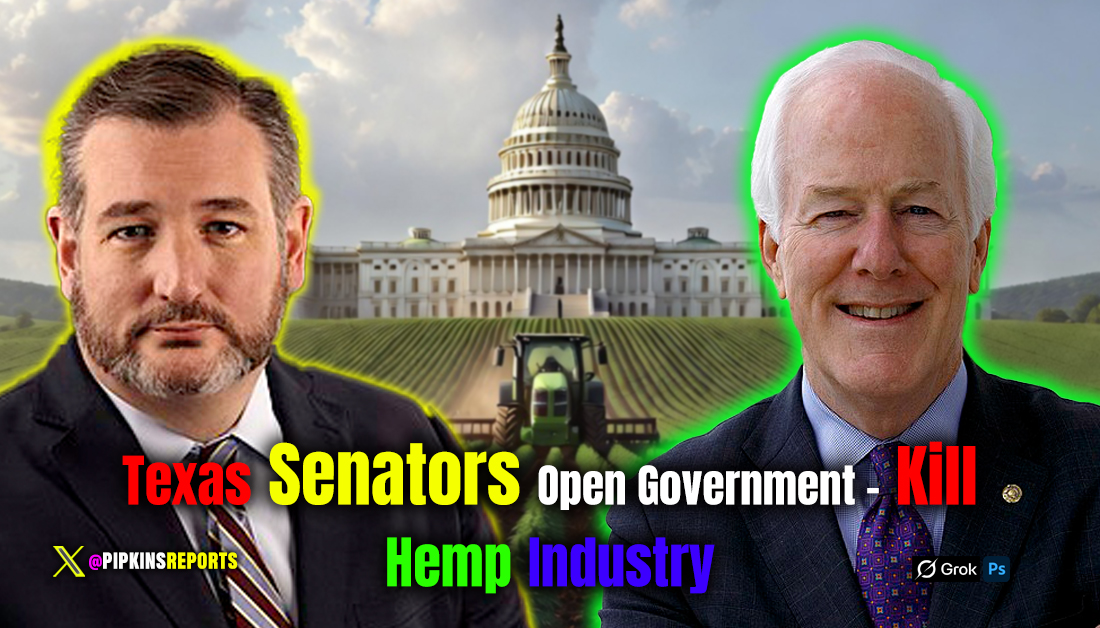
Both Texas Senators, Ted Cruz and John Cornyn, voted in favor of H.R. 5371. Their “Yea” votes helped secure the 60-vote threshold needed to end the shutdown—and, in doing so, endorsed the controversial hemp restrictions which has put thousands of Texas farmers out of business.

The move stunned many Texas growers who had looked to Cruz and Cornyn as defenders of market freedom and state-level autonomy. “It’s disappointing,” said one Central Texas farmer who shifted to hemp after drought destroyed his corn crop in 2023, according to High Times Magazine. “They talk about fighting big government, but this was Washington picking winners and losers. And we just lost.

The Political Chess Behind the Hemp Ban

Supporters of the ban, including Texas Lieutenant Governor Dan Patrick and a bipartisan coalition of 38 state attorneys general, claim the new restrictions are necessary to curb youth access to intoxicating products that have flooded the market. Patrick had previously pushed for similar restrictions in Texas under Senate Bill 3, which was vetoed by Governor Greg Abbott earlier this year.

But critics suggest corporate money and political convenience played as large a role as public safety.

Documents reviewed by industry watchdogs show major beer and spirits lobbies have quietly funneled campaign donations to lawmakers who supported the hemp restrictions. Hemp-infused seltzers and THC beverages have been eating into alcohol sales, and the new federal limit—0.4 mg per serving—essentially eliminates that competition.

The alcohol lobby couldn’t regulate us out of existence at the state level,” said Higdon, “so they went to Washington.

Economic Fallout Already Underway

The hemp sector, which ballooned from a niche market to a $30 billion industry in just seven years, now faces a regulatory cliff. Distributors and manufacturers that invested heavily in delta-8 and delta-10 production facilities may be forced to shutter within months.

We’ll lose 70% of our revenue,” said C. M., owner of a hemp beverage company in Austin. “We employ local people. We pay taxes. Now Washington has lumped us in with drug cartels.

Even as markets reel, state officials warn of ripple effects far beyond small business closures. Texas Agriculture Commissioner Sid Miller, who has supported hemp as a diversification crop, said in a statement that “federal overreach like this punishes responsible farmers and rewards black markets.

The ban’s 90-day implementation window gives agencies until February 2026 to issue enforcement rules. The FDA and DEA will jointly determine which cannabinoids are deemed “naturally occurring” and which are prohibited. Businesses caught in the gray area could face criminal penalties for noncompliance.

Political Consequences on the Horizon

Strategists are already warning that the move could alienate younger and libertarian-leaning voters ahead of the 2026 midterms. A Gallup poll from November 2025 found that only 40% of Republicans still support marijuana legalization, but nearly 70% of voters under 40 favor looser restrictions on cannabis and hemp.

The GOP just handed the Democrats a culture-war gift,” one Republican campaign consultant said privately. “You can’t preach free markets and then destroy an entire industry because a beer company made a few phone calls.”

Still, the political establishment appears unmoved. President Trump has not publicly commented on the hemp ban but is expected to sign H.R. 5371 into law, given his administration’s emphasis on “law and order” and curbing intoxicating products.

The Road Ahead

The House is expected to approve the bill swiftly, eager to claim credit for ending the shutdown before Thanksgiving. Once signed, the hemp restrictions will take effect within three months, leaving the industry little time to adjust.

In Kentucky, Texas, and dozens of other states, warehouses filled with unsold hemp beverages and gummies may soon become evidence in federal enforcement actions.

What began in 2018 as a bipartisan success story—an effort to revive rural economies and replace illicit markets with legitimate commerce—has ended in yet another cautionary tale of Washington politics.

The Senate’s passage of H.R. 5371 may reopen the government, but in doing so, lawmakers—including both Texas senators—have closed the door on a generation of American entrepreneurs who staked their livelihoods on the promises of deregulation and innovation.

For them, the lights in Washington may be back on—but the future of the Republican Party just went dark.


Michael Pipkins focuses on public integrity, governance, constitutional issues, and political developments affecting Texans. His investigative reporting covers public-record disputes, city-government controversies, campaign finance matters, and the use of public authority. Pipkins is a member of the Society of Professional Journalists (SPJ). As an SPJ member, Pipkins adheres to established principles of ethical reporting, including accuracy, fairness, source protection, and independent journalism.

Fate, TX

CyberSquatting City Hall: How City Claimed a Developer’s Domain

Published

on

Secret Domains

How Fate registered a developer’s project domain after seeing it in official plans, then fought to keep that fact hidden

FATE, TX – Cities are expected to regulate development, not steal its name.

Records obtained by Pipkins Reports show the City of Fate registered the domain name of a private development, lafayettecrossing.com, while actively working with the developer who had already claimed that name in official plans. The move, made quietly during a heated approval process, raises serious questions about whether Fate’s city government crossed from partner to predator, taking digital ownership of a project it was supposed to oversee with neutrality and good faith… and depriving the developer of their rights to domain ownership.

What followed, attempts to conceal the purchase, shifting explanations from city officials, and a documented pattern of advocacy on behalf of the developer, suggests the domain registration was not an accident, but part of a broader effort to control the narrative around one of the most divisive projects in the city’s history.

A site plan submitted by the developer, D-F Funds GP, LLC, led by Robert Yu, shows the project title “Lafayette Crossing” clearly identified in the title block on December 20, 2023. The document was part of the city’s official development review for the controversial project at the corner of I-30 and Highway 551.

Plan Submitted December 20, 2023 to Fate Planning and Zoning

Less than two months later, on February 7, 2024, the City of Fate registered the domain lafayettecrossing.com, Invoice #116953461, for $12.

Domain records confirm the registration date, with the domain set to expire on February 7, 2027. By that point, Lafayette Crossing was already the established name of the project, used by the developer and embedded in official plans circulating within City Hall.

This was not a coincidence. The city had the plans from the developer. Their were extensive talks regarding the project. Then the city registered the domain without the knowledge of the developer. This is known in the industry as, “Cybersquatting.”

The development, originally referred to as the “Yu Tract,” became known as Lafayette Crossing as it moved through the approval process. The project ignited intense public opposition over density, traffic congestion, infrastructure strain, and the long-term direction of Fate’s growth. Despite sustained resistance and packed council chambers, the city council approved the project.

The political fallout was severe. In the elections that followed, four council members and the mayor were replaced, an extraordinary level of turnover that reflected deep voter dissatisfaction. Two members from that Council, Councilman Mark Harper and Councilman Scott Kelley, remain, but are up for reelection this May.

That context matters, because the domain registration did not occur in isolation. It occurred amid a broader, documented pattern of city officials actively working to shape public perception in favor of the developer.

In February 2024, Pipkins Reports, then operating as the Fate Tribune, published an exposé based on internal city emails showing City Manager Michael Kovacs discussing strategies to “educate” the public about Lafayette Crossing. In those emails, Kovacs suggested deploying what he referred to as “Fire Support,” a term used to describe both paid and unpaid advocates brought forward to counter citizen opposition and astroturf public support for the project.

That reporting revealed a city government not merely responding to public concerns, but actively attempting to manage and counter them.

In a later publication, Pipkins Reports (Fate Tribune) documented the City of Fate’s hiring of Ryan Breckenridge of BRK Partners, engaging in what records showed to be a coordinated public relations effort aimed at improving the project’s image and swaying public sentiment. The campaign was presented as informational, but residents viewed it as advocacy on behalf of the developer, funded with public resources.

It was within this environment, where city staff had already aligned themselves publicly and privately with the developer’s interests, that the city registered the lafayettecrossing.com domain. Yet that fact remained hidden until PipkinsReports.com submitted an Open Records Request on September 30, 2025, seeking a list of all domains owned by the city.

Rather than comply, the City of Fate objected. On October 14, 2025, officials asked the Texas Attorney General’s Office for permission to withhold the records, citing “cybersecurity” concerns.

On January 6, 2026, the Attorney General rejected that claim and ordered the information released. The city complied on January 20, 2026.

In addition to the lafayettecrossing.com domain, the records revealed the city owns numerous domains tied to redevelopment and branding initiatives, including:

  • FateTX.gov
  • DowntownFate.com
  • FateFoodHaul.com
  • FateMainStreet.com
  • FateStationHub.com
  • FateStationMarket.com
  • FateStationPark.com
  • FateStationSpur.com
  • OldTownFate.com
  • TheHubAtFateStation.com
  • TheSpurAtFateStation.com
  • ForwardFate.com

Most clearly relate to city-led initiatives. LafayetteCrossing.com stands apart because it mirrors the established name of a private development already proposed, named, and publicly debated.

When questioned via email, Assistant City Manager Steven Downs initially suggested the domain purchase occurred long before his involvement and downplayed any potential issues. When we revealed documents to show Downs was actively engaged with the project at the same time the Lafayette Crossing name entered the city’s official workflow, his story changed.

In follow-up correspondence, Downs acknowledged he was aware of the project name, while placing responsibility for the domain purchase on former Assistant City Manager Justin Weiss. Downs stated he did not know whether the developer was aware of the purchase and said he was not concerned about potential liability.

What remains unexplained is why the city registered the domain at all, knowing it belonged to a private project, and why it attempted to keep that information from the public.

Opinion

Viewed in isolation, a $12 domain purchase might seem trivial. Viewed in context, it is not.

When a city that has already worked to astroturf support, hire public relations firms, and counter citizen opposition also quietly registers a developer’s project domain, then attempts to conceal that information from the public, the line between regulator and advocate disappears.

The question is no longer whether the city knew the name. The record shows it did.

The question is why a city government so deeply invested in selling a controversial project to its residents felt the need to take ownership of the project’s digital identity as well.

Control of messaging, control of perception, and control of narrative are powerful tools. Sometimes it is equally as important to control what is not said.

Continue Reading

Election

New Poll Shows Crockett, Paxton Leading Texas Senate Primary Contests

Published

on

Jasmine Crockett Takes the Lead in Race with Talarico

Texas Senate Primaries Show Early Leads for Crockett and Paxton

AUSTIN, Texas – A new poll released by The Texas Tribune indicates that Jasmine Crockett and Ken Paxton are leading their respective primary races for the U.S. Senate seat in Texas. The survey, published on February 9, 2026, highlights the early momentum for both candidates as they vie for their party nominations in a closely watched election cycle. The results point to strong voter recognition and support for Crockett in the Democratic primary and Paxton in the Republican primary.

The poll, conducted among likely primary voters across the state, shows Crockett holding a significant lead over her Democratic challenger James Talarico, while Paxton maintains a commanding position among Republican contenders John Cornyn & Wesley Hunt.

According to the poll, Ken Paxton leads with 38 percent of likely GOP primary voters, pulling ahead of incumbent John Cornyn, who trails at 31 percent, while Wesley Hunt remains a distant third at 17 percent. The survey indicates Paxton would hold a commanding advantage in a runoff scenario and currently outperforms Cornyn across nearly every key Republican demographic group, with Latino voters the lone exception, where Cornyn maintains a seven-point edge.

Among Democrats, the poll shows Jasmine Crockett opening a notable lead, capturing 47 percent of likely primary voters compared to 39 percent for James Talarico—a meaningful shift from earlier polling that had Talarico in the lead. While still early, the numbers suggest momentum is consolidating ahead of primaries that will determine the general election matchups.

Jasmine Crockett, a sitting U.S. Representative whose district lines were redrawn out from under her, has responded to political extinction with a desperate lurch toward the U.S. Senate. Her campaign, widely criticized as race-baiting and grievance-driven, has leaned heavily on inflaming urban Democratic turnout while cloaking thin policy substance in fashionable slogans about healthcare and “equity.”

By contrast, Ken Paxton enters the race with a long, battle-tested record as Texas Attorney General, earning fierce loyalty from conservatives for his aggressive defense of state sovereignty, constitutional limits, and successful legal challenges to federal overreach. Though relentlessly targeted by opponents, Paxton’s tenure reflects durability, clarity of purpose, and an unapologetic alignment with the voters he represents—qualities that define his standing in the contest.

The Texas U.S. Senate race draws national attention, as the state remains a critical battleground in determining the balance of power in Congress. With incumbent dynamics and shifting voter demographics at play, the primary outcomes will set the stage for a potentially contentious general election. The Texas Tribune poll serves as an initial benchmark, though voter sentiment could evolve as campaigns intensify and debates unfold in the coming weeks.

Continue Reading

Featured

Kristi Noem Commemorates Border Crossing Decline with National Leaders

Published

on

Kristi Noem Border

WASHINGTON, D.C. – Secretary of Homeland Security Kristi Noem joined national security leaders in a dual-state event to commemorate a historic decline in border crossings, according to an official release from the Department of Homeland Security. The event spanned two locations, Arizona and North Dakota, in a single day, highlighting coordinated efforts to strengthen border security. Noem, alongside other officials, marked the achievement as a significant milestone in national security policy.

The Department of Homeland Security reported a measurable drop in unauthorized border crossings, attributing the success to enhanced enforcement measures and inter-agency collaboration. Specific data on the decline was not detailed in the initial announcement, though officials emphasized the impact of recent policy implementations. The two-state commemoration underscored the geographic breadth of the issue, addressing both southern and northern border concerns.

In Arizona, Noem and security leaders reviewed operations along the southern border, a longstanding focal point for immigration enforcement. Later in the day, the group traveled to North Dakota to assess northern border security, an area often overlooked in national discussions but critical to comprehensive policy. The dual focus aimed to demonstrate a unified approach to protecting all U.S. borders, per the department’s statement.

The official release from Homeland Security included remarks from Noem, who praised the dedication of personnel involved in the effort. “This decline in crossings is a testament to the hard work of our agents and the effectiveness of our strategies,” she said. Her comments were echoed by other leaders present, though no additional direct quotations were provided in the initial report.

Background on the border security initiatives reveals a multi-year push to address vulnerabilities at both entry points. Southern border challenges, particularly in Arizona, have long dominated policy debates due to high volumes of crossings and complex terrain. Meanwhile, northern border issues in states like North Dakota often involve different dynamics, including trade security and seasonal migration patterns. The Department of Homeland Security has prioritized resources for both regions, though specific funding allocations remain undisclosed in the latest update.

The cause of the reported decline ties directly to recent enforcement actions, though exact mechanisms were not specified in the announcement. Officials pointed to improved technology, increased staffing, and stronger partnerships with local and state authorities as contributing factors. Further details on these efforts are expected in forthcoming reports from the department, which has committed to transparency on border metrics.

Opinion

The recognition of a decline in border crossings signals a potential turning point in how the nation secures its frontiers. Celebrating this achievement in two distinct regions reinforces the importance of a comprehensive strategy that does not neglect less-discussed areas like the northern border.

Events like these also serve as a reminder that security is not a partisan issue but a fundamental duty of government. Prioritizing resources and personnel to protect sovereignty while maintaining lawful entry processes should remain a core focus, ensuring that progress is sustained through consistent policy and accountability.

Continue Reading