


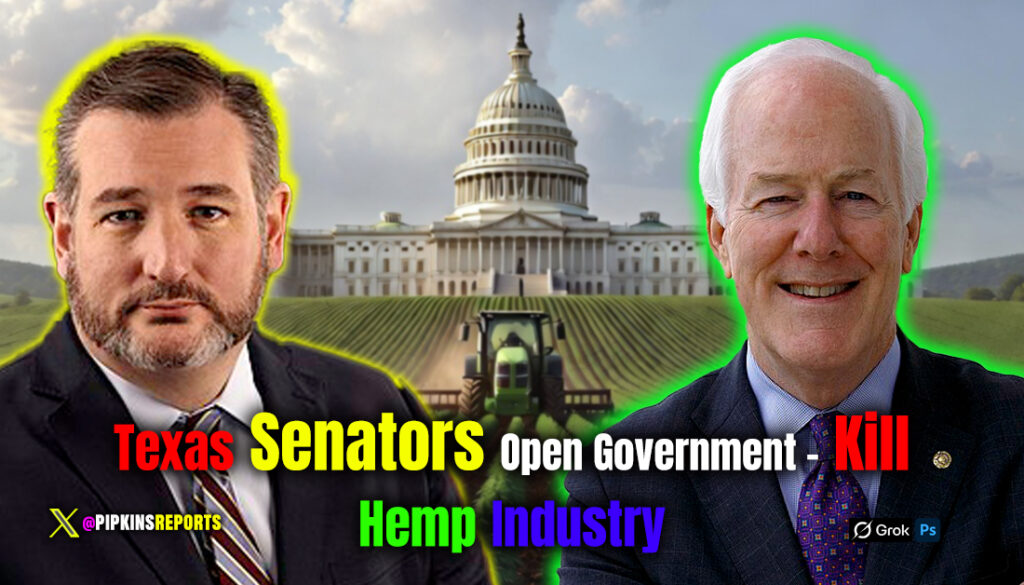
After forty-one days of furloughs, stalled paychecks, and shuttered government offices, the U.S. Senate late Monday finally passed H.R. 5371, the Continuing Appropriations and Extensions Act, 2026, ending the longest government shutdown since 2018. But hidden deep inside the stopgap spending bill that reopens Washington lies a provision that may devastate one of America’s fastest-growing agricultural and manufacturing industries—the hemp market.
What was meant to keep the lights on in D.C. may soon snuff out the livelihoods of hundreds of thousands of farmers, processors, and small business owners across the country.
A Hidden Sting in a Lifeline Bill
The Senate approved the measure by a 60-40 vote just before midnight on November 10, ensuring that federal agencies would receive temporary funding through January 30, 2026. On paper, the legislation restores pay to federal workers, secures funding for food assistance programs, and prevents further disruptions to air travel and the military.
But tucked among those spending provisions is language that rewrites federal hemp law—with implications few Americans realize. The so-called “hemp loophole,” which since 2018 has allowed hemp-derived THC products such as delta-8 and delta-10 to be sold legally in most states, has now been effectively closed.
Under H.R. 5371, any consumable product exceeding 0.4 milligrams of total THC per serving, a threshold so low that it disqualifies nearly every existing hemp-derived THC product, will be banned nationwide. The restriction applies to edibles, beverages, tinctures, vapes, and even topicals marketed for personal or household use. Only non-intoxicating CBD and industrial hemp for fiber or seed will remain exempt.
“This Isn’t Regulation—It’s Eradication”
Within hours of passage, hemp producers across the country flooded social media with outrage. Jim Higdon, co-founder of Cornbread Hemp, called the bill “a declaration of war against an entire American industry.” Farmers in Kentucky, Tennessee, Texas, and North Carolina—many of whom had transitioned from tobacco or cotton to hemp after the 2018 Farm Bill—now face the prospect of bankruptcy.
“This isn’t regulation,” said one Texas grower, J. L., who runs a small hemp processing facility near Waco. “It’s eradication. The federal government just made my business illegal overnight.”
Industry analysts estimate the decision could wipe out more than $10 billion in annual economic activity and eliminate up to 400,000 jobs, many of them in rural communities that have few other viable cash crops… all for nothing more than a two and a half month continuing resolution. Poof. It’s all gone.
A Battle Between the Bluegrass and the Beltway
Ironically, the most heated debate came not from Democrats but from within the Republican Party. Senator Rand Paul (R-KY) staged a procedural delay to block the bill, warning that the hemp provision would “obliterate” Kentucky’s hemp farmers—many of whom had relied on federal assurances since 2018 that hemp was a lawful, profitable crop.
But Paul’s effort failed. His amendment to strike the ban was tabled 76–24 after intense lobbying from Senate leadership, including Mitch McConnell, the same Kentucky senator who had shepherded hemp legalization into the 2018 Farm Bill.
McConnell, once hailed as the industry’s patron, has since become one of its fiercest critics. He now argues that the “unintended consequences” of hemp legalization—chiefly the unregulated sale of psychoactive THC derivatives in gas stations and convenience stores—have created a public health crisis.
Paul, in floor remarks before the vote, shot back that McConnell’s about-face “betrays the very farmers he once claimed to champion.”
The Texas Angle: Cruz and Cornyn Back the Ban
Both Texas Senators, Ted Cruz and John Cornyn, voted in favor of H.R. 5371. Their “Yea” votes helped secure the 60-vote threshold needed to end the shutdown—and, in doing so, endorsed the controversial hemp restrictions which has put thousands of Texas farmers out of business.
The move stunned many Texas growers who had looked to Cruz and Cornyn as defenders of market freedom and state-level autonomy. “It’s disappointing,” said one Central Texas farmer who shifted to hemp after drought destroyed his corn crop in 2023, according to High Times Magazine. “They talk about fighting big government, but this was Washington picking winners and losers. And we just lost.”
The Political Chess Behind the Hemp Ban
Supporters of the ban, including Texas Lieutenant Governor Dan Patrick and a bipartisan coalition of 38 state attorneys general, claim the new restrictions are necessary to curb youth access to intoxicating products that have flooded the market. Patrick had previously pushed for similar restrictions in Texas under Senate Bill 3, which was vetoed by Governor Greg Abbott earlier this year.
But critics suggest corporate money and political convenience played as large a role as public safety.
Documents reviewed by industry watchdogs show major beer and spirits lobbies have quietly funneled campaign donations to lawmakers who supported the hemp restrictions. Hemp-infused seltzers and THC beverages have been eating into alcohol sales, and the new federal limit—0.4 mg per serving—essentially eliminates that competition.
“The alcohol lobby couldn’t regulate us out of existence at the state level,” said Higdon, “so they went to Washington.”
Economic Fallout Already Underway
The hemp sector, which ballooned from a niche market to a $30 billion industry in just seven years, now faces a regulatory cliff. Distributors and manufacturers that invested heavily in delta-8 and delta-10 production facilities may be forced to shutter within months.
“We’ll lose 70% of our revenue,” said C. M., owner of a hemp beverage company in Austin. “We employ local people. We pay taxes. Now Washington has lumped us in with drug cartels.”
Even as markets reel, state officials warn of ripple effects far beyond small business closures. Texas Agriculture Commissioner Sid Miller, who has supported hemp as a diversification crop, said in a statement that “federal overreach like this punishes responsible farmers and rewards black markets.”
The ban’s 90-day implementation window gives agencies until February 2026 to issue enforcement rules. The FDA and DEA will jointly determine which cannabinoids are deemed “naturally occurring” and which are prohibited. Businesses caught in the gray area could face criminal penalties for noncompliance.
Political Consequences on the Horizon
Strategists are already warning that the move could alienate younger and libertarian-leaning voters ahead of the 2026 midterms. A Gallup poll from November 2025 found that only 40% of Republicans still support marijuana legalization, but nearly 70% of voters under 40 favor looser restrictions on cannabis and hemp.
“The GOP just handed the Democrats a culture-war gift,” one Republican campaign consultant said privately. “You can’t preach free markets and then destroy an entire industry because a beer company made a few phone calls.”
Still, the political establishment appears unmoved. President Trump has not publicly commented on the hemp ban but is expected to sign H.R. 5371 into law, given his administration’s emphasis on “law and order” and curbing intoxicating products.
The Road Ahead
The House is expected to approve the bill swiftly, eager to claim credit for ending the shutdown before Thanksgiving. Once signed, the hemp restrictions will take effect within three months, leaving the industry little time to adjust.
In Kentucky, Texas, and dozens of other states, warehouses filled with unsold hemp beverages and gummies may soon become evidence in federal enforcement actions.
What began in 2018 as a bipartisan success story—an effort to revive rural economies and replace illicit markets with legitimate commerce—has ended in yet another cautionary tale of Washington politics.
The Senate’s passage of H.R. 5371 may reopen the government, but in doing so, lawmakers—including both Texas senators—have closed the door on a generation of American entrepreneurs who staked their livelihoods on the promises of deregulation and innovation.
For them, the lights in Washington may be back on—but the future of the Republican Party just went dark.