Google’s Confession Exposes Biden’s Authoritarian Censorship

This is what Fascism actually looks like
Alphabet Inc., the parent company of Google and YouTube, submitted a letter on September 23, 2025, to the U.S. House Judiciary Committee in response to a subpoena. The letter, authored by attorney Daniel F. Donovan of King & Spalding, details communications between the company and the Biden administration regarding content moderation on YouTube.
The letter states that senior Biden administration officials, including White House staff, conducted “repeated and sustained outreach” to Alphabet about user-generated content related to the COVID-19 pandemic that did not violate YouTube’s policies. The letter describes this outreach as creating a “political atmosphere that sought to influence the actions of platforms based on their concerns regarding misinformation.“
The letter also addresses content related to the 2020 election, noting that YouTube had terminated over 8,000 channels by December 2020 for election-related violations. Thus, the terminations may be seen as a direct attempt to interfere with the election. It further indicates that the company’s policies during this period relied on input from Biden administration health authorities and those policies were maintained through 2024, until the Trump administration returned to office. Alphabet states in the letter that such government attempts to dictate content moderation are “unacceptable and wrong“, but they stop short of admitting to their own culpability.
Actions Taken by YouTube
According to the letter, YouTube removed videos and banned accounts for content on topics including vaccine efficacy, mask mandates, the lab-leak hypothesis, and election fraud claims. Among thousands affected were prominent individuals such as Dan Bongino, Sebastian Gorka, and Steve Bannon, whose accounts were permanently banned for COVID-19 or election-related content. The letter estimates that thousands of accounts were impacted overall. Others say that the number is more likely “tens of thousands”.
Policy Changes Announced
Alphabet announced in the letter that YouTube will offer reinstatement opportunities to all creators previously banned for “political speech violations” related to COVID-19 and the 2020 election. The platform will no longer use third-party fact-checkers to take actions or apply labels to content. The company also expressed concerns about the European Union’s Digital Services Act and Digital Markets Act, stating it will remain vigilant regarding obligations that could affect content moderation.
There was no mention of any sort of compensation or reparations for those affected.
This disclosure follows similar admissions from Meta in 2024, where the company ended its third-party fact-checking program after revealing pressure from the Biden administration. The House Judiciary Committee, chaired by Rep. Jim Jordan (R-OH), described Alphabet’s response as a step in its ongoing investigation into content moderation practices.
Alphabet’s letter aligns with earlier document releases from X (formerly Twitter), known as the “Twitter Files,” which detailed interactions between the platform and the Biden administration on content moderation. Initiated in December 2022 by then-new owner Elon Musk, the Twitter Files consisted of internal documents shared with journalists, revealing government pressure on Twitter to moderate content related to COVID-19, the 2020 election, and other topics.
Key installments include:
- December 2022 (Part 10, by David Zweig): Documents showed that both the Trump and Biden administrations pressured Twitter to moderate COVID-19 content, including elevating certain information and suppressing others, such as vaccine skepticism. The Biden White House requested meetings shortly after inauguration, focused on “COVID misinformation,” targeting high-profile accounts.
- Other Installments (2022): Files revealed Twitter’s handling of the Hunter Biden laptop story, including requests from the 2020 Biden campaign to flag or remove tweets. They also documented FBI and White House communications urging moderation of election-related content, with Twitter granting requests from both the Trump White House and Biden campaign to remove posts in 2020.
These releases contributed to broader investigations, including the House Judiciary Committee’s 2024 interim report “The Censorship-Industrial Complex,” which cited Twitter Files evidence alongside emails from the Biden White House to platforms like Twitter, showing coordinated efforts to censor content on COVID-19 and elections.
Connection to Prior Legal Proceedings
The letter aligns with findings from the 2022 lawsuit Missouri v. Biden (later Murthy v. Missouri), filed by the attorneys general of Missouri and Louisiana. The suit alleged that Biden administration officials coerced social media platforms, including YouTube and Twitter, to suppress content on COVID-19, elections, and other topics. In July 2023, U.S. District Judge Terry Doughty issued a preliminary injunction blocking certain government communications with platforms, describing the actions as an “Orwellian ‘Ministry of Truth.‘”
The U.S. Court of Appeals for the 5th Circuit partially upheld the injunction in September 2023, ruling that officials from the White House, Surgeon General’s office, CDC, and FBI likely violated the First Amendment through coercion or significant encouragement of content moderation.
The Supreme Court vacated the injunction in June 2024 in a 6-3 decision, ruling that the plaintiffs lacked standing to sue. The majority opinion, written by Justice Amy Coney Barrett, held that the plaintiffs failed to show a direct causal link between government actions and their content moderation experiences. Justice Samuel Alito dissented, arguing that the case demonstrated a “successful campaign of coercion” that posed risks to free speech.
Potential Legal Recourse for Affected Individuals
Individuals and entities whose content was removed or accounts banned, such as Bongino, Gorka, Bannon, and thousands of others, may have grounds to pursue legal action against individuals in the Biden administration and Alphabet for alleged violations of First Amendment rights. Potential lawsuits could seek damages for lost revenue, reputational harm, and suppression of protected speech, alleging that government pressure led to unconstitutional collusion (fascism) with private platforms. Similar claims have been filed in cases like Justin Hart’s 2023 lawsuit against Twitter, Facebook, and Biden officials, citing Twitter Files evidence of collusion.
The full text of Alphabet’s letter is available on the House Judiciary Committee’s website. For further developments, visit PipkinsReports.com.




FATE, TX – A document containing unproven allegations, some of which could raise defamation concerns if false, and stamped with a warning against distribution, is now at the center of a growing political storm in Fate, Texas, after a student’s testimony revealed it was nonetheless handed out at a public recall event targeting the mayor.
At the March 23, 2026 Fate City Council meeting, Gus Richardson, a local debate student, stepped forward during public comment and described attending a petition signing event tied to the ongoing recall effort against Mayor Andrew Greenberg, Councilman Mark Hatley, Councilman Rick Maneval, and Councilwoman Martha Huffman.
According to Richardson’s testimony, he was provided a document outlining reasons for removing the mayor by individuals he identified as being involved in the recall effort.
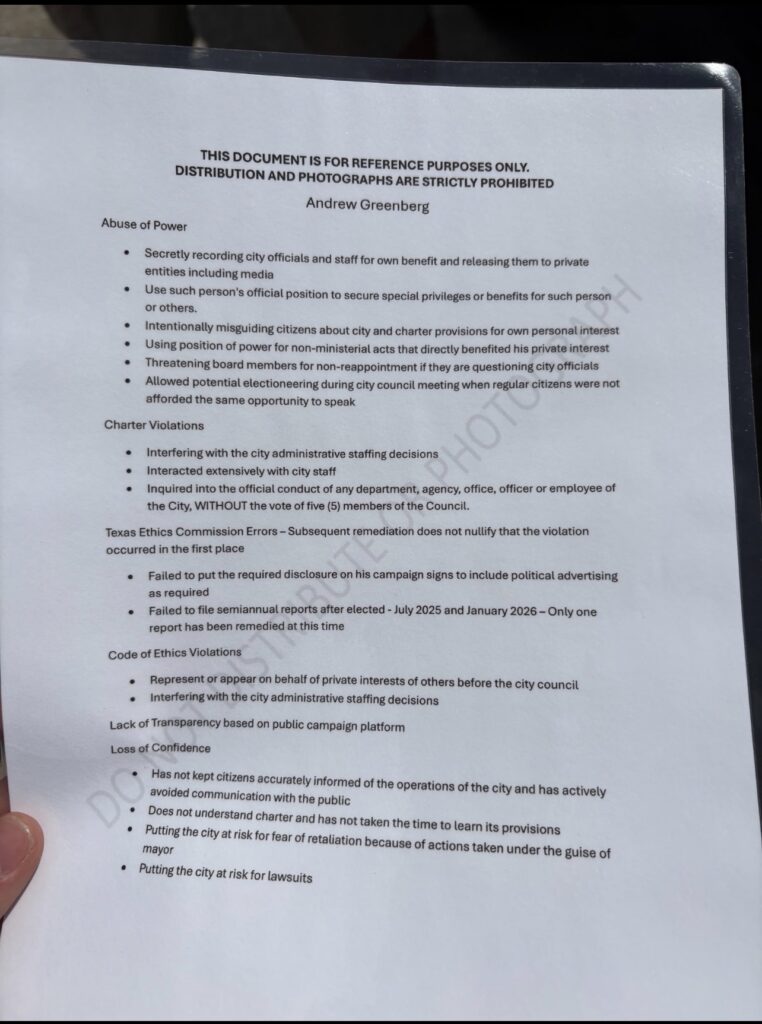
The document was marked with a warning that read: “This document is for reference purposes only. Distribution and photographs are strictly prohibited.” Despite the printed warning, Richardson proceeded to photograph the document, and the organizer then removed the document from his hands, Richardson stated.
[Video of presentation of Gus Richardson to Fate City Council]
That contradiction, a document marked for secrecy but distributed in a public setting as reasons for the removal of an elected Mayor, quickly became the focal point of Richardson’s remarks. While Richardson questioned the validity of some of the allegations made in the document, his primary focus was on the process and transparency behind their circulation.
Pipkins Reports has obtained a copy of the document and presents it here as part of this report. We note that notices of, “DISTRIBUTION AND PHOTOGRAPHS ARE STRICTLY PROHIBITED”, generally do not carry clear legal enforceability in a public setting.
Notably, one of the document’s central allegations involves the recording of city officials, and it is a matter of public record that Mayor Greenberg did record at least one phone call with Councilwoman Codi Chinn, a recording later released by Pipkins Reports, though the motivations and context surrounding that call remain disputed.
The document itself is structured as a list of allegations under several headings, including “Abuse of Power,” “Charter Violations,” “Texas Ethics Commission Errors,” and “Code of Ethics Violations.” It presents the claims in declarative language, offering no citations, supporting documentation, or sourcing within the text.
Under “Abuse of Power,” the document asserts that Mayor Greenberg secretly recorded city officials and staff for personal benefit, used his position to secure special privileges, and intentionally misled citizens about city governance and charter provisions. It further claims he used his authority for actions benefiting his private interests and threatened board members with removal if they questioned city officials.
Another claim alleges that the mayor allowed what the document describes as “potential electioneering” during a city council meeting, suggesting unequal treatment between certain speakers and regular citizens. Additional points accuse him of interfering in administrative staffing decisions and engaging with city staff without the required council authorization.
The section labeled “Texas Ethics Commission Errors” raises campaign-related concerns, including an allegation that required political advertising disclosures were omitted from campaign signs and that semiannual campaign finance reports were not filed on time in July 2025 and January 2026. It further states that only one of those reports has been remedied, though no official findings from the Texas Ethics Commission are cited in the document itself.
Other portions of the document claim violations of the city’s code of ethics, including representing private interests before the council, and paint a broader picture of what is described as a “lack of transparency.” The final section, labeled “Loss of Confidence,” includes assertions that the mayor has failed to keep citizens informed, does not understand the city charter, and has placed the city at risk of retaliation and lawsuits.
None of the claims included in the document were accompanied by evidence within the material reviewed, and the organizers explanation to Richardson, he states, was that the document “wasn’t verified yet and was simply what they believed.” However, the language used presents the allegations as statements of fact, rather than opinion, a distinction that carries legal implications if the claims cannot be substantiated.
Richardson’s testimony only briefly touched on how be believed the printed allegations were false. Instead, he focused on what he characterized as an inconsistency, that a document warning against distribution was nonetheless handed out to members of the public at an organized event. His remarks, measured in tone, appeared aimed at prompting greater transparency from those involved in the recall effort.
The City Council did not provide a response during the meeting regarding the document or its contents. This is typical of the Public Comments section of the agenda.
Mayor Greenberg’s Comment
Pipkins Reports reached out to Mayor Greenberg for comment. Regarding the document, he stated, “It’s a list of broad accusations without real evidence or specifics, and that’s just not a fair or productive way to have a conversation. If you’re going to make claims, don’t hide behind a command not to take photos or share-if they are strong enough to try to get people upset, they should be strong enough to be share publicly and examined. If someone disagrees with my policies, that’s completely fair, but pushing baseless accusations this way is disappointing.“
Christopher Rains Comment
We also reached out to Christopher Rains, the petition organizer, who it appears was also the person to whom Richardson spoke to. He stated, “It [the conversation] is not how I remember the exchange. I was talking with two people, both combative in nature and upon recognizing that they were not in support tried to exit the exchange as quickly as possible. If I misspoke, I am not above admitting as much. I am not a politician and have no aspirations to become one, I am not afraid to say I am wrong. But, I stated and reiterated many times that I was there because I believe there were charter violations based on my understanding of the charter. He claimed that I said they broke the law, I clarified that I did not believe it was criminally illegal, but a civil violation and morally questionable.“
Ashley Rains was also respectful to our request for comment and provided the following statement: “I was not surprised to see Gus Richardson, or his mother, at the City Council meeting Monday evening. If anything, I was proud and impressed to see Gus in attendance and participating. Proud because I firmly believe it’s imperative that our younger generations become interested and involved in the future of our government, at all levels. Our current political climate may not be where it is today if that had been the case sooner.
I was simultaneously impressed by his willingness to speak publicly on such a controversial topic. Not many young people have the wherewithal or courage to do so. I applaud him for that.
However, I was surprised to hear my name casually mentioned, while presenting as though he was unsure who the gentleman was he speaking with.
Gus and his mother approached our table while I was engaged in conversation with another citizen. But my husband is both cordial and a business professional. He shakes your hand and introduces himself, every time, with every new person we encounter in a mutually respectful setting.
I was unable to join their conversation until the last couple of minutes of their exchange. To hear my name referenced in the speech Gus delivered Monday evening was surprising, as the premise of the delivery seemed to be geared more toward attacking my campaign rather than presenting the facts of the exchange as the truly were.
I still applaud his involvement and courage. I also recognize the true potential he has to offer our society, political or otherwise. But, truthfully, I would’ve preferred to hear the recollection of events delivered less politically and more forthright.“
As the recall effort continues to unfold, the emergence of this document and the circumstances surrounding its distribution are likely to draw increased scrutiny from both the public and those directly involved. Richardson’s testimony has added a new layer to an already contentious political environment, raising questions not only about the claims themselves, but about how information is being presented to voters in the course of the petition process.
For now, the allegations outlined in the document remain unverified, and no formal findings by relevant authorities have been publicly confirmed. As the situation develops, the focus may shift toward greater transparency from all parties involved, particularly as residents weigh the credibility of the information being circulated in connection with the recall effort.
FATE, TX – Voters in Fate may soon face a familiar name on the ballot, but beneath the surface of Allen Robbins’ political comeback lies a record that could reshape how residents view his return. As the May 2026 city council election approaches, Robbins, a former Fate councilman, is seeking another term, bringing with him a documented voting history that raises pointed questions about taxes, fees, and development decisions that directly affected residents’ wallets and the city’s character.
Public records from the City of Fate show that during his previous tenure, Robbins not only introduced a series of consequential motions, but in each instance, those motions ultimately passed the council. The result was a slate of enacted policies that increased costs and advanced higher-density development, leaving a clear legislative footprint for voters to evaluate.
Below are seven key actions tied to Robbins’ record that voters may weigh as they consider his candidacy.
1. Ratifying a Property Tax Increase
Robbins made the motion to approve Ordinance No. 0-2023-036, ratifying a property tax increase embedded in the adopted budget for fiscal year 2023–2024. The motion passed, formally locking in the increased tax burden tied to that budget cycle.
2. Supporting a 5.96 Percent Tax Rate Increase
Robbins also made the motion to adopt Ordinance No. 0-2023-037, setting the property tax rate at $0.26421, an effective increase of approximately 5.96 percent. The council approved the measure, resulting in a higher rate applied to property owners across the city.
3. Approving Increased Solid Waste Fees
Through Ordinance No. O-2023-038, Robbins moved to approve updated rates for solid waste and refuse collection services. The motion passed, leading to increased service charges for residents.
4. Road Fee Adoption
Although introduced by another council member, Robbins voted to approve Ordinance No. 0-2023-039, establishing a $3 road fee for both single-family and multi-family residential units. The measure adds a recurring fee impacting nearly all households.
5. Zoning Change with Financial Penalties
Robbins made the motion to approve Ordinance No. O-2023-021, which amended zoning classifications on approximately 3.18 acres from Mixed Use to Mixed Use Transition for a Townhouse Development.
6. Approval of a 179-Unit Townhome Development
Through Resolution No. R-2023-055, Robbins moved to approve a Type III development plan for a 179-unit townhome project on approximately 13.9 acres. The council approved the motion, clearing the way for the higher-density development to proceed.
7. Advancing a Maximum Tax Rate Above Key Thresholds
Robbins also made the motion to approve Resolution No. R-2023-058, setting a maximum tax rate that exceeded both the no-new-revenue rate and the voter-approval rate, within the de minimis threshold allowed under Texas law. The motion passed, advancing the process for adopting the higher rate and triggering required public notices and hearings.
Context and Verification
Each of these actions is documented in official City of Fate council records from 2023. Motions made by a council member are a critical procedural step in municipal governance, and in these cases, each motion successfully resulted in council approval, meaning the policies were not merely proposed, but enacted.
Municipal leaders often justify such decisions as necessary responses to growth, infrastructure demands, and service costs. Fate, like many North Texas communities, has experienced rapid expansion, increasing pressure on roads, utilities, and public services.
The Stakes in 2026
As Robbins seeks a return to office in May 2026, voters are presented with a clear and verifiable record of policy actions that translated into tangible outcomes, higher taxes, new fees, and expanded development density.
Whether those outcomes are viewed as responsible governance or excessive government expansion will likely shape the election.
Opinion: A Pattern, Not an Accident
Seven motions. Seven approvals. One consistent direction.
That pattern is difficult to dismiss as coincidence. Robbins’ record reflects a governing philosophy that leans toward increasing revenue through taxation and fees while accommodating denser residential growth.
Supporters may argue these were necessary decisions in a growing city. That is a fair argument. Growth requires infrastructure, and infrastructure costs money.
But voters should also ask whether every increase was necessary, whether alternatives were explored, and whether the cumulative impact on residents was fully considered.
Because while each individual vote might be explained away, together they tell a broader story, one of a councilman comfortable with expanding both the cost and scope of local government.
In a community like Fate, where many families moved seeking affordability and space, that story carries weight.
And in May 2026, voters will decide whether it carries enough weight to keep Allen Robbins out of office, or return him to it.
TEXAS, 15th Congressional District – A South Texas congressional race, veered into the realm of bizarro when a decades-old video clip resurfaced, casting a blanket over a newly minted Democratic nominee. What should have been a straightforward primary victory became a flashpoint, as a Republican incumbent Monica De La Cruz amplified a controversial video clip of her Democratic opponent, Bobby Pulido.
Tejano singer Bobby Pulido, a well-known figure in Texas music circles, secured the Democratic nomination earlier this month in Texas’ 15th Congressional District, according to results reported by the Texas Secretary of State and coverage from regional outlets including The Texas Tribune. Pulido, who has built a career as a performer with a loyal following across South Texas, entered politics as part of a broader Democratic effort to reclaim the historically competitive district.
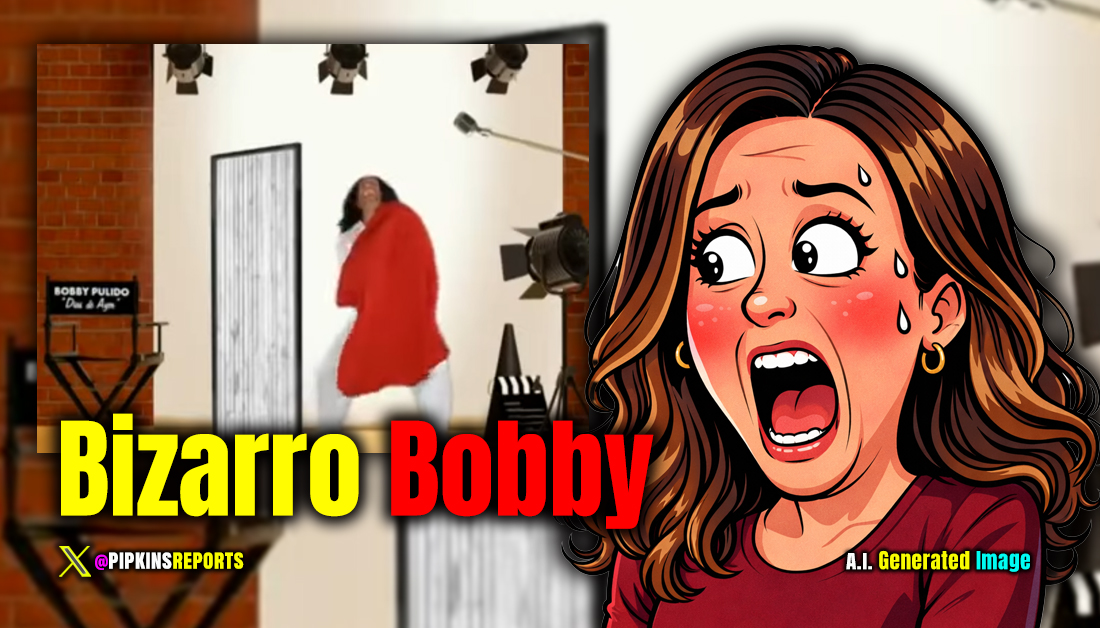
His opponent in the general election, Republican Rep. Monica De La Cruz, wasted little time drawing contrasts. Within days of the primary result, De La Cruz reposted a video clip circulating online that appears to show Pulido under a blanket, making suggestive movements that some viewers interpreted as simulating a “sexual act”. The video’s origin is not entirely clear, though it has been described in online discussions as footage from earlier in Pulido’s entertainment career.
De La Cruz’s campaign did not produce the video, but her decision to repost it on social media drew immediate attention. According to archived posts and reporting from local political blogs, the video had already been circulating among political activists before it reached a broader audience through the congresswoman’s platform.
Pulido has not denied that the video depicts him, but allies have characterized the clip as an out-of-context moment from a performance or comedic setting, arguing that it is being weaponized for political gain. As of this writing, Pulido’s campaign has not issued a detailed public statement addressing the specifics of the video, though supporters have pushed back on what they describe as a “smear tactic.”
The 15th Congressional District, which stretches from the Rio Grande Valley northward toward Seguin, has become a political battleground in recent cycles. De La Cruz flipped the seat for Republicans in 2022, defeating Democratic incumbent Vicente Gonzalez after redistricting reshaped the district’s partisan balance. National observers, including Cook Political Report and Sabato’s Crystal Ball, have since rated the district as competitive, making it a target for both parties.
Pulido’s candidacy reflects a Democratic strategy aimed at leveraging cultural recognition and regional identity. As a Tejano artist, he carries name recognition that traditional political candidates often lack, particularly among Hispanic voters who form a majority in the district. His campaign messaging has emphasized economic opportunity, healthcare access, and immigration reform, themes consistent with broader Democratic priorities.
De La Cruz, for her part, has leaned into a law-and-order message and economic conservatism, aligning closely with House Republican leadership. Her campaign website highlights border security, energy independence, and opposition to what she describes as “Washington overreach.”
The resurfaced video has complicated what might otherwise have been a conventional contrast between policy agendas. Political analysts note that such controversies can have unpredictable effects, particularly in districts where personal image and cultural familiarity carry weight.
“Voters often say they want substance, but moments like this can dominate the narrative,” one South Texas political consultant told The Monitor. “The question is whether it sticks, or whether it backfires.”
There is also the matter of tone. While negative campaigning is hardly new, the use of suggestive or potentially embarrassing footage raises questions about where campaigns draw the line. The Federal Election Commission does not regulate the content of political speech in this context, leaving such decisions largely to candidates and, ultimately, voters.
You must be logged in to post a comment Login