
Connect with us

Published

on

FATE, TX – A document containing unproven allegations, some of which could raise defamation concerns if false, and stamped with a warning against distribution, is now at the center of a growing political storm in Fate, Texas, after a student’s testimony revealed it was nonetheless handed out at a public recall event targeting the mayor.

At the March 23, 2026 Fate City Council meeting, Gus Richardson, a local debate student, stepped forward during public comment and described attending a petition signing event tied to the ongoing recall effort against Mayor Andrew Greenberg, Councilman Mark Hatley, Councilman Rick Maneval, and Councilwoman Martha Huffman.

According to Richardson’s testimony, he was provided a document outlining reasons for removing the mayor by individuals he identified as being involved in the recall effort.

The document was marked with a warning that read: “This document is for reference purposes only. Distribution and photographs are strictly prohibited.” Despite the printed warning, Richardson proceeded to photograph the document, and the organizer then removed the document from his hands, Richardson stated.

[Video of presentation of Gus Richardson to Fate City Council]
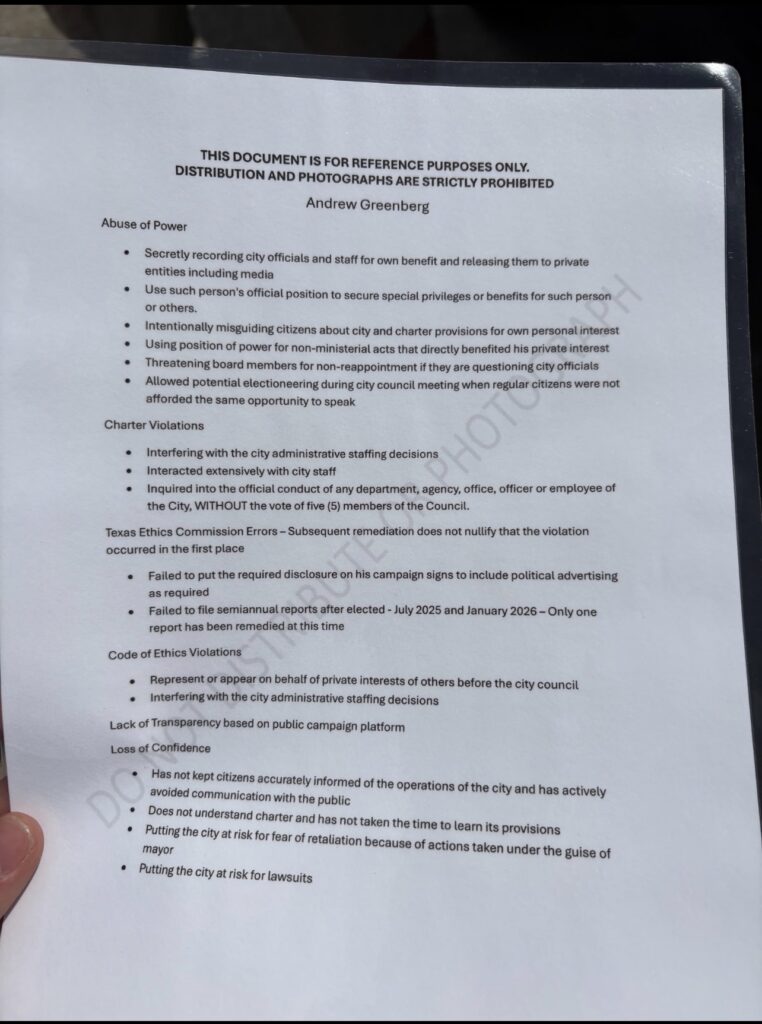
[Image of document taken by Gus Richardson.]

That contradiction, a document marked for secrecy but distributed in a public setting as reasons for the removal of an elected Mayor, quickly became the focal point of Richardson’s remarks. While Richardson questioned the validity of some of the allegations made in the document, his primary focus was on the process and transparency behind their circulation.

Pipkins Reports has obtained a copy of the document and presents it here as part of this report. We note that notices of, “DISTRIBUTION AND PHOTOGRAPHS ARE STRICTLY PROHIBITED”, generally do not carry clear legal enforceability in a public setting.

Notably, one of the document’s central allegations involves the recording of city officials, and it is a matter of public record that Mayor Greenberg did record at least one phone call with Councilwoman Codi Chinn, a recording later released by Pipkins Reports, though the motivations and context surrounding that call remain disputed.

The document itself is structured as a list of allegations under several headings, including “Abuse of Power,” “Charter Violations,” “Texas Ethics Commission Errors,” and “Code of Ethics Violations.” It presents the claims in declarative language, offering no citations, supporting documentation, or sourcing within the text.

Under “Abuse of Power,” the document asserts that Mayor Greenberg secretly recorded city officials and staff for personal benefit, used his position to secure special privileges, and intentionally misled citizens about city governance and charter provisions. It further claims he used his authority for actions benefiting his private interests and threatened board members with removal if they questioned city officials.

Another claim alleges that the mayor allowed what the document describes as “potential electioneering” during a city council meeting, suggesting unequal treatment between certain speakers and regular citizens. Additional points accuse him of interfering in administrative staffing decisions and engaging with city staff without the required council authorization.

The section labeled “Texas Ethics Commission Errors” raises campaign-related concerns, including an allegation that required political advertising disclosures were omitted from campaign signs and that semiannual campaign finance reports were not filed on time in July 2025 and January 2026. It further states that only one of those reports has been remedied, though no official findings from the Texas Ethics Commission are cited in the document itself.

Other portions of the document claim violations of the city’s code of ethics, including representing private interests before the council, and paint a broader picture of what is described as a “lack of transparency.” The final section, labeled “Loss of Confidence,” includes assertions that the mayor has failed to keep citizens informed, does not understand the city charter, and has placed the city at risk of retaliation and lawsuits.

None of the claims included in the document were accompanied by evidence within the material reviewed, and the organizers explanation to Richardson, he states, was that the document “wasn’t verified yet and was simply what they believed.” However, the language used presents the allegations as statements of fact, rather than opinion, a distinction that carries legal implications if the claims cannot be substantiated.

Richardson’s testimony only briefly touched on how be believed the printed allegations were false. Instead, he focused on what he characterized as an inconsistency, that a document warning against distribution was nonetheless handed out to members of the public at an organized event. His remarks, measured in tone, appeared aimed at prompting greater transparency from those involved in the recall effort.

The City Council did not provide a response during the meeting regarding the document or its contents. This is typical of the Public Comments section of the agenda.

Mayor Greenberg’s Comment

Pipkins Reports reached out to Mayor Greenberg for comment. Regarding the document, he stated, “It’s a list of broad accusations without real evidence or specifics, and that’s just not a fair or productive way to have a conversation. If you’re going to make claims, don’t hide behind a command not to take photos or share-if they are strong enough to try to get people upset, they should be strong enough to be share publicly and examined. If someone disagrees with my policies, that’s completely fair, but pushing baseless accusations this way is disappointing.

Christopher Rains Comment

We also reached out to Christopher Rains, the petition organizer, who it appears was also the person to whom Richardson spoke to. He stated, “It [the conversation] is not how I remember the exchange. I was talking with two people, both combative in nature and upon recognizing that they were not in support tried to exit the exchange as quickly as possible. If I misspoke, I am not above admitting as much. I am not a politician and have no aspirations to become one, I am not afraid to say I am wrong. But, I stated and reiterated many times that I was there because I believe there were charter violations based on my understanding of the charter. He claimed that I said they broke the law, I clarified that I did not believe it was criminally illegal, but a civil violation and morally questionable.

Ashley Rains was also respectful to our request for comment and provided the following statement: “I was not surprised to see Gus Richardson, or his mother, at the City Council meeting Monday evening. If anything, I was proud and impressed to see Gus in attendance and participating. Proud because I firmly believe it’s imperative that our younger generations become interested and involved in the future of our government, at all levels. Our current political climate may not be where it is today if that had been the case sooner.

I was simultaneously impressed by his willingness to speak publicly on such a controversial topic. Not many young people have the wherewithal or courage to do so. I applaud him for that.

However, I was surprised to hear my name casually mentioned, while presenting as though he was unsure who the gentleman was he speaking with.

Gus and his mother approached our table while I was engaged in conversation with another citizen. But my husband is both cordial and a business professional. He shakes your hand and introduces himself, every time, with every new person we encounter in a mutually respectful setting.

I was unable to join their conversation until the last couple of minutes of their exchange. To hear my name referenced in the speech Gus delivered Monday evening was surprising, as the premise of the delivery seemed to be geared more toward attacking my campaign rather than presenting the facts of the exchange as the truly were.

I still applaud his involvement and courage. I also recognize the true potential he has to offer our society, political or otherwise. But, truthfully, I would’ve preferred to hear the recollection of events delivered less politically and more forthright.


As the recall effort continues to unfold, the emergence of this document and the circumstances surrounding its distribution are likely to draw increased scrutiny from both the public and those directly involved. Richardson’s testimony has added a new layer to an already contentious political environment, raising questions not only about the claims themselves, but about how information is being presented to voters in the course of the petition process.

For now, the allegations outlined in the document remain unverified, and no formal findings by relevant authorities have been publicly confirmed. As the situation develops, the focus may shift toward greater transparency from all parties involved, particularly as residents weigh the credibility of the information being circulated in connection with the recall effort.


Michael Pipkins focuses on public integrity, governance, constitutional issues, and political developments affecting Texans. His investigative reporting covers public-record disputes, city-government controversies, campaign finance matters, and the use of public authority. Pipkins is a member of the Society of Professional Journalists (SPJ). As an SPJ member, Pipkins adheres to established principles of ethical reporting, including accuracy, fairness, source protection, and independent journalism.

Council

Ethics Fight Ends in Censure of Councilman Mark Hatley

Published

on

Ethics Censure Hatley

FATE, TX — The Fate City Council voted last night to censure Councilman Mark Hatley following a contentious ethics hearing that exposed deep divisions among elected officials.

The censure stems from two ethics complaints alleging Hatley improperly disclosed confidential information tied to internal discussions about the potential firing of former Department of Public Safety Chief Lyle Lombard. According to testimony, Hatley shared details with local journalist Michael Pipkins of PipkinsReports.com, including references to recorded conversations with City Manager Michael Kovacs.

The complaint was filed by outgoing councilman Scott Kelley, who played a central role throughout the proceedings and ultimately did not recuse himself and voted in favor of censure.

Monday’s meeting included a formal evidentiary hearing where Hatley, represented by attorney David Dodd, presented a defense and attempted to question fellow council members. The process, however, was repeatedly constrained by legal warnings from City Attorney Jennifer Richie, who advised council members not to answer questions related to Lombard’s termination due to ongoing litigation. That guidance, issued numerous times during the hearing, limited testimony and narrowed the scope of cross-examination.

The council ultimately split along familiar lines. Kelley was joined by outgoing councilman Mark Harper and recalled councilwoman Codi Chinn in supporting the censure. Mayor Andrew Greenberg and Councilman Rick Maneval opposed it, creating a 3–2 divide before the deciding vote was cast. Councilwoman Martha Huffman ultimately sided with the majority, breaking what would have otherwise been a tie, and would have quashed the censure.

Under Texas municipal norms, a censure is a formal statement of disapproval by a governing body against one of its own members. It carries no direct legal penalty, meaning Hatley retains his elected position and voting authority. However, such a reprimand can damage political standing, limit influence within the council, and shape future electoral prospects…if the electorate so decides.

The underlying controversy traces back to the dismissal of Lombard, which has since evolved into a broader legal dispute involving claims of wrongful termination. During Monday’s hearing, repeated references to that litigation underscored the complexity of the case and the limits placed on public disclosure. Richie’s guidance, aimed at protecting the city’s legal position, effectively curtailed testimony that might have clarified key details. Critics argue this dynamic left Hatley unable to fully defend himself against the allegations.

The political context surrounding the vote is difficult to ignore. This was Chinn’s last meeting, as she was recalled from office by the voters, in part due to her involvement in the Lombard matter. Kelley, who initiated the ethics complaint, participated fully in the decision-making process knowing that this was his last meeting. Harper has also been linked in prior discussions about leadership conflicts within city administration, and for he as well, this was his last meeting. Meanwhile, all three have supported recall efforts targeting Hatley, Greenberg, Maneval, and Huffman, for additional recall, along with two new councilmen who will take their seats at the next meeting.

From a procedural standpoint, the meeting reflected a council operating under significant strain. Testimony was fragmented, legal cautions were frequent, and the final vote appeared to follow established political alliances rather than shifting based on evidence presented during the hearing. Even Hatley’s legal representation struggled to gain traction within the constraints imposed by the city’s legal posture.

Opinion

The battle for power in Fate is very real. What unfolded Monday night was not merely an ethics hearing; it was the visible culmination of an ongoing political battle inside Fate’s leadership. When a complainant votes on his own accusation; when key witnesses are effectively shielded from cross examination; when you have councilmen under recall by the very people bringing charges against their opponents; the process begins to look less like a search for truth and more like a managed outcome. It’s cut-throat politics at its worst.

What’s changed due to this Hearing? Essentially, nothing. Hatley gets a political black eye, but that’s about it. The sides were already defined, and the votes exactly as expected. Councilmen whose terms were ending anyway are now gone after delivering one last poke in the eye to their opponents. And the City Manager, who is at the heart of this debacle because of his employee decisions, and his inability to stand up to influence from Council Members… is still employed.

For residents of Fate, the final result is an up-close view into how dirty local politics can get. It diminishes the desirability of the city to new residents, hurts economic growth, and the entire process gives citizens the perspective that their city government is completely dysfunctional.

Disclosure

The author of this article was referenced during the hearing as a recipient of information discussed in the ethics complaints. The reporting above is based on observations of the public meeting and review of the proceedings.

Continue Reading

Election

Fate Voters Go Familiar: Robbins Edges McCarthy in Tight Place 3 Race

Published

on

Robbins wins race against McCarthy

FATE, TX — Allen Robbins defeated newcomer Melinda McCarthy for Place 3 on the Fate City Council in the May 2, 2026 election, signaling that a slim majority of voters preferred experience over change.

The seat, previously held by Scott Kelley, was open after Kelley declined to seek reelection, setting up a direct contest between Robbins’ prior service and McCarthy’s outsider campaign.

Unofficial results show Robbins winning with 52.22% of the vote, 883 votes, to McCarthy’s 47.78%, 808 votes, out of 1,691 ballots cast. The margin reflects a divided electorate, with nearly half backing a first-time candidate.

Robbins campaigned on experience, but his record on the council became a central issue. Public records show he supported a roughly 5.96 percent property tax rate increase, higher solid waste fees, and a $3 monthly road fee applied broadly to residents.

He also backed zoning changes and approved a 179-unit townhome development, decisions that critics argue contributed to rapid growth and increased density. Some residents have tied those policies to worsening traffic and a perceived decline in quality of life in Fate.

McCarthy’s campaign focused on transparency, responsiveness, and reevaluating growth decisions. Her message resonated with a significant share of voters but fell short against Robbins’ name recognition and governing background.

The results remain subject to canvassing, but Robbins is expected to return to the council as debates over growth, taxation, and infrastructure continue.

Analysis and Commentary

This race underscores a familiar tension in local politics. Voters often voice frustration with growth and rising costs, yet still choose candidates they believe understand the system.

Robbins’ win suggests that, for now, experience outweighs dissatisfaction. But the narrow margin tells a different story beneath the surface.

Nearly half the electorate signaled a desire for change, and those concerns are unlikely to fade. If anything, they will follow Robbins back into office, where the consequences of past decisions, and future ones, will be closely watched.

Continue Reading

Election

Knockout! Rains Beats Grove for Fate City Council – Place 2

Published

on

Rains Beats Grove. Knockout!

FATE, TX — In a decisive and unexpected outcome, Ashley Rains defeated Lorna Grove for Fate City Council Place 2, delivering a clear upset against a candidate backed by a unified slate of local Republican leadership.

Unofficial results from May 2 show Rains winning with 56.38% of the vote (945 votes) to Grove’s 43.62% (731 votes). The margin, more than 200 votes, signals a strong voter preference that defied expectations heading into election night.

The seat opened after Councilman Mark Harper declined to seek reelection, setting up a race that quickly became a referendum on the direction of city leadership.

Establishment Support Falls Short

Grove entered the race with significant political backing, including endorsements from State Senator Bob Hall, Jace Yarbrough, John Stacy, Dennis London, and Darcy Gildon. Fate Mayor Andrew Greenberg and every Republican precinct chair in Rockwall County also supported her candidacy, forming a rare, consolidated front in a local race.

Despite that support, voters broke the other direction.

Rains positioned herself as a grassroots alternative, emphasizing accountability and independence from what some voters viewed as coordinated political influence. The result suggests that message resonated more strongly than institutional endorsements.

Recall Effort Played a Key Role

A secondary, but important, factor in the race was Rains’ leadership role in the ongoing recall effort targeting three council members and the mayor. The effort will likely be placed on the November election ballot, giving Rains elevated visibility and an engaged base of supporters.

While she did not run solely on the recall, her involvement helped frame her candidacy as part of a broader push for change at City Hall. That connection likely contributed to turnout among voters already invested in the issue.

What It Means Going Forward

Rains’ victory may serve as an early indicator of voter sentiment ahead of the November recall election, though the two contests are not perfectly aligned.

With 1,676 total votes cast, turnout was solid for a municipal race, and the nearly 13-point margin suggests a clear mandate—at least in this contest.

The results remain unofficial pending canvassing, but the outcome is unlikely to change.

For now, the takeaway is straightforward: Fate voters rejected a unified political slate and elevated a candidate tied to grassroots activism, signaling a shift in the city’s political landscape with more tests to come this fall.

Continue Reading