Connect with us

Published

on


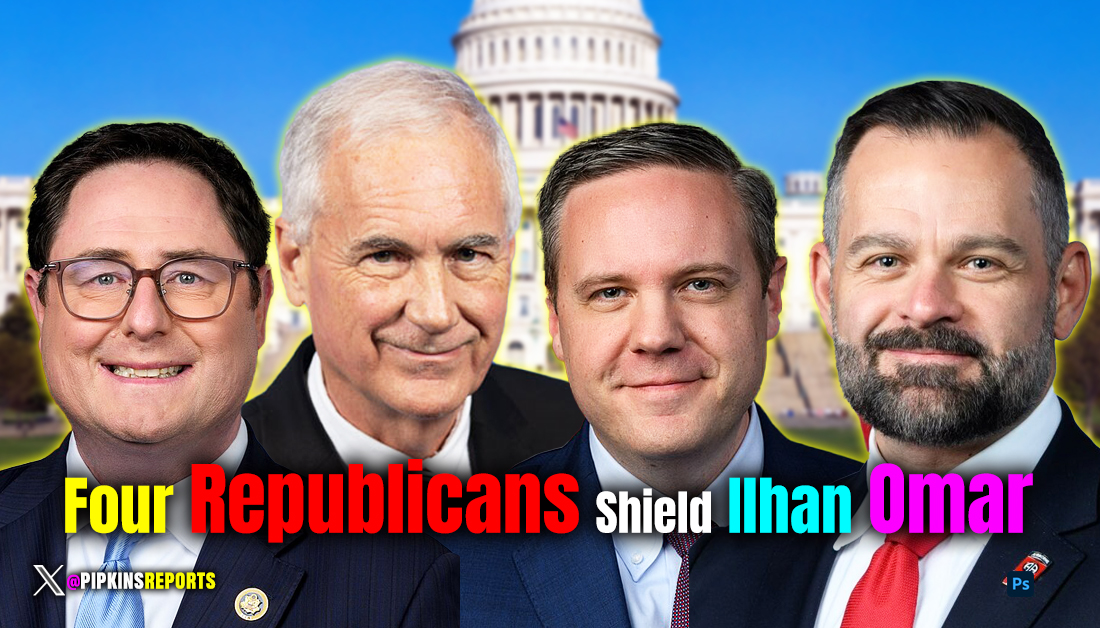
Four Republicans—Mike Flood of Nebraska, Jeff Hurd of Colorado, Cory Mills of Florida, and Tom McClintock of California—cast votes on September 17, 2025, to shield Rep. Ilhan Omar, of Minnesota, from facing any consequences for her vile reposts mocking the assassination of conservative icon Charlie Kirk.

This 214-213 House vote to table Rep. Nancy Mace’s censure resolution isn’t just a political misstep; it’s a gut punch to the very principles of constitutional conservatism that have long anchored the Republican Party. Let’s unpack this betrayal, piece by perplexing piece, and ask: What in the world were these lawmakers thinking?

First, let’s set the stage. Charlie Kirk, founder of Turning Point USA and a tireless defender of American values, was gunned down on September 10, 2025, by a deranged transgender activist at Utah Valley University. The nation reeled, and rightfully so. Yet, in the aftermath, Omar—never one to miss a chance to stoke division—reposted content labeling Kirk a “stochastic terrorist,” a term dripping with justification for the violence that ended his life.

Rep. Mace, a fierce patriot, introduced a resolution to censure Omar and strip her of her committee assignments, a move rooted in the House’s constitutional authority to discipline its members (Article I, Section 5). It should have been a slam dunk. Instead, four GOP turncoats joined Democrats to protect this radical, fracturing party unity and spitting on the graves of those who’ve fought for free speech without incitement.

Take Mike Flood, Nebraska’s supposed conservative stalwart. This former Speaker of the Nebraska Legislature has built a career on rural values and limited government—until now. His vote to shield Omar suggests either a stunning lapse in judgment or a craven bow to some unseen pressure. Flood’s district, reliant on agriculture, deserves a representative who stands firm against those who glorify violence, not one who coddles a congresswoman with ties to radical ideologies.

The backlash is already brewing—X users like McCall Calhoun (@the_J6_Lawyer) are calling for his ouster in the primaries. Good luck, indeed.

Then there’s Jeff Hurd, the freshman from Colorado’s 3rd District, who rode into Congress on a wave of rural healthcare promises. Hurd’s vote reeks of naiveté or worse—perhaps a misguided nod to “free speech” that ignores the Constitution’s clear allowance for Congress to police its own. His district, with its Medicaid-dependent population, might tolerate this if he spins it as compassion, but constitutional conservatives know better: protecting Omar’s seat undermines the rule of law.

Cory Mills, Florida’s Bronze Star veteran, is perhaps the most confounding of the bunch. A Trump ally with a record of pushing border security and anti-China legislation, Mills’ vote against censure is a head-scratcher. His district, once a GOP stronghold, now questions his loyalty—Rick Waite (@RJWaite) branded him a “disgrace.”

Is this a tactical pivot to moderates, or did his military background lead him to avoid escalating tensions post-Kirk? Whatever the reason, it’s a betrayal of the constitutional principle that elected officials must face accountability, not a free pass to incite violence.

Finally, Tom McClintock, California’s libertarian-leaning veteran, offers a twist. Known for ditching the House Freedom Caucus in 2015 over strategy, his vote aligns with his free-speech absolutism—evidenced by his own statement defending Omar’s First Amendment rights. But this is where the perplexity peaks: Does McClintock not see that Omar’s rhetoric crossed into incitement, a line the Supreme Court has long recognized (e.g., Brandenburg v. Ohio, 1969)? His deregulatory zeal doesn’t excuse shielding a lawmaker who mocks a murdered American husband and father. The “RINO” cries on X Baxter Allen (@baxterallen2) are harsh but not unwarranted.

This vote isn’t just a procedural hiccup; it’s a seismic shift away from Republican principles. Constitutional conservatism demands accountability, a strong defense of life, and a rejection of radical ideologies—principles these four have abandoned. The House’s power to discipline members isn’t a suggestion; it’s a safeguard against those like Omar, who’ve supported ISIS and the Muslim Brotherhood, as Rep. Mace rightly noted. Yet, Flood, Hurd, Mills, and McClintock chose party discord over duty, handing Democrats a victory in a 214-213 squeaker that leaves conservatives reeling.

The fallout is already chaotic. X is ablaze with calls to primary these defectors, with Zack Everett (@ZachObryan13) urging checks for challengers. The Reuters/Ipsos poll showing 67% of Americans linking rhetoric to violence underscores the stakes—yet these four ignored the public’s cry for sanity.

As a constitutional conservative, I’m left wondering: If Republicans won’t police their own house, who will? The primaries in 2026 will be the battleground, and these unprincipled four should brace for a reckoning. Stay tuned, Texas—corruption and cowardice know no state lines.


Michael Pipkins focuses on public integrity, governance, constitutional issues, and political developments affecting Texans. His investigative reporting covers public-record disputes, city-government controversies, campaign finance matters, and the use of public authority. Pipkins is a member of the Society of Professional Journalists (SPJ). As an SPJ member, Pipkins adheres to established principles of ethical reporting, including accuracy, fairness, source protection, and independent journalism.

Fate, TX

Exclusive: Text Messages Reveal Former Fate Mayor Continued to Receive Inside Access to City Hall After Leaving Office

Published

on

Billings - Kovacs Texts

Private conversations between former Mayor David Billings and City Manager Michael Kovacs raise new questions about influence, transparency, and who really had access to City Hall.

Fate, TX – Text messages obtained between former Fate Mayor David Billings and City Manager Michael Kovacs reveal a relationship that continued well after Billings left elected office—one in which the former mayor was regularly discussing active city business, asking for information unavailable to the public, and at times appearing to direct or advise the city’s chief executive officer.

The conversations, which span numerous topics, occurred between May 1, 2025 and December 31, 2025, paint the picture of a former elected official who maintained extraordinary access to City Hall without submitting Open Records Requests required of ordinary citizens.

While former elected officials frequently maintain friendships with city staff, these exchanges raise broader questions about whether Billings continued to wield informal influence over municipal operations after voters had elected a new city council.

Direct Access Outside the Open Records Process

Throughout the messages, Billings repeatedly asks Kovacs questions regarding ongoing city matters and receives prompt responses.

Rather than directing Billings to publicly available records or suggesting he submit an Open Records Request, Kovacs routinely answers questions directly, provides updates, and discusses city operations.

For residents seeking similar information, the City of Fate has frequently required formal Public Information Act requests, and in many instances has asserted legal exceptions to disclosure of city business.

The contrast between the public process and the private communications is likely to invite scrutiny.

Discussions of Active Public Safety Matters

Among the more striking conversations are discussions involving registered sex offenders.

Billings questions Kovacs about individuals living within the city and asks whether Fate has anyone violating local sexual offender restrictions.

According to the texts, Billings asks:

“Are you sure we have no one in violation of the Fate sexual offenders laws.”

Rather than declining to discuss an active law enforcement matter, Kovacs responds with detailed information about multiple individuals, explaining that one suspect had fled, another was moving away, and describing the status of investigations.

Kovacs also tells Billings that police were reviewing maps to determine whether additional offenders might be hiding within prohibited areas.

The conversation continues with Billings asking follow-up questions about which offender local residents were monitoring and commenting that he would remain silent regarding information not yet known publicly.

Later in the exchange, Billings promotes the value of automated license plate readers, noting from his own experience that they quickly tracked down criminals.

Whether any of this information was confidential under Texas law would ultimately depend on the status of the investigations and applicable law enforcement exceptions. Regardless, the exchange demonstrates that Billings was being briefed on ongoing public safety matters despite no longer serving in elected office.

A Former Mayor Giving Direction

The conversations also show Billings offering more than casual opinions.

On multiple occasions he appears to instruct or advise Kovacs regarding city operations.

Among the examples:

  • Billings tells Kovacs, “You should get Codi educated and onboard.”
  • Billings advises that the police chief “needs to take threats more seriously,” adding that he would explain later.
  • Billings offers recommendations regarding technology and law enforcement practices.
  • He regularly asks follow-up questions that resemble those of an active policymaker rather than a private citizen.

While city managers routinely receive advice from many individuals, these exchanges suggest Billings occupied a uniquely influential position long after his term ended.

The Discovery Warning

Perhaps the most revealing exchange comes when the discussion turns to Department of Public Safety matters.

Kovacs informs Billings that the text messages involving DPS (ie: Chief Lyle Lombard) will be captured during the discovery process.

Following that warning, the conversations regarding those subjects effectively stop.

For observers familiar with litigation, the significance is difficult to ignore.

Discovery is the legal process through which communications and documents become subject to production in lawsuits.

Whether Kovacs was simply acknowledging that the communications would eventually become public or signaling that sensitive discussions should no longer occur by text is open to interpretation.

What is evident is that once the prospect of discovery is raised, the subject matter changes.

For journalists, that transition may prove one of the more noteworthy portions of the exchange.

Access Not Available to Ordinary Citizens

Perhaps the broader issue raised by the messages is one of unequal access.

Residents seeking information from City Hall generally must:

  • Submit formal Open Records Requests.
  • Wait statutory response periods.
  • Potentially pay production fees.
  • Sometimes litigate withheld records.

Billings, by contrast, appears simply to send a text message directly to the City Manager.

The exchanges suggest that information concerning city operations, policing issues, development, and other municipal matters flowed privately between the city manager and a former elected official without the formal transparency mechanisms available to the public.

Whether that arrangement was appropriate is ultimately a matter for residents to decide.

Questions Raised

The messages raise several questions deserving public answers:

  • Why was a former mayor receiving updates on active city business instead of obtaining information through public channels?
  • What role, if any, did Billings continue to play in influencing municipal decisions after leaving office?
  • Were other former elected officials afforded similar access?
  • Were any discussions conducted outside the public record to avoid future disclosure?
  • Should communications between city leadership and former elected officials concerning municipal business be subject to greater transparency?

None of the texts, standing alone, establish wrongdoing.

However, they do provide an unusual window into the continuing relationship between the City’s top administrator and a former mayor whose official authority had already ended.

For a community that has increasingly questioned transparency at City Hall, the messages are likely to fuel renewed debate over who truly had access to the decision-makers—and whether some voices carried more weight than others.

Read the entire conversation of text messages we have obtained here:


(Edited: Higher Resolution File Uploaded: )

Edited: Additional pages that were corrupted from above:

*Edited: Meanwhile, if you are a citizen, you get this:

Continue Reading

Featured

America’s Forgotten First Constitution: The Articles Came Before the Constitution

Published

on

Shays Rebellion

HISTORY – As Americans prepare to celebrate the 250th anniversary of the Declaration of Independence, it’s worth remembering something many school textbooks and social media historians tend to skip these days. The Constitution that hangs behind glass in the Rotunda for the Charters of Freedom, was not America’s first constitution.

It was the second.

Long before James Madison and the delegates gathered in Philadelphia in 1787, the young nation experimented with another system of government, one born amid war, shaped by distrust of centralized authority, and ultimately abandoned when its flaws became impossible to ignore.

On July 4, 1776, the Continental Congress adopted the Declaration of Independence, formally announcing that the Thirteen Colonies of Britain considered themselves free and independent states. Yet true independence would have to be won on the battlefield.

The Revolutionary War had already begun more than a year earlier with the battles of Lexington and Concord in April 1775. For eight years, General George Washington‘s Continental Army fought the British Empire through defeats, shortages, and brutal winters. Victory was never guaranteed. It would end with Britain’s surrender at Yorktown in October 1781, although the war was formally concluded with the Treaty of Paris in September 1783.

However, while the war was still raging, Congress recognized that the new nation, if it were to be successful in its rebellion, needed a framework for government.

Delegates drafted the Articles of Confederation in November 1777. After years of debate among the states, the Articles were finally ratified on March 1, 1781, becoming America’s first constitution.

The Articles established what was essentially a loose alliance of 13 sovereign states. Congress could conduct diplomacy, declare war, and manage western territories, but its powers were intentionally limited. There was no president. No national judiciary. Congress could request money from the states, but had no authority to compel payment or levy taxes.

At the time, the arrangement made sense.

Americans were still fighting for independence, and few had any appetite for creating a strong national government that might resemble the British system they were trying to escape. Nobody wanted to trade George III for another distant authority. So the states retained most of their power, and Congress remained intentionally weak.

But peace exposed weaknesses that war had masked.

States often ignored Congress. They imposed tariffs against one another, printed competing currencies, and frequently refused to contribute money to the national government. War debts mounted. Foreign powers questioned whether the United States could survive as a unified nation. There was no executive branch to enforce laws and no national courts to settle disputes.

Then came Shays’ Rebellion in 1786.

Shays’ Rebellion erupted in western Massachusetts in the fall of 1786, when farmers burdened by debt and heavy taxes faced foreclosures and possible imprisonment. Many were Revolutionary War veterans who believed they had sacrificed for independence only to find themselves losing their farms.

Led by former Continental Army captain Daniel Shays, groups of armed men shut down courts to prevent foreclosures and, in January 1787, attempted to seize the federal arsenal at Springfield. The uprising was ultimately suppressed by a privately funded state militia, but the episode sent shockwaves throughout the country. To many national leaders, the rebellion exposed the inability of the Confederation government to maintain order or provide for the common defense.

The uprising by Massachusetts farmers alarmed George Washington, James Madison, and Alexander Hamilton. Washington even wrote in a letter to Henry Lee that he was, “mortified beyond expression” and worried that Americans were proving incapable of self-government. James Madison viewed the rebellion as proof that excessive democracy and weak national authority endangered republican government, and Alexander Hamilton practically used the rebellion as Exhibit A to propose a stronger central government. It became painfully clear that merely tweaking the Articles would not solve the problem.

So delegates assembled in Philadelphia in May 1787 with the stated purpose of revising the Articles of Confederation. But instead, they scrapped them altogether.

Over the course of four months, the Constitutional Convention produced an entirely new framework. Completed in September 1787, the United States Constitution officially took effect on March 4, 1789. It created three branches of government, gave Congress the power to tax and regulate commerce, and established a system of checks and balances intended to preserve liberty while providing enough national authority to hold the republic together.

Most importantly, the States regained most of their independence. With the Federal Government becoming the arbitrator of conflict between them. Any power not specifically specified as belonging to the federal government is reserved for the States, or the People.

Over the years, many amendments have been made. Perhaps the most disastrous amendment that is still in effect today is the 17th amendment … which stripped away representation by the States, which were so important to our founding fathers.

Opinion

Modern political debates often treat the Constitution as though it sprang into existence fully formed in 1787, but those of us who follow history understand another side of the story.

With the Articles of Confederation, the Founders first tried a decentralized system that left most authority with the States. But they learned through experience that a weak national government could be nearly as dangerous as one that is too strong.

That doesn’t mean they intended to create the sprawling administrative state Americans know today. Far from it. Their goal was balance, national unity without sacrificing liberty, federal authority restrained by checks, balances, and state sovereignty.

As the nation approaches its semiquincentennial (250th anniversary), Americans should remember that the Constitution itself was born from a humble trial and error. The Founders recognized when their first attempt wasn’t working, and had the wisdom to take steps and fix it.

It’s a reminder that self-government requires both principle and the willingness to confront reality when facts demand it.

Continue Reading

Featured

Why America Should Repeal the 17th Amendment and Give the States Their Voice Back

Published

on

Repeal the 17th Amendment

OPINION

The United States of America – The framers of our Constitution weren’t building a pure democracy; they were building a balancing act. And they knew exactly what they were doing.

The original Constitution divided political power among different interests. The People elected the House of Representatives. State legislatures selected Senators. The Executive branch was headed by a President chosen through the Electoral College. Everybody had skin in the game. Everybody had a seat at the table. And nobody got all the power.

That arrangement wasn’t some accident buried in old parchment. It was deliberate.

Article I, Section 3 of the Constitution plainly stated that senators would be “chosen by the Legislature” of each state. According to James Madison in Federalist No. 62, appointment by state legislatures was designed to create a direct connection between the states and the federal government. He wrote that this method would “form a convenient link between the two systems.” The Senate was never intended to represent the passions of the public. The House already did that. The Senate represented the states themselves.

And that’s because the United States was formed by sovereign states entering into a union, not by Washington handing power down from on high.

During the Constitutional Convention of 1787, delegates spent weeks fighting over representation. Large states wanted population-based representation. Smaller states feared being steamrolled. The eventual Connecticut Compromise created two chambers, one representing the People and one representing the States. It was a compromise that helped save the convention from collapse. Benjamin Franklin himself urged concessions to preserve the union.

Madison argued repeatedly that the Senate’s structure would act as a stabilizing force. The upper chamber would provide experience and continuity while insulating the country from sudden swings in public opinion. The U.S. Senate’s own historical records note that senators were intentionally made older and selected by state legislatures to provide stability and restraint.

Then came 1913.

The Seventeenth Amendment fundamentally changed the arrangement by transferring the election of senators from state legislatures to popular vote. Supporters argued it would reduce corruption and legislative deadlocks. It certainly changed things, but it also removed the states themselves from direct representation in Washington. The National Constitution Center describes the amendment as the only major constitutional change affecting the structure of Congress since the Bill of Rights.

Since then, senators have become national politicians rather than ambassadors of their state governments. Their incentives changed. Governors and legislatures may protest federal mandates, but their senators often answer first to national donors, party leadership and television cameras.

That’s a very different system than the one the founders designed.

State governments today have no institutional voice inside Congress. They sue Washington. They lobby Washington. They beg Washington. But they no longer possess representation within Washington itself, which is exactly what the original Senate provided.

Supporters of the Seventeenth Amendment point to corruption scandals that occurred before 1913. Those problems were real. But replacing one flaw with another doesn’t necessarily count as progress, history is full of reforms that created new problems while solving old ones.

The Constitution was built on competing interests checking one another. The House represented the people. The Senate represented the states. The president represented the nation as a whole. It wasn’t complicated.

We’ve drifted far from that arrangement.

Today Washington treats states less like partners and more like administrative districts. Federal agencies dictate policy, Congress spends borrowed money with abandon, and senators spend more time chasing campaign cash than defending state sovereignty.

Maybe the old system wasn’t perfect. Nothing designed by human beings ever is. But the framers understood something modern politicians often forget… Power needs rivals.

Repealing the Seventeenth Amendment wouldn’t weaken democracy. It would restore federalism. It would give state governments a genuine stake in the game again and force Washington to remember that the states created the federal government, not the other way around.

We shouldn’t expect the people who benefit from the current arrangement to voluntarily surrender power. Congress is not likely to repeal the Seventeenth Amendment, and senators certainly aren’t inclined to vote themselves out of their present status. The framers anticipated moments like this.

That’s why Article V of the Constitution gives the states another path, a convention for proposing amendments called by two-thirds of the state legislatures. If Americans truly want to restore federalism and return the states to their rightful place in the constitutional order, the answer probably won’t come from Washington. It’ll have to come from the states themselves, from the People. The people created the states, the states created the federal government, and sometimes it’s necessary to remind Washington who’s really supposed to be in charge.

For those who believe the time has come to restore the constitutional balance our founders envisioned, organizations like Convention of States Action are already leading the fight. Visit https://conventionofstates.com/, get informed, and get involved, because Washington isn’t going to limit itself unless the states and the people demand it.

Sources: Article I of the Constitution, James Madison’s Federalist No. 62, Madison’s notes from the Constitutional Convention, and historical material from the U.S. Senate and Library of Congress.

Continue Reading