Fate City Leaders Keep Citizens in the Dark on Financial Operations

Investigative Report – How the City Hides Their Real Agenda.
Fate, TX – For a city government that claims to value transparency, the City of Fate under City Manager Michael Kovacs and its rubber-stamp City Council sure have an odd way of showing it. Despite repeated assurances that Fate’s taxpayers have a say in how their hard-earned money is spent, the city’s leadership has gone to extraordinary lengths to keep citizens from knowing the full details of their financial decisions—especially when it comes to the $20 million Fate DPS bond approved in November 2024.
Ahead of the election, the Fate Tribune submitted an Open Records Act request seeking documentation of the city’s deliberations on how those bond funds would be allocated. Instead of responding with full transparency, the city handed over a heavily redacted document, blacking out nearly all meaningful information. To further shield itself from public scrutiny, the city simultaneously requested an exemption from the Texas Attorney General’s office to avoid full disclosure.
Fast forward four months, long after voters unwittingly approved the bond without full access to the facts. Attorney General Ken Paxton’s office has finally issued a ruling—one that grants the city exemptions on certain redactions but also mandates disclosure on others. Unfortunately, the key details of how Fate’s leadership actually intends to use this $20 million remain obscured. What little has been forced into public view barely scratches the surface, leaving Fate’s residents in the dark about where their money is truly going.
The lack of transparency isn’t just an accident or bureaucratic oversight—it’s a choice. The city isn’t required to redact this information; it is deliberately choosing to do so. This is the work of a city administration that believes its citizens should be taxed, and ignored.
Shutting Out Public Participation
To illustrate the city’s blatant disregard for citizen input, consider the 2024 Budget Workshop Presentation. The document, which was prepared by city staff and presented to the council, serves as a perfect example of Fate’s leadership operating behind closed doors while keeping residents at arm’s length.
Despite being an opportunity to educate the public and foster discussion, the budget workshop instead reinforced the city’s long-standing attitude that public involvement is unnecessary and unwelcome. It was not designed to genuinely solicit input; rather, it was a carefully curated slideshow meant to pacify those who dared to ask questions, while the real decisions had already been made behind closed doors.
This has become a troubling pattern under City Manager Kovacs, whose administration has time and again demonstrated a preference for opacity over openness. And the City Council? They do little more than nod along, approving decisions without pushback, effectively serving as an extension of the city bureaucracy rather than a check on it.
Citizens Deserve Better
The question residents of Fate should be asking is simple: Why is our city government so desperate to keep us from knowing how our money is being spent? If the bond funds are being allocated appropriately, why the secrecy? Why the blacked-out documents, the legal maneuvering, the delays, and the obstruction?
Voters beware.
In the upcoming May 3, 2025 election, those candidates who are endorsed and supported by Mayor David Billings, Councilmen Robbins, Megyesi, and Kelly, as well as city officials … will be selected to continue the secrecy and maintain the status quo. Be sure to vet your chosen candidate carefully and reject those who will not vow to remain open and transparent.
The images below are the Budget Workshop files received by the Fate Tribune by the attorney, hired by the City of Fate to do their bidding. This is their idea of “transparency”:




FATE, TX – A document containing unproven allegations, some of which could raise defamation concerns if false, and stamped with a warning against distribution, is now at the center of a growing political storm in Fate, Texas, after a student’s testimony revealed it was nonetheless handed out at a public recall event targeting the mayor.
At the March 23, 2026 Fate City Council meeting, Gus Richardson, a local debate student, stepped forward during public comment and described attending a petition signing event tied to the ongoing recall effort against Mayor Andrew Greenberg, Councilman Mark Hatley, Councilman Rick Maneval, and Councilwoman Martha Huffman.
According to Richardson’s testimony, he was provided a document outlining reasons for removing the mayor by individuals he identified as being involved in the recall effort.
The document was marked with a warning that read: “This document is for reference purposes only. Distribution and photographs are strictly prohibited.” Despite the printed warning, Richardson proceeded to photograph the document, and the organizer then removed the document from his hands, Richardson stated.
[Video of presentation of Gus Richardson to Fate City Council]
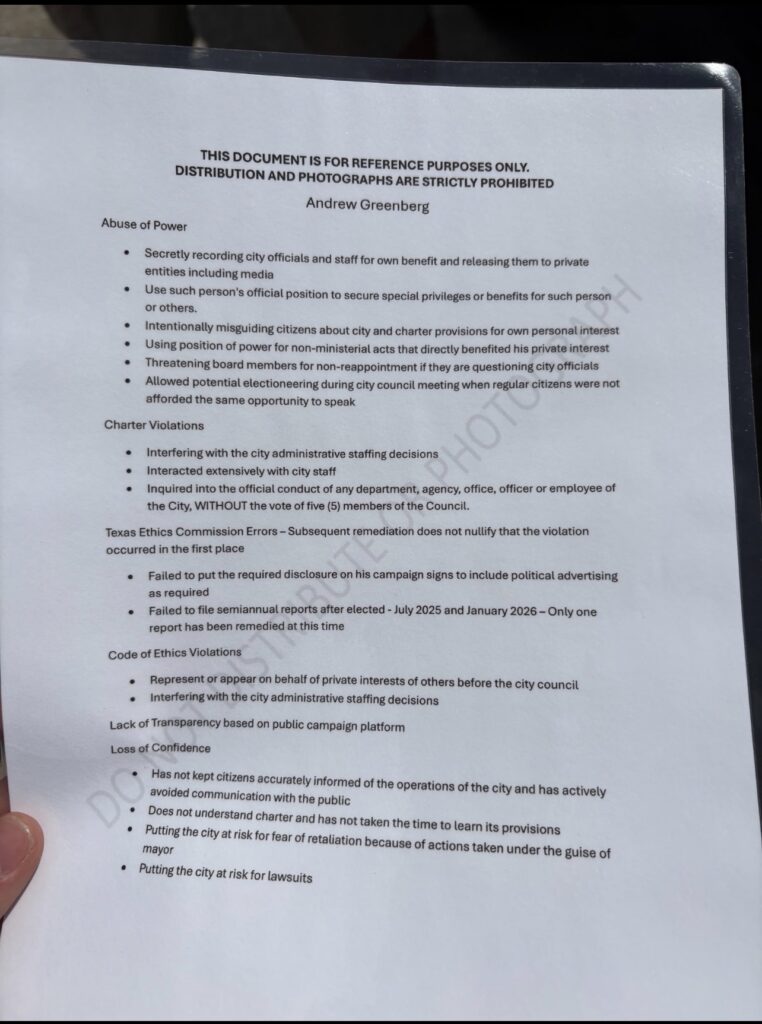
That contradiction, a document marked for secrecy but distributed in a public setting as reasons for the removal of an elected Mayor, quickly became the focal point of Richardson’s remarks. While Richardson questioned the validity of some of the allegations made in the document, his primary focus was on the process and transparency behind their circulation.
Pipkins Reports has obtained a copy of the document and presents it here as part of this report. We note that notices of, “DISTRIBUTION AND PHOTOGRAPHS ARE STRICTLY PROHIBITED”, generally do not carry clear legal enforceability in a public setting.
Notably, one of the document’s central allegations involves the recording of city officials, and it is a matter of public record that Mayor Greenberg did record at least one phone call with Councilwoman Codi Chinn, a recording later released by Pipkins Reports, though the motivations and context surrounding that call remain disputed.
The document itself is structured as a list of allegations under several headings, including “Abuse of Power,” “Charter Violations,” “Texas Ethics Commission Errors,” and “Code of Ethics Violations.” It presents the claims in declarative language, offering no citations, supporting documentation, or sourcing within the text.
Under “Abuse of Power,” the document asserts that Mayor Greenberg secretly recorded city officials and staff for personal benefit, used his position to secure special privileges, and intentionally misled citizens about city governance and charter provisions. It further claims he used his authority for actions benefiting his private interests and threatened board members with removal if they questioned city officials.
Another claim alleges that the mayor allowed what the document describes as “potential electioneering” during a city council meeting, suggesting unequal treatment between certain speakers and regular citizens. Additional points accuse him of interfering in administrative staffing decisions and engaging with city staff without the required council authorization.
The section labeled “Texas Ethics Commission Errors” raises campaign-related concerns, including an allegation that required political advertising disclosures were omitted from campaign signs and that semiannual campaign finance reports were not filed on time in July 2025 and January 2026. It further states that only one of those reports has been remedied, though no official findings from the Texas Ethics Commission are cited in the document itself.
Other portions of the document claim violations of the city’s code of ethics, including representing private interests before the council, and paint a broader picture of what is described as a “lack of transparency.” The final section, labeled “Loss of Confidence,” includes assertions that the mayor has failed to keep citizens informed, does not understand the city charter, and has placed the city at risk of retaliation and lawsuits.
None of the claims included in the document were accompanied by evidence within the material reviewed, and the organizers explanation to Richardson, he states, was that the document “wasn’t verified yet and was simply what they believed.” However, the language used presents the allegations as statements of fact, rather than opinion, a distinction that carries legal implications if the claims cannot be substantiated.
Richardson’s testimony only briefly touched on how be believed the printed allegations were false. Instead, he focused on what he characterized as an inconsistency, that a document warning against distribution was nonetheless handed out to members of the public at an organized event. His remarks, measured in tone, appeared aimed at prompting greater transparency from those involved in the recall effort.
The City Council did not provide a response during the meeting regarding the document or its contents. This is typical of the Public Comments section of the agenda.
Mayor Greenberg’s Comment
Pipkins Reports reached out to Mayor Greenberg for comment. Regarding the document, he stated, “It’s a list of broad accusations without real evidence or specifics, and that’s just not a fair or productive way to have a conversation. If you’re going to make claims, don’t hide behind a command not to take photos or share-if they are strong enough to try to get people upset, they should be strong enough to be share publicly and examined. If someone disagrees with my policies, that’s completely fair, but pushing baseless accusations this way is disappointing.“
Christopher Rains Comment
We also reached out to Christopher Rains, the petition organizer, who it appears was also the person to whom Richardson spoke to. He stated, “It [the conversation] is not how I remember the exchange. I was talking with two people, both combative in nature and upon recognizing that they were not in support tried to exit the exchange as quickly as possible. If I misspoke, I am not above admitting as much. I am not a politician and have no aspirations to become one, I am not afraid to say I am wrong. But, I stated and reiterated many times that I was there because I believe there were charter violations based on my understanding of the charter. He claimed that I said they broke the law, I clarified that I did not believe it was criminally illegal, but a civil violation and morally questionable.“
Ashley Rains was also respectful to our request for comment and provided the following statement: “I was not surprised to see Gus Richardson, or his mother, at the City Council meeting Monday evening. If anything, I was proud and impressed to see Gus in attendance and participating. Proud because I firmly believe it’s imperative that our younger generations become interested and involved in the future of our government, at all levels. Our current political climate may not be where it is today if that had been the case sooner.
I was simultaneously impressed by his willingness to speak publicly on such a controversial topic. Not many young people have the wherewithal or courage to do so. I applaud him for that.
However, I was surprised to hear my name casually mentioned, while presenting as though he was unsure who the gentleman was he speaking with.
Gus and his mother approached our table while I was engaged in conversation with another citizen. But my husband is both cordial and a business professional. He shakes your hand and introduces himself, every time, with every new person we encounter in a mutually respectful setting.
I was unable to join their conversation until the last couple of minutes of their exchange. To hear my name referenced in the speech Gus delivered Monday evening was surprising, as the premise of the delivery seemed to be geared more toward attacking my campaign rather than presenting the facts of the exchange as the truly were.
I still applaud his involvement and courage. I also recognize the true potential he has to offer our society, political or otherwise. But, truthfully, I would’ve preferred to hear the recollection of events delivered less politically and more forthright.“
As the recall effort continues to unfold, the emergence of this document and the circumstances surrounding its distribution are likely to draw increased scrutiny from both the public and those directly involved. Richardson’s testimony has added a new layer to an already contentious political environment, raising questions not only about the claims themselves, but about how information is being presented to voters in the course of the petition process.
For now, the allegations outlined in the document remain unverified, and no formal findings by relevant authorities have been publicly confirmed. As the situation develops, the focus may shift toward greater transparency from all parties involved, particularly as residents weigh the credibility of the information being circulated in connection with the recall effort.
FATE, TX – Voters in Fate may soon face a familiar name on the ballot, but beneath the surface of Allen Robbins’ political comeback lies a record that could reshape how residents view his return. As the May 2026 city council election approaches, Robbins, a former Fate councilman, is seeking another term, bringing with him a documented voting history that raises pointed questions about taxes, fees, and development decisions that directly affected residents’ wallets and the city’s character.
Public records from the City of Fate show that during his previous tenure, Robbins not only introduced a series of consequential motions, but in each instance, those motions ultimately passed the council. The result was a slate of enacted policies that increased costs and advanced higher-density development, leaving a clear legislative footprint for voters to evaluate.
Below are seven key actions tied to Robbins’ record that voters may weigh as they consider his candidacy.
1. Ratifying a Property Tax Increase
Robbins made the motion to approve Ordinance No. 0-2023-036, ratifying a property tax increase embedded in the adopted budget for fiscal year 2023–2024. The motion passed, formally locking in the increased tax burden tied to that budget cycle.
2. Supporting a 5.96 Percent Tax Rate Increase
Robbins also made the motion to adopt Ordinance No. 0-2023-037, setting the property tax rate at $0.26421, an effective increase of approximately 5.96 percent. The council approved the measure, resulting in a higher rate applied to property owners across the city.
3. Approving Increased Solid Waste Fees
Through Ordinance No. O-2023-038, Robbins moved to approve updated rates for solid waste and refuse collection services. The motion passed, leading to increased service charges for residents.
4. Road Fee Adoption
Although introduced by another council member, Robbins voted to approve Ordinance No. 0-2023-039, establishing a $3 road fee for both single-family and multi-family residential units. The measure adds a recurring fee impacting nearly all households.
5. Zoning Change with Financial Penalties
Robbins made the motion to approve Ordinance No. O-2023-021, which amended zoning classifications on approximately 3.18 acres from Mixed Use to Mixed Use Transition for a Townhouse Development.
6. Approval of a 179-Unit Townhome Development
Through Resolution No. R-2023-055, Robbins moved to approve a Type III development plan for a 179-unit townhome project on approximately 13.9 acres. The council approved the motion, clearing the way for the higher-density development to proceed.
7. Advancing a Maximum Tax Rate Above Key Thresholds
Robbins also made the motion to approve Resolution No. R-2023-058, setting a maximum tax rate that exceeded both the no-new-revenue rate and the voter-approval rate, within the de minimis threshold allowed under Texas law. The motion passed, advancing the process for adopting the higher rate and triggering required public notices and hearings.
Context and Verification
Each of these actions is documented in official City of Fate council records from 2023. Motions made by a council member are a critical procedural step in municipal governance, and in these cases, each motion successfully resulted in council approval, meaning the policies were not merely proposed, but enacted.
Municipal leaders often justify such decisions as necessary responses to growth, infrastructure demands, and service costs. Fate, like many North Texas communities, has experienced rapid expansion, increasing pressure on roads, utilities, and public services.
The Stakes in 2026
As Robbins seeks a return to office in May 2026, voters are presented with a clear and verifiable record of policy actions that translated into tangible outcomes, higher taxes, new fees, and expanded development density.
Whether those outcomes are viewed as responsible governance or excessive government expansion will likely shape the election.
Opinion: A Pattern, Not an Accident
Seven motions. Seven approvals. One consistent direction.
That pattern is difficult to dismiss as coincidence. Robbins’ record reflects a governing philosophy that leans toward increasing revenue through taxation and fees while accommodating denser residential growth.
Supporters may argue these were necessary decisions in a growing city. That is a fair argument. Growth requires infrastructure, and infrastructure costs money.
But voters should also ask whether every increase was necessary, whether alternatives were explored, and whether the cumulative impact on residents was fully considered.
Because while each individual vote might be explained away, together they tell a broader story, one of a councilman comfortable with expanding both the cost and scope of local government.
In a community like Fate, where many families moved seeking affordability and space, that story carries weight.
And in May 2026, voters will decide whether it carries enough weight to keep Allen Robbins out of office, or return him to it.

FATE, Texas — A growing recall effort targeting four of the seven members of the Fate City Council is being framed by supporters as a necessary corrective to alleged misconduct. But if the effort succeeds, the consequences could extend far beyond a reshuffling of elected officials. In fact, under a straightforward reading of municipal governance rules and typical Texas city procedures, a full recall victory could leave Fate functionally unable to govern itself for months.
At the center of the issue is a simple but critical number: FOUR. That is both the number of council members being targeted and the number required to maintain a quorum on a seven-member council. Remove all four at once, and the remaining body drops to three—below the threshold needed to legally conduct city business.
What follows is not a political argument, but a procedural reality with tangible implications for residents, developers, and city operations.
What Happens If the Recall Petition Succeeds
If recall organizers gather enough valid signatures under the city’s charter, the targeted officials would be placed on the ballot for a recall election, likely in November. Voters would then decide whether each of the four officials should be removed from office.
If voters reject the recall, the matter ends there.
But if voters approve all four recalls, the result is immediate and structural: upon canvassing of the election results, those four seats are vacated simultaneously.
That leaves three sitting council members—insufficient to meet quorum requirements.
The Quorum Problem: Government at a Standstill
In Texas municipalities, a quorum is generally defined as a majority of the governing body. For a seven-member council, that means at least four members must be present to conduct official business.
Without a quorum, the council cannot:
- Pass ordinances
- Approve budgets or expenditures
- Conduct public hearings
- Approve or deny development applications
- Rule on zoning or land-use changes
- Hear appeals on code enforcement actions
- Enter into contracts
- Take formal votes of any kind
In short, the machinery of local government STOPS.
Routine administrative functions carried out by staff may continue in a limited capacity, but any action requiring council approval would be frozen.
Two Possible Paths Forward—and Both Have Consequences
Once a quorum is lost, Fate would face two options, neither of which provides an immediate solution.
Option 1: Wait Until the Next Regular Election (May)
One possibility is that the city simply waits until the next scheduled municipal election in May to fill the vacant seats.
This approach avoids the cost and complexity of a special election, but it comes with a significant downside: a governance vacuum lasting several months.
From November to May, the city would effectively operate without a functioning legislative body. During that period:
- No new development projects could receive approval
- Zoning changes would be stalled indefinitely
- Builders and investors would face uncertainty or delay
- Residents would have no elected body to address grievances requiring council action
- ZERO Budget adjustments or emergency appropriations could not be made. Without a budget for the upcoming fiscal year, layoffs might ensue. DPS might lose equipment. The new buildings can’t go forward. For a fast-growing city like Fate, such a pause could have ripple effects across the local economy.
Option 2: Seek a Court-Ordered Special Election
Alternatively, the city could petition a court to authorize a special election to fill the unexpired terms.
This route is more proactive but still far from immediate.
The process would likely involve:
- Legal action to establish the need for a special election
- Court review and issuance of an order
- Coordination with election authorities
- Scheduling and conducting the election
Even under an expedited timeline, this process could take weeks or months, during which the city would still lack a quorum.
In other words, while a special election may shorten the disruption, it does not eliminate it.
The Development Freeze: Real-World Impact
One of the most immediate and visible consequences of a non-functioning council would be a halt in development activity.
Fate, like many North Texas cities, relies on council approvals for:
- Site plans
- Plat approvals
- Zoning changes
- Variances and special exceptions
Without a quorum, none of these items can move forward.
Developers could find themselves in limbo, unable to proceed with projects that may already be in progress. That uncertainty can lead to:
- Delayed construction timelines
- Increased costs
- Potential withdrawal of investment
- Lawsuits against the city
For a city positioning itself for controlled growth, even a temporary freeze could have lasting effects.
Zoning, Enforcement, and Appeals: No Relief Valve
Beyond development, the absence of a quorum would also affect everyday governance.
Residents seeking to:
- Appeal zoning decisions
- Challenge code enforcement actions
- Request variances or accommodations
would have no forum for resolution.
This creates a situation where administrative decisions stand without recourse, not because they are unchallengeable, but because the body that hears those challenges cannot convene.
Budgetary Constraints and Financial Oversight
Municipal budgets are not static documents. Councils routinely:
- Amend budgets
- Approve expenditures
- Allocate funds for unexpected needs
Without a quorum, these functions are suspended.
While some essential services may continue under previously approved budgets, the city would have limited flexibility to respond to changing conditions.
Representation Gap: Citizens Without a Voice
Perhaps the most fundamental issue is representation.
City councils serve as the primary interface between residents and local government. They are the venue where citizens:
- Speak during public comment
- Petition for change
- Hold officials accountable
If the council cannot meet, that channel effectively disappears.
For months, residents could find themselves without a functioning body to hear concerns or take action.
A Structural Risk, Not a Hypothetical One
The scenario outlined here is not speculative in the abstract—it is a direct consequence of how quorum requirements and recall mechanisms intersect.
Recall is a legitimate democratic tool, designed to give voters a mechanism to remove officials they believe are not serving in the public interest.
But like any tool, its use carries consequences.
When applied to a majority of a governing body simultaneously, recall has the potential to disable the very institution it seeks to reform, at least temporarily.
The Central Question for VotersAs the recall effort unfolds, voters may ultimately face a decision that goes beyond the merits of individual officials.
The question becomes:
- Is the perceived benefit of removing four council members worth the potential for a months-long interruption in city governance?
That is not a legal question, but a practical one—one that weighs accountability against continuity.
Conclusion: Accountability vs. Continuity
Be careful what you wish for, you might get it. The Fate recall effort highlights a tension inherent in local governance: the balance between holding officials accountable and maintaining the continuity of government operations.
A successful recall could achieve the former, but at the cost of the latter—at least in the short term.
For residents, businesses, and stakeholders, the implications are clear. The outcome of the recall, if it proceeds, will not only determine who sits on the council, but whether the council can function at all in the months that follow.
You must be logged in to post a comment Login