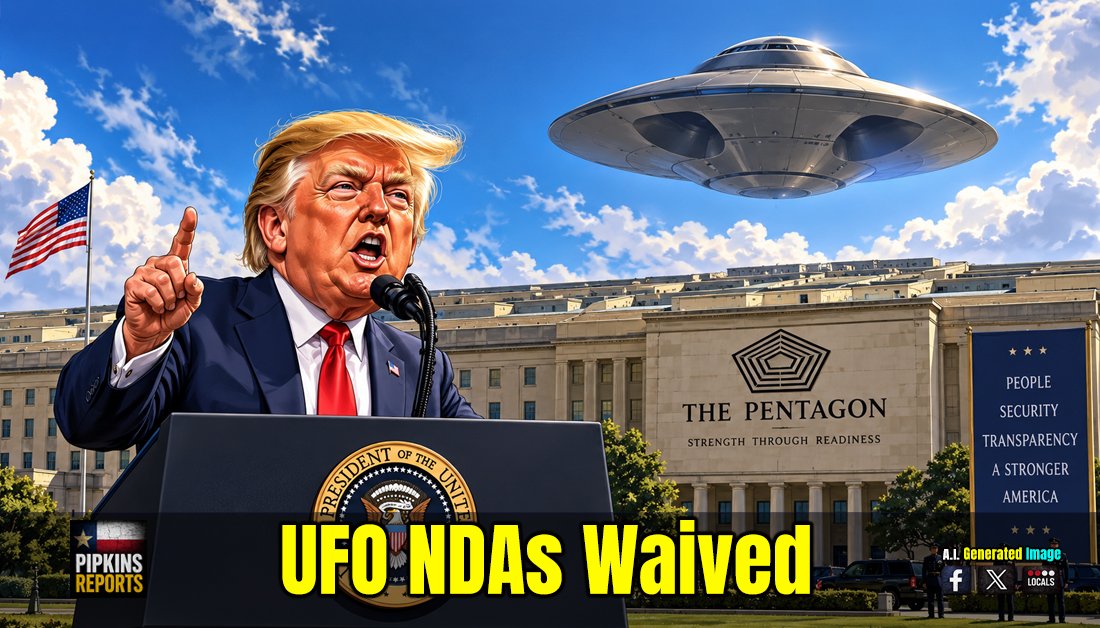
Trump Issues Waiver to NDA’s for PURSUE Disclosure

The Pentagon – Virginia – The Department of War (DOW) announced today that it has issued a legal waiver allowing current and former military personnel, civilian employees and contractors with UAP-related National Defense Information to disclose that information to authorized representatives of the Presidential Unsealing and Reporting System for UAP Encounters, better known as PURSUE. The waiver specifically addresses Non-Disclosure Agreements and Special Access Program Indoctrination Agreements, or SAPIAs, that previously could prevent people from talking about what they knew.
PURSUE is the Trump administration’s government-wide mechanism for finding, reviewing and potentially declassifying UAP records. The Department of War has already released five batches of material, beginning May 8 and continuing through Aug. 7. The public database includes records from the Department of War, NASA, FBI, Department of Energy, the intelligence community, ODNI and other federal entities.
The administration has now taken aim at another problem: people.
Government files are only useful if the government knows they exist. A former employee or contractor might know about a program, a compartment, a facility, a test or a piece of evidence that never made its way into the records being reviewed by PURSUE due to top secret classifications. Until now, that person could have faced serious consequences for discussing protected or classified information.
The new waiver is intended to change that.
Government contractors are the source
Much of America’s advanced military technology is not designed, built or maintained entirely by government employees. Private defense contractors operate inside the national security system, often under contracts requiring personnel to obtain security clearances and access Special Access Programs.
Companies such as Lockheed Martin, including its Skunk Works organization, Raytheon and other major defense contractors routinely perform classified work for the federal government. Federal acquisition rules recognize that contractors can possess classified and Special Access Program information, and contractor personnel can be required to execute security agreements governing that access. These companies are beyond the reach of FOIA requests.
Today’s waiver expressly covers Department of War contractors who hold, or previously held, access to UAP-related National Defense Information.
The administration says the waiver supersedes civil and administrative enforcement provisions in applicable NDAs and SAPIAs for communications made to authorized PURSUE representatives. In plain English, a person who previously believed, “I can’t tell the government because I already promised the government I wouldn’t,” now has an authorized government channel through which that information can be reported.
This isn’t a permission slip to leak classified documents to reporters, post them online or walk them into Congress. Legal analysis of the administration’s earlier July guidance noted that the process was designed for disclosures to authorized government representatives, not unrestricted public disclosure.
So the government isn’t throwing open the vault door. It’s handing someone the key to a particular hallway.
Why PURSUE matters
The purpose is straightforward: get information into the hands of investigators who can evaluate it, determine whether it can be declassified and, eventually, make appropriate material public.
PURSUE has already accumulated a substantial archive. Its releases include historical records dating back decades, modern military videos and unresolved UAP reports from locations around the world. The Department says some cases remain unresolved because there simply isn’t enough information to determine what was observed.
The new waiver could help address that evidence problem. A former contractor may know where another record is located. A retired engineer may know which program handled an unusual incident. A former security official may know that a particular collection of records exists but was never included in a previous review.
For taxpayers, that is the part worth watching. Americans have spent decades funding an enormous national security establishment, including billions of dollars in contracts with private companies. If UAP-related information exists inside that system, the public has a legitimate interest in knowing what the government knows, what it doesn’t know and why.
The waiver won’t answer those questions by itself. But it removes one of the excuses that has long stood in the doorway.
Now somebody just has to walk through it.




You must be logged in to post a comment Login