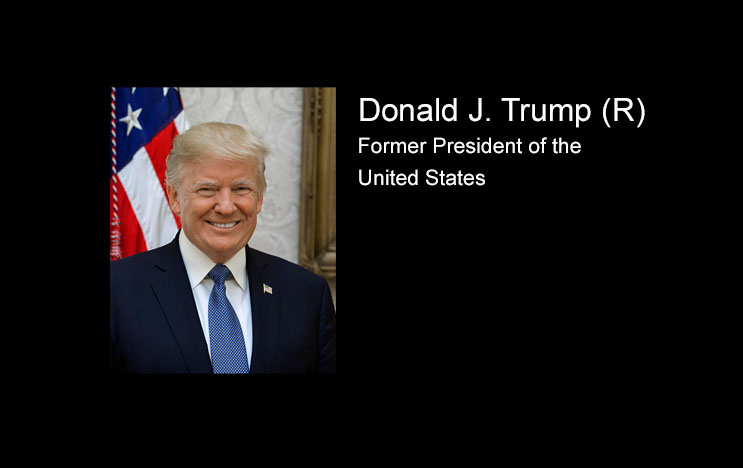
Trump Acquitted
Donald J. Trump was acquitted in the fraudulent impeachment trial on Saturday, February 13, 2021.
02/13/2021 – Washington, DC
Donald J. Trump was acquitted in the fraudulent impeachment trial on Saturday, February 13, 2021. He was acquitted with a vote of 57 (Guilty) to 43 (Not Guilty). It would have taken 67 (Guilty) votes to convict.
Officially, the charge against President Trump was for:
H. Res. 24
In the House of Representatives, U. S.,
January 13, 2021.
Resolved, That Donald John Trump, President of the United States, is impeached for high crimes and misdemeanors and that the following article of impeachment be exhibited to the United States Senate:
Article of impeachment exhibited by the House of Representatives of the United States of America in the name of itself and of the people of the United States of America, against Donald John Trump, President of the United States of America, in maintenance and support of its impeachment against him for high crimes and misdemeanors.
ARTICLE I: INCITEMENT OF INSURRECTION
The Constitution provides that the House of Representatives “shall have the sole Power of Impeachment” and that the President “shall be removed from Office on Impeachment for, and Conviction of, Treason, Bribery, or other high Crimes and Misdemeanors”. Further, section 3 of the 14th Amendment to the Constitution prohibits any person who has “engaged in insurrection or rebellion against” the United States from “hold[ing] any office … under the United States”. In his conduct while President of the United States—and in violation of his constitutional oath faithfully to execute the office of President of the United States and, to the best of his ability, preserve, protect, and defend the Constitution of the United States, and in violation of his constitutional duty to take care that the laws be faithfully executed—Donald John Trump engaged in high Crimes and Misdemeanors by inciting violence against the Government of the United States, in that:
On January 6, 2021, pursuant to the 12th Amendment to the Constitution of the United States, the Vice President of the United States, the House of Representatives, and the Senate met at the United States Capitol for a Joint Session of Congress to count the votes of the Electoral College. In the months preceding the Joint Session, President Trump repeatedly issued false statements asserting that the Presidential election results were the product of widespread fraud and should not be accepted by the American people or certified by State or Federal officials. Shortly before the Joint Session commenced, President Trump, addressed a crowd at the Ellipse in Washington, DC. There, he reiterated false claims that “we won this election, and we won it by a landslide”. He also willfully made statements that, in context, encouraged—and foreseeably resulted in—lawless action at the Capitol, such as: “if you don’t fight like hell you’re not going to have a country anymore”. Thus incited by President Trump, members of the crowd he had addressed, in an attempt to, among other objectives, interfere with the Joint Session’s solemn constitutional duty to certify the results of the 2020 Presidential election, unlawfully breached and vandalized the Capitol, injured and killed law enforcement personnel, menaced Members of Congress, the Vice President, and Congressional personnel, and engaged in other violent, deadly, destructive, and seditious acts.
President Trump’s conduct on January 6, 2021, followed his prior efforts to subvert and obstruct the certification of the results of the 2020 Presidential election. Those prior efforts included a phone call on January 2, 2021, during which President Trump urged the secretary of state of Georgia, Brad Raffensperger, to “find” enough votes to overturn the Georgia Presidential election results and threatened Secretary Raffensperger if he failed to do so.
In all this, President Trump gravely endangered the security of the United States and its institutions of Government. He threatened the integrity of the democratic system, interfered with the peaceful transition of power, and imperiled a coequal branch of Government. He thereby betrayed his trust as President, to the manifest injury of the people of the United States.
Wherefore, Donald John Trump, by such conduct, has demonstrated that he will remain a threat to national security, democracy, and the Constitution if allowed to remain in office, and has acted in a manner grossly incompatible with self-governance and the rule of law. Donald John Trump thus warrants impeachment and trial, removal from office, and disqualification to hold and enjoy any office of honor, trust, or profit under the United States.
All legitimate legal scholars agree that the trial was unconstitutional on multiple grounds, including the fact that Trump is a private citizen and that Supreme Court Justice Roberts would not preside over the “trial”.
All Democrats voted in favor of impeachment and 7 Republicans joined them.
Election
$100 Million, No Winner: Cornyn and Paxton Head to High-Stakes Texas Senate Runoff
Cost per Vote Calculated
TEXAS – After more than $100 million in political warfare, Texans woke up Wednesday morning to a simple reality, the Republican primary for U.S. Senate is not over. In fact, it may have only reached halftime.
Incumbent U.S. Sen. John Cornyn and Texas Attorney General Ken Paxton are now headed to a runoff election after neither candidate secured the majority required to win outright in Tuesday’s Republican primary. The contest, widely described as the most expensive Senate primary in American political history, will now stretch another two months before Republican voters decide the nominee.
As of publication, with roughly 94 percent of the vote counted, Cornyn held a narrow lead with 41.9 percent of the vote, totaling 897,187 ballots. Paxton followed closely with 40.7 percent, receiving 871,672 votes. U.S. Rep. Wesley Hunt finished third with 13.5 percent, or 289,403 votes.
Under Texas election law, a candidate must receive more than 50 percent of the vote to win a primary outright. When no candidate crosses that threshold, the top two candidates advance to a runoff election. That runoff is scheduled for May 26.
The results guarantee an extended political showdown between two figures representing sharply different visions of Republican leadership.
Paxton addressed supporters Tuesday night during an election watch event in Dallas hosted by the pro-Paxton Lone Star Liberty PAC. The attorney general framed the outcome as a rejection of the political establishment and a signal from grassroots voters across Texas.
“Together with your support, we just sent a message loud and clear to Washington,” Paxton told the crowd. “Texas is not for sale.”
Paxton also pointed to the massive financial disparity between the campaigns, arguing that despite overwhelming spending by groups aligned with the incumbent senator, Republican voters still rejected the status quo.
“Nearly 60 percent of Texas voters, who have known Cornyn for over 40 years, after hearing $100 million worth of ads, chose to vote against the incumbent,” Paxton said. “That’s historic.”
Cornyn did not host an election night event but briefly addressed reporters Tuesday evening as the vote count continued.
“I’ve worked for decades to build the Republican Party, both here in Texas and nationally,” Cornyn said. “I refuse to allow a flawed, self-centered and shameless candidate like Ken Paxton risk everything we’ve worked so hard to build over these many years.”
Cornyn’s campaign has consistently argued that Paxton represents a risk to the Republican Party’s electoral prospects, while Paxton’s supporters have framed the race as a battle between grassroots conservatives and Washington insiders.
Cornyn campaign spokesman Matt Mackowiak previously told reporters that the campaign would not hold an election night celebration because the team does not “do halftime parties.”
The Cost of Each Vote
The financial dynamics of the race reveal an even more striking contrast between the campaigns.
Based on available spending figures tied to advertising and campaign messaging efforts, Cornyn’s political operation and allied groups spent roughly $70 million supporting his campaign. Paxton’s campaign and aligned efforts spent approximately $4.1 million, while Hunt’s campaign spending totaled about $11.4 million.
When those spending totals are compared with the number of votes received, the results highlight a dramatic difference in campaign efficiency.
- Cornyn’s spending equates to roughly $78.02 per vote, calculated by dividing $70 million by his 897,187 votes.
- Paxton’s campaign achieved nearly the same vote total at dramatically lower cost, spending approximately $4.70 per vote to secure 871,672 votes.
- Hunt’s campaign, which finished third, spent about $39.39 per vote, based on $11.4 million in spending and 289,403 votes.
In practical terms, Paxton’s campaign proved vastly more efficient at converting dollars into voter support, achieving almost the same vote share as Cornyn while spending only a fraction of the money.
Political analysts say the spending gap reflects heavy financial involvement by national Republican organizations and establishment political committees seeking to defend the incumbent senator.
Despite that financial advantage, the spending did not produce the decisive victory many expected.
Instead, it produced a runoff.
What Comes Next
The May 26 runoff now becomes the defining stage of the race. Historically, Texas runoff elections attract significantly lower voter turnout than primary elections, meaning campaigns must rely heavily on organization, messaging, and targeted voter mobilization.
Both candidates are expected to intensify campaigning across the state in the coming weeks, focusing on grassroots engagement, media messaging, and turnout operations.
The runoff will determine which candidate ultimately represents the Republican Party in the general election.
Opinion
One candidate’s role in Tuesday’s outcome should not be overlooked.
Congressman Wesley Hunt finished a distant third, but his presence in the race likely ensured that Paxton would not get the 50% needed to secure the nomination and may have now handed the election over to Cornyn.
It matters because Texas runoff elections tend to favor the campaign with the deeper pockets and stronger political machinery…that’s Cornyn. Cornyn’s access to national Republican fundraising networks and establishment political organizations could translate into a powerful turnout operation. Ground operations, voter targeting, and aggressive get-out-the-vote campaigns often determine the winner when turnout drops.
Paxton, by contrast, will rely heavily on grassroots enthusiasm among voters who see his candidacy as a challenge to what they view as a disconnected Washington political class. Cornyn is deeply hated by the electorate. The only question is, do they hate him enough to come out for a 2nd time to vote against him?
Featured
Markets Plunge as Iran Conflict Escalates, But Oil Reality Tells a Different Story
New York, NY – Global markets convulsed at the opening bell, shedding billions in value as war headlines involving Iran ricocheted across trading floors from New York to Tokyo. Traders reacted swiftly, energy prices spiked, and the financial press warned of supply shocks rippling across the world economy.
According to reporting from The New York Times, major stock indices fell sharply amid intensified military activity tied to Iran. Exchanges in the United States, Europe, and Asia all registered significant losses. Oil futures climbed on fears that instability in the Persian Gulf could disrupt tanker traffic through the Strait of Hormuz, a critical shipping lane for global crude.
The downturn began early in the trading session as reports of expanded strikes circulated. Analysts cited by The New York Times described widespread panic selling, with algorithmic trading accelerating declines once volatility thresholds were breached. Technology and transportation stocks led losses. Defense firms saw modest gains as investors anticipated increased military spending.
Yet beneath the red ink and breathless headlines lies a critical fact often missing from early coverage.
Iran accounts for roughly 2 percent of the global traded oil supply. While it remains a member of the Organization of the Petroleum Exporting Countries, years of sanctions following the U.S. withdrawal from the Joint Comprehensive Plan of Action in 2018 have pushed much of its crude into what analysts call the “grey market.”
Rather than selling transparently on regulated exchanges, Iranian oil typically moves through ship-to-ship transfers, obscured tracking systems, and intermediary traders. China has been a principal buyer of these discounted barrels. Transactions often bypass Western financial clearing systems, making the supply less visible but still economically present.
In short, Iran’s oil is already marginal to formal global trading structures.
Markets nevertheless reacted as though a primary energy artery had been severed. The CBOE Volatility Index surged, reflecting investor anxiety. Safe-haven assets, including gold and U.S. Treasury bonds, drew inflows as portfolio managers sought shelter from geopolitical uncertainty.
Complicating the picture, U.S. military officials confirmed that American forces conducted strikes that neutralized Iran’s naval presence in the Gulf of Oman, according to public statements released by U.S. Central Command. Those operations reportedly destroyed multiple Iranian vessels operating in that theater, significantly degrading Tehran’s ability to threaten commercial shipping lanes in the immediate area.
While independent verification remains limited, the operational effect appears clear: Iran’s capacity to directly interfere with tanker traffic near the Strait of Hormuz has been substantially reduced in the short term.
Energy analysts note that the Strait, while strategically vital, is patrolled by multiple international naval forces. With Iran’s regional naval capabilities diminished, the probability of prolonged shipping disruption appears lower than early market reactions suggested.
Moreover, if sanctions enforcement tightens amid escalating hostilities, nations purchasing discounted Iranian crude may be compelled to source oil from legitimate, regulated markets instead of grey market channels. That shift would not remove supply from the global system. It would redirect demand toward transparent producers.
Historically, geopolitical shocks produce immediate price spikes followed by recalibration once traders assess actual supply data. During prior Middle East conflicts, oil markets often stabilized after initial surges, particularly when physical infrastructure remained intact.
Government officials in several countries have urged calm. At this stage, no confirmed long term production outages have been reported. Strategic reserves among major economies provide additional buffers against short term volatility.
Opinion
Financial markets dislike uncertainty, but they often overprice fear.
When a nation responsible for about 2 percent of global traded supply triggers worldwide selling, the reaction says more about investor psychology than structural fundamentals. Iran’s oil already circulates through shadow networks at discounted rates. If conflict constrains that channel further, buyers such as China would likely pivot toward lawful suppliers, strengthening formal markets rather than collapsing them.
The destruction of Iran’s naval presence in the Gulf of Oman, if sustained, further reduces the specter of prolonged maritime shutdowns. Shipping lanes do not appear poised for indefinite closure.
Panic selling generates drama. It does not automatically generate durable economic damage.
Investors would be wise to separate headlines from hard supply data. Markets tend to correct once reality asserts itself. And reality, at least for now, suggests the global oil system remains far more resilient than Monday’s selloff implied.
Colony Ridge
Colony Ridge – $68M Settlement with DOJ
COLONY RIDGE, TX – In a $68 million settlement announced by the U.S. Department of Justice, Colony Ridge Land LLC and its affiliated entities agreed to resolve allegations that the developer engaged in predatory land sales and lending practices targeting Hispanic borrowers. The agreement, reached in coordination with Texas Attorney General Ken Paxton’s office, concludes litigation initiated in late 2023 and expanded through early 2024.
According to the DOJ’s Civil Rights Division, the lawsuit accused Colony Ridge of violating the Equal Credit Opportunity Act and the Fair Housing Act through marketing and lending tactics that allegedly steered vulnerable buyers into high risk seller financed loans without verifying their ability to repay. Investigators said the result was a pattern of defaults, foreclosures, and financial distress across the rapidly expanding Liberty County development.
Assistant Attorney General Harmeet K. Dhillon stated the government viewed the conduct as both unlawful and socially harmful, asserting that deceptive lending schemes undermine civil rights protections while destabilizing communities. Dhillon also noted enforcement efforts would extend to lenders and developers whose practices may contribute to illegal immigration or unsafe housing conditions.
The settlement resolves a December 2023 federal lawsuit filed jointly by the Justice Department and the Consumer Financial Protection Bureau, alongside a March 2024 lawsuit brought by the Texas Attorney General’s Office.
Under the terms of the agreement, Colony Ridge must allocate $48 million toward infrastructure upgrades, including $18 million dedicated to drainage improvements intended to mitigate flooding risks that residents and investigators say have caused costly property damage. An additional $30 million will fund broader infrastructure enhancements throughout the development.
The developer also agreed to adopt underwriting standards requiring verification of borrower income, assets, and debt levels before issuing loans, a shift designed to reduce default risk. The settlement further mandates foreclosure mitigation policies, borrower assistance programs, and a credit remediation plan addressing past reporting tied to defaulted loans.
Investigators also cited concerns involving marketing practices. As part of the settlement, Colony Ridge must ensure advertising accurately represents property conditions, utility access, and loan terms. Pre sale disclosures must now clearly indicate whether homes are move in ready and whether essential services are immediately available.
A legal settlement involving the State of Texas, the federal government, and Colony Ridge will also require prospective buyers to verify lawful presence in the United States. According to reporting from Yahoo News, purchasers must present a valid Texas-issued identification card or driver’s license, or appropriate immigration documentation such as a passport accompanied by a current visa, before completing certain transactions.
Another significant provision includes a $20 million commitment aimed at strengthening law enforcement presence within the development. The agreement requires Colony Ridge to coordinate with local, state, and federal authorities to enhance public safety efforts as the community continues to grow.
Additionally, the settlement imposes documentation requirements tied to federal land sales exemptions and halts new residential plats for direct to consumer sales for three years, effectively slowing the rapid expansion that drew national scrutiny.
Colony Ridge has not admitted wrongdoing as part of the settlement, a common feature in civil resolutions. The company has previously stated that it provides affordable homeownership opportunities to buyers who may struggle to access traditional financing, while emphasizing its cooperation with regulators.
The development has been the subject of intense political and media attention due to its size, unconventional financing model, infrastructure concerns, and questions surrounding population growth patterns in the region.
Sources: U.S. Department of Justice Civil Rights Division announcement, Justice.gov; Texas Office of the Attorney General filings; Consumer Financial Protection Bureau case records.
You must be logged in to post a comment Login