The Battle for Fate: Defending Our Town Against the Apartment Onslaught

Fate, TX – Our beloved town, Fate, stands at a precipice. The City Council, blinded by their misguided vision, threatens to unleash a torrent of up to 1,300 new apartments upon our community. As a staunch defender of Fate, The Fate Tribune refuses to mince words. Let’s expose the truth behind this reckless proposal known as Lafayette, which will come before the council for a vote tonight! (02/05/2024).
The Citizens’ Outcry
Picture it: Fate’s sunsets, the laughter of children in our parks, the comforting hum of our local diner. Now imagine it all obliterated by towering apartment complexes and overrun by transient renters who don’t have a stake in our community. Our concerns are real:
- Traffic Nightmare: Fate’s roads are already clogged during rush hour. Adding 1,300 more units will turn our streets into a perpetual traffic jam. The developer is offering little more than words to mitigate this problem. The City Council’s response? Crickets.
- Schools Overwhelmed: Our schools are already overcrowded. But with this influx, classrooms will burst at the seams. Our kids deserve better. Why is the Council deaf to our pleas.
- Rural Lifestyle: Fate’s charm lies in rural environment…away from crowded cities. This project is an attempt to urbanize our small town… just like the Strong Towns philosophy that our City Government covets like a cult. And the Mayor and Council are willing participants.
- Property Values Plummet: Apartments built next to train tracks have only one possible outcome … Section 8. No amount of appeasement will change this. The noise and vibration cannot be mitigated with architectural design and the end result will be that only the poorest of families would be willing to put up with this situation (because they unfortunately have no choice). The result will be a community in decline. The Council’s solution? Apathy.
- Strained Emergency Services: It won’t take long before the influx of thousands of new residents will overwhelm our emergency services … and the Council will tell us we MUST approve a new bond to pay for all the new emergency service buildings, trucks, police, & fire. They simply ignore these facts.
City Council’s Betrayal
Let’s dissect their arguments – if we can call them that:
- Economic Growth Delusion: They chant “progress” like a broken record. They say it is “inevitable” … but they are the cause of it. And at what cost? Our peace? Our identity? Their math doesn’t add up.
- Affordable Housing Mirage: They dangle “affordability” like a carrot. But this word is mutable and can mean anything they want it to mean. (Read Here) But these apartments won’t house struggling families; they’ll attract transient renters. The kind of renters that won’t care if they live next to train tracks. Our community deserves better.
- Density Disaster: They preach density like zealots. It’s a mantra of the Strong Towns philosophy that they covet. But Fate isn’t Manhattan. We cherish open spaces, not concrete jungles. Their vision blinds them.
- Property Rights Suppression: The Council portrays the developer’s property rights as sacrosanct. But what about our rights as existing residents? Are we mere collateral damage? The Community also has rights. WE THE PEOPLE have the right to decide what developments are allowed in our community. The Council are supposed to represent the People … not Developers.
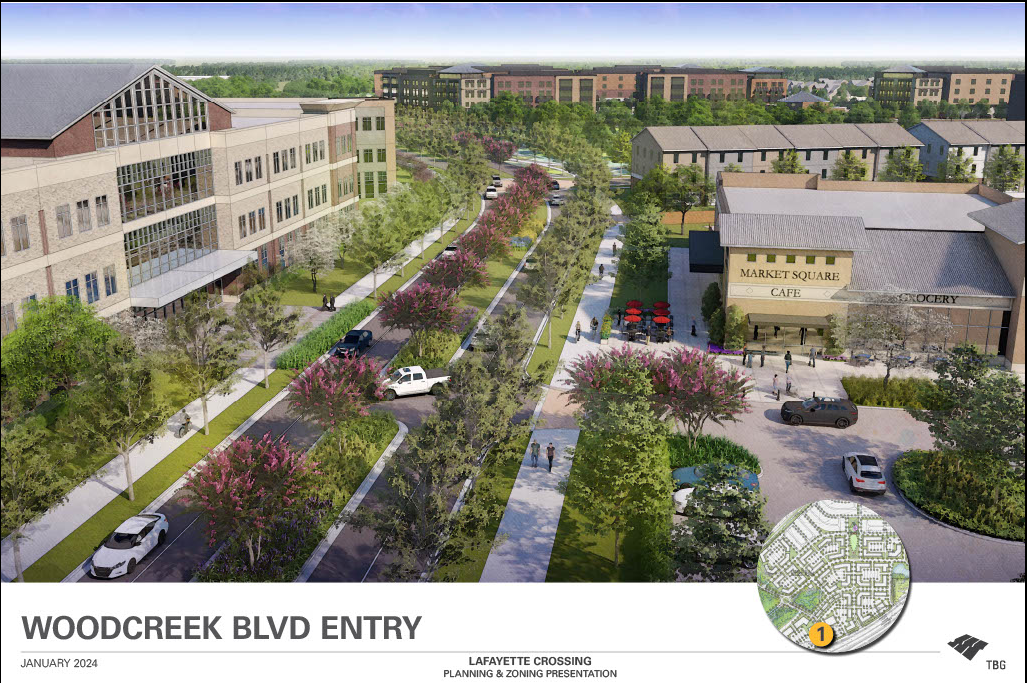
- Deceitful Pretty Pictures: The presentation made to the Planning & Zoning Commission include pretty pictures (renderings) of trees and open spaces. But this is just PR…these renderings to not exist in the legal, official documents. The legal documents contain vagaries that will not restrict the design concepts once approval is provided.
The Legal Quandary
Despite claims by some on the council, Texas law, does NOT prohibit “exclusionary zoning”. Exclusionary zoning refers to zoning ordinances and practices that effectively exclude certain types of zoning, such as multi-family housing. It is NOT illegal to exclude multi-family housing in a City as long as the reasons why you are excluding multi-family housing are not discriminatory. The law governing discrimination in housing is the Fair Housing Act. The reason ‘why’ you are excluding multi-family development matters.
There are plenty of legal reasons to exclude multi-family zoning which don’t ‘presume’ to discriminate.
- For one, a lack of infrastructure to support a large block of new housing. This would include roads, water, and availability of emergency services to name a few.
- “Crime” is part of the infrastructure … but not in the sense that the apartment dwellers are more likely to be criminals, but because the availability of police to serve any additional populous of permanent residents would be stressed to the breaking point.
- “Noise” can be a factor. Not because apartment dwellers can be viewed discriminately as “noisy” but because any large gathering of individuals in a concentrated area would dramatically increase the livability of those already in the region.
- “Traffic” is a legitimate, legal concern. While commercial development may increase traffic during the daytime, large concentrations of residents in a single area increase traffic in the early mornings, evenings, and nighttime. The proposed development is expected to generate 1418 entering trips and 1085 exiting trips in the AM peak hour, and 1751 entering and 1679 exiting trips in the PM peak hour. THAT’S JUST ONE HOUR – in the morning and evening. The final result will be 10’s of thousands of new vehicles on our roads daily.
Our Call to Arms
Fellow Fate-dwellers, rise! Attend the Council meeting TONIGHT (02/05/2024). Raise your voices. Remind them that Fate isn’t just a dot on a map; it’s our home. We won’t surrender to big developers who only care about money and don’t care about our community. The bottom line is that if the project doesn’t work without apartments … then it doesn’t work. Try again.
In the end, our FATE rests with us!
Disclaimer: For those in the cheap seats, this article reflects The Fate Tribune’s unapologetically biased views. If you seek impartiality, look elsewhere. Fate’s destiny hangs in the balance, and we stand with our community. Why don’t YOU!




Austin
Texas GOP Wants Closed Primaries. New Secretary of State Robert Howden Is Preparing to Fight Them.

Austin, TX – Texas Republicans spent years demanding control of their own primary. Now they have a new Secretary of State, Robert S. Howden, appointed by Republican Governor Greg Abbott, and the man taking over the state’s election machinery is inheriting a lawsuit in which his office is expected to defend the very open primary system the GOP wants to dismantle.
The Republican Party of Texas filed the federal lawsuit in September 2025, arguing that Texas’ open primary system violates the party’s First Amendment right of association. Under the current system, Texas voters do not register by party and may choose which party’s primary to vote in during an election cycle. The GOP wants only registered Republicans participating in Republican primaries.
The case is pending in federal court in Amarillo before U.S. District Judge Matthew Kacsmaryk.
And Robert S. Howden has now inherited it.
Howden Steps Into the Fight
Gov. Abbott appointed Howden as Texas’ 116th secretary of state on July 17, effective July 18. Howden previously served as Abbott’s senior adviser and director of legislative affairs and has worked in the administrations of four Republican governors. As secretary of state, he is Texas’ chief elections officer.
Abbott has been quite clear about where he stands.
At the 2026 Republican Party convention, he said Texas would eventually make clear that “only Republicans vote in Republican primaries.” Abbott has also said lawmakers “can and should be more responsive to Republicans than a judge may be,” indicating that he expects the Legislature to address the issue during the 2027 session.
But that doesn’t mean the Secretary of State’s office is supposed to simply surrender in court.
That was the position taken by Howden’s predecessor, Jane Nelson.
Nelson argued that changing Texas’ primary system was a job for the Legislature, not a federal judge. In an October 2025 statement, she said it was her responsibility to defend existing election laws and that she would implement whatever changes the Legislature lawfully enacted.
The Attorney General’s office took the opposite position.
Attorney General Ken Paxton sided with the Texas GOP, asking the federal court to strike down portions of the Texas Election Code governing open primaries. According to reporting by The Texas Tribune, Nelson’s lawyers said Paxton’s office gave them less than an hour’s notice before taking the opposing position.
So the Republican Party sued the Republican-controlled state government. The Republican Attorney General joined the plaintiffs. And the Republican Secretary of State fought the lawsuit.
That’s not exactly the tidy party unity politicians like to advertise.
The Real Fight Is Over Who Controls the Nomination
The GOP argues that crossover voting allows Democrats and independents to influence Republican nominations, potentially helping candidates who are less conservative than the party base.
The lawsuit specifically pointed to the 2024 Republican primaries involving former House Speaker Dade Phelan and Rep. Gary VanDeaver. Both won their races by fewer than 800 votes, and the party argued that crossover voters helped determine the outcomes.
The party has already made closing primaries an official priority. Republicans adopted rules supporting closed primaries in 2024 and renewed that push at their 2026 convention.
But changing the system is not as simple as flipping a switch.
Texas has more than 18 million registered voters, and the state’s registration system was never designed around party registration. Moving to closed primaries could require new registration procedures, computer-system changes and a method for existing voters to establish party affiliation.
The GOP wants the courts to clear the way, preferably in time for 2028.
Art & Culture
McKinney Approves Controversial Islamic Center After Marathon Meeting That Exposed Deep Divisions

McKinney, TX – After nearly six hours of emotional testimony, shouted applause, boos, and police intervention, the McKinney City Council unanimously approved plans Tuesday night for a new Islamic center, closing another chapter in a debate that has simmered in Collin County for years. The vote may have been unanimous, but it certainly wasn’t uncontroversial.
Just before 11:30 p.m. on August 4, the council voted 7-0 to approve the site plan for the McKinney Islamic Association‘s proposed campus on roughly 5.5 acres at Virginia Parkway and Crutcher Crossing. City officials repeatedly emphasized that the decision before them was not whether Islam should have a place of worship in McKinney, but whether the submitted site plan complied with existing city ordinances and development standards. According to council members, the property’s current planned development zoning already permits religious assembly, leaving the city with little legal discretion to deny an otherwise compliant application.
The approved project includes a roughly 15,000-square-foot sanctuary, a classroom building of approximately 10,000 square feet, a 7,000-square-foot multi-purpose gymnasium, parking, and related site improvements. The McKinney Islamic Association says its current facility, where it has served the community for decades, can no longer accommodate its growing congregation.
The meeting itself became the story.
More than 150 people registered to speak, forcing city officials to delay the start of the regular meeting while names were entered into the system. Supporters and opponents packed the council chambers, overflow rooms, and hallways, creating an atmosphere that multiple local news outlets described as tense and, at times, hostile.
Opponents raised a mix of concerns.
Some focused squarely on practical issues, including increased traffic, parking shortages, neighborhood compatibility, and whether a campus serving large numbers of worshippers could comfortably fit on the site. Others voiced broader objections rooted in concerns about Islamic doctrine, Sharia law, and the changing cultural landscape of North Texas. Congressman Keith Self, whose district includes McKinney, spoke against the proposal before public testimony began, warning of dangers he associates with extremist interpretations of Islam.
Supporters argued that the project involved a long-established congregation simply seeking room to grow. They pointed to constitutional protections for religious liberty and rejected accusations directed toward the association as prejudice against Muslim residents. Veterans, longtime community members, and faith leaders urged the council to evaluate the application based on municipal law rather than religious disagreement.
Former McKinney Mayor George Fuller received one of the night’s harshest public receptions after speaking in support of the project. He was booed by portions of the crowd, and according to WFAA, police escorted him from the building after a woman reportedly shoved a sign reading “Don’t Sharia My Texas” into his shirt while he exited the meeting.
Despite the emotional testimony, council members repeatedly returned to the same legal conclusion, the site plan either met the city’s development requirements or it did not. Planning and Zoning had already recommended approval in July, and council members indicated denying a compliant application would almost certainly expose the city to litigation it was unlikely to win. Previous proposals involving substantially larger facilities required rezoning and were rejected, but the revised plan fits within the property’s existing zoning framework.
The approval does not authorize immediate construction. The project must still complete platting requirements, undergo a traffic study, and obtain building permits before construction can begin.
Below is the list of the current city council that voted 7/0 to approve the project.
| Member Name | Title | |
|---|---|---|
| Bill Cox | Mayor | |
| Rick Franklin | Mayor Pro Tem – District 4 | |
| Justin Beller | Council Member – District 1 | |
| Patrick Cloutier | Council Member – District 2 | |
| Geré Feltus | Council Member – District 3 | |
| Ernest Lynch | Council Member – At Large 1 | |
| Michael Jones | Council Member – At Large 2 |
Fate, TX
Fate Council Approves Settlement in Former DPS Chief Lyle Lombard’s Wrongful Termination Dispute

Fate, TX — The Fate City Council voted Monday night to approve a proposed settlement with former Department of Public Safety Chief Lyle Lombard, bringing what has been a months-long wrongful termination dispute one step closer to resolution.
The vote of 4 to approve and 2 abstentions followed an executive session in which council members met privately with legal counsel to discuss the arbitration matter. Returning to open session, the council approved the settlement, though the financial terms and other provisions of the agreement were not disclosed during the public meeting.
The settlement resolves Lombard’s wrongful termination claim, which has been proceeding through arbitration following his separation from the City of Fate. Unlike traditional court proceedings, arbitration generally occurs outside public view, leaving many details of the dispute undisclosed unless the parties choose to release them or disclosure is otherwise required by law.
As of publication, the City has not released the settlement agreement, and it remains unclear whether the document contains confidentiality provisions or other restrictions governing what information may become public. It is also unknown whether the agreement includes any admission of liability by either party, the amount of any monetary payments, or other negotiated terms.
Lombard served as the City’s Department of Public Safety Chief before his separation from the City, a decision that ultimately resulted in the arbitration proceedings. The dispute drew considerable public attention as questions surrounding the circumstances of his departure remained largely unanswered because of the confidential nature of the arbitration process.
Monday night’s vote concludes the council’s role in approving the negotiated resolution, but it may not immediately answer many of the questions residents have asked throughout the dispute. Depending on the terms of the agreement and applicable provisions of the Texas Public Information Act, some portions of the settlement could eventually become public, while other details may remain confidential if protected by law.
Pipkins Reports has submitted requests for records related to the settlement and will review any documents released by the City. Those records may provide additional information regarding the financial impact of the agreement, the obligations of each party, and the extent to which the dispute has been fully resolved.
Neither the City of Fate nor Lombard publicly commented on the settlement during Monday night’s meeting.
While the approval brings the arbitration to a close, it also marks the end of one of the most closely watched employment disputes in recent City history. Whether additional information becomes available will likely depend on the release of public records, the language of the settlement agreement, and any future statements made by the parties.
Pipkins Reports will continue following the story and will publish updates as additional records become available.
You must be logged in to post a comment Login