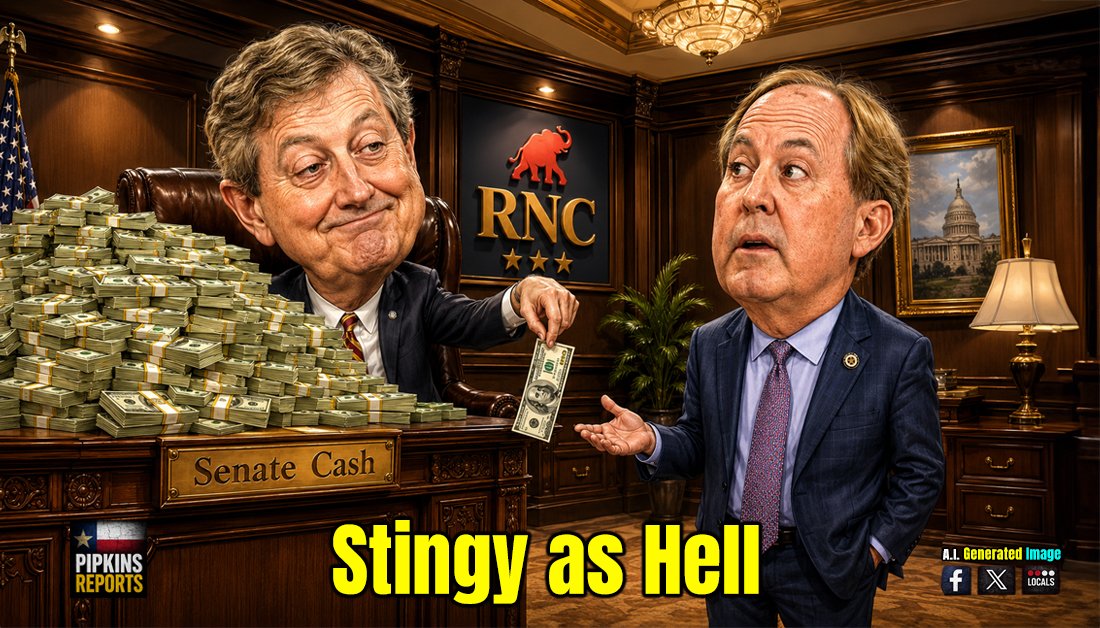
Senate Republicans Would Rather Risk Losing Texas Than Let Ken Paxton Into the Club

Washington, DC – Washington Republicans spent millions trying to keep Ken Paxton out of the U.S. Senate. Now that Republican voters have put him there as their nominee, some of those same Republicans appear considerably less interested in spending the money needed to keep the seat in Republican hands.
That creates an uncomfortable question for the Republican establishment: Would Senate leaders rather lose a Texas Senate seat than fully embrace the outsider who defeated one of their own?
The financial record suggests the question is not entirely hypothetical.
In 2020, when Republican Sen. John Cornyn faced Democrat MJ Hegar, Cornyn received the standard maximum contribution from the National Republican Senatorial Committee, $44,600, along with the sort of $5,000 to $10,000 leadership PAC contributions routinely exchanged among Republican senators. Cornyn ultimately raised roughly $34 million for the 2019-2020 cycle.
But the serious institutional money came from outside the campaign account.
In the closing weeks of the 2020 election, the Senate Leadership Fund, the super PAC closely associated with then-Senate Majority Leader Mitch McConnell, provided $1.2 million to Texans for a Conservative Majority, a super PAC supporting Cornyn. The group received approximately $4.3 million between mid-October and Election Day and spent heavily on advertising attacking Hegar.
Cornyn won by more than 10 percentage points.
Six years later, the circumstances are remarkably different.
Paxton defeated Cornyn in the May 2026 Republican runoff, ending the Senate career of one of Washington’s most established Republican politicians. Paxton now faces Democrat James Talarico, a state representative who has rapidly emerged as a formidable fundraiser and campaigner.
Through June 30, Federal Election Commission records showed approximately $62,000 in contributions from party committees and $157,500 from other political committees to Paxton’s principal campaign committee. Those numbers are a fraction of the party and PAC money that flowed into Cornyn’s campaign in 2020.
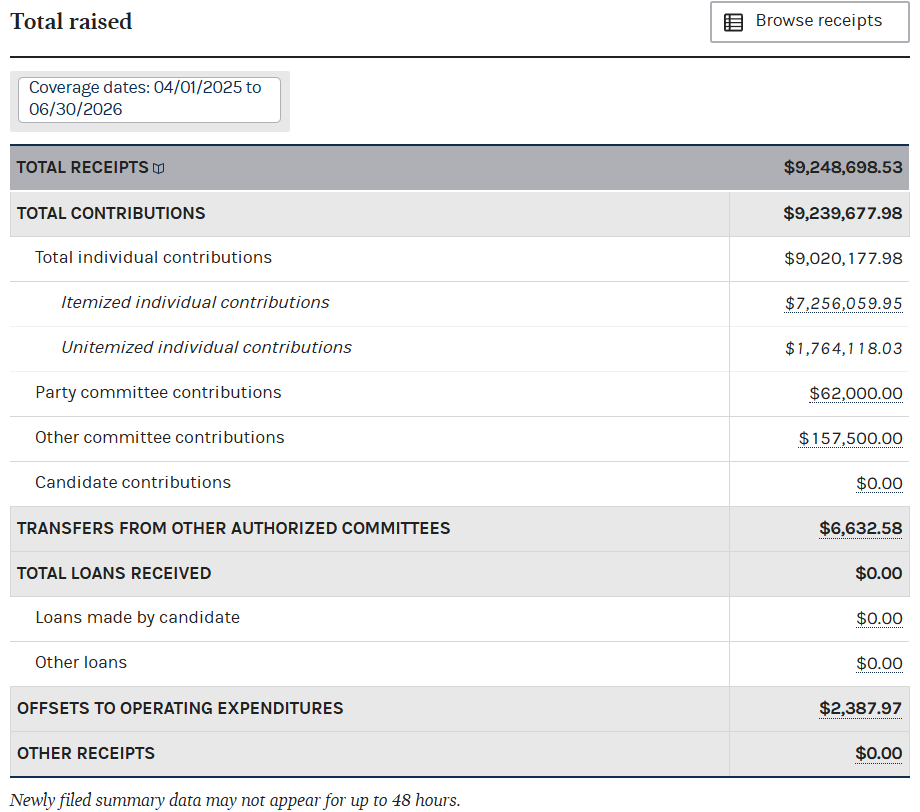
But Paxton has not been abandoned entirely.
After his victory over Cornyn, the NRSC established a joint fundraising committee involving Paxton, the Republican Party of Texas and other Republican committees. Republican senators have also begun appearing at fundraising events for him. More than 20 Republican senators co-hosted a Washington fundraiser for Paxton in July, and Sen. Ted Cruz has participated in efforts to raise money for his fellow Texas Republican.
But the Senate establishment’s financial commitment remains notably smaller than the one it made to protect Cornyn.
The contrast is even more striking because some of the same Republican organizations now expected to help Paxton spent millions trying to defeat him during the primary.
Senate Leadership Fund-aligned groups, including One Nation, poured millions into the effort to keep Cornyn in office. One Nation alone spent approximately $11 million opposing Paxton during the primary, while total spending by Cornyn’s allies reached tens of millions of dollars.
Now the primary is over. The voters have spoken. And the Republican establishment has a new problem.
James Talarico has money. Lots of it.
Republicans have publicly acknowledged the need for substantial additional spending in Texas, with some GOP figures pointing toward tens, and potentially hundreds, of millions of dollars that may be necessary to close the financial gap and protect the seat.
Enter Donald Trump.
Trump has now personally campaigned for Paxton. During his Aug. 27 visit to Houston, Trump appeared at a Republican National Committee fundraiser and publicly pledged to spend significant time and effort helping Paxton. Trump said, “I’m going to help Ken Paxton and I’m going to spend a lot of time in Texas.”
The distinction is that Trump’s Houston appearance was an RNC fundraiser, not a fundraiser specifically for Paxton’s campaign. Still, Republicans clearly view Trump’s involvement as potentially decisive, particularly because the president controls a massive political fundraising operation.
MAGA Inc., Trump’s principal super PAC, reported approximately $403.5 million in cash on hand at the end of July. According to Forbes, the organization had spent only about $21 million since January 2025, leaving Trump with an extraordinary amount of money available for the 2026 elections.
So far, however, there has been no publicly disclosed dollar commitment from MAGA Inc. specifically for Paxton’s Texas Senate campaign.
Trump has said his political operation will spend heavily on Republican candidates he considers worthy. His team has also tested possible messages against Talarico. But reporting from Puck.news and other outlets indicated that approval for major Texas spending had not yet been given.
That leaves Paxton in an unusual position.
The Republican president is publicly backing him. Republican senators are holding fundraisers for him. The NRSC has created a joint fundraising operation. Yet the major Senate establishment money has not arrived in anything approaching the scale deployed to protect Cornyn.
Meanwhile, Cornyn himself has reportedly been raising money for Republican Senate candidates in competitive states including New Hampshire, Michigan and Alaska rather than for Paxton in Texas. Cornyn has described Texas as a “black hole” for campaign cash.
There is a certain irony here.
Republican leaders were willing to spend millions to keep Cornyn in the Senate when Republican voters still had a choice. After those voters chose Paxton, the same establishment has been considerably slower to open its checkbook.
The question now isn’t whether Paxton belongs to the Washington Republican club…he clearly doesn’t.
The question is whether Senate Republicans are willing to risk losing Texas because they don’t like the man Texas Republicans chose to represent them.
For now, the money trail leaves that question hanging in the air. And with Talarico already raising and spending heavily, Republicans don’t have unlimited time to answer it.









*Update: This article has been updated to better explain the connection between our “Ideological Index” and our election model, which wasn’t outlined in our first edition.
Austin, TX – If the Texas Senate election were decided by ideology, turnout, and the assumptions laid out in the Pipkins Reports election model, Ken Paxton wouldn’t just beat James Talarico, he would beat him badly.
The Pipkins Reports model predicts Ken Paxton will defeat James Talarico approximately 55% to 45%, a Republican victory of about 10 percentage points.
More precisely, the model produces a 10.04 percentage point Paxton margin.
And, to be perfectly clear, this is an election model, not a polling forecast. We aren’t claiming to know what individual Texans will tell a pollster. We’re testing what happens if the electorate has the ideological composition and voting behavior specified in our model.
The Ideological Index
Pipkins Reports uses a scale running from -10 to +10, with 0 representing the political center.
Negative numbers indicate movement toward the political left. Positive numbers indicate movement toward the political right.
The scores are our analytical assessments, based on candidates’ public records and positions on major political issues, including taxation, government spending, abortion, guns, immigration, transgender policy, health care, education, criminal justice, energy, federalism and cultural issues.
That methodology produces the following historical comparison:
| Year | Democratic nominee | Ideological score, Democrat | Republican nominee | Ideological score, Republican | Ideological difference | GOP margin of victory |
|---|---|---|---|---|---|---|
| 2002 | Ron Kirk | -2.0 | John Cornyn | +5.0 | 7.0 | 11.90 pts. |
| 2008 | Rick Noriega | -3.5 | John Cornyn | +5.0 | 8.5 | 11.98 pts. |
| 2012 | Paul Sadler | -3.0 | Ted Cruz | +8.0 | 11.0 | 15.82 pts. |
| 2014 | David Alameel | -3.0 | John Cornyn | +5.0 | 8.0 | 27.20 pts. |
| 2018 | Beto O’Rourke | -6.5 | Ted Cruz | +8.0 | 14.5 | 2.56 pts. |
| 2020 | M.J. Hegar | -5.5 | John Cornyn | +5.0 | 10.5 | 9.64 pts. |
| 2024 | Colin Allred | -4.0 | Ted Cruz | +8.0 | 12.0 | 8.49 pts. |
| 2026 | James Talarico | -8.5 | Ken Paxton | +9.0 | 17.5 | TBD |
The historical election results come from the Texas Secretary of State and federal election records. For example, the 2018 official results show Cruz with 50.89% and O’Rourke with 48.33%, while the 2024 results show Cruz with 53.05% and Allred with 44.56%.
One thing jumps off the page. Immediately, we see that Talarico is considerably farther left than either Beto O’Rourke or Colin Allred.
Our index places O’Rourke at -6.5, Allred at -4.0 and Talarico at -8.5.
(As an additional point of reference, Jasmine Crocket rates at -9.0)
That assessment reflects more than party affiliation. Talarico has defended transgender children and, during a 2021 Texas House debate over transgender participation in school sports, said, “God is nonbinary,” while arguing that transgender children are made in God’s image.
He has also built a political message around progressive Christianity, reproductive rights, expanded government health care and economic policies that include raising taxes on billionaires. His campaign describes itself as fighting for working people and says the central divide is “top versus bottom.”
Paxton receives a +9.0 score in our index.
That creates a 17.5-point ideological separation, larger than any previous matchup in our comparison, but this is where our revised model gets serious.
Connecting the Index to the Voters
Texas Public Opinion Research surveyed 843 registered voters in August 2025 and asked respondents to place themselves on a 0-to-10 ideological scale, with zero representing very conservative and 10 representing very liberal.
The results were 43% conservative, 34% moderate and 24% liberal. Because those rounded numbers total 101%, we normalize them to 100%, producing:
42.574% conservative, 33.663% moderate, 23.762% liberal
But merely assigning conservatives to Paxton and liberals to Talarico isn’t enough. We put those voter blocs on the same ideological scale as the candidates.
For modeling purposes, we place the conservative bloc at +6, the moderate bloc at 0, and the liberal bloc at -6. Those positions are explicit model assumptions, not claims that every conservative Texan is exactly +6 or every liberal is exactly -6.
Now we calculate ideological distance.
Conservative voters
Paxton: +9.0
Conservative electorate: +6.0
Distance: 3.0
Talarico: -8.5
Conservative electorate: +6.0
Distance: 14.5
Paxton is much closer.
Liberal voters
Talarico: -8.5
Liberal electorate: -6.0
Distance: 2.5
Paxton: +9.0
Liberal electorate: -6.0
Distance: 15.0
Talarico is much closer.
Moderate voters
Talarico: -8.5
Moderate electorate: 0
Distance: 8.5
Paxton: +9.0
Moderate electorate: 0
Distance: 9.0
That is almost a dead heat.
And this is why our revised model does not simply hand every moderate to one candidate.
Turning Distance Into Votes
We use a simple inverse-distance formula. The candidate who is closer to a particular voter bloc receives the greater share of that bloc, with the difference determined by the candidates’ relative ideological distances.
Under that calculation:
| Voter bloc | Share of electorate | Paxton affinity | Talarico affinity |
| Conservative | 42.574% | 82.86% | 17.14% |
| Moderate | 33.663% | 48.57% | 51.43% |
| Liberal | 23.762% | 14.29% | 85.71% |
That produces an overall theoretical result of approximately:
Ken Paxton: 55.02%
James Talarico: 44.98%
Paxton margin: 10.04 percentage points
Add Five Percent More Voters
The model also assumes turnout will increase 5% over the previous midterm election.
Texas recorded 8,102,908 voters in the November 2022 general election, according to the Texas Secretary of State. A 5% increase produces a projected 8,508,053 voters in 2026.
We assume the additional voters have the same ideological composition as the existing electorate. Under those assumptions, the model produces approximately:
Ken Paxton: 4.68 million votes
James Talarico: 3.83 million votes
Paxton margin: approximately 854,000 votes
The additional turnout therefore changes the number of votes, but not the percentage relationship, because we’re assuming the new voters resemble the existing ideological distribution.
OPINION: Here’s Why I Think This Matters
Originally, we reported a much larger Paxton victory, but in my writing, I was conflating two separate models without bringing them together. Still, despite the large (18.8 point) spread presented in the math, I limited my prediction to 10 points…the smaller of the models that I omitted.
What is really important to remember is that Talarico is not Beto O’Rourke, he is much farther left and any election outcome will reflect this in the voter sentiment. He isn’t Colin Allred, either. He’s considerably farther left than Allred according to our index.
But Paxton isn’t Ted Cruz either; he is far more popular. He also far exceeds John Cornyn in populism, whom most Republicans now view as a full-tilt RINO. Paxton farther to the right than either of them in our model.
So we’re looking at two candidates sitting near opposite ends of the political spectrum, with a 17.5-point ideological gap between them.
The model says that gap favors Paxton because Texas has a larger conservative bloc, while Talarico dominates the liberal bloc and comes surprisingly close to Paxton among moderates.
If Talarico can pull substantially more moderates than this model assumes, the race tightens. If Paxton performs better among moderates or holds conservatives more completely, the margin expands.
That’s the beauty, and the limitation, of an election model. Of cource, it doesn’t tell us what Texans will actually do. It tells us what happens when we make our assumptions explicit and then follow the math wherever it leads.
Right now, our revised model leads to a very simple conclusion:
Ken Paxton 55.0%
James Talarico 45.0%
Projected Republican victory: approximately 10 points.
But in November this will no longer be theoretical. The assumptions will either be proven correct … or not.

Fate, TX – The race to fill the vacant Fate City Council Place 1 seat vacated by the recall of Codi Chinn, will consist of four candidates. Randy Long, Stephanie Delaine Adams, Joshua Martin and Donovan Heinrich.
Randy Long is a serves as the Rockwall County director for True Texas Project, a conservative grassroots organization.
Stephanie Delaine Adams served 12 years on the Rockwall ISD Board of Trustees, including two years as board president from 2017 to 2019. She is now a Realtor.
Joshua Martin has lived in Fate for approximately six years and is a recruiting manager with QXO. He previously served as president of the Old Shepard Place neighborhood association in Plano.
Donovan Heinrich previously ran for Fate City Council, Place 5, in 2021, receiving 288 votes, or 30.48%, against eventual winner Jim DeLand.
More to follow on each candidate in the upcoming days.
Election
Texas Senate Hopeful James Talarico Shared Pride Event Stage With 11-Year-Old Child Drag Performer

Federal Court Upholds State Limits on Minors at Adult Drag Shows
Taylor, TX – A federal appeals court has just upheld a Florida law restricting minors from attending certain adult live performances, including some drag shows. Within hours of that ruling, renewed attention was focused on Texas Democratic U.S. Senate candidate James Talarico after reports resurfaced showing he headlined a 2021 Pride fundraiser featuring an 11-year-old child drag performer promoted as one of the event’s main attractions.
On Tuesday, the U.S. Court of Appeals for the 11th Circuit ruled in HM Florida-ORL, LLC v. Secretary of the Florida Department of Business and Professional Regulation, allowing Florida to enforce its law restricting minors from attending certain adult live performances. Florida Attorney General James Uthmeier announced the decision, calling it a victory for protecting children. The ruling does not prohibit drag performances for adults, but it recognizes that states may impose limits when minors are involved.
The timing has drawn renewed scrutiny to Talarico’s record as he campaigns for the U.S. Senate against Texas Attorney General Ken Paxton.

According to promotional materials first highlighted by the Washington Free Beacon, Talarico was a featured speaker during Taylor PRIDE’s June 26, 2021 fundraiser in Taylor, Texas. The event was organized to raise money for “rural LGBTQ communities” and included live music, Drag Story Hour, adult drag performers, and an 11-year-old performer using the stage name “Kween Kee Kee.”
Taylor PRIDE advertised the child as “the absolute cutest & youngest of our drag performers.” Promotional posts stated the child would perform a drag routine and host “Kee Kee Storytime,” where children would participate in Pride-themed craft activities. The event was held at Texas Beer Company.
Photographs published from the event show Talarico addressing attendees from the stage and posing with participants. Additional photographs and video posted publicly show Kween Kee Kee, a local preteen named Keegan, performing in a shimmering blue dress, platinum blonde wig, and theatrical makeup during what organizers described as a Youth Drag Show. One attendee shared video of the child performing the splits before the audience.
The fundraiser also featured several adult drag performers, including Brianna Brinxx, Belladonna Dior, Felecia Enspire, and a performer using the stage name Sedonya Face.
Following criticism from conservative activists who protested the event, Taylor PRIDE defended the festival on social media. The organization rejected claims that the event was sexually explicit or exploitative and encouraged the public to review photographs from the event and decide for themselves.
Talarico’s campaign did not respond to requests for comment from the Washington Free Beacon regarding his participation.
The resurfaced event adds to a broader record that Republicans have highlighted throughout Talarico’s political career. While serving in the Texas House, Talarico opposed legislation restricting drag performances in the presence of children and argued lawmakers should avoid harming what he described as Texas’ drag performers. He has also opposed Republican-backed legislation restricting certain transgender medical treatments for minors and has frequently spoken in support of LGBTQ causes.
More recently, however, Talarico has attempted to present himself as a more moderate statewide candidate. He has described previous remarks, including referring to God as “nonbinary,” as “cringey” and has removed some progressive messaging from campaign materials as he seeks to broaden his appeal beyond Democratic primary voters.
The renewed attention comes as cultural debates surrounding children and drag performances continue playing out both politically and legally. Florida’s appellate court victory represents one of the most significant recent rulings supporting a state’s authority to restrict minors from attending certain adult-oriented live performances, even as litigation over similar laws continues elsewhere.
You must be logged in to post a comment Login