Connect with us

Published

on

Fort Worth, TX – The Texas Liberty Journal

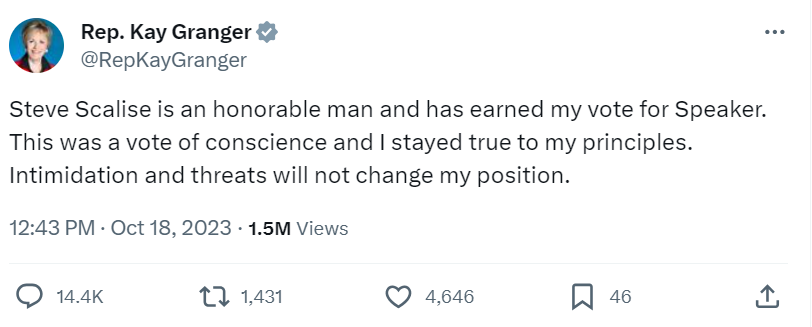
Kay Granger, a prominent figure in Texas politics, has found herself at the center of a political storm due to her recent vote for House Majority Leader Steve Scalise as Speaker of the House, rather than Tea Party supporter Jim Jordan. Granger, who represents Texas’ 12th Congressional District, is the Chair of the influential House Appropriations Committee. Her claim that her vote was an act of conscience, demonstrating her unwavering commitment to an “honorable man,” has raised eyebrows. But is there more to this story than meets the eye?

Born on January 18, 1943, Kay Granger will be 81 years old upon potential reelection in 2024, a fact that has raised questions about her long-standing political career and her capacity to adapt to the changing political landscape. Granger’s impressive political journey includes roles such as:

  • 1965: Graduated from Texas Wesleyan University with a B.S.
  • 1981-1989: Zoning Commission, Fort Worth, Texas
  • 1989-1991: City Council, Fort Worth, Texas
  • 1991-1995: Mayor of Fort Worth, Texas
  • 1997-Present: U.S. Representative from Texas’ 12th Congressional District

Granger’s entry into the world of national politics occurred in 1996 when Congressman Pete Geren announced his retirement. Both the Democratic and Republican parties actively courted Granger to run for his seat. At the time, Republicans were optimistic about their chances in Texas’s 12th congressional district, which had once been represented by Democratic Speaker of the House Jim Wright. However, legislative redistricting after the 1990 census had added areas with more Republican residents, changing the district’s political landscape.
Granger ran as a Republican candidate and secured victory with 56% of the vote against Democratic nominee Hugh Parmer, another former Fort Worth mayor. She went on to win reelection in 1998 and faced significant opposition only in 2000. In 2008, Granger defeated Democratic nominee Tracey Smith with a resounding 67% of the vote.

Throughout her political career, Granger has held influential positions, published a book titled What’s Right About America, Celebrating Our Nation’s Values in 2006, and been reelected to her sixth term in Congress. She also achieved the position of Conference Vice Chair, the fourth-ranking position among House Republicans. Granger’s notable roles have included chairing the House Appropriations Subcommittee on State-Foreign Operations, serving on the United States House Committee on Appropriations’s Subcommittee on Defense (as the first woman to do so), and the Labor, Health, Human Services, and Education Subcommittee. Additionally, she has served as a House Deputy Whip.

In the realm of national politics, Granger endorsed former Massachusetts governor Mitt Romney in the Republican presidential primary, showcasing her support for candidates who align with her political ideology.

Now, let’s revisit the recent controversy. Granger’s vote for Speaker of the House raised questions about whether her loyalty to donors in the military-industrial complex influenced her decision more than her “conscience.” Her top donors, eight out of the 15, are major players in the defense and aerospace industry, including L3Harris Technologies, Leidos Inc, Elbit Systems, Lockheed Martin, GE Aerospace, Textron Inc., Huntington Ingalls Industries, and Anduril Industries. These companies are no small players:

L3Harris Technologies:

With $17 billion in annual revenue, L3Harris Technologies is a significant player in the defense industry, positioning themselves as a “Trusted Disruptor in defense.”

Leidos Inc:

Based in Reston, Virginia, Leidos Inc specializes in defense, aviation, information technology, and biomedical research, contributing to various aspects of national defense.

Elbit Systems of America, LLC:

A wholly-owned subsidiary of Elbit Systems Ltd., they provide technology-based systems for diverse defense and commercial applications.

General Electric Aerospace:

GE Aerospace is a world-leading provider of jet engines, components, and integrated systems for both commercial and military aircraft.

Huntington Ingalls Industries:

HII is a global, all-domain defense provider, specializing in powerful ships and technologies that safeguard various domains.

Textron Inc:

A well-known multi-industry company, Textron Inc leverages its global network of aircraft, defense, industrial, and finance businesses to provide innovative products and services.

Anduril Industries:

This California-based defense contractor, founded by Oculus VR founder Palmer Luckey and Founders Fund partner Trae Stephens, focuses on identifying problems and rapidly delivering solutions.

This controversy underscores the ongoing debate about the role of campaign contributions and the influence of interest groups in shaping the decisions of elected officials. As Granger’s age and extensive political history come under scrutiny in the lead-up to the 2024 elections, citizens of Texas’ 12th Congressional District and political observers across the nation will undoubtedly be watching closely to see how these factors will impact Granger’s future in American politics.

On the other hand …

Jim Jordan, the Ohio Republican Representative and Tea Party supporter, has been a vocal advocate for military spending cuts, leaving no stone unturned as he boldly states that “everything” is on the table, including what he terms as ‘woke’ policies. As the chairman of the House Select Subcommittee on the Weaponization of the Federal Government, Jordan has announced a significant probe into nearly a dozen unauthorized record disclosures made by the U.S. Air Force. As a founding member of the hardline conservative Freedom Caucus, Jordan’s approach to military assistance and foreign policy is notably different from Granger’s. He has consistently voted against various bills offering assistance to Ukraine since the Russian invasion began in February 2022. However, he did support an early 2022 proposal to send certain equipment to Kyiv as part of a lend-lease deal. Jordan’s positions and actions present a contrasting perspective on critical matters related to defense and foreign policy.

On the other side of the political spectrum, Steve Scalise’s association with certain donors sheds light on his financial ties. His “F” rated Liberty Score from Conservative Review suggests a misalignment with the conservative base. Scalise’s top donors, including The GEO Group, Inc., which invests in private prisons and mental health facilities, healthcare companies like Ochsner Health System, law firms, banking companies, large construction companies, and energy giants such as Valero Energy, highlight the diversity of interests contributing to his campaign funds. These associations offer a glimpse into the financial influences that may have played a role in his political decisions and priorities.


Michael Pipkins focuses on public integrity, governance, constitutional issues, and political developments affecting Texans. His investigative reporting covers public-record disputes, city-government controversies, campaign finance matters, and the use of public authority. Pipkins is a member of the Society of Professional Journalists (SPJ). As an SPJ member, Pipkins adheres to established principles of ethical reporting, including accuracy, fairness, source protection, and independent journalism.

Featured

Clintons in Contempt

Published

on

Bill and Hillary Clinton

WASHINGTON, DC — The Clinton political machine, long accustomed to dictating the terms of engagement, ran headlong this week into an institution that does not negotiate its constitutional authority. In a rare and politically explosive move, the House Committee on Oversight and Government Reform voted on a bipartisan basis to advance contempt of Congress resolutions against former President Bill Clinton and former Secretary of State Hillary Clinton for defying lawful subpoenas tied to the Jeffrey Epstein investigation.

The January 21 vote clears the way for the full House to consider whether to formally hold the Clintons in contempt, a step that could result in criminal referrals to the Department of Justice. While neither Clinton has been accused of a crime related to Epstein, lawmakers framed the issue more narrowly and more starkly: whether elite political figures are subject to the same compulsory process as everyone else when Congress demands sworn testimony.

The subpoenas arise from Congress’s ongoing investigation into how Epstein operated a vast international sex trafficking network for years while avoiding meaningful accountability. Epstein allegedly died by suicide in a New York jail in 2019 as he awaited trial, but subsequent court filings and document releases revealed his deep and troubling access to political, financial, and cultural power centers. Bill Clinton, and numerous other influential figures appear in those records.

Oversight Committee Chairman James Comer, R-Ky., said the subpoenas issued to the Clintons were approved unanimously last summer by Republicans and Democrats alike. Bill Clinton’s deposition was initially scheduled for October 14, 2025, then moved to December 17, and later reset for January 13, 2026. Hillary Clinton followed a similar trajectory, declining multiple proposed dates before failing to appear for a January 14 deposition. In each instance, the committee said it offered flexibility if the Clintons would propose firm alternative dates. They did not.

Instead, the Clintons’ attorneys countered with what Comer described as an unacceptable proposal. Under that offer, Comer would travel to New York to speak with Bill Clinton alone, without placing him under oath, without producing an official transcript, and without allowing other members of Congress to participate. Comer rejected the proposal, arguing that it amounted to special treatment unavailable to any other witness.

Subpoenas are not mere suggestions,” Comer said during the hearing. “They carry the force of law and require compliance.

The committee emphasized that sworn, transcribed testimony is essential to transparency and accountability. Oversight investigators have already released transcripts of interviews with former Attorney General Bill Barr and former Labor Secretary Alex Acosta, both of whom had direct dealings with Epstein during earlier stages of his prosecution. Allowing the Clintons to substitute informal conversations or written statements, Comer argued, would erode the integrity of the investigation and leave the public dependent on competing recollections rather than a fixed record.

Democrats on the committee were divided. Some argued the subpoenas lacked a legitimate legislative purpose, while others conceded that Congress cannot selectively enforce its authority based on party loyalty. Rep. Robert Garcia of California said no current or former president should be categorically immune from oversight. Several Democrats stressed that full transparency in the Epstein case demands uniform standards, even when politically inconvenient.

Recent history undercuts claims that contempt powers are merely symbolic. Steve Bannon, former Trump campaign and White House strategist, was convicted in 2022 of contempt of Congress after defying a subpoena from the House January 6 committee. Peter Navarro, another former Trump White House adviser, was likewise charged and later imprisoned after refusing to provide testimony to the same panel. Both cases demonstrated that contempt citations can and do result in criminal penalties, including incarceration.

The Clintons have argued through counsel that the subpoenas are invalid and that they possess little relevant information. In a letter to the committee, they described Epstein’s crimes as “horrific” and said they had cooperated in good faith by offering written declarations outlining their limited interactions with him. The committee rejected that approach, noting that Hillary Clinton’s tenure as secretary of state gives her direct knowledge of federal anti trafficking initiatives and that both Clintons maintained documented personal and social ties to Epstein and his associate Ghislaine Maxwell.

Historically, contempt of Congress has been used sparingly, particularly against high profile political figures. No former president has ever been successfully compelled to testify before Congress. However, legal analysts note that the Clintons are private citizens and cannot claim executive privilege protections that might apply to a sitting president.

The contempt resolutions now move to the full House, where passage will require a majority vote. Even if approved, the Justice Department retains discretion over whether to pursue prosecution. That uncertainty has not dampened the broader significance of the moment.

At its core, the dispute is not about partisan score settling or retroactive guilt. It is about whether Congress’s investigative power means what the Constitution says it means. For decades, the Clintons operated within a political ecosystem that treated them as exceptions. The Oversight Committee’s vote suggests that era may be ending.

If subpoenas bind only the unfavored and the powerless, they bind no one at all. The House must now decide whether the rule of law applies equally, even when the names on the subpoena are Clinton.

Continue Reading

Election

Texas AI Attack Ad Sparks Outrage After Showing Jasmine Crockett and John Cornyn Dancing “Washington Waltz” in Heated Senate Race

Published

on

Crockett & Cornyn Dance

AUSTIN, Texas — A controversy over the use of artificial intelligence in political advertising has erupted in the Texas U.S. Senate race, after a newly released AI-generated video depicts Congresswoman Jasmine Crockett and Senator John Cornyn dancing together in stylized scenes meant to satirize their relationship in Washington, D.C. The ad, issued by Texas Attorney General and GOP Senate contender Ken Paxton’s campaign, has drawn criticism from across the political spectrum and underscored growing concerns about the use of synthetic media in elections.

The ad, which circulated online beginning around January 16, 2026, shows AI-rendered versions of Crockett and Cornyn engaged in choreographed dancing inside what appears to be a dance hall and in front of the U.S. Capitol. According to reporting, the visuals are meant to reference past remarks in which Cornyn described Crockett as his “dance partner” in the Senate in a metaphorical sense, highlighting their occasional bipartisan cooperation.

What Happened

Ken Paxton’s campaign released the ad titled “Partner” as part of his broader effort to define Cornyn as a weak Republican and to draw contrasts with other candidates in the GOP Senate primary. The video pairs the AI imagery with music and imagery that suggests a partnership out of step with conservative values, implying that Cornyn’s willingness to work across the aisle weakens his Republican bona fides.

The ad appears on social media platforms rather than traditional television and it includes a small disclaimer noting that parts of the video were generated using artificial intelligence. A move supporters say aims to satisfy transparency concerns even though Texas law does not require such disclosure outside of defined electioneering periods.

The Candidates Involved

  • Jasmine Crockett, a Democratic congresswoman from Texas’ 30th District, which has been redefined by the Texas Legislature, is running in the Democratic primary for the U.S. Senate seat currently held by Cornyn. She has toured parts of the state campaigning on issues such as opioid crisis intervention, hunger, and broader economic concerns. She is currently running behind her Democratic challenger, James Talarico.
  • John Cornyn is the incumbent Republican U.S. Senator seeking re-election in 2026. Polling shows him falling behind his rival, Ken Paxton, and may even come in third, behind Wesley Hunt.

Reactions From Campaigns

Crockett’s campaign has pushed back against Paxton’s framing, with spokespeople noting that the focus on bipartisanship is not a substantive attack on her record but an attempt to weaponize generative media against her. Supporters say Crockett’s actual work on issues like the opioid crisis and food insecurity demonstrates cross-party cooperation in service of Texans, not political theater.

Cornyn’s team has so far declined to directly comment on the ad, according to reporting, leaving a vacuum that has allowed digital discourse to flourish largely unchecked on social platforms.

Legal and Ethical Implications

The use of AI to depict real political figures doing things they never actually did raises significant legal and ethical questions. Texas law includes provisions that make it a misdemeanor to distribute a “deep fake” video within 30 days of an election with intent to influence the outcome, although enforcement of such statutes is untested and subject to interpretation.

Experts and advocates warn that generative content in political advertising could mislead voters, erode trust in legitimate campaigning, and outpace current regulatory frameworks. There is no federal requirement that ads containing AI-generated content carry clear labels, and states vary widely in how — or whether — they regulate synthetic media in political contexts.

Public and Political Response

The ad has quickly become a topic of discussion on digital forums and social media. Commenters have described it variously as humorous, cringe-inducing, or disturbing, with discussions often centering on broader fears that AI will drown political discourse in manipulated content. Some observers on platforms like Reddit note that the synthetic depictions could backfire on Paxton, especially among voters who see bipartisanship as a virtue.

Republican and Democratic voters alike have expressed frustration online that artificial intelligence is being used to blur the line between satire and misinformation in an already polarized political environment.

Context Within the 2026 Senate Race

The Texas Senate contest in 2026 remains highly competitive. Polls show Cornyn’s support varying across matchups against Democratic contenders, including Crockett and others, with some surveys indicating narrow leads or possible runoff scenarios in the Republican primary.

This ad is one of the earliest signals that the 2026 cycle will ably test the boundaries of campaign messaging technology, and it arrives amidst broader debates about whether legislative or judicial action is needed to govern the use of AI in political communications.

Why This Matters

The “Washington Waltz” style ad exemplifies how rapidly advancing technology is reshaping political campaigns — for better or worse. It forces voters and lawmakers to ask whether current laws are equipped to preserve truthful discourse, or whether new guardrails are required to prevent deceptive content from influencing elections.

For constitutional conservatives and civic activists alike, this incident highlights a deeper tension between free speech protections and the need for electoral integrity. The stakes extend beyond the characters in this particular Senate race; they speak to a future in which digital manipulation can construct realities that never occurred.

As the 2026 primaries approach, voters in Texas — and observers nationwide — will be watching not just who wins or loses, but how campaigns wield revolutionary tools of persuasion in a hypercharged political era.

Continue Reading

Business

California’s Billionaire Wealth Tax Sends Rich People Fleeing to Texas and Florida

Published

on

Newsome Causes Billionaires to leave California

Google Co-Founder Heads to Florida

Sacramento, CA. – A seismic shift in California’s economic landscape is quietly underway as lawmakers and union backers push a controversial billionaire wealth tax. What was pitched as a modest 5 percent levy on the ultra-wealthy has exposed more serious threats to innovation and property rights — and it has already driven one of the state’s most famous founders out of California. Google co-founder Larry Page has relocated to Florida, driven in part by provisions in the tax that could assess billions of dollars on unrealized gains tied to super-voting Class B stock.

The proposal — officially titled the 2026 Billionaire Tax Act — would impose a one-time 5 percent charge on the net worth of individuals whose worldwide assets exceed $1 billion as of January 1, 2026. Supporters frame it as a targeted revenue source for healthcare, food assistance, and education, critics warn the tax’s mechanics could reshape American capital formation.

What the Proposal Actually Does

Under the initiative, wealth is defined as total global net worth, including publicly traded stocks, private business interests, intellectual property, and other assets — excluding most real estate and certain retirement accounts. Rather than taxing only realized income, the tax includes unrealized gains in asset value. That means founders may owe tax on increases in stock value they have never sold.

The language of the proposal goes a step further: it treats voting power as though it were equivalent to economic ownership for founders with dual-class stock structures. In Silicon Valley, it is common for founders to hold Class B super-voting shares that confer control with far less economic interest than voting interest. Under the initiative’s valuation rules, a founder with 3 percent of a company’s economic shares but 30 percent voting control could be treated, for tax purposes, as owning 30 percent of the company — multiplying their taxable wealth many times over.

Economists have pointed out that this “voting power equals ownership” assumption effectively taxes phantom wealth — value that exists on paper but is not proportionate to actual economic ownership. The result: tax bills far greater than a simple 5 percent of net worth might suggest, particularly for founders of tech companies structured around dual-class stock.

Exodus of Billionaires Begins

The reaction among California’s wealthy has been dramatic. Larry Page, whose super-voting Class B shares give him outsized control at Alphabet, has purchased multiple high-value properties in Florida and moved many business entities out of California. His relocation comes amid widespread concerns that the wealth tax could penalize founders disproportionately based on voting shares rather than actual economic stake.

Venture capitalist Peter Thiel has also publicly mobilized against the tax, donating millions to efforts to defeat it and shifting aspects of his business operations to Miami. Other tech leaders and investors are reconsidering their California footprint, with some establishing offices or residences in states like Texas or Florida.

Economic and Legal Concerns

Economists and legal scholars caution that enforcing a tax on unrealized gains is inherently complex. Valuing privately held assets and dual-class stock structures invites disputes and litigation. The retroactive assessment based on residency at a fixed date could expose residents to significant tax bills even if they had intended to leave the state before the tax was implemented.

Critics also argue that using voting power as a proxy for economic value could violate constitutional protections against uncompensated takings, as it effectively treats control rights — not purely economic interest — as taxable property. Legal challenges are almost certain if the measure qualifies for the ballot and is approved by voters.

Political Clash

Supporters, including union leaders and some progressive advocates, say the tax would help fill budget gaps in healthcare and social services created by federal spending cuts. They maintain that the ultra-wealthy have benefited disproportionately from California’s economy and should contribute more.

Governor Gavin Newsom (D), has distanced himself from the proposal, warning that it threatens investment and could accelerate capital flight. Business groups such as the California Chamber of Commerce and the California Business Roundtable have echoed those warnings, describing the tax as a “dangerous wealth tax” that could harm the state’s competitiveness.

Broader Implications

California’s billionaire tax debate has quickly transcended local politics to become a national test case. If approved by voters in November 2026, it could encourage similar initiatives elsewhere, particularly in high-tax states. At the same time, the backlash has highlighted the risks of taxing unrealized gains — a feature that economists and tax policy experts say is untested and could disrupt capital formation.

For states like Texas and Florida, which champion low taxes and economic freedom, California’s experiment presents both a contrast and an opportunity. As capital and executives reassess their domiciles, the business climate and economic growth of states without such wealth taxes may benefit.

Larry Page’s move to Florida is not just a personal choice. It is a symbolic indicator of where capital flows in response to policy. Once talent and wealth leave, they seldom return. California’s experiment in wealth taxation should give pause not only to its voters but to every state considering similar schemes.

Sources:
Tax Foundation, “The Proposed California Wealth Tax Is Far Higher than 5 Percent,” January 2026.
California Attorney General Initiative Text, “2026 Billionaire Tax Act.”
Business Insider, “Larry Page Continues His California Exile with Florida Property Purchases,” January 2026.
Yahoo Finance, “Peter Thiel’s $3 Million Donation to Defeat California Wealth Tax,” January 2026.
WebProNews, “Dual-Class Voting Share Valuation Sparks Silicon Valley Outrage,” January 2026.

Continue Reading