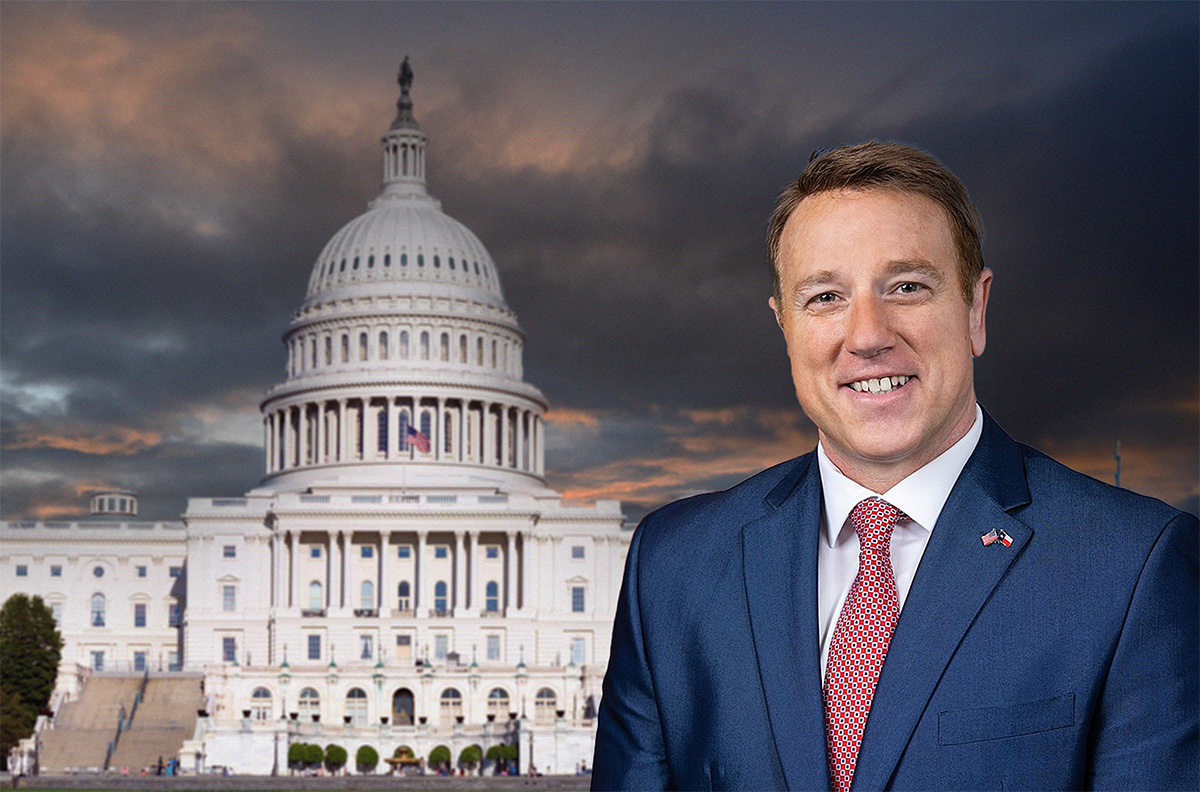
Pat Fallon’s Controversial Choice: Voting to Retain Kevin McCarthy as Speaker of the House
Representative’s Decision Sparks Questions About Accountability
In a surprising turn of events on Tuesday, U.S. House Representative Pat Fallon cast his vote to support Kevin McCarthy’s continued leadership as Speaker of the House. This decision has raised significant questions about his commitment to accountability and responsive leadership.
After the decision to remove Speaker McCarthy, U.S. House Representative Patrick McHenry of North Carolina was appointed as speaker pro tempore, and will oversee the upcoming vote and selection of the chamber’s next speaker.
Eight Republicans, led by GOP Representative Matt Gaetz, joined Democrats in a historic move to remove McCarthy from his position. McHenry’s decision to adjourn the House, sending members home, has added further complexity to the situation.
Texas’ Fourth Congressional District, encompassing twelve diverse counties, including Rockwall, Bowie, Collin, Denton, Fannin, Grayson, Hopkins, Hunt, Lamar, Rains, Red River, and more, is represented by Pat Fallon. His vote in favor of McCarthy, despite earlier statements about the need for accountability mechanisms, has left constituents perplexed.
During an interview with Newsmax in January, Fallon had voiced his willingness to back McCarthy as House Speaker if a new rule was introduced, allowing five members of the House majority to force a vote of no-confidence in their leader. “So, if Kevin McCarthy does not lead boldly, we can throw him out. There’s a mechanism to make sure he keeps his word. So, I’m ready to get going. Let’s go,” Fallon declared during the interview.
However, it’s essential to note that since that interview, the rule in question underwent a substantial change. Originally, it required five votes to initiate a vote of no-confidence. But this rule was subsequently amended to require just one vote, making it significantly easier for members to challenge leadership decisions.
This change in the rule underscores the gravity of Fallon’s decision to support McCarthy, as the bar for accountability had been lowered considerably. It raises valid questions about the alignment between his earlier promises and his ultimate vote.
Fallon’s political trajectory has been marked by his staunch adherence to conservative values and fiscal responsibility. Since his grassroots campaign victory in 2009 for a seat on the Frisco City Council, he has consistently voted against tax rate increases and budget proposals that would escalate municipal debt.
In subsequent years, Fallon secured victories in Texas House District 106 and state Senate District 30, championing conservative causes and co-authoring legislation allowing students and employees of independent school districts to say “Merry Christmas” instead of the secular “Happy Holidays.”
During a recent interview with Newsmax, Pat Fallon expressed his bewilderment at the decision to adjourn the House and emphasized the importance of fulfilling their responsibilities. He pressed for the prompt selection of a new House Speaker. Curiously, he did not explicitly mention his vote in favor of retaining Speaker McCarthy during this interview.
Pat Fallon’s choice to vote in favor of Kevin McCarthy’s continued leadership in the House has ignited debate and skepticism among his constituents. Many are now questioning whether this decision aligns with his professed dedication to accountability and responsive leadership within the Republican Party. As the political climate continues to evolve, the fallout from Pat Fallon’s controversial decision will undoubtedly remain a topic of discussion. Whether this vote will have long-term implications for his standing within the Fourth Congressional District and the broader political landscape remains uncertain. Persistent questions about the alignment between his words and actions cast a shadow over his commitment to holding leadership accountable.
*Update: Pat Fallon Responds to our Inquiry.
Election
Jasmine Crockett’s District Got a Hard Reset – and She’s NOT in it Anymore.
Dallas, TX – Fresh off her now-infamous CNN appearance where Rep. Jasmine Crockett sneered about “white tears” without so much as a raised eyebrow from the anchor, the freshman firebrand has bigger problems than cable-news backlash. The new congressional map — PLANC2333, has surgically removed Crockett from Texas District 30. Yes, her own district. The one she’s held for less than two years.
Let’s be clear: this isn’t a minor tweak. This is a full-on redistricting gut punch.
Under the old lines, TX-30 was a comfortably Democratic, majority-minority seat that stretched from downtown Dallas south almost to Red Oak—an anchor of Black political power in North Texas. 42% Black, 35% Hispanic, 16% White. Median income $71k. Poverty rate is pushing 16%. A district drawn, let’s be honest, to elect someone exactly like Jasmine Crockett, who would become the embodied spirit of the once race-baiting Shelia Jackson Lee (deceased).
The new TX-30 snakes along I-30 through downtown, clips the eastern edge at I-175, and hugs the Dallas County line to the south. The areas carved out (shown in red on Pipkins Reports map) were the heart of Crockett’s old base—south Dallas neighborhoods that reliably turned out for her. In their place (blue on the map) come whiter, more affluent precincts to the west. The demographic shift is brutal: Black voting-age population down, Hispanic share down, White share up. Translation? TX-30 just became a swing district masquerading as a D+20 stronghold.
And then there’s the real kicker: District 33, currently held by Marc Veasey, now swoops in like an upside-down U, wrapping around the new TX-30 and swallowing huge chunks of downtown Dallas. That new TX-33? It’s a demographic kaleidoscope—White, Black, and Hispanic populations are almost perfectly balanced. Turnout will decide everything. Good luck predicting who wins that one.
If Crocket chooses to continue on in TX-30, she is likely to face a tough road. This is what happens when you spend your first term auditioning for MSNBC panels instead of building goodwill back home. You rant about “white tears” on national television, you mock colleagues across the aisle, you forget that even safe seats can be made unsafe with a few strokes of a GIS pen. The Texas Legislature has sent a message, and it’s written in precinct-level data: play stupid games, win stupid prizes.
The Texas Secretary of State confirms the candidate filing window for the 2026 primaries opened Saturday, November 8, and closes at 6:00 p.m. on Monday, December 8, 2025—Crockett, Veasey, and every other incumbent now playing musical districts have less than a month to decide where (or if) they’re running.
Constitutional conservatives have been warning for years that the era of bulletproof, identity-carved districts was coming to an end. The courts demanded “compactness” and “communities of interest.” The GOP in Austin finally delivered. And the first casualty? A loudmouth progressive who thought performative rage was a substitute for legislating.
Marc Veasey’s seat is scrambled too, by the way. In fact, half of Dallas just woke up in a different congressional universe.
Featured
National Trust Tries to Bully the President
The National Trust for Historic Preservation (NTHP), a private 501(c)(3) nonprofit, sent a sharply worded “demand” letter to the National Park Service (NPS) on October 21, aiming to halt President Trump’s bold plan to demolish the White House’s East Wing for a grand 90,000-square-foot ballroom addition.
The move, meant to modernize the People’s House for state dinners and global summits, has preservationists clutching their blueprints in horror. But this isn’t about saving history—it’s about a private club flexing muscle it doesn’t have, trying to strong-arm an Executive Branch that answers only to the Constitution and the American people.

Let’s get one thing straight: The NPS, which oversees the White House as a national historic site, isn’t a free-floating bureaucracy taking orders from self-appointed guardians of granite. It’s a cog in the Department of the Interior, a cabinet-level agency nestled firmly within the Executive Branch. Article II of the Constitution vests the President with singular authority to administer the government, meaning the NPS takes its marching orders from 1600 Pennsylvania Avenue, not a donor-funded NGO with a fancy letterhead. The President doesn’t need a permission slip from anyone—least of all a group whose congressional charter from 1949 (Title 54 U.S.C.) grants them zero enforcement power, only a soapbox to “facilitate public participation” in preservation debates.
The White House, battered by time and tight quarters, needs this upgrade. The East Wing, a 1940s wartime add-on, wasn’t built for 21st-century diplomacy. Trump’s team, riding a fresh mandate from 74 million voters, broke ground on October 20 to clear the way for a ballroom that can host world leaders without elbowing ambassadors into the Rose Garden. It’s a practical fix, not a wrecking ball to history. Yet the NTHP, led by President and CEO Carol Quillen, fired off their letter to the NPS, the National Capital Planning Commission (NCPC), and the Commission of Fine Arts, demanding a “pause” until the project undergoes “legally required public review processes.” Their fear? The new wing might “overwhelm” the White House’s aesthetic balance, as if a President’s vision for his own residence needs a focus group’s approval.

This is where the NTHP’s overreach gets laughable. Their charter, signed by Harry Truman, makes them a nonprofit cheerleader for preservation, not a coequal branch of government. They’re a membership organization—think country club for history buffs, bankrolled by corporate sponsors and tax-deductible donations. They partner with the NPS on grants and advocacy, sure, but that’s like a booster club claiming veto power over the coach’s playbook.
The NPS, managing $62 million in Historic Preservation Fund grants for FY25, answers to Congress’s purse and the President’s pen, not Quillen’s pleas. The NCPC and CFA? They’re advisory bodies, not czars. Their input on D.C. federal projects, born from post-WWII urban planning laws, carries weight only as far as the President allows. For the White House itself? That’s executive turf, exempt from the zoning red tape that snarls lesser projects.
Quillen’s letter drips with sanctimonious concern, urging “transparency and broad input from the public.” Translation: Let us, the enlightened few, gatekeep the nation’s heritage. This isn’t advocacy—it’s audacity. The NTHP’s claim to speak for “the American people’s investment” in the White House ignores the 74 million who voted for action, not paralysis. Their cozy ties to the NPS—shared programs, joint field offices—make this less a principled stand than a power play by insiders who think they own the narrative on “historic.” The American Institute of Architects piled on in August, fretting about “scale and balance,” but their opinions, like the NTHP’s, are just that—opinions, not edicts.
Conservatives know this game. It’s the same soft tyranny we’ve seen in Texas, where unelected boards and NGOs try to smother progress with red tape. From Austin’s zoning wars to the Alamo’s restoration fights, we’ve learned that preservation without purpose is just stagnation. The White House isn’t a museum diorama; it’s a living seat of power, meant to project American strength. Trump’s ballroom isn’t defacing history—it’s enabling it to serve the future.
White House officials, unmoved by the posturing, signaled yesterday that demolition continues. “The scope and size of the project has always been subject to vary as the process developed,” a spokesperson said, noting plans would hit the NCPC “at the appropriate time.” In other words: We’re building, and your memo’s been filed under ‘irrelevant.’ (my words) That’s the Executive Branch at work—accountable to the voters, not the vetoes of a nonprofit elite.
This dust-up exposes a deeper rot: the creeping assumption that private groups can check the President’s constitutional power. The NTHP’s letter isn’t just a misstep; it’s a microcosm of the swamp’s obsession with control, where every decision must pass through layers of unelected gatekeepers. Article II doesn’t bend to such nonsense. The President’s authority over his own residence, and the agencies that serve it, is as clear as the Constitution’s parchment.
In Texas, we’ve fought these battles before—against bureaucrats who’d rather embalm our past than let it breathe. The White House deserves the same fierce pragmatism. The NTHP’s demands are confetti in a constitutional storm—pretty, fleeting, and powerless against the will of a President elected to act. Let the jackhammers roar. America’s house is getting a long-overdue upgrade, and no amount of nonprofit noise can stop it.
Featured
New Pentagon Media Access Rules: Balancing Security and Scrutiny in a Military Stronghold
Arlington, VA – The Pentagon has rolled out updated rules for media access this week, effective October 15, 2025. Dubbed Pentagon Facility Alternative Credentials (PFACs), these guidelines replace previous protocols with a structured framework aimed at safeguarding a building that’s as much a nerve center for national defense as it is a hub for public information.
While dozens of journalists from major outlets like The New York Times, CNN, and even Fox News have dramatically turned in their badges in protest—vacating shared workspaces in a symbolic walkout—the changes deserve a measured nod of approval. After all, this isn’t the open-air spectacle of Congress, where elected officials thrive on unscripted drama. The Pentagon is a working military facility, teeming with classified operations and personnel whose daily tasks could tip the scales of global security. Prioritizing leak prevention over a reporter’s dash for an exclusive “scoop” from an undisclosed source isn’t just prudent—it’s essential.
The new rules, outlined in a May 2025 memo and refined through an October 6 update, stem from the Pentagon Force Protection Agency’s (PFPA) need to tighten physical and information controls amid rising threats. At their core, they require media members to complete a “Security Awareness Briefing” and sign an acknowledgment pledging compliance with Department of War (DoW) policies—no small ask, but one that underscores the gravity of the environment. Key provisions include:
- Visible Credentials and Escort Mandates: PFACs must be worn above the waist at all times (except during approved events like briefings), and unescorted access is limited to narrow zones, such as the first-floor food court between Corridors 1 and 10 or specific paths on upper floors (detailed in Appendices C and D). Elsewhere, public affairs escorts are required, ensuring journalists don’t inadvertently wander into sensitive areas.
- Information Safeguards: The briefing explicitly warns against unauthorized disclosure of Classified National Security Information (CNSI) or Controlled Unclassified Information (CUI), with potential revocation for violations under laws like 18 U.S.C. §§ 793 and 952. This isn’t a gag order on reporting—media can still publish anything they learn through proper channels—but it draws a firm line against soliciting or handling non-public materials that could endanger lives or operations.
- Filming and Recording Restrictions: Per 32 CFR 234.15, cameras and recorders are prohibited without at least one week’s advance approval from PFPA or the Assistant Secretary of Defense for Public Affairs. Exceptions abound for official press events, unilateral stand-ups in the Briefing Room, or DoD-monitored interviews, preserving the visual storytelling that defines modern coverage.
These measures aren’t born of paranoia; they’re a direct response to the Pentagon’s unique mandate. Unlike the Capitol, where transparency is baked into democratic oversight, the E-Ring houses strategists plotting responses to cyber threats, missile defenses, and covert ops. A leaked memo or ambushed official spilling beans mid-corridor isn’t just embarrassing—it’s a vector for adversaries. The rules affirm that access is a “privilege subject to the discretion of government officials,” not an unfettered right, aligning with longstanding regs like 32 CFR Part 234.
And crucially, they don’t shutter the doors to journalism: Reporters retain full entree to public briefings, podium announcements, and any declassified info shared via the Office of the Assistant Secretary of Defense for Public Affairs (OATSD(PA)). No story is off-limits; the only taboo is the ambush-style sourcing that turns a secure workspace into a free-for-all.
That said, the framework isn’t flawless, and here’s where reservations creep in:
These rules could inadvertently squeeze independent media, the scrappy underdogs who often deliver the most unvarnished takes on defense matters. Requirements like sponsorship through a U.S. public affairs office and proof of “minimum monthly” visits for renewals (initial three-month PFACs, then six-month probationary periods) favor entrenched outlets with deep pockets and dedicated Pentagon beats.
Freelancers or solo operators—think podcasters dissecting procurement scandals or bloggers tracking drone ethics—might struggle to secure that elusive sponsor or log the requisite face time without institutional backing. Add vague revocation triggers like “unprofessional conduct” or “soliciting non-public info,” and the chilling effect on diverse voices grows. As one defense trade press statement lamented, this risks sidelining “smaller publications specializing in military coverage” at a time when broad scrutiny is vital.
It’s a fair critique, echoed in the en masse badge surrenders: Over 30 outlets, from giants to niche players, opted out rather than ink the pledge, warning of eroded First Amendment ground. Yet even here, the Pentagon’s revisions show flexibility—issuance for existing PFACs extends through October 31, and parking perks like designated “PRESS” spots remain for compliant crews. During emergencies, from pandemics to active threats, access might tighten for all, but that’s workforce protection, not press persecution.
Ultimately, these rules fortify the Pentagon’s dual role: a fortress of secrets and a fountain of facts. By channeling media energy toward structured engagement—escorted interviews, approved footage, and robust briefings—they enhance, rather than hinder, accountable reporting. Independents deserve a carve-out to level the field, perhaps via streamlined sponsorship for verified freelancers. But in a world of hybrid warfare and info ops, national security can’t play second fiddle to the thrill of the scoop.
As the dust settles from this week’s exodus, let’s hope cooler heads prevail. But let us not forget that the press, who have set their own hair on fire over this issue, have reported 90% negative news coverage of the Trump administration and are, without any doubt, hostile to every action taken by this administration. So, a bit of perspective is in order.
** A copy of the entire rules and regulations can be found here:
Pipkins Reports is committed to fair, fact-based coverage of defense and national security. Views expressed are those of the author.
You must be logged in to post a comment Login