
Lombard’s Performance Review – Part 2. How a DPS Chief Got Railroaded due to Politics, Deception & Corruption

Fate, Texas – This is Part 2 of an ongoing investigation into the political firestorm engulfing Fate over the ousting of DPS Chief Lyle Lombard.
In this installment, records obtained by Pipkins Reports via an Open Records Request (ORR) are placed side by side: Police Chief Lyle Lombard’s performance evaluations, the official letter terminating his employment, and the chief’s detailed written rebuttal. Together, they reveal a pattern of shifting claims and material inconsistencies used to justify a firing that internal records had not supported just months earlier. As the documents are examined in full, a clearer picture emerges of how it appears that Lombard was methodically railroaded, not for professional failure, but for reasons that appear personal, political, and wholly disconnected from public safety.
The controversy erupted publicly after the November 21, 2025 termination of Public Safety Chief Lyle Lombard, a veteran lawman who had led Fate’s police and fire operations for years. City officials claimed the firing stemmed from performance issues. But documents, audio recordings, and timelines reviewed by Pipkins Reports suggest a far more troubling story, one involving political coercion and apparent disregard for due process.
Let’s step back and look at the timeline and performance reviews.
According to internal performance records, Lombard submitted his semi-annual self-evaluation on September 30, 2025. Just six months earlier, on May 20, 2025, City Manager Michael Kovacs had issued Lombard a glowing review, rating him “Successful,” “Highly Successful,” and even “Outstanding” in areas including honesty and public safety leadership. No deficiencies were noted at that time, despite the fact that he would later allege problems existed.
Things changed abruptly in late October 2025. During an October 30 review meeting, Kovacs downgraded several categories to “Needs Improvement”, the first such marks Lombard had received in seven years, but he also stopped short of rating Lombard as, “Unsuccessful”.
Reviews
(In the comparison sheet created by Pipkins Reports of the last two employment reviews, we have highlighted those categories where Lombard’s review was downgraded by Kovacs. We are not including those 15 other categories where Lombards’ review stayed the same, or improved.)
Following the review, Lombard was allowed to address some of the issues noted by Kovacs.
On November 3rd, he responds with the following letter, pointing out factual errors and noting that some complaints appeared driven by personal animus tied to unrelated social media posts by his spouse, and disgruntled employees.
The content of that letter is as follows:
“Sir,
During my semi-annual development discussion, you had mentioned that this is currently in draft, and if I wanted to appeal any of the items we discussed, I could. I recognize that I have areas for improvement and will make an effort to address those items. I believe that over the past two years, the political climate has been incredibly tumultuous and has entangled others within it. I have documented a few points from our conversation last week below for your consideration:
• I trusted two supervisors who registered the sex offender in a timely manner as required by state law, and interpreted the residency ordinance themselves. Within the City Attorney’s response, she noted that the wording creates some ambiguity. Regarding timeliness, the notice from Councilman Harper to you was within 12 days of the person registering as a sex offender, and I’m sure that timeframe was shortened by the time it took Texas DPS to update the registry website. The personnel within DPS make many critical decisions daily that affect people’s health, welfare, and civil liberties.
• During the salary survey period, I had not promised anyone a definite increase amount. It doesn’t make sense that we would do a salary survey if it were known to provide a certain percentage increase. This process has identified a few members who have become greedy with the salary provided to them. I was shocked to hear that Council member(s) were informed.
• In reference to the FEMA grant, I spot-checked our fire personnel to see if they knew the plan if we did not receive the grant, and they did know we would hire three and run a squad vehicle when staffing allows to start tackling the overlapping calls.
• The reference to the police building design and land, I have always liked the two-story police building design for several reasons, but during our visits to other police facilities, Steven and I had discussed the cost savings and the loss of internal interaction with personnel having a two-story building. I agreed with some council members that a one-story building would result in lower construction costs. Since the original concept of a multi-use building was turned down, the land space for a two-story or single-story police building was not going to be available for a fire station on the single lot. I was attempting to provide options and not mislead anyone by not being able to do both buildings in the future as separate builds. The original shared spaces were the key factor in the single lot.
• In reference to the pay plan roll-out, the Captains had attempted to reach you to discuss the pay plan because I had discussed this situation with Leigh and separately with you about their concerns about the lack of use of the step plan during this salary adjustment proposal. I was unable to make any changes to their satisfaction, so their next step was to contact you directly. We did speak about the situation I was having trying to appeal to Leigh regarding their expectations, specifically [Redacted: Officer #1]. I believe that part of the issue with venting to other managers or Council members is that when they are present, some council members ask pointed questions about the pay study or inquire if there are any concerns they should be aware of. Then, they hear the comments. I have been teaching the Captains more management practices and budgeting, and allowing more decision-making authority for their future.
• The detective reorganization was not a surprise. I have verbalized my idea of rotating personnel through as many aspects of the department as possible to create well-rounded police officers from the beginning. It was only “confusing” to [Redacted: Officer #2] because he did not want to leave the Monday-Friday, off on holidays schedule to do shift work. He had been on this assignment for over 5 years. [Redacted: Officer #2] has expressed that he felt like he was being demoted, but he hasn’t been. [Redacted: Officer #2] had attached himself to the command staff due to the proximity of offices and the ability to overhear discussions. I can’t account for how other members may tease him. Several members of the department informed me that they appreciated the change. Morale in CID has increased following the reorganization. A couple of officers have requested shift transfers away from [Redacted: Officer #2] current supervision. I am not writing this rebuttal to be argumentative. I am attempting to reveal another side of the situation. I would like to respectfully ask you to consider the sources of information and evaluate whether this is a result of personal hard feelings stemming from past social media postings that are not my own.”
[Note: Pipkins Reports has voluntarily chosen to redact the names of officers found in Lombard’s response even though this information is public record.]
What Changed?
Things changed on November 10th, at the City Council Meeting when the discussion for splitting the DPS into separate Police & Fire was put on hold. Witnesses say this allegedly made Councilman Mark Harper furious. He had been advocating for this split for a long time. They say he blamed Mayor Andrew Greenberg, Michael Kovacs, and Chief Lombard.
According to a recording obtained by Pipkins Reports, purportedly capturing Councilwoman Codi Chinn, she states that Harper was ready to fire them both and wanted to bring both Kovacs and Lombard into Executive Session. But Councilman Scott Kelley wasn’t ready to put Kovacs into the hot seat. Kelley agreed to go forward only with Chief Lombard. In this same conversation, which occurred prior to the executive session, Chinn states that the plan is already in the works to fire the chief.
Introduction of an Anonymous Complaint.
Dated November 11, 2025, the unsigned letter accused Lombard of causing low morale, misconduct, and closely mirrored language from his performance review. Perhaps suggesting that the person who wrote the letter either had knowledge of the review’s contents or played a role in its creation.
The letter was hand delivered to Councilwoman Codi Chinn (she claims), who sent it to Kovacs, via text. The complaint was never verified, never signed, not investigated, and Lombard was not formally given the opportunity to respond, despite Texas Government Code sections 614.022 and 614.023 requiring sworn complaints and officer notification.
Kovacs referred to the letter as “new information” and sent it to all Councilmen ahead of the Executive Session, yet he conspicuously omitted it as a stated reason for termination, a move that could indicate awareness of potential legal exposure and would invite actionable legal defense by Lombard.
On November 18th, the day after the Executive Session where the “Anonymous” letter was presented to Council, Kovacs issued his letter of a “Notice of Investigation and Complaint” to Lombard. This amounts to his written “suspension”, following the verbal suspension he received 4 days prior. This is the only complaint that was ever officially filed against the chief.
In the complaint, Kovacs completely discounts any and all explanations previously given by the chief and alleges of Lombard:
- Poor Communication
- Detectives’ reorganization created confusion and morale issues,
- DPS pay plan rollout mishandled; staff believed raises had been promised,
- Lack of early conflict identification and proactive mitigation,
- Delay in addressing a sex offender residency issue and failure to seek legal advice contributed to public controversy,
- Judgment and decision making
- Uncoordinated decisions have created confusion and unnecessary risk, (property acquisition and facility development)
- Failed to maintain trust with executive team leaders by not maintaining confidentiality of discussions and subsequent failure to repair relationship(s),
- Communications with elected officials regarding official town business and failed to disclose communications to management
- Made [a] public presentation regarding [the] ongoing sex offender registration matter which included identifiable photographs of minors and disclosed sensitive information regarding city property.
Lombard refuted every allegation and provided a written response to Kovacs at the mandatory review meeting on November 20th. We have provided a copy of that response here.
To summarize,
- The reorganization was a process designed to provide for well-rounded officers by rotating them through the detective division and cross-training them. There was one Lieutenant who wasn’t pleased with this policy because it meant they would have to go back into the field for a period of time.
- The DPS pay plan is a creation of HR (Leigh Corson) and Michael Kovacs, not the Chief. The chief discussed the issues with them on several occasions. There was no promise for pay increases because the chief was not responsible for that activity. He did however, point out how the recommended pay plan would put officers at a rate that is above the survey for those positions.
- Regarding the sex offender, Lombard sought legal interpretations from Lt. Guerrica as well as City Attorney David Overcash who both interpreted the law and ordinances and came to the same conclusion. As for the identifiable photographs of minors, those images came directly from the subject’s Facebook page that was set to public viewing. This was not under the control of the chief.
- The chief did not disclose confidential or under-cover information by showing pictures of vehicles in the Police station parking lot. For one, Fate does not have an undercover division. Vehicles in the parking lot are not only visible to the general public, but they are vehicles that are used by administrative personnel. Second, undercover detectives (if we ever did have any) would not come into the station at all. Lest their cover be blown by doing so.
- The issue with Stephen Downs, stems from an event where he demanded that the chief take to social media and defend previous Mayor David Billings. The chief did this one time, reluctantly, after which he told Downs he did not like being put into that position and not to do that again. This occurred months prior and should have been listed on his previous review … if it were an issue.
Conclusion
Now the political consequences are arriving. On January 5, 2026, a recall petition targeting Councilwoman Chinn was officially filed. (Our Story here). While the petition does not list specific grounds, the timing and context of her alleged involvement in terminating the chief are unmistakable.
Adding fuel to the fire, Chinn published a copy of the Recall Application, which included the names and personal details of petition signers. Information that she received via her official Fate email account when the information had not yet been made public. Prompting backlash from residents who view the move as deliberately retaliatory and intimidating.
What emerges from the record is not a single act of misconduct. It reveals a lifetime of favorable performance reviews followed by abrupt downgrades due to politics, political pressure, an unverified anonymous complaint from an [allegedly] disgruntled employee, and a termination justified by allegations the city’s own documents had not previously identified as deficiencies. Whether these actions reflect poor governance, political expediency, or something more deliberate is a question now squarely before the public. What is clear is that the official justification for Lombard’s removal does not align neatly with the documentary record created by the city.
As Fate continues to grapple with the fallout—including a recall effort, growing public distrust, and unanswered questions about due process—residents are left to decide whether this episode represents accountability in action or a cautionary tale about the use of power behind closed doors. Pipkins Reports will continue examining the documents, recordings, and legal implications surrounding Lombard’s firing, because the issue at stake is larger than one chief or one council vote: it is whether transparency and the rule of law still govern how Fate conducts its public business.







Fate, TX
Exposed: City of Fate Withholds Documents from Disclosure Without Permission From Attorney General
Ethics Investigation Raises New Questions About Fate’s Response to Open Records Request
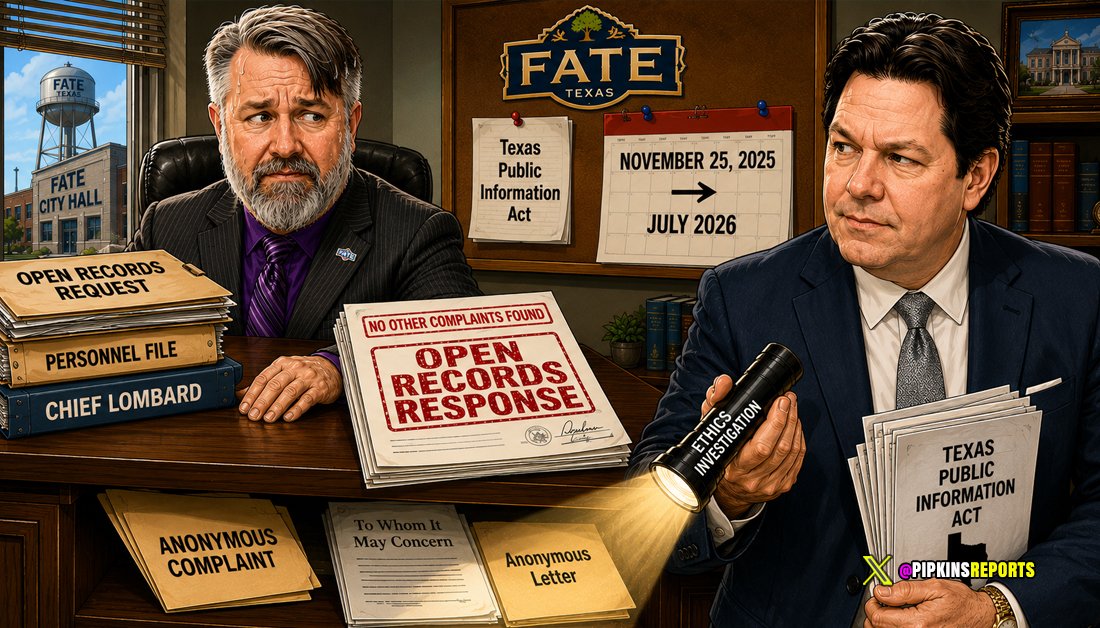
Fate, TX — An ethics investigation into former Fate City Councilwoman Codi Chinn has uncovered evidence suggesting the City of Fate possessed at least one employee complaint against former Department of Public Safety Chief Lyle Lombard that it never disclosed in response to an Open Records Request submitted by Pipkins Reports.
The newly released investigative report also raises additional questions about whether City Manager Michael Kovacs fully described his receipt of employee complaint letters during his interview with the City’s outside investigator.
The documents establish the following timeline.
On November 25, 2025, Pipkins Reports submitted a Texas Public Information Act request seeking four categories of records related to Chief Lombard’s employment. Item No. 3 requested:
“Copy of any written complaints against Chief Lombard within the last 12 months prior to termination.”
On December 11, 2025, the City responded by producing Chief Lombard’s performance evaluations, termination documents, and the investigation initiated by City Manager Michael Kovacs. However, the city produced no employee complaint letters.
Because no complaint letters were produced, Pipkins Reports immediately contacted the City for clarification. The follow-up specifically noted that an anonymous employee complaint concerning Lombard had already become publicly known and requested that letter, along with any other anonymous or signed complaints concerning the former chief.
On December 16th, after Pipkins Reports challenged the City’s original response, Associate Attorney Paige Goins of Messer Fort acknowledged that one document—the anonymous letter already known to exist—had been inadvertently omitted and she sent that document to Pipkins Reports.
Then, on December 18, the City supplemented its response again by producing awards and commendations received by Lombard.
At the time, Pipkins Reports did not pursue the matter further. New information obtained through a subsequent ethics investigation has now renewed serious questions about whether the City’s response complied with the Texas Public Information Act.
Under the Texas Public Information Act, governmental bodies generally must either promptly produce responsive public records or seek a ruling from the Texas Attorney General if they believe the requested information falls within an exception to disclosure. If a governmental body fails to timely request an Attorney General ruling, the requested information is generally presumed to be public unless a compelling reason exists to withhold it. See Texas Government Code §§ 552.221, 552.301, and 552.302.
In this case, the City did not seek an Attorney General ruling authorizing its withholding of any documents.
Ethics Investigation Reveals New Information
Seven months later, in July of 2026, an unrelated ethics investigation would reveal information that casts new light on the City’s response.
The investigation originated from an ethics complaint filed by Fate resident Darcy Gildon, who alleged former Councilwoman Codi Chinn improperly involved herself in personnel matters by directing city employees to prepare written complaints concerning Chief Lombard.
Attorney Laura Mueller of Baker Robertson & O’Brien ultimately concluded that Chinn violated Section 2-309(10) of the city’s Code of Ethics by directing employees to provide information to her in writing. Pipkins Reports reported on that story … here.
More significant for purposes of this investigation, however, were the interviews conducted with the individuals involved.
According to the investigative report, Chinn told investigators that city employees approached her seeking assistance. She stated that she instructed them to put their concerns in writing so they could be presented to the City Council. Instead, according to her interview, the employees compiled a letter addressed to the entire City Council, after which she instructed them to deliver the letter to City Manager Michael Kovacs.
The investigative report summarizes Kovacs’ interview as follows:
“In my interview with Mr. Kovacs, we discussed his conversations with then Councilmember Chinn and the employees. Mr. Kovacs stated that he received the letter outlining the employee issues directly from an officer, but with the understanding that the information was given to him at the direction of Ms. Chinn. Mr. Kovacs also stated that Ms. Chinn kept him informed of the conversations she was having with the employees, but that he warned her against such communications.”
The report, however, does not discuss the original anonymous complaint letter that Pipkins Reports previously reported had been delivered to Kovacs through Councilwoman Chinn.
Taken together, the report’s statements—and its omissions—appear to indicate that Kovacs possessed at least two written employee complaints that would have been responsive to Pipkins Reports’ November 2025 Public Information Act request.
Two Letters, One Unanswered Question
Pipkins Reports has independently obtained copies of both complaint letters from sources outside City Hall. One anonymous letter begins with the words, “To Whom It May Concern.” The second letter is addressed to the entire City Council and was reportedly transmitted through Councilwoman Chinn.
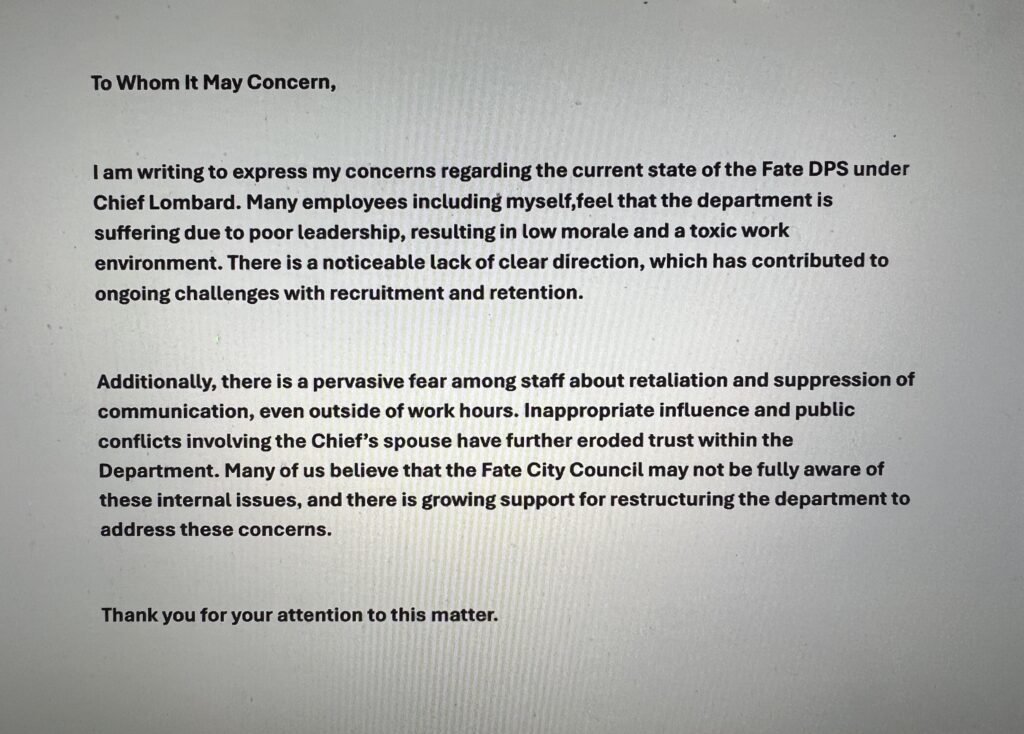
Their existence, however, does not resolve whether the City complied with the Texas Public Information Act. The central question is whether the City properly disclosed responsive records in response to a lawful request.
As of this publication, the City still has not disclosed the separate complaint letter that Kovacs later acknowledged receiving directly from a police officer. By his own admission, City Manager Michael Kovacs is the person responsible for the dissemination of records per State Law, and therefore he is the person who should be held accountable.
If Kovacs’ statement to investigators is accurate, that second complaint letter would have existed when the City’s response to the November 2025 Public Information Act request was prepared.
A New Public Information Request
In light of the newly disclosed information, Pipkins Reports has submitted another Texas Public Information Act request seeking all written complaints concerning Chief Lombard, including the complaint letter Kovacs acknowledged receiving from an officer, the complaint letter transmitted through Councilwoman Chinn, and any additional written complaints in the City’s possession.
The request states, in part:
“On 11/25/2025, as part of Open Records Request #R001735-112525, I requested ‘Copy of any written complaints against Chief Lombard within the last 12 months prior to termination.’ The City failed to provide any responsive documents, even though it was publicly known that at least one anonymous complaint letter existed.
During the ethics investigation conducted by Baker Robertson & O’Brien, Michael Kovacs stated that he received a complaint letter from a police officer. This admission indicates the City possessed an additional responsive document that was not disclosed.
The City did not seek an Attorney General ruling authorizing the withholding of either complaint letter. This request seeks both documents, together with any additional written complaints concerning Chief Lombard.”
Whether the City ultimately produces the records—or explains why they were not disclosed nearly eight months ago—may determine whether this story ends as an administrative oversight or raises more significant questions regarding the City’s compliance with the Texas Public Information Act.
This remains an ongoing investigation. Pipkins Reports will continue to report on developments as additional records become available.

Fate Council Dropped Case Before Reviewing
Fate, TX — An ethics investigation commissioned by the City of Fate concluded that former Councilwoman Codi Chinn violated the City’s Code of Ethics before the City Council voted earlier this month to discontinue the matter, according to documents obtained by Pipkins Reports through an Open Records Request.
The report, prepared by attorney Laura Mueller of the law firm Baker, Robertson & O’Brien, found that the allegation against Chinn was “substantiated, but with mitigating factors.”
The Executive Summary states:
“After investigation, my determination is that allegation of a violation of the Ethics Code is substantiated, but with mitigating factors.”
The report concludes that Chinn violated Section 2-309(10) of the City’s Code of Ethics after directing City employees to provide their concerns to her in writing.
“After reviewing the Charter, the Code of Ethics, and reviewing all of the evidence, my conclusion is that Ms. Chinn violated Section 2-309(10) of the Code of Ethics when she directed employees to provide information to her in writing.”
Mueller also concluded that mitigating circumstances should be considered because Chinn immediately informed City Manager Michael Kovacs about the employee concerns and because the employees ultimately submitted their written complaints directly to the City.
Council Ends Investigation
The ethics complaint summary report was scheduled to appear on the July 6 City Council agenda for executive session discussion.
Instead of going into Executive Session, the Council waived deliberative privilege and discussed the matter in open session where they ultimately voted to discontinue the ethics proceedings and drop the matter, before being presented with the findings from Mueller.
The Council did not impose any sanction against Chinn.
The following day, Pipkins Reports requested a copy of the complaint and the investigative report, and received it through an Open Records Request.
Investigation Details
According to the report, investigators interviewed Chinn, Councilman Mark Harper, City Manager Michael Kovacs, and other witnesses.
Regarding the allegations, Mueller wrote:
“In my interview with Ms. Chinn and Mr. Harper, we discussed the allegation. I questioned Ms. Chinn about her conversations with city employees and with Mr. Kovacs.”
According to the report, Chinn stated that city employees approached her seeking assistance and that she intended to present their concerns to the City Manager after compiling the information.
However, the report states that employees instead prepared a letter addressed to the City Council. Chinn then instructed them to provide the letter directly to the City Manager.
The report also summarizes Kovacs’ account of the events.
“Mr. Kovacs stated that he received the letter outlining the employee issues directly from an officer, but with the understanding that the information was given to him at the direction of Ms. Chinn.”
Previously, it was reported that Chinn provided a copy of an, “anonymous letter”, that she claims was provided by DPS officers to her. Chinn further states that she sent the letter to Michael Kovacs … who then forwarded it on to the rest of the Council. This report also states that Kovacs told investigators he had warned Chinn against communicating with employees in that manner.
Pipkins Reports continues to investigate this aspect of the situation … as the conditions shed new light on the events that have transpired with regard to the termination of DPS Chief Lyle Lombard.
Meanwhile, the city council’s decision effectively ended the ethics proceeding against Chinn without imposing any sanction or issuing any formal determination of its own regarding the investigator’s findings. While the Council possessed the authority to discontinue the matter, the decision also brought the ethics process to a close despite an independent investigation concluding that a violation of the City’s Code of Ethics had occurred.
For the complainant, Darcy Gildon, the Council’s action marked the end of a process that resulted in no public accountability beyond the release of the investigative report which Pipkins Reports has now provided.
Fate, TX – Just hours after Fate city leaders submitted a list of pointed legal questions to the city’s law firm, Messer Fort notified the city it was resigning as legal counsel.
Now, Mayor Andrew Greenberg has released those unanswered questions to the public, saying residents deserve to see exactly what city officials were asking before the firm’s departure.
The release comes amid months of political turmoil inside Fate City Hall. Since the recall of former Councilwoman Codi Chinn, ethics complaints have been filed against Mayor Andrew Greenberg and Councilman Mark Hatley, while they and two other current council members now face recall elections of their own, backed by political opponents, including Councilwoman Ashley Rains, Councilman Allen Robbins, and former Councilman Scott Kelley, along with former Mayor David Billings.
Messer Fort had been hired by the City of Fate to serve as its contracted city attorney in place of employing a full-time in-house attorney. Jennifer Riche has been the attorney from that firm who has represented Fate directly. During Messer Fort’s tenure, the firm became deeply involved in several high-profile disputes, including ethics investigations, Public Information Act requests, and legal advice surrounding those matters.
According to a statement released by Greenberg, Messer Fort invited council members to submit any questions they had regarding the firm’s representation of the city. The first seven questions were submitted on July 9. Later that same day, the firm informed the city it would resign, effective July 20. Additional questions were submitted before the firm’s departure, but Greenberg said Messer Fort has not responded.
“As I mentioned during today’s City Council meeting,” Greenberg wrote. “I believe transparency is important. In that spirit, I am sharing the questions exactly as they were submitted so our residents can see what information was being requested and judge for themselves.“
The questions cover several issues that have divided the city over the past year, including Messer Fort’s handling of Texas Attorney General rulings on open records requests, the legal basis for redactions made under the Texas Public Information Act, ethics investigations involving elected officials, the firm’s analysis of potential Texas Open Meetings Act issues, and the use of city legal resources in matters questioned by council members. They also seek documentation supporting legal conclusions that influenced city decisions and ethics proceedings.
Rather than releasing only selected excerpts, Greenberg published the complete list of questions submitted to Messer Fort. The documents allow residents to review the requests in full and draw their own conclusions regarding the issues council members wanted addressed before the firm’s resignation.
Editor’s Note: The questions were originally posted as images on Facebook, making them difficult to read and appearing out of sequence. Pipkins Reports reorganized the pages, enhanced readability where necessary, and compiled them into a single PDF so readers can review the complete document in its proper order.
You must be logged in to post a comment Login