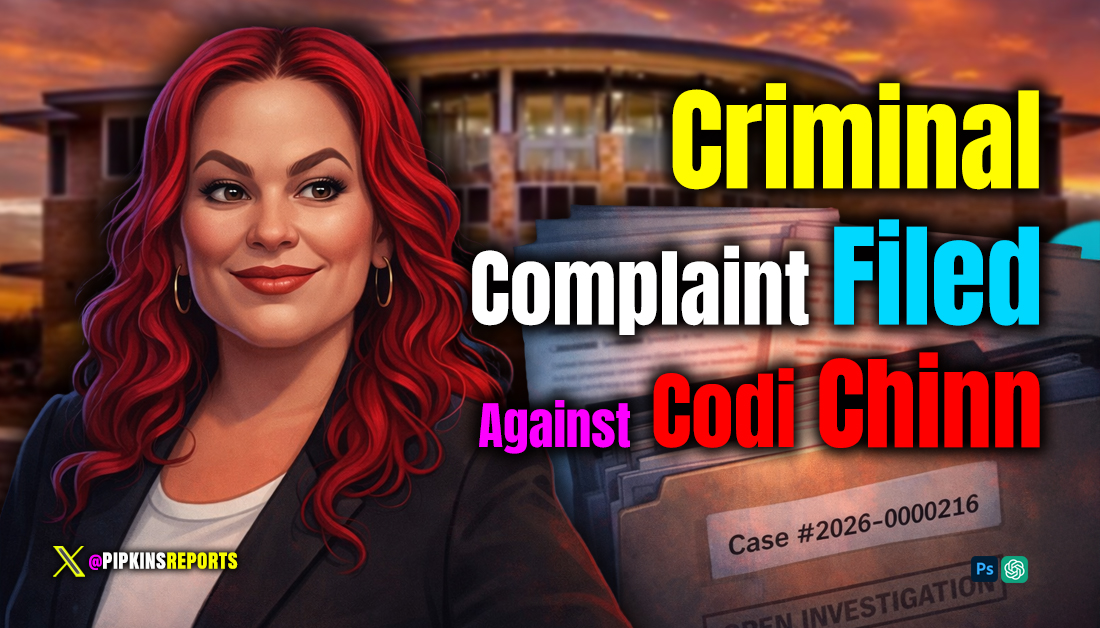
Police Report Names Fate Councilwoman as Suspect in Unlawful Disclosure Case
FATE, TX – In the weeks after a citizen-led recall petition was filed against Fate Councilwoman Codi Chinn, the political fight moved from City Hall into a police case file.
A criminal complaint obtained through an open records request shows the Fate Police Department opened Case #2026-00000216 listing Chinn as a suspect in an investigation under Texas Penal Code §42.074(b) — Unlawful Disclosure of Address or Telephone Number. The report classifies the alleged offense as having occurred in “Cyberspace” and notes the offender was suspected of using a computer. The case status is listed as Open / Ready for Review, and no charges have been filed as of publication.
The report identifies multiple Fate residents as victims — whose names we have redacted. The remaining redactions, which includes addresses of the victims as shown on the documents below, were made by the City of Fate.
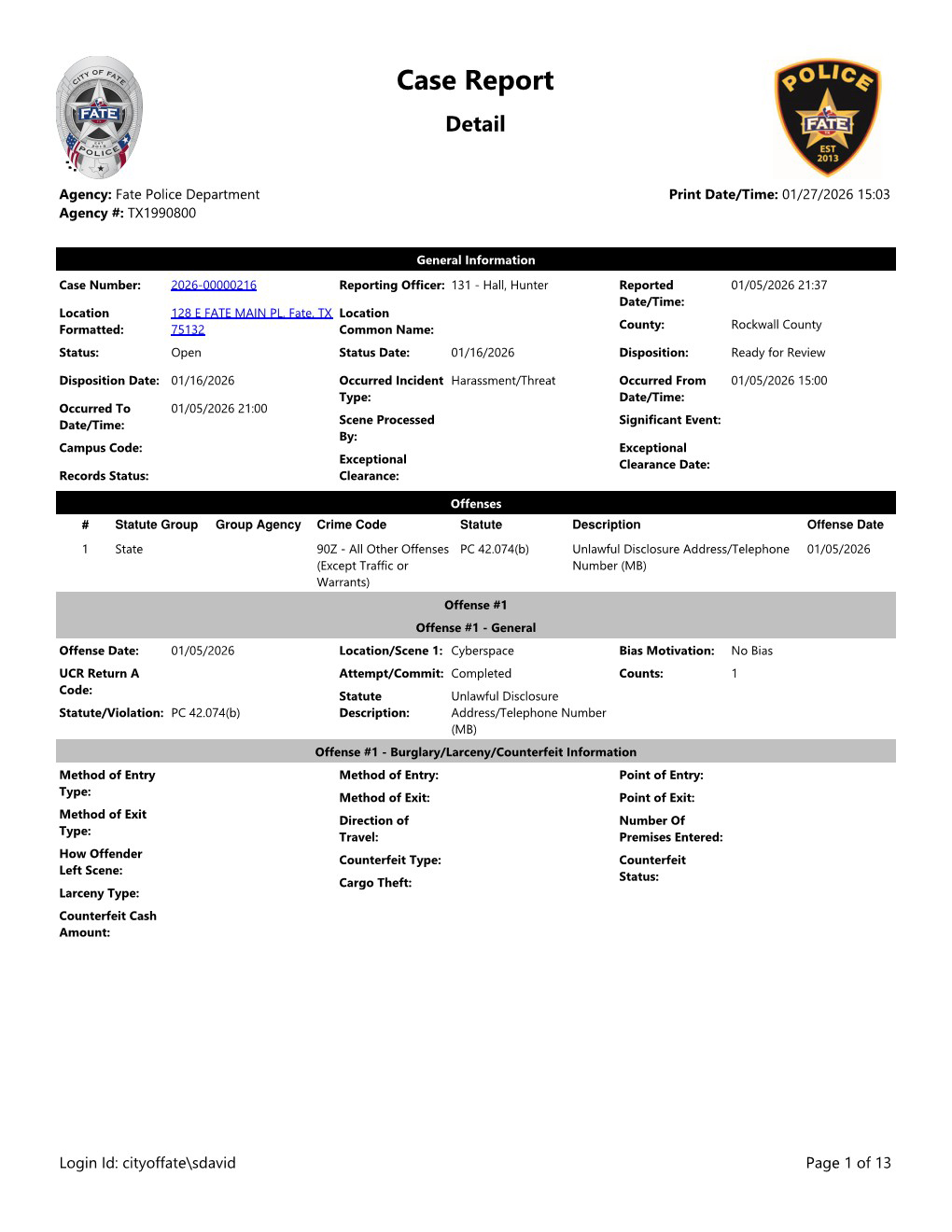
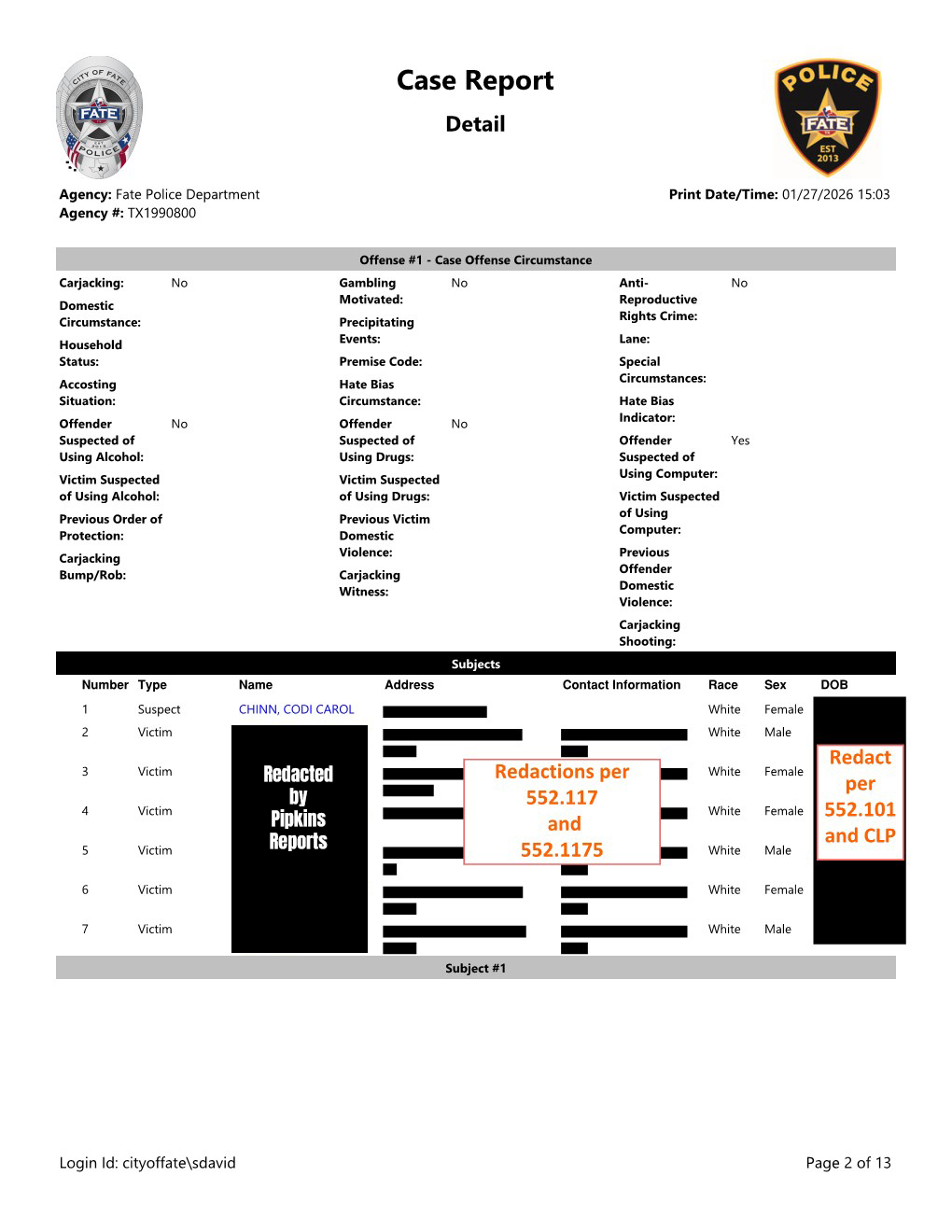
[Pages of complaint against Fate Councilwoman Codi Chinn received via Open Records Request. Pipkins Reports has provided an additional redaction to the victims names.]
What triggered the complaint
According to the complainants, after the recall petition was formally submitted to the City of Fate, the document — which included the names and home addresses of the recall committee members — was distributed by the city manager to all members of the city council, including Chinn. The citizens allege that Chinn later posted images of the unredacted petition pages on Facebook, thereby displaying the names and residential addresses of those responsible for initiating the recall.
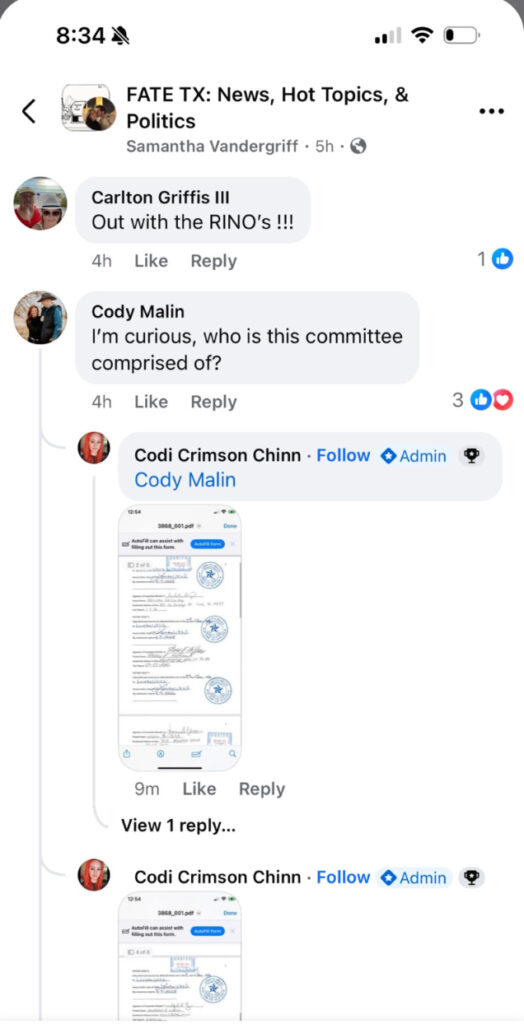
Some of the petition committee members then filed a criminal complaint, asserting the disclosure exposed them to potential harassment and intimidation. The police report reflects that allegation by citing the specific statute related to unlawful disclosure of personal information.
A public statement of fear
During Fate City Council meetings on February 2, 2026 and the following week on February 9, 2026, some individuals spoke during the public comment period and stated, on the record, that they believe the disclosure has placed both themselves and their family in danger. One person spoke about how their children were harassed and frightened. She even spoke about how her children have taken to carry nerf guns … in case something happened to daddy and they needed to protect mommy.
The law at the center of the case
Texas Penal Code §42.074 — Unlawful Disclosure of Personal Information
Texas law makes it a criminal offense to post on a publicly accessible website, or distribute electronically, the home address or telephone number of an individual with intent to cause harm or threaten harm.
- Classified as a Class B misdemeanor
- Elevated to Class A if bodily injury results
- Contains an exemption for public servants only when releasing information as part of their official duties in accordance with law.
The statute does not prohibit publishing a person’s name or signature. It specifically protects residential address and telephone number. Furthermore, the mere posting of an address, absent intent to harm, does not automatically satisfy the statute.
That distinction is central to the complaint.
Why this is unusual
Recall petitions are public political documents. Names of organizers are not confidential. Addresses, however, are often redacted by municipalities before release in open records responses.
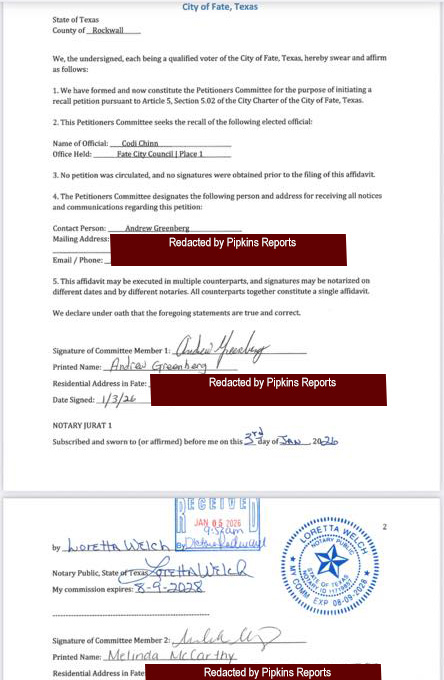
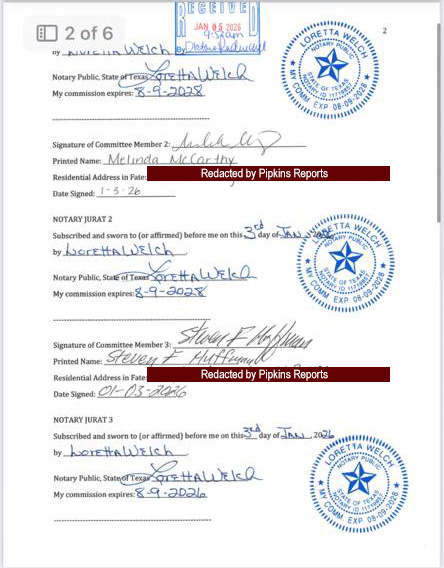
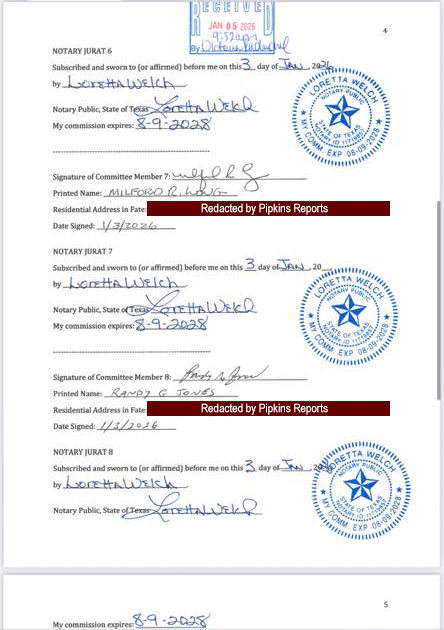
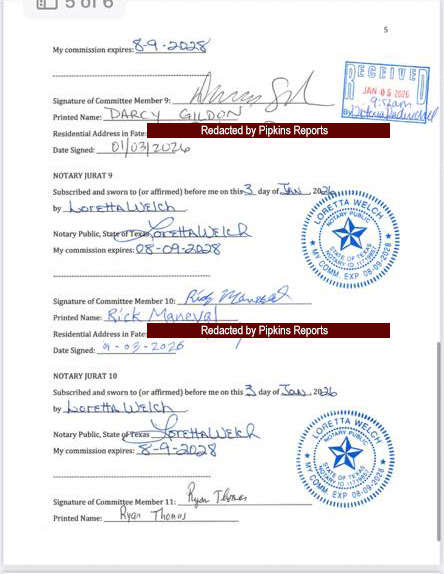
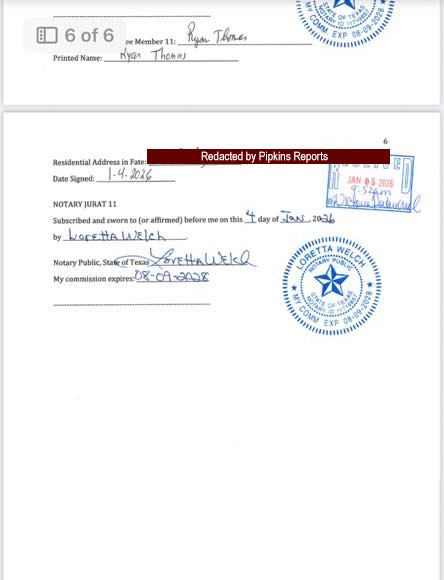
Page Cropping and Redactions by Pipkins Reports.]
The complainants argue that while the petition itself is public, the manner in which it was posted — unredacted, on social media, without city review — falls outside normal procedure and outside any official city function.
There is also no record indicating that Chinn was designated by the city in any official capacity to disseminate public records or communicate such materials to the public. The City of Fate maintains a Public Information Officer (PIO) role specifically tasked with handling the release of documents and public communications.
The police report does not determine intent. It documents that a complaint was made, identifies a statute, and names a suspect.
What the police document confirms
The report confirms:
- A complaint was filed January 5, 2026
- The alleged incident occurred online
- A specific criminal statute was cited
- Chinn is listed as the suspect
- The listed victims are recall participants
- The case is active and under review
It does not state that a crime occurred. It does not assign motive. It does not announce charges. It establishes that law enforcement considered the allegation serious enough to open a formal case.
The public servant exemption question
A key issue likely to be examined by prosecutors is whether Chinn’s posting of the petition falls under the statutory exemption for public servants acting within their official duties. The exemption applies only when disclosure is required by law or when disclosure is performed as part of an official governmental function.
The complainants contend that Chinn is not the city Public Information Officer (PIO) and is not authorized to post information on behalf of the city. They allege that posting the document to a personal Facebook page, without redaction and without city authorization, does not meet that threshold. They allege that the disclosure functioned as retaliation for initiating the recall.
What happens next
The case status of “Ready for Review” indicates the report has been forwarded for prosecutorial consideration. Whether the matter results in charges will be determined by the Rockwall County District Attorney, Kenda Culpepper, after review of the evidence.
Until then, the matter remains an open investigation.
Why this matters beyond Fate
Texas’ unlawful disclosure statute is increasingly cited in cases involving online publication of personal data. The law was designed to address modern forms of harassment often referred to as “doxxing.”
This case tests how that statute applies when the disclosure occurs in the context of a political dispute between elected officials and citizens.
It raises a novel question:
When does sharing a public document cross into unlawful disclosure?
That answer now sits in a police file.
Documentation
All information in this report is drawn from the Fate Police Department case report obtained through an open records request and social media sources. Home addresses, or potential victims’ names from the petition are not presented here to avoid republishing the information at issue in the investigation.
Pipkins Reports reached out to Councilwoman Chinn for comment before publication and received a call from her attorney, Cody Skipper, with Shook & Gunter Attorney at Law. Skipper’s response was, “Codi Chinn has done nothing wrong, nothing illegal, nothing unethical. Codi Chinn has done her job as a public servant.“
We also asked Mr. Skipper if he thought that when she posted the petition, if she was acting in an official capacity. He stated, “Every one of these people are acting in an official capacity.”
We have also verified that the Facebook post containing the recall petition with the committee members’ addresses has been removed. It is unclear when the post was removed.
Council
Refugio’s Government Meltdown: Mayor, Secretary and Three Council Officials Arrested in Two Days
Refugio, TX — It is one thing when a Texas mayor gets arrested. It is quite another when the mayor, city secretary and three current or former council members are all swept into the same criminal investigation within roughly 48 hours. That is what happened this week in Refugio, a small South Texas town where local government has suddenly become the subject of a Texas Rangers investigation and multiple felony charges.
Mayor Wanda Dukes and City Secretary Callie Shreckengost were arrested Wednesday on first-degree felony charges involving the alleged misapplication of fiduciary property valued at $300,000 or more, according to reporting by Crossroads Today and Texas Municipal Watch. The allegations involve the town’s Economic Development Corporation funds.
Then came Thursday.
Mayor Pro Tem Ixtlazihuatl “Lala” Vasquez, along with former council members Michael Rocha and Frank Hosey, surrendered at the Refugio County Jail and were arrested on third-degree felony charges alleging abuse of official capacity involving government property valued at more than $30,000 but less than $150,000.
The Texas Rangers reportedly told Crossroads Today that Thursday’s arrests stem from the same grand jury indictment that produced the charges against Dukes and Shreckengost. Texas Municipal Watch reported that it had not independently reviewed the indictment and was relying on Crossroads Today’s account of the Rangers’ statement.
Under Texas Penal Code Section 39.02, abuse of official capacity involves a public servant intentionally or knowingly misusing government property, services, personnel or other resources under that official’s control for an improper benefit or to harm or defraud another person. At the dollar range alleged in the Thursday arrests, the offense is classified as a third-degree felony.
The identities of the officials involved are not in question. Refugio County records list Dukes as mayor, Vasquez as Alderman Place 1, Rocha as Alderman Place 3, and Hosey as Alderman Place 4. Town financial records also identify Shreckengost as city secretary.
But there is still a great deal the public does not know.
Texas Municipal Watch reported that the specific conduct allegedly underlying the charges against Vasquez, Rocha and Hosey had not yet been independently confirmed, nor had the outlet confirmed their release conditions or upcoming court appearances. The underlying indictment had also not been obtained at the time of its Thursday report.
The town council has apparently recognized that it has a problem. Council members Robert Jaso and Dana Alsop issued an identical statement Wednesday saying the town was aware of criminal accusations against officials, could not comment on an ongoing investigation, and intended to take steps to protect municipal resources. They also said a special meeting would be held as soon as possible to consider whatever action might be necessary.
Council
“Not Guilty”: Eva Royer Acquitted After Granbury Election Fraud Prosecution
Granbury, TX – A Granbury political fight that escalated into a criminal prosecution has ended with a jury refusing to convict Eva Royer, a Hood County Republican Party official who was arrested after questions arose over the address she used when filing to run for Granbury City Council.
Royer was found not guilty after facing charges of perjury of certain election procedures and election fraud stemming from her 2024 City Council candidacy, according to reporting by Erin Anderson of Texas Scorecard. The verdict closes a case that had already raised uncomfortable questions about how aggressively local government pursued what began as a dispute over residency.
The case began after Royer filed to run for Granbury City Council Place 5 in August 2024. She listed a Granbury address and stated that she had lived within the city for approximately two years and nine months. City officials later questioned whether that address was actually her primary residence.
Royer withdrew her candidacy before a scheduled City Council meeting could determine whether she met the city’s residency requirements. That could have been the end of the matter.
It wasn’t.
In April 2025, Granbury police arrested Royer on one count of perjury of certain election procedures, a state jail felony, and one count of election fraud, a Class A misdemeanor. She posted bond and was released the following day. The charges were based largely on allegations that she used a Granbury property as her residence even though officials believed she primarily lived elsewhere.
The prosecution focused heavily on three locations: Royer’s Granbury property, a home in Pecan Plantation belonging to her former boyfriend, and a Dallas condominium.
The state presented evidence that Royer’s vehicle entered and exited Pecan Plantation regularly. A security director testified that Royer had a guest pass connected to the vehicle, but also acknowledged under questioning from defense attorney Rob Christian that regularly visiting a boyfriend does not necessarily make someone a resident. He further testified that a guest tag indicated the person was not a resident.
Prosecutors also pointed to the fact that Royer’s Granbury property had been approved for short-term rental use. But testimony established that a short-term rental permit did not require the property to be rented for any particular number of days. In other words, having a permit to rent a house does not automatically establish that its owner doesn’t live there.
Then came the homestead exemption argument.
Hood County Chief Appraiser Jeff Law testified that Royer had not claimed a homestead exemption on the Granbury property. Her attorney countered that the property was owned through Royer’s LLC, making her ineligible for the exemption under the circumstances. Royer’s driver license also listed the Granbury address.
The trial also produced testimony about the investigation itself, including the use of license plate reader technology (FLOCK) to locate Royer. Texas Scorecard reported that her former boyfriend’s license plate had been placed on a “hot list” because of his association with Royer. Police eventually arrested Royer after locating her with Bolton.
And there was considerably more.
Defense questioning raised issues involving city officials, police leadership and communications concerning the prosecution. According to Texas Scorecard’s trial coverage, Granbury Police Chief Mitch Galvan acknowledged providing incorrect testimony during earlier proceedings and acknowledged that text messages concerning the case had not initially been produced despite court orders.
Royer’s acquittal ends the criminal case, but it leaves questions about how the dispute escalated to that point. Why was so much pressure brought against her over the address she used on her election paperwork? Why did multiple officials at the City of Granbury become so deeply involved in pursuing the matter after she had withdrawn from the race? And given the issues raised during the trial about the investigation and the handling of evidence, are there additional questions about how and why the case was pursued? Those questions remain unanswered, and whether there is a deeper problem within Granbury’s political or administrative structure is something that warrants further examination.
Business
San Angelo’s Data Center Fight Is Now a Recall Fight
San Angelo, TX – San Angelo’s battle over massive data centers has moved from City Hall chambers to the ballot box, and two council members could soon have to defend their seats before voters angry about how the city has handled the projects. What began as a fight over water, power, development and transparency is now a full-blown political revolt, with recall efforts targeting Council Members Harry Thomas and Joe Self.
And the controversy comes at an interesting moment for Texas. Gov. Greg Abbott has ordered state regulators to conduct a comprehensive audit of data centers moving through the state’s electric grid interconnection process, saying the review must be completed before any data center project moves forward. ERCOT subsequently told Fox News Digital that Abbott’s directive “effectively pauses all data center projects” while the state reviews their demands on the grid.
That means the questions being shouted at San Angelo City Hall are no longer merely local complaints from residents opposed to a particular development. Texas officials are now asking some of the same questions.
Abbott directed the Public Utility Commission of Texas and ERCOT to examine pending data center projects and gather information, including projected annual and peak electricity demand, water consumption, water sources, and whether facilities intend to generate some of their own electricity. ERCOT reported that roughly 90 percent of the 474 gigawatts of large-load interconnection requests currently under review are associated with data centers, more than five times Texas’ record peak electricity demand.
Back in San Angelo, the San Angelo Data Center Citizen Coalition has been pushing its own accountability campaign.
A petition seeking the recall of Council Member Harry Thomas, who represents Single Member District 3, was submitted July 15 with more than the required signatures. The city clerk later certified the petition after determining 53 signatures were sufficient, clearing the way for a recall election.
Following public comment, the City Council voted 6-1 to call the recall election.
Thomas has maintained that he has no intention of resigning.
“I weigh every decision I’ve ever made on behalf of the 100,000 citizens in San Angelo,” Thomas said after the petition was submitted. “Every time I vote, I vote for all the citizens. I have no plans to resign from my position.”
Self is now facing his own recall effort.
The coalition submitted an affidavit seeking Self’s recall and subsequently collected the signatures necessary to move forward. On Aug. 6, Self issued a statement saying he supports residents’ right to seek a recall but rejected what he described as misinformation about his involvement with data centers.
“I have not signed any non-disclosure agreements,” Self said. “I have not benefited financially. I have not voted in favor of a data center.”
Self said the council has instead voted on regulations that would apply if a data center is established in San Angelo.
That distinction between approving a specific project and approving regulations governing potential projects has become one of the central arguments in the political fight. San Angelo officials have considered rules addressing land use, water and wastewater issues as the city confronts proposals for large-scale data center development.
The proposed Skybox project has become particularly contentious. City officials have described it as a potential $7.2 billion investment, while opponents have raised concerns about water consumption, electricity demand, infrastructure, noise and transparency surrounding the development process.
The political consequences are spreading beyond San Angelo.
Residents in Temple and Granbury have also launched recall or charter efforts amid disputes over data center development. In Temple, opponents have cited concerns about land, water consumption and heat generated by facilities. In Granbury, activists gathered signatures seeking recalls involving the mayor and most members of the City Council.
Pingback: Recall War in Fate: Councilwoman’s Past Disclosure Comes Back to Haunt Her – pipkinsreports.com