
Local Leaders Rally Behind Katrina Pierson’s Candidacy for House District 33

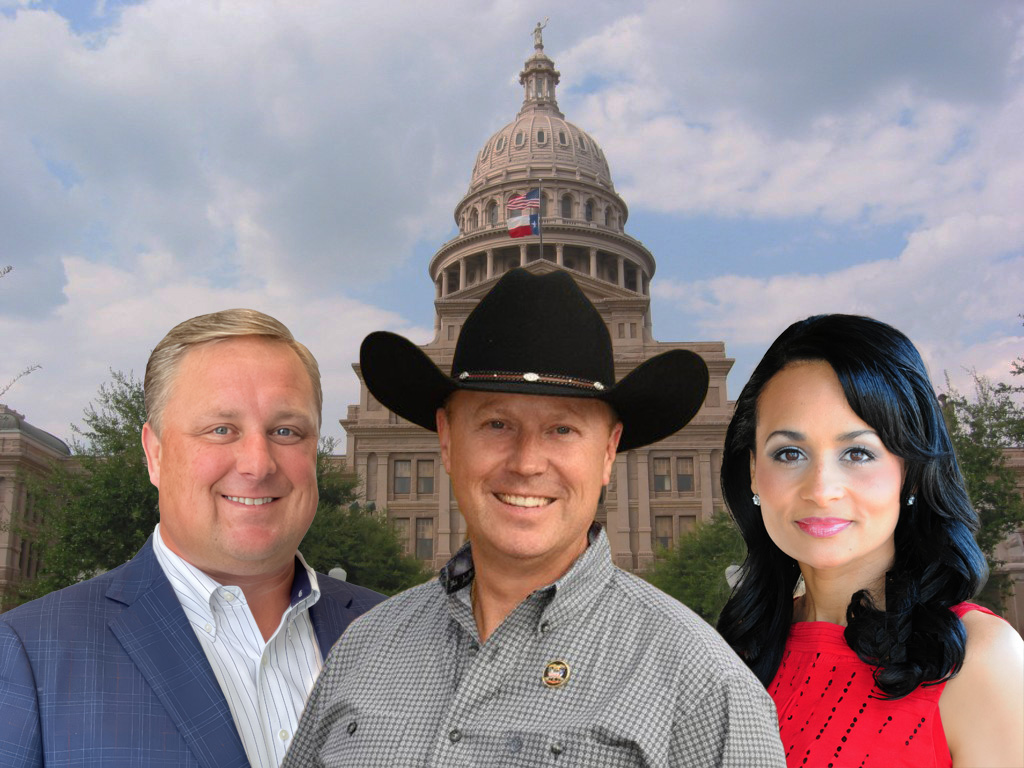
Rockwall County, Texas – In a significant show of local support, the Katrina Pierson Campaign proudly announced a series of endorsements from key figures in the City of Heath leadership. As the race for House District 33 heats up, these endorsements underscore the confidence that community leaders place in Pierson’s ability to represent their interests faithfully.
Mayor Kelson Elam, expressed his unwavering support for Pierson, emphasizing the importance of having a representative who prioritizes the needs of the community over outside influences. “The citizens of Heath deserve a state representative who can be trusted to represent us faithfully, not take orders from special interests in Austin. Katrina Pierson has demonstrated, time and time again, the qualities that we need and deserve, and I am proud to support her,” Mayor Elam stated.
Pierson herself, grateful for the local backing, acknowledged the significance of the endorsements, especially from those in her immediate community. “I am honored to have overwhelming support from my neighbors and friends in Justin Holland’s backyard, and I look forward to representing the citizens of Heath and all of District 33 in Austin,” Pierson remarked.
The list of elected officials endorsing the campaign further solidifies Pierson’s standing in Rockwall County:
- Mayor Kelson Elam
- Paul Ruffo – Mayor Pro Tem, Council Member P. 2
- Sharon Caldwell – Council Member Pl. 1
- Donna Rolater – Council Member Pl. 3
- Jim Chester – Council Member Pl. 5
These endorsements reflect a diverse spectrum of leaders within the City of Heath, each bringing a unique perspective and commitment to the well-being of the community. Mayor Pro Tem Paul Ruffo, Council Members Sharon Caldwell, Donna Rolater, and Jim Chester have all rallied behind Pierson’s candidacy, illustrating a broad base of local support.
As the campaign gains momentum, these endorsements from influential local figures are expected to play a pivotal role in shaping the narrative around Katrina Pierson’s candidacy. With a focus on community-driven representation, Pierson’s campaign aims to resonate with voters in Rockwall County and beyond.
The Fate Tribune will continue to closely follow the developments in the House District 33 race, providing our readers with comprehensive coverage of the candidates and their campaigns. Stay tuned for more updates as we approach the upcoming election.




Austin
Texas GOP Wants Closed Primaries. New Secretary of State Robert Howden Is Preparing to Fight Them.
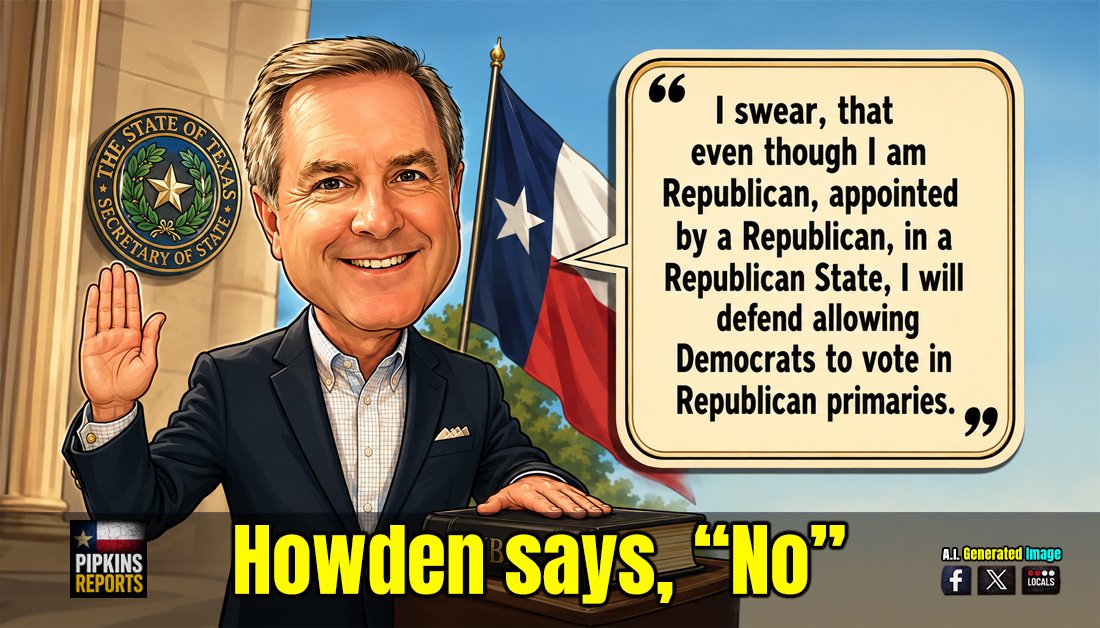
Austin, TX – Texas Republicans spent years demanding control of their own primary. Now they have a new Secretary of State, Robert S. Howden, appointed by Republican Governor Greg Abbott, and the man taking over the state’s election machinery is inheriting a lawsuit in which his office is expected to defend the very open primary system the GOP wants to dismantle.
The Republican Party of Texas filed the federal lawsuit in September 2025, arguing that Texas’ open primary system violates the party’s First Amendment right of association. Under the current system, Texas voters do not register by party and may choose which party’s primary to vote in during an election cycle. The GOP wants only registered Republicans participating in Republican primaries.
The case is pending in federal court in Amarillo before U.S. District Judge Matthew Kacsmaryk.
And Robert S. Howden has now inherited it.
Howden Steps Into the Fight
Gov. Abbott appointed Howden as Texas’ 116th secretary of state on July 17, effective July 18. Howden previously served as Abbott’s senior adviser and director of legislative affairs and has worked in the administrations of four Republican governors. As secretary of state, he is Texas’ chief elections officer.
Abbott has been quite clear about where he stands.
At the 2026 Republican Party convention, he said Texas would eventually make clear that “only Republicans vote in Republican primaries.” Abbott has also said lawmakers “can and should be more responsive to Republicans than a judge may be,” indicating that he expects the Legislature to address the issue during the 2027 session.
But that doesn’t mean the Secretary of State’s office is supposed to simply surrender in court.
That was the position taken by Howden’s predecessor, Jane Nelson.
Nelson argued that changing Texas’ primary system was a job for the Legislature, not a federal judge. In an October 2025 statement, she said it was her responsibility to defend existing election laws and that she would implement whatever changes the Legislature lawfully enacted.
The Attorney General’s office took the opposite position.
Attorney General Ken Paxton sided with the Texas GOP, asking the federal court to strike down portions of the Texas Election Code governing open primaries. According to reporting by The Texas Tribune, Nelson’s lawyers said Paxton’s office gave them less than an hour’s notice before taking the opposing position.
So the Republican Party sued the Republican-controlled state government. The Republican Attorney General joined the plaintiffs. And the Republican Secretary of State fought the lawsuit.
That’s not exactly the tidy party unity politicians like to advertise.
The Real Fight Is Over Who Controls the Nomination
The GOP argues that crossover voting allows Democrats and independents to influence Republican nominations, potentially helping candidates who are less conservative than the party base.
The lawsuit specifically pointed to the 2024 Republican primaries involving former House Speaker Dade Phelan and Rep. Gary VanDeaver. Both won their races by fewer than 800 votes, and the party argued that crossover voters helped determine the outcomes.
The party has already made closing primaries an official priority. Republicans adopted rules supporting closed primaries in 2024 and renewed that push at their 2026 convention.
But changing the system is not as simple as flipping a switch.
Texas has more than 18 million registered voters, and the state’s registration system was never designed around party registration. Moving to closed primaries could require new registration procedures, computer-system changes and a method for existing voters to establish party affiliation.
The GOP wants the courts to clear the way, preferably in time for 2028.
Election
Texas Senate Hopeful James Talarico Shared Pride Event Stage With 11-Year-Old Child Drag Performer

Federal Court Upholds State Limits on Minors at Adult Drag Shows
Taylor, TX – A federal appeals court has just upheld a Florida law restricting minors from attending certain adult live performances, including some drag shows. Within hours of that ruling, renewed attention was focused on Texas Democratic U.S. Senate candidate James Talarico after reports resurfaced showing he headlined a 2021 Pride fundraiser featuring an 11-year-old child drag performer promoted as one of the event’s main attractions.
On Tuesday, the U.S. Court of Appeals for the 11th Circuit ruled in HM Florida-ORL, LLC v. Secretary of the Florida Department of Business and Professional Regulation, allowing Florida to enforce its law restricting minors from attending certain adult live performances. Florida Attorney General James Uthmeier announced the decision, calling it a victory for protecting children. The ruling does not prohibit drag performances for adults, but it recognizes that states may impose limits when minors are involved.
The timing has drawn renewed scrutiny to Talarico’s record as he campaigns for the U.S. Senate against Texas Attorney General Ken Paxton.
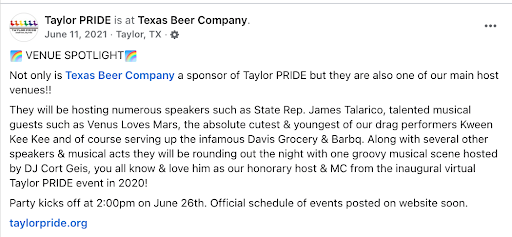
According to promotional materials first highlighted by the Washington Free Beacon, Talarico was a featured speaker during Taylor PRIDE’s June 26, 2021 fundraiser in Taylor, Texas. The event was organized to raise money for “rural LGBTQ communities” and included live music, Drag Story Hour, adult drag performers, and an 11-year-old performer using the stage name “Kween Kee Kee.”
Taylor PRIDE advertised the child as “the absolute cutest & youngest of our drag performers.” Promotional posts stated the child would perform a drag routine and host “Kee Kee Storytime,” where children would participate in Pride-themed craft activities. The event was held at Texas Beer Company.
Photographs published from the event show Talarico addressing attendees from the stage and posing with participants. Additional photographs and video posted publicly show Kween Kee Kee, a local preteen named Keegan, performing in a shimmering blue dress, platinum blonde wig, and theatrical makeup during what organizers described as a Youth Drag Show. One attendee shared video of the child performing the splits before the audience.
The fundraiser also featured several adult drag performers, including Brianna Brinxx, Belladonna Dior, Felecia Enspire, and a performer using the stage name Sedonya Face.
Following criticism from conservative activists who protested the event, Taylor PRIDE defended the festival on social media. The organization rejected claims that the event was sexually explicit or exploitative and encouraged the public to review photographs from the event and decide for themselves.
Talarico’s campaign did not respond to requests for comment from the Washington Free Beacon regarding his participation.
The resurfaced event adds to a broader record that Republicans have highlighted throughout Talarico’s political career. While serving in the Texas House, Talarico opposed legislation restricting drag performances in the presence of children and argued lawmakers should avoid harming what he described as Texas’ drag performers. He has also opposed Republican-backed legislation restricting certain transgender medical treatments for minors and has frequently spoken in support of LGBTQ causes.
More recently, however, Talarico has attempted to present himself as a more moderate statewide candidate. He has described previous remarks, including referring to God as “nonbinary,” as “cringey” and has removed some progressive messaging from campaign materials as he seeks to broaden his appeal beyond Democratic primary voters.
The renewed attention comes as cultural debates surrounding children and drag performances continue playing out both politically and legally. Florida’s appellate court victory represents one of the most significant recent rulings supporting a state’s authority to restrict minors from attending certain adult-oriented live performances, even as litigation over similar laws continues elsewhere.
Art & Culture
McKinney Approves Controversial Islamic Center After Marathon Meeting That Exposed Deep Divisions
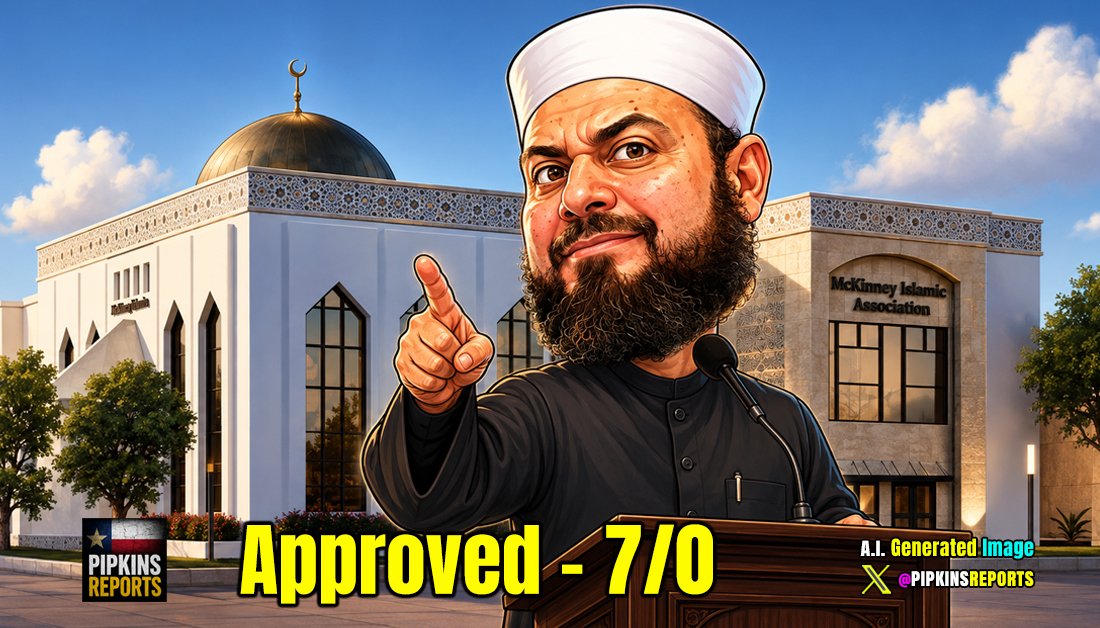
McKinney, TX – After nearly six hours of emotional testimony, shouted applause, boos, and police intervention, the McKinney City Council unanimously approved plans Tuesday night for a new Islamic center, closing another chapter in a debate that has simmered in Collin County for years. The vote may have been unanimous, but it certainly wasn’t uncontroversial.
Just before 11:30 p.m. on August 4, the council voted 7-0 to approve the site plan for the McKinney Islamic Association‘s proposed campus on roughly 5.5 acres at Virginia Parkway and Crutcher Crossing. City officials repeatedly emphasized that the decision before them was not whether Islam should have a place of worship in McKinney, but whether the submitted site plan complied with existing city ordinances and development standards. According to council members, the property’s current planned development zoning already permits religious assembly, leaving the city with little legal discretion to deny an otherwise compliant application.
The approved project includes a roughly 15,000-square-foot sanctuary, a classroom building of approximately 10,000 square feet, a 7,000-square-foot multi-purpose gymnasium, parking, and related site improvements. The McKinney Islamic Association says its current facility, where it has served the community for decades, can no longer accommodate its growing congregation.
The meeting itself became the story.
More than 150 people registered to speak, forcing city officials to delay the start of the regular meeting while names were entered into the system. Supporters and opponents packed the council chambers, overflow rooms, and hallways, creating an atmosphere that multiple local news outlets described as tense and, at times, hostile.
Opponents raised a mix of concerns.
Some focused squarely on practical issues, including increased traffic, parking shortages, neighborhood compatibility, and whether a campus serving large numbers of worshippers could comfortably fit on the site. Others voiced broader objections rooted in concerns about Islamic doctrine, Sharia law, and the changing cultural landscape of North Texas. Congressman Keith Self, whose district includes McKinney, spoke against the proposal before public testimony began, warning of dangers he associates with extremist interpretations of Islam.
Supporters argued that the project involved a long-established congregation simply seeking room to grow. They pointed to constitutional protections for religious liberty and rejected accusations directed toward the association as prejudice against Muslim residents. Veterans, longtime community members, and faith leaders urged the council to evaluate the application based on municipal law rather than religious disagreement.
Former McKinney Mayor George Fuller received one of the night’s harshest public receptions after speaking in support of the project. He was booed by portions of the crowd, and according to WFAA, police escorted him from the building after a woman reportedly shoved a sign reading “Don’t Sharia My Texas” into his shirt while he exited the meeting.
Despite the emotional testimony, council members repeatedly returned to the same legal conclusion, the site plan either met the city’s development requirements or it did not. Planning and Zoning had already recommended approval in July, and council members indicated denying a compliant application would almost certainly expose the city to litigation it was unlikely to win. Previous proposals involving substantially larger facilities required rezoning and were rejected, but the revised plan fits within the property’s existing zoning framework.
The approval does not authorize immediate construction. The project must still complete platting requirements, undergo a traffic study, and obtain building permits before construction can begin.
Below is the list of the current city council that voted 7/0 to approve the project.
| Member Name | Title | |
|---|---|---|
| Bill Cox | Mayor | |
| Rick Franklin | Mayor Pro Tem – District 4 | |
| Justin Beller | Council Member – District 1 | |
| Patrick Cloutier | Council Member – District 2 | |
| Geré Feltus | Council Member – District 3 | |
| Ernest Lynch | Council Member – At Large 1 | |
| Michael Jones | Council Member – At Large 2 |
You must be logged in to post a comment Login