
Fate City Council Finds “Credible Evidence” Against Mark Hatley, Moves Toward Hearing

FATE, TX — The Fate City Council voted Monday night to formally recognize what it called “credible evidence” that Councilman Mark Hatley may have violated the city’s Code of Ethics, setting the stage for a hearing and potential sanctions, and intensifying an already bitter political divide.
The decision came following an executive session on Monday night, and considered a motion by Councilman Scott Kelley, who was the person who filed the ethics complaint against Hatley. Kelley’s motion asserted that the council had sufficient basis to proceed under Section 2-309.10 of the Fate Code of Ethics and Section 3.093 of the City Charter.
The motion passed with support from Codi Chinn, Scott Kelley, Mark Harper, and Martha Huffman. Mayor Andrew Greenberg and Councilman Rick Maneval voted against the measure, according to the official meeting record and public proceedings.
It remains unclear from the meeting record whether Hatley voted on the motion concerning himself. He was not presented as voting in the negative, yet the Mayor made no mention of him abstaining either.
Mayor Greenberg highlighted that this process is political, not criminal.
Following the vote, Kelley introduced a second motion, requesting that Hatley provide a sworn affidavit within seven days addressing key questions tied to the investigation.
Those questions focused on whether Hatley had shared recorded conversations involving City Manager Michael Kovacs with anyone outside city government, including investigative journalist Michael Pipkins. The motion also sought to compel Hatley to cooperate with any additional information requests from the city’s Ethics Council.
Councilwoman Chinn clarified during the discussion that Hatley is not legally required to submit such an affidavit, implying the request is voluntary rather than enforceable under current rules.
The council set the public hearing for May 4, 2026.
That date falls after the city’s General Election on May 2, but before the results are officially canvassed on May 11, meaning the current council will still be seated at the time of the hearing.
Harper currently holds Place 2, a seat being sought by candidates Lorna Grove and Ashley Rains. Rains is one of the petition members seeking to remove multiple councilmembers, including Hatley, through a new recall effort.
Kelley holds Place 3, which is being sought by former Councilman Allen Robbins and Melinda McCarthy. Robbins is also aligned with those supporting the recall of the four councilmen, while McCarthy supported the recall of Codi Chinn, which is already on the ballot for May 2nd.
Early voting for that election is scheduled to begin April 20.








Fate Council Dropped Case Before Reviewing
Fate, TX — An ethics investigation commissioned by the City of Fate concluded that former Councilwoman Codi Chinn violated the City’s Code of Ethics before the City Council voted earlier this month to discontinue the matter, according to documents obtained by Pipkins Reports through an Open Records Request.
The report, prepared by attorney Laura Mueller of the law firm Baker, Robertson & O’Brien, found that the allegation against Chinn was “substantiated, but with mitigating factors.”
The Executive Summary states:
“After investigation, my determination is that allegation of a violation of the Ethics Code is substantiated, but with mitigating factors.”
The report concludes that Chinn violated Section 2-309(10) of the City’s Code of Ethics after directing City employees to provide their concerns to her in writing.
“After reviewing the Charter, the Code of Ethics, and reviewing all of the evidence, my conclusion is that Ms. Chinn violated Section 2-309(10) of the Code of Ethics when she directed employees to provide information to her in writing.”
Mueller also concluded that mitigating circumstances should be considered because Chinn immediately informed City Manager Michael Kovacs about the employee concerns and because the employees ultimately submitted their written complaints directly to the City.
Council Ends Investigation
The ethics complaint summary report was scheduled to appear on the July 6 City Council agenda for executive session discussion.
Instead of going into Executive Session, the Council waived deliberative privilege and discussed the matter in open session where they ultimately voted to discontinue the ethics proceedings and drop the matter, before being presented with the findings from Mueller.
The Council did not impose any sanction against Chinn.
The following day, Pipkins Reports requested a copy of the complaint and the investigative report, and received it through an Open Records Request.
Investigation Details
According to the report, investigators interviewed Chinn, Councilman Mark Harper, City Manager Michael Kovacs, and other witnesses.
Regarding the allegations, Mueller wrote:
“In my interview with Ms. Chinn and Mr. Harper, we discussed the allegation. I questioned Ms. Chinn about her conversations with city employees and with Mr. Kovacs.”
According to the report, Chinn stated that city employees approached her seeking assistance and that she intended to present their concerns to the City Manager after compiling the information.
However, the report states that employees instead prepared a letter addressed to the City Council. Chinn then instructed them to provide the letter directly to the City Manager.
The report also summarizes Kovacs’ account of the events.
“Mr. Kovacs stated that he received the letter outlining the employee issues directly from an officer, but with the understanding that the information was given to him at the direction of Ms. Chinn.”
Previously, it was reported that Chinn provided a copy of an, “anonymous letter”, that she claims was provided by DPS officers to her. Chinn further states that she sent the letter to Michael Kovacs … who then forwarded it on to the rest of the Council. This report also states that Kovacs told investigators he had warned Chinn against communicating with employees in that manner.
Pipkins Reports continues to investigate this aspect of the situation … as the conditions shed new light on the events that have transpired with regard to the termination of DPS Chief Lyle Lombard.
Meanwhile, the city council’s decision effectively ended the ethics proceeding against Chinn without imposing any sanction or issuing any formal determination of its own regarding the investigator’s findings. While the Council possessed the authority to discontinue the matter, the decision also brought the ethics process to a close despite an independent investigation concluding that a violation of the City’s Code of Ethics had occurred.
For the complainant, Darcy Gildon, the Council’s action marked the end of a process that resulted in no public accountability beyond the release of the investigative report which Pipkins Reports has now provided.
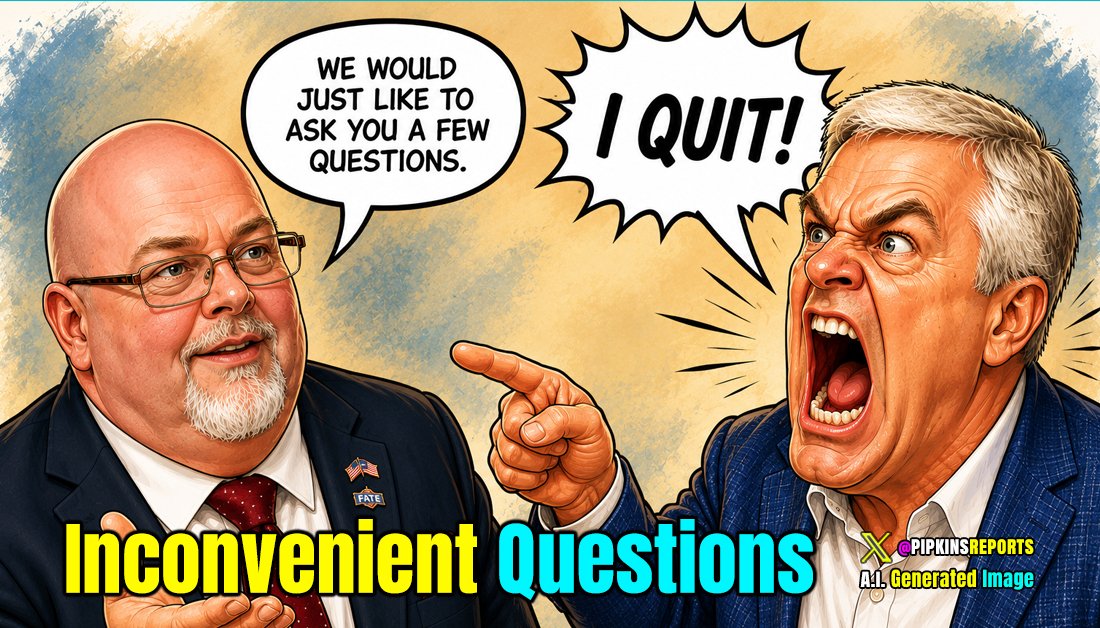
Fate, TX – Just hours after Fate city leaders submitted a list of pointed legal questions to the city’s law firm, Messer Fort notified the city it was resigning as legal counsel.
Now, Mayor Andrew Greenberg has released those unanswered questions to the public, saying residents deserve to see exactly what city officials were asking before the firm’s departure.
The release comes amid months of political turmoil inside Fate City Hall. Since the recall of former Councilwoman Codi Chinn, ethics complaints have been filed against Mayor Andrew Greenberg and Councilman Mark Hatley, while they and two other current council members now face recall elections of their own, backed by political opponents, including Councilwoman Ashley Rains, Councilman Allen Robbins, and former Councilman Scott Kelley, along with former Mayor David Billings.
Messer Fort had been hired by the City of Fate to serve as its contracted city attorney in place of employing a full-time in-house attorney. Jennifer Riche has been the attorney from that firm who has represented Fate directly. During Messer Fort’s tenure, the firm became deeply involved in several high-profile disputes, including ethics investigations, Public Information Act requests, and legal advice surrounding those matters.
According to a statement released by Greenberg, Messer Fort invited council members to submit any questions they had regarding the firm’s representation of the city. The first seven questions were submitted on July 9. Later that same day, the firm informed the city it would resign, effective July 20. Additional questions were submitted before the firm’s departure, but Greenberg said Messer Fort has not responded.
“As I mentioned during today’s City Council meeting,” Greenberg wrote. “I believe transparency is important. In that spirit, I am sharing the questions exactly as they were submitted so our residents can see what information was being requested and judge for themselves.“
The questions cover several issues that have divided the city over the past year, including Messer Fort’s handling of Texas Attorney General rulings on open records requests, the legal basis for redactions made under the Texas Public Information Act, ethics investigations involving elected officials, the firm’s analysis of potential Texas Open Meetings Act issues, and the use of city legal resources in matters questioned by council members. They also seek documentation supporting legal conclusions that influenced city decisions and ethics proceedings.
Rather than releasing only selected excerpts, Greenberg published the complete list of questions submitted to Messer Fort. The documents allow residents to review the requests in full and draw their own conclusions regarding the issues council members wanted addressed before the firm’s resignation.
Editor’s Note: The questions were originally posted as images on Facebook, making them difficult to read and appearing out of sequence. Pipkins Reports reorganized the pages, enhanced readability where necessary, and compiled them into a single PDF so readers can review the complete document in its proper order.

Chinn and Billings Bash Senator Bob Hall
Fate, TX – The political firestorm over secret recordings inside Fate City Hall just took a sharp and deeply ironic turn. Pipkins Reports has obtained an audio recording that appears to show former Fate City Councilwoman Codi Chinn secretly recording a private telephone conversation with former Mayor David Billings, despite her later public criticism of the practice.
The recording, verified through multiple sources familiar with the matter, predates the recent controversy involving Mayor Andrew Greenberg‘s recorded conversation with Chinn and Councilman Mark Hatley‘s recording of a discussion with City Manager Michael Kovacs. The discovery raises uncomfortable questions about consistency, credibility, and whether Chinn’s outrage over recorded conversations has been driven more by politics, than principle.
Pipkins Reports received a copy of a 32-minute audio recording from an anonymous source who said it originated from a recording obtained through an Open Records Request submitted to the City of Fate.
Pipkins Reports has reviewed documentation related to that request and separately confirmed the recording’s authenticity through sources with knowledge of the file maintained by the city.
Much of the conversation centers around mundane talk about MUD districts. Pipkins Reports has edited the recording to a 2-minute, 47-second excerpt focusing on the discussion involving Texas Sen. Bob Hall because it is directly relevant to matters of public interest.
During the conversation, Chinn expresses frustration with Hall’s reluctance to support legislation to strengthen child protection in schools. Stating that he is, “not interested in having that conversation.” She continues, “He is interested in getting people all riled up, but when it comes time to actually do the work, and his job, he’s nowhere to be found.“
Billings echoes that frustration, and opines how he says Bob Hall, “fights dirty“, and how he has voted against cities 9 times. The conversation paints a picture of two local political figures who believe the longtime senator was not sufficiently responsive to their legislative priorities.
The policy disagreements themselves are not especially unusual. Elected officials often criticize one another behind closed doors. What makes this recording different is the hypocrisy of Chinn, stirring up outrage about “secret recordings” when she herself has been a proponent.
The Hall recording is not the only documented instance in which Chinn appears to have secretly recorded a conversation. Through a separate Open Records Request submitted by Pipkins Reports, this publication obtained a city copy of a recorded interview between Michael Pipkins and Chinn concerning her involvement in the dismissal of former Fate Department of Public Safety Chief Lyle Lombard.
That recording also predates the controversy that would inevitably follow.
According to the records produced by the City of Fate, Chinn recorded that interview without disclosing it during the conversation. The existence of multiple recordings attributed to Chinn adds additional context to the current debate over undisclosed recordings by public officials and further raises questions about the consistency between her past actions and her more recent public criticism of the practice.
But according to the evidence reviewed by Pipkins Reports, Chinn appears to have engaged, multiple times, in the very conduct she later condemned.
Texas is a one-party consent state under state law, meaning only one participant in a conversation generally must consent to its recording. If Chinn initiated or participated in the call, recording it would not necessarily violate Texas law. The issue presented here is not primarily a legal one.
It is political.
Opinion
Politics has a funny way of exposing selective outrage.
For months, Fate residents have heard lectures from Codi Chinn about how secret recordings destroy trust, poison relationships, and undermine good government. Fair enough. Those are arguments reasonable people can debate.
But what legitimate purpose would have been gained by Chinn recording a conversation with the Former Mayor?
Given this revelation, it’s possible that the recordings by others that followed Chinn, may have been a defense mechanism (even unconsciously), over a situation that they could feel was off. Couple that with the deceptions that we now know were taking place by Chinn, and other council members, as well as the city manager, and it appears that there might have been a valid justification for both Greenberg and Hatley to take the actions that they did.
There’s another layer here which is important to understand as to why Pipkins Reports chose to clip this section of the audio. Chinn and Billings were not merely venting about Sen. Hall. They were criticizing an elected state senator over legislation affecting Fate, as well as Rockwall County in general, and discussing his approach to measures involving child safety in schools. Voters deserve to hear how public officials truly feel about those issues, and how they discuss those issues when they believe no one else is listening.
This recording doesn’t settle every argument currently consuming City Hall. It does, however, remove any illusion that only one side has participated in private recordings.
Sometimes the loudest critics leave behind the clearest evidence.
You must be logged in to post a comment Login