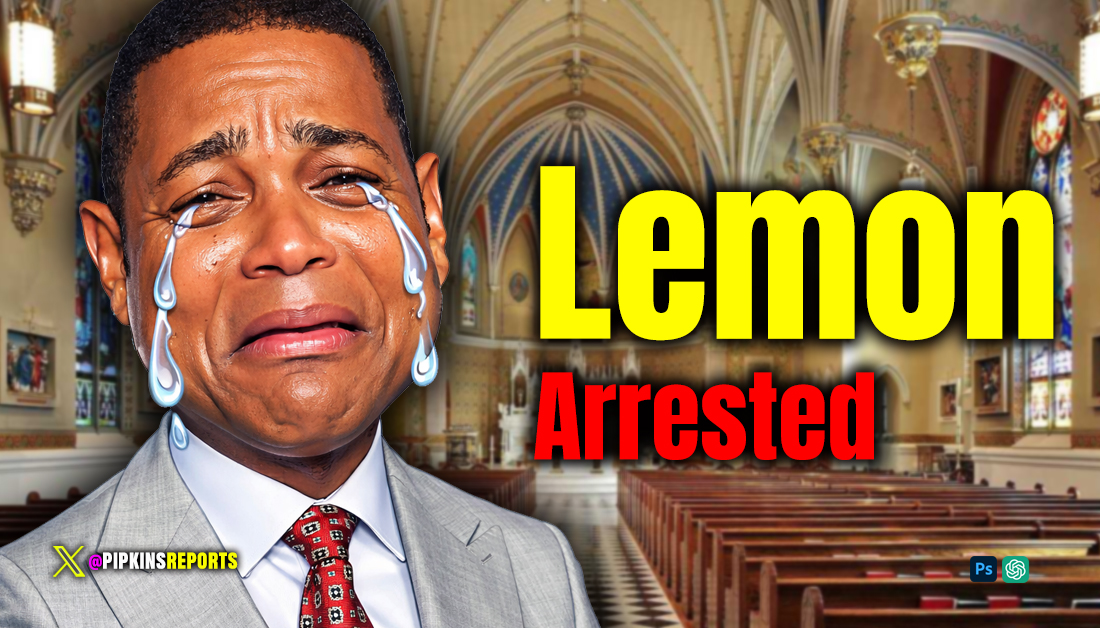
Don Lemon Arrested by Federal Agents After Disruptive Minnesota Church Protest
First Amendment Clash Erupts
LOS ANGELES, CA – Former CNN anchor and independent journalist Don Lemon was taken into federal custody Thursday night in Los Angeles, in connection with a disruptive protest that entered a St. Paul, Minnesota church during a service on January 18, 2026.
Federal agents, acting on information developed by prosecutors, apprehended Lemon while he was in California covering the Grammy Awards. This stunning development has ignited nationwide debate over protest rights, press freedom, and federal enforcement priorities.
Don Lemon, 60, a former CNN primetime anchor and currently an independent media figure and commentator, is known for his radical leftist ideology and anti-white racist slant in his reporting. After being fired from CNN he started his own podcast which can be seen on YouTube and iHeart.
Abbe Lowell, Lemon’s attorney, confirmed the arrest and provided the account of events to multiple outlets.
Multiple unnamed federal law enforcement sources and government officials are involved in the investigation.
Sources say Lemon was taken into custody under federal authority, though specific criminal charges have not yet been publicly disclosed. Federal agents reportedly acted after a grand jury was empaneled earlier on Thursday, indicating prosecutors are pursuing formal charges tied to the church incident.
The Minnesota protest targeted a pastor allegedly associated with ICE, and demonstrators called for removal of federal immigration enforcement involvement in local communities. The service disruption drew immediate attention from local media and legal authorities, and the federal government opened a civil rights and enforcement inquiry.
At least three other individuals connected to the protest have been arrested in connection with civil rights violations related to disrupting the church service. Authorities have indicated that any action in a place of worship, including entering without permission and interrupting religious activities, can invoke both criminal and civil statutes protecting access to houses of worship.
LEGAL BACKGROUND SO FAR
Earlier in the month, a federal magistrate judge refused to approve charges against Lemon, citing insufficient evidence at that early stage. Prosecutors were reportedly instructed to seek a grand jury indictment instead. Subsequently, that path appears to have succeeded, culminating in the arrest.
At least one federal appellate panel previously declined the Justice Department’s emergency request to authorize an arrest, though one judge acknowledged probable cause existed. This procedural history illustrates the complexity of prosecuting protest-related actions that intersect with press coverage and constitutional protections. The magistrate’s rejection, and subsequent grand jury action, have raised questions about prosecutorial judgment and judicial oversight.
RESPONSES FROM THE PARTIES
Lawyer Abbe Lowell — representing Lemon — publicly denounced the arrest as an “attack on the First Amendment,” asserting Lemon was acting entirely in his capacity as a journalist and that his actions were constitutionally protected reporting. Lowell vowed that Lemon will “fight these charges vigorously and thoroughly in court.”
Lemon himself has consistently maintained he was present to report and document, not to participate, and that he had no organizational role in the demonstration.
Federal authorities have not released official statements on the legal basis for the arrest, and charges remain undisclosed in public filings as of this publication. Prosecutors have linked the church disruption to violations of laws designed to protect the free exercise of religion and civil rights, but official charging documents have not yet been filed in open court.
This arrest marks a rare instance where a national media figure has been taken into custody for coverage of a protest event, particularly one involving the disruption of a religious service. For conservative observers and press freedom advocates alike, the case poses questions about the boundary between journalism and participation in politically charged events, and whether the federal government is setting a precedent for prosecuting media figures covering controversial demonstrations.
Legal scholars note that journalists generally receive broad protection under the First Amendment when documenting events, even if those events turn chaotic or involve other participants committing crimes. The government’s position, as implied by its pursuit of Lemon, suggests prosecutors believe Lemon’s presence and actions may have crossed a legal line — a position his defense vigorously disputes.
Observers expect formal charges to be announced when Lemon next appears in federal court, potentially in Los Angeles. The case is likely to draw intense scrutiny from press freedom groups, civil liberties advocates, and political commentators nationwide.
Opinion and Analysis
The arrest of Don Lemon raises serious questions: Are journalists being held to the same standards as ordinary citizens when they cover protests? The First Amendment is clear — the freedom to gather news is sacred and necessary to hold government accountable. Yet this case demonstrates how federal enforcement can transform neutral reporting into a prosecutorial target when political sensitivities run high.
If Lemon truly was reporting, walking ahead of protestors who later disrupted a service, then the act of documenting events should be protected. The government’s expansion of enforcement into spaces where journalistic documentation occurs threatens to blur the line between witness and participant — a dangerous ambiguity that chills free speech and press freedom.
Conversely, if Lemon participated in the disruption of worship services by providing aid or assistance in any way, he was no longer a reporter, and his press badge would not act as a shield from prosecution. The federal statutes designed to protect religious gatherings are legitimate insofar as they preserve Americans’ rights to worship without intimidation or interference. Enforcement of those statutes should be even-handed, not influenced by political or media status.
Here’s the critical question: Is the DOJ enforcing law impartially, or choosing political targets? That answer will shape the future of American civil liberties. Lemon’s arrest is not just about one man — it is about the fundamental guarantees of free expression and religious liberty in a democratic society.
Featured
Kristi Noem Commemorates Border Crossing Decline with National Leaders
WASHINGTON, D.C. – Secretary of Homeland Security Kristi Noem joined national security leaders in a dual-state event to commemorate a historic decline in border crossings, according to an official release from the Department of Homeland Security. The event spanned two locations, Arizona and North Dakota, in a single day, highlighting coordinated efforts to strengthen border security. Noem, alongside other officials, marked the achievement as a significant milestone in national security policy.
The Department of Homeland Security reported a measurable drop in unauthorized border crossings, attributing the success to enhanced enforcement measures and inter-agency collaboration. Specific data on the decline was not detailed in the initial announcement, though officials emphasized the impact of recent policy implementations. The two-state commemoration underscored the geographic breadth of the issue, addressing both southern and northern border concerns.
In Arizona, Noem and security leaders reviewed operations along the southern border, a longstanding focal point for immigration enforcement. Later in the day, the group traveled to North Dakota to assess northern border security, an area often overlooked in national discussions but critical to comprehensive policy. The dual focus aimed to demonstrate a unified approach to protecting all U.S. borders, per the department’s statement.
The official release from Homeland Security included remarks from Noem, who praised the dedication of personnel involved in the effort. “This decline in crossings is a testament to the hard work of our agents and the effectiveness of our strategies,” she said. Her comments were echoed by other leaders present, though no additional direct quotations were provided in the initial report.
Background on the border security initiatives reveals a multi-year push to address vulnerabilities at both entry points. Southern border challenges, particularly in Arizona, have long dominated policy debates due to high volumes of crossings and complex terrain. Meanwhile, northern border issues in states like North Dakota often involve different dynamics, including trade security and seasonal migration patterns. The Department of Homeland Security has prioritized resources for both regions, though specific funding allocations remain undisclosed in the latest update.
The cause of the reported decline ties directly to recent enforcement actions, though exact mechanisms were not specified in the announcement. Officials pointed to improved technology, increased staffing, and stronger partnerships with local and state authorities as contributing factors. Further details on these efforts are expected in forthcoming reports from the department, which has committed to transparency on border metrics.
Opinion
The recognition of a decline in border crossings signals a potential turning point in how the nation secures its frontiers. Celebrating this achievement in two distinct regions reinforces the importance of a comprehensive strategy that does not neglect less-discussed areas like the northern border.
Events like these also serve as a reminder that security is not a partisan issue but a fundamental duty of government. Prioritizing resources and personnel to protect sovereignty while maintaining lawful entry processes should remain a core focus, ensuring that progress is sustained through consistent policy and accountability.
Featured
Trump Says U.S. Used Classified “Discombobulator” to Paralyze Venezuelan Defenses
CARACAS, VENEZUELA — When President Donald J. Trump dropped the phrase “Discombobulator” in a recent interview, the world sat up and took notice. According to the president, the United States deployed a secret weapon to render Venezuelan military systems useless as U.S. forces executed a daring raid that resulted in the capture of Nicolás Maduro.
In an interview with the New York Post, Trump stated the device “made the equipment not work,” and that Venezuelan radar, missiles, and defensive systems “never got their rockets off” during the operation. “I’m not allowed to talk about it,” he said, referring to the classified nature of the technology.
The remarks have sparked curiosity, skepticism, and intense speculation about what the “Discombobulator” might actually be — and what its use means for U.S. military capability and foreign policy.
What Happened: The Maduro Raid and the Discombobulator Claim
On January 3, 2026, U.S. special operations forces carried out a rapid, highly coordinated mission in Caracas that culminated in the capture of Venezuela’s president, Nicolás Maduro, and his wife, Cilia Flores. The operation, code-named Operation Absolute Resolve, involved aircraft, helicopters, unmanned drones, and elite troops.
Speaking about the raid, Trump took credit for the success, telling the New York Post and others that a classified weapon, the so-called Discombobulator, as he called it, played a decisive role. He claimed that the device disabled Venezuelan military equipment, including systems supplied by Russia and China, before U.S. forces landed.
According to Trump’s account, Venezuelan troops tried to activate their defenses, “pressed buttons,” and found nothing worked. The president’s description suggests a form of electronic or directed-energy warfare — although he offered no detail on mechanism or development.
Context: Military Technology and Secrecy
The U.S. military has long invested in electronic warfare and directed-energy research. Systems that jam radar, disrupt communications, and interfere with electronic signals have been under development for decades. Yet no publicly acknowledged program has been confirmed to match Trump’s description of the Discombobulator.
Wartime secrecy and classification make it entirely plausible that capabilities not widely known could exist. Still, without independent verification or military documentation, journalists and analysts caution against jumping to definitive claims based on the president’s interview alone.
Conservative Commentary and Conclusion (Opinion)
The success of the Maduro raid reflects decisive leadership and a willingness to act where lesser administrations have hesitated. The Discombobulator claim — irrespective of its accuracy — underscores a broader theme: American ingenuity paired with bold strategy is unstoppable.
If such a capability exists and was responsibly employed to save lives and neutralize threats without explosive conflict, it represents a powerful demonstration of military superiority. Critics who mock the name risk missing the larger strategic point.
Whether the Discombobulator ends up in the annals of military history or remains a rhetorical flourish, the episode has already ignited fear in our adversaries about American power, innovation, and military might.
Sources:
- President Trump comments on “Discombobulator,” PBS NewsHour, Jan. 26, 2026.
- AP News reporting on Trump’s interview and weapon description.
- Gulf News analysis of unnamed weapon and its reported effects.
- Axios on use of U.S. drones and technology in operation.
- Wikipedia entry on 2026 United States intervention in Venezuela.
Council
Fate City Council Votes to Release Secret Recordings
Councilman Mark Harper walks out of meeting before adjournment.
FATE, TX – The Fate City Council voted late Monday night to waive deliberative privilege, opening the door to the public release of secret audio recordings that may have driven a recall election against Councilwoman Codi Chinn. The decision came after hours of public criticism, procedural friction, and a lengthy executive session with legal counsel.
The meeting, held Monday, February 2, was streamed live by the city and is available on YouTube at: https://www.youtube.com/live/zQVN0i-d8C0 (Embedded Below)
(Source: City of Fate, official meeting broadcast)
Timeline for Readers
- 00:33:52 – Public comments begin, largely focused on the recall election of Councilwoman Codi Chinn.
- 00:56:10 – Councilman Harper interrupts public Comment.
- 00:57:00 – Councilman Harper interrupts public Comment.
- 00:58:00 – Councilman Harper interrupts public Comment.
- 02:21:00 – Executive Session – Council enters closed session to consult with legal counsel.
- 03:22:52 – Council reconvenes in open session.
- Primary motion – Council votes to “waive deliberative privilege”, allowing release of disputed audio recordings.
Public Comment and Visible Strain
Public comments began just after the 33 minute mark and quickly centered on the recall election. Speaker after speaker questioned the conduct of city officials and demanded transparency regarding audio recordings that have circulated privately but remained unavailable to the public.
During one speaker’s remarks, critical of Councilwoman Chinn, procedural tension became visible. Three separate times, Councilman Mark Harper interrupted to remind Mayor Andrew Greenberg that the speaker had exceeded the three-minute time limit. Each time, Mayor Greenberg thanked Harper for the reminder, then directed the speaker to continue.
The exchange stood out. While council rules clearly limit speakers to three minutes, the mayor’s repeated decision to allow the speaker to proceed suggested an effort to avoid the appearance of silencing criticism during a highly charged meeting.
Clarifying the Recordings
Contrary to some early assumptions, the audio recordings at issue were not recordings of executive sessions. Instead, they are one-party consent recordings, the existence of which has been previously reported and alluded to on Pipkins Reports. Their precise origin has not been publicly detailed, but their contents have been referenced repeatedly by both supporters and critics of the recall effort.
Behind Closed Doors
Following the public meeting, the council entered executive session to consult with legal counsel. After about an hour, members returned to open session at approximately 3:22:52 .
The primary motion coming out of that session was to “waive deliberative privilege“. The effect of the vote was to remove a legal obstacle to releasing the secret audio recordings that have been at the center of the controversy.
No excerpts were played, and no conclusions were announced. The council did not rule on the legality of the recordings, nor did it weigh in on the merits of the recall election itself.
Why the Vote Matters
The decision does not resolve the recall of Councilwoman Chinn. It does not validate or refute claims made by either side. What it does is shift the debate away from rumor and secondhand accounts.
According to guidance from the Texas Municipal League, governing bodies may waive certain privileges when transparency is deemed to serve the public interest, particularly when litigation risk is balanced against public trust (Texas Municipal League, Open Meetings Act resources).
Opinion and Perspective
The council’s action was a necessary step. Secret recordings, selectively referenced and strategically leaked, undermine confidence in local government. So does a refusal to confront them directly.
Transparency is not about protecting officials from embarrassment. It is NOT the job of the council to assist the city in concealing information that may be used against it in legal proceedings when the City Manager, or Councilmen, may have done bad things. It is about protecting citizens from manipulation. If the recordings exonerate those involved, their release will restore credibility. If they raise concerns, voters deserve to hear them unfiltered before making decisions in a recall election.
Monday night in Fate did not end the controversy. It ended the excuse for keeping the public in the dark.
You must be logged in to post a comment Login
