Dallas has Little Data to Justify Flock Safety

Dallas, TX – Dallas has turned its streets into a giant electronic net. In response to an Open Records Request from Pipkins Reports, the Dallas Police Department says 671 Flock Safety cameras were deployed or operating across the city during 2025. The DPD initiates approximately 67,000 searches every month. In the year 2025, the system produced 18,841 stolen vehicle alerts. And Dallas taxpayers have committed millions to keep the system running, including cameras, installation, software, maintenance and support…and yet, they have no data to determine if the system is cost effective.
The sales pitch is public safety. Flock is supposed to help police identify vehicles, locate stolen cars, develop investigative leads and connect vehicles to criminal activity. The City of Dallas has specifically said the technology is intended to help deter and detect crime and increase clearance rates.
Fine. If government is going to put hundreds of cameras around a city and spend millions of dollars doing it, taxpayers have every right to expect more than a slick technology platform and assurances that it works.
Pipkins Reports was determined to find out how Flock is being used and what taxpayers are getting in return. What we’ve found is a remarkable imbalance: Dallas has plenty of numbers showing how much Flock is watching, searching and alerting, but surprisingly few numbers showing what all that surveillance actually accomplishes. The city can count cameras. It can count searches. It can count alerts. But when asked how many stolen vehicles were actually located or recovered as a result of Flock generated alerts, DPD says it, “doesn’t maintain that aggregate information“.
Taxpayers have forked over $5.7 million for a surveillance system around the promise of safer streets, yet the city apparently hasn’t built the corresponding scorecard to determine whether that promise is being kept. And the crimes Flock should be tailor made to address: vehicle theft, kidnappings, missing persons and hit and run crashes, provide an opportunity to test that claim. So let’s look at the numbers.
Vehicle Theft: 11,175 Crimes, 18,841 Alerts
If there is one category where Dallas ought to be able to demonstrate what Flock is accomplishing, it is vehicle theft.
Dallas recorded 11,175 Unauthorized Use/Motor Vehicle Theft offenses in 2025, according to documents provided to Pipkins Reports. That number is down 23.4% from the 14,591 offenses reported in 2024, a substantial decline. But even after that decline, thousands of Dallas residents were still victims of vehicle theft.
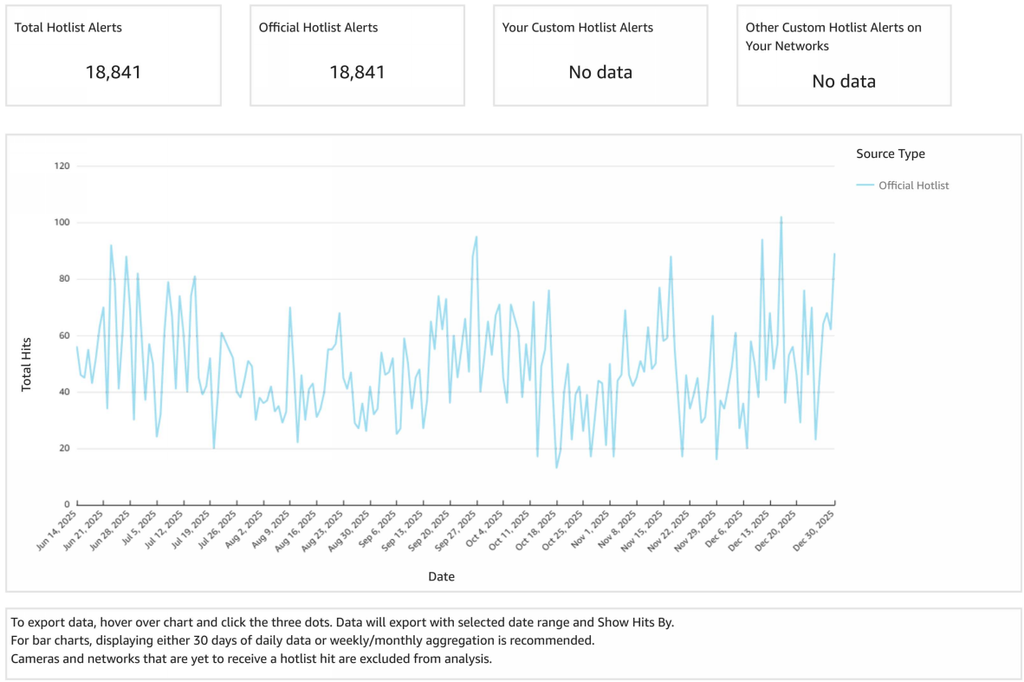
Now consider what Flock was doing during the same year.
The system generated 18,841 stolen vehicle alerts in Dallas during 2025. That’s a remarkable volume of alerts for a system specifically designed to help police identify and locate stolen vehicles. With 671 cameras spread throughout the city and tens of thousands of searches every month, this is precisely the kind of crime where Flock should be producing measurable investigative results.
But when Pipkins Reports asked the Dallas Police Department the most basic follow up question, “how many stolen vehicles were actually located or recovered following a Flock generated alert “, DPD couldn’t provide the answer. The department told us that the requested aggregate information is “not currently maintained” and that it is, “working to improve its tracking and reporting processes.“
Think about that for a moment. Dallas can tell taxpayers that Flock generated 18,841 stolen vehicle alerts. It can tell us how many cameras it operates and how often officers search the system… but it cannot tell us how many stolen vehicles those alerts actually helped recover.
Kidnappings, Amber Alerts and Missing People
Vehicle theft isn’t the only crime where Flock’s capabilities would seem to offer an obvious investigative advantage. A vehicle can be the key to finding a kidnapped child, an endangered adult or a missing person. Investigators don’t even need a license plate number, they can search by vehicle descriptions. They will also know where it was last seen. Thus, a network of hundreds of license plate readers can potentially provide eyes across the city to locate that vehicle.
Dallas reported 548 kidnapping and abduction offenses in 2025. That number doesn’t specifically tell us how many involved an Amber Alert. Amber Alerts are reserved for a much narrower set of circumstances involving an abducted child believed to be in imminent danger and other qualifying criteria. The city does not publish a separate annual total for Amber Alerts, missing children, or endangered missing adults (ie:Silver Alerts).
But here’s the question taxpayers should be asking: How often did Flock actually help?
In its response to Pipkins Reports, DPD said it does not maintain a comprehensive Flock-specific measurement showing how many kidnapped or missing people were located through the use of the Flock Safety system. There is no readily available number telling taxpayers how many Amber Alert investigations Flock assisted, how many missing person cases it helped resolve, or how many endangered people were located through information generated by the cameras.
Again, Dallas can tell us how extensively the system is being used. What it can’t readily tell us is how often that surveillance translates into a measurable public safety result. And when the justification for putting this much surveillance infrastructure on the streets is security, citizens should have a reasonable expectation that Dallas is keeping track of whether the promised security is actually being delivered.
Hit and Run: Thousands of Crashes, Still No Flock Scorecard
Then there are hit and run crashes, another category where license plate reader technology would seem almost tailor made for the job.
A hit and run investigation can begin with little more than a vehicle description, a location and an approximate time. If the suspect vehicle leaves the scene, an extensive network of cameras capable of reading license plates or identifying vehicle descriptions, could potentially give investigators a trail to follow. Yet DPD does not maintain a comprehensive statistic showing how many hit and run investigations were assisted or solved by Flock.
Part of the problem is the way Dallas classifies these incidents. Hit and run isn’t a standalone NIBRS crime category. It is a traffic crash classification, with the underlying crash data maintained through TxDOT’s Crash Records Information System. The available data indicates Dallas has experienced thousands of these crashes in recent years, with an estimated 3,300 hit and run crashes in 2025 based on a midpoint calculation from the relevant crash data.
That’s thousands of opportunities for a technology built around identifying vehicles to demonstrate its value.
But Dallas isn’t keeping the scorecard taxpayers need. DPD does not keep Flock-specific statistics showing how many hit-and-run suspects were identified through the cameras, how many cases were cleared because of Flock, or how many investigations received a meaningful Flock lead.
Dallas Tracks the Surveillance. It Doesn’t Track the Results.
At this point, a pattern starts to emerge.
Dallas has no shortage of numbers when it comes to Flock activity. What Dallas has a much harder time producing are the numbers that taxpayers actually need to evaluate the program. DPD also acknowledged that it does not currently maintain comprehensive statistics measuring Flock’s effectiveness, success rate, recovery rate or overall public safety benefit.
And DPD isn’t hiding the fact that its record keeping isn’t there yet. In response to Pipkins Reports, the department says it is “working to improve its tracking and reporting processes so that Flock’s impact can be measured more comprehensively in the future“. In other words, Dallas spent millions putting the cameras on the streets before it had a comprehensive system for measuring what those cameras actually accomplish.
( Letter from Dallas Police Department in response to our questions. Note: This is how the letter arrived. As an attachment with no letterhead or signature. )
That’s a problem when the stated justification is public safety. A police department doesn’t need to prove that every arrest, recovered vehicle or solved case came exclusively from one piece of technology. Investigations don’t work that way. But it should be able to tell taxpayers, at least in broad terms, whether a multimillion dollar surveillance system is producing measurable results. Right now, Dallas can tell us how much Flock is watching. It can’t tell us nearly as much about what all that watching is accomplishing.
Homicides: Somehow, Dallas Knows When Flock Solves Them
There is, however, one category where Dallas appears to have a much better handle on measuring Flock’s contribution: homicide.
According to DPD, the department has tracked the primary solving factor in homicide cases for several years. For 2025, DPD identified 15 homicide cases as “Cleared by Flock.” The department says that designation means Flock or other ALPR evidence was the primary factor that directly “cleared” the case, ie: the evidence that put detectives on the path toward identifying the suspect. DPD also made clear that the figure does not capture every homicide in which ALPR was used or every case where Flock simply provided additional evidence.
Although Pipkins Reports has not independently reviewed the individual case files underlying those 15 homicide cases, if true, that’s a meaningful number, and it shouldn’t be dismissed. It would appear that the department has a methodology for identifying the cases in which the technology was considered the primary solving factor. It can track that information, categorize it and report it.
Which raises an awkward question.
If Dallas can track Flock’s contribution when it solves a homicide, why can’t it track the same thing when Flock is used to find stolen vehicles, identify hit and run suspects, locate missing people or assist in kidnapping investigations?
The issue, then, isn’t whether Flock can ever be used to help solve a crime. The homicide records provide evidence that it can. The issue is why Dallas has a measuring stick for homicide but not for the broader system it is asking taxpayers to fund with millions of dollars.
Dallas, and all Cities Owe Taxpayers Accountability
Dallas has committed up to $5,738,000 dollars to Flock. The city has deployed 671 cameras, officers conduct roughly 800,000 searches a year, and the system generated 18,841 stolen vehicle alerts in 2025. Those are substantial numbers. But when taxpayers ask to see the results what those numbers produced, the answers become considerably harder to find.
If one were to average the ‘cost per crime solved’ into a metric, all that could be proved at this point is that it cost taxpayers, $382,533.33 per crime, for the use of Flock Safety. That’s a fairly ineffective investigative tool by any definition.
DPD couldn’t provide even the most basic of information and said that, to its knowledge, “no formal cost benefit analysis has been conducted“. The City of Dallas formally authorized its first Flock Group agreement on February 9, 2022. In four years of use, they haven’t conducted a single cost/benefit analysis. When we asked who is responsible for determining whether the city’s multimillion dollar commitment provides sufficient value, DPD pointed us toward the City Council.
There is a larger constitutional question here that Dallas shouldn’t be able to dodge. The Fourth Amendment protects Americans from unreasonable searches and seizures. Citizens are being asked to accept, and pay for, increasingly sophisticated government surveillance in the name of public safety. If government is going to make that argument, citizens should demand an equal measure of accountability from the government using the technology.
The city shouldn’t merely be able to say Flock can help solve crimes. It should be able to show taxpayers how often it actually does, what crimes it helps solve, how much those results cost and whether the public safety benefit justifies the intrusion. DPD has already demonstrated that it can track Flock as the primary solving factor in homicide cases. So why can’t it do the same for stolen vehicles, hit and runs, kidnappings and missing persons?
Security may be the justification for surveillance, but accountability should be the price of admission.
Beyond the homicide cases DPD identifies as “Cleared by Flock,” the records and responses obtained by Pipkins Reports contain no documented evidence demonstrating that Dallas’ Flock system is cost effective or that it reduces crime in any meaningful way. DPD has not produced a comprehensive Flock-specific recovery rate, success rate, effectiveness measurement, public safety benefit or cost-benefit analysis.
That doesn’t prove Flock doesn’t work in some capacity. It means Dallas hasn’t produced the evidence necessary to establish how effective the system is or whether its measurable benefits justify its cost. So when anyone claims that Dallas’ $5.7 million Flock system delivers a measurable public safety benefit beyond the documented homicide cases, they are making an assertion or expressing an opinion, not stating a fact established by the records obtained by Pipkins Reports.





You must be logged in to post a comment Login