Cutting Taxpayer Costs in Fate: How Impact Fees Could Lighten the Load for Infrastructure Needs

Had the City of Fate implemented impact fees on developers to address the infrastructure demands of new growth, a $20 million bond—and its associated taxpayer burden—could have been unnecessary. Impact fees, applied strategically, would allow Fate to offset the costs of new public services, roads, water, and emergency services by requiring developers to pay for the added strain their projects place on city infrastructure.
With an informed and experienced council focused on long-term fiscal responsibility, Fate could have positioned itself to harness developer-driven revenue streams. This approach used effectively in cities like Frisco, San Diego, and Fort Collins, has provided critical funding to support growth sustainably, ensuring residents don’t bear the full financial impact of development. By proactively planning for growth in this way, Fate might have avoided the need for a significant bond, creating a model for fiscal efficiency and taxpayer protection. But it’s not too late, the city can offset the cost of the new bond by increasing impact fees immediately.
What Are Impact Fees?
Impact fees are charges that cities levy on developers to cover a portion of the costs associated with public infrastructure demands created by new development. When a new subdivision, shopping center, or commercial area is built, it requires additional public resources—more roads, water, and sewer capacity, and greater public safety coverage. Traditionally, these costs were often shouldered by the general taxpayer. With impact fees, the responsibility for new infrastructure shifts partially or wholly onto developers.
These fees are typically assessed based on the estimated “impact” a development will have on city services. While the structure and application of impact fees vary across jurisdictions, the principle is the same: development should pay for itself, reducing taxpayer burden. The fees can be earmarked for specific projects, such as road expansions, new fire stations, or enhanced public utilities, and are legally restricted for those uses.
How Impact Fees Are Applied
Cities tailor impact fees to meet their unique needs and growth patterns. Some target transportation improvements, while others focus on utilities, public safety, and parks. Texas law allows municipalities to impose impact fees, but guidelines are stringent; fees must be proportionate, directly connected to the development, and justifiable through studies showing the development’s projected impact. This makes impact fees a flexible but carefully regulated tool that, when used effectively, can significantly ease financial strain on local budgets.
Real-World Examples of Impact Fees in Action
To understand how Fate could utilize impact fees, let’s look at five U.S. cities where impact fees have successfully offset infrastructure costs. Each of these cities demonstrates a practical approach Fate could adapt to fund essential services without placing undue burdens on residents.
1. Frisco, Texas: Expanding Services for a Booming Suburb
In the Dallas-Fort Worth metroplex, Frisco stands as a model for proactive growth management through impact fees. Frisco’s development fees are rigorously structured, covering roads, parks, water, and wastewater infrastructure. For residential development, the city imposes impact fees based on lot sizes. For instance:
- Roadway Impact Fees: New residential developments incur roadway impact fees of approximately $8,508 per single-family home lot. For multifamily projects, the fees are about $5,317 per unit.
- Water and Wastewater Impact Fees: For water, Frisco charges around $1.33 per square foot for commercial developments, while wastewater impact fees can add another $0.96 per square foot.
- Parks and Open Spaces: Frisco also assesses fees for parks, amounting to roughly $1,000 per residential unit to ensure parkland and amenities keep pace with population growth.
These fees generate millions annually. For example, in 2022, Frisco collected over $25 million in impact fees, which funded the construction of new roads, utility expansions, and public safety facilities. This approach has allowed Frisco to continue its rapid growth trajectory while maintaining high standards of infrastructure without imposing additional taxes on existing residents.
2. San Diego, California: Transportation and Public Safety
San Diego employs a well-established system of impact fees to fund its regional growth. The city charges developers based on the projected increase in traffic, utility demand, and emergency services. These fees are strategically allocated, with a strong emphasis on expanding roadways, upgrading transit systems, and constructing new fire and police stations. San Diego’s approach ensures that growth directly contributes to maintaining and improving the quality of life for its residents, protecting taxpayers from shouldering the full cost of new infrastructure.
The City of San Diego collects significant funds through impact fees, with specific fees for residential and non-residential developments based on metrics like average daily trips (ADTs) and gross floor area (GFA). For example, in the Midway-Pacific Highway area, impact fees in 2019 included:
- Mobility Facilities: Fees for road and transit improvements amount to $533 per ADT. With an average of 7 ADTs per dwelling unit (DU), this results in $3,731 per residential unit for mobility improvements.
- Fire-Rescue Facilities: Impact fees are set at $164 per DU for residential and $164 per 1,000 square feet of GFA for non-residential buildings.
- Parks and Recreation: Residential developments are also charged $3,723 per DU to support parks and recreation facilities.
The city collected millions annually from these fees to fund various infrastructure projects, including road, park, fire-rescue, and transit improvements, which are distributed across neighborhoods and specifically tailored to meet the infrastructure needs of each development area. For example, Carmel Valley collected over $332,980 for improvements in one fiscal year, while downtown areas saw over $8 million in fees during the same period.
You can find more details on San Diego’s impact fees and projects in their public records site. Here: San Diego.
3. Fort Collins, Colorado: Public Utilities and Affordable Housing
Fort Collins has used impact fees for years to fund water and wastewater services and other public utility upgrades required by new development. By charging developers impact fees dedicated to expanding these utility networks, the city has effectively managed costs while also considering affordable housing needs. Fort Collins recalibrates its impact fees annually, ensuring they accurately reflect the city’s infrastructure expenses and growth trends. This ensures that new development is contributing to community infrastructure, reducing pressure on general tax revenues.
In Fort Collins, the impact fees are known as Capital Expansion Fees (CEFs)—are applied to a variety of development types to fund critical infrastructure, including public safety, parks, and general government facilities. Specific fee amounts vary based on the nature of the development, with detailed rates per square footage and per acre.
For instance, residential development fees for single-family homes in Fort Collins are structured by dwelling size. A dwelling between 1,201 and 1,700 square feet incurs an approximate fee of $3,537 per unit, while larger homes exceeding 2,200 square feet are assessed at $4,982. These fees incorporate costs across parks, fire, police, and general government services, providing a mechanism for the city to support infrastructure needs created by growth without over-burdening existing taxpayers. Non-residential developments are similarly charged: commercial spaces incur around $1,311 per 1,000 square feet, while industrial developments face lower fees, approximately $309 per 1,000 square feet.
In recent years, Fort Collins has adjusted these fees upwards to more accurately reflect the increasing costs of service expansion, aiming to align impact fees with current economic conditions and projected city growth. This adjustment process has helped Fort Collins maintain a steady influx of funding for infrastructure, with CEFs totaling millions annually.
For more specific financial data on Fort Collins’ impact fees, the city’s development and utility fees documentation is publicly accessible at fcgov.com
4. Charlotte, North Carolina: Keeping Pace with Growth
Charlotte is another example of a fast-growing city that relies on impact fees to manage infrastructure costs. As one of the Southeast’s leading economic hubs, Charlotte has seen significant population growth, and increasing demands on roadways, water, sewer, and public safety services. The city implemented impact fees to ensure that new developments fund necessary upgrades, allowing Charlotte to invest in critical infrastructure and services without significantly raising taxes on existing residents.
Charlotte’s focus is on water and sewer infrastructure. Although Charlotte does not traditionally employ broad-based development impact fees like some other municipalities, it leverages other types of fees to fund necessary improvements. One primary revenue source comes from system development fees, which help cover capital costs for expanding water and sewer infrastructure to support new development. These fees are calculated based on projected infrastructure costs and the level of demand that new developments impose on existing resources, ensuring that the city recoups a portion of its costs directly from developers.
In terms of specifics, recent updates reflect Charlotte’s commitment to expanding these fees to maintain high service levels amidst growing demand. Development fees are calculated per gallon for water and sewer usage based on expected capacity needs of each new project. The fees in Charlotte and Mecklenburg County provide a proportional structure, where the higher the demand created by a project, the higher the fees imposed to cover required expansions, which helps balance growth with the city’s fiscal responsibilities.
For further details on how Charlotte calculates and applies these fees, including specific fee schedules and supporting data, you can review their infrastructure planning and fee schedules in their fiscal and planning documentation Charlotte Future 2040.
5. Phoenix, Arizona: Balancing Growth with Infrastructure Needs
Phoenix, a city known for its expansive urban growth, has long used impact fees to finance infrastructure expansion. Fees in Phoenix help fund transportation improvements, water resources, parks, and public safety facilities in growing areas. This allows the city to maintain an orderly expansion without straining existing infrastructure or local budgets. The city’s fees are periodically reviewed and adjusted to align with changes in development patterns and infrastructure needs, ensuring a fair contribution from new projects.
In Phoenix, impact fees are structured to ensure that new development contributes significantly to the infrastructure required to support it. Fees are assessed differently across nine specific impact fee areas within the city, with variations based on the infrastructure needs and density of each zone. For instance, in Paradise Ridge, developers of single-family homes pay $16,824 in total impact fees, while in areas like the Northeast and Northwest, fees for similar developments are approximately $15,092 and $15,169, respectively. Each area has tailored fees to meet its unique requirements, which are recalculated and updated periodically by the city to stay aligned with growth and service demands.
For multi-family, commercial, and industrial projects, Phoenix calculates impact fees based on specific project characteristics, such as building size, location, and water meter requirements, making these assessments more variable. These funds are allocated directly to dedicated accounts and are earmarked strictly for infrastructure that serves each impact area, following city policy to ensure that the cost of growth does not fall on existing residents but is absorbed proportionally by new developments.
More information on Phoenix’s impact fees, including detailed rates by area, is available from the City of Phoenix’s official planning and development department City of Phoenix.
Over a recent period, the city collected over $191 million in development impact fees to support capital facility expansion across various zones, which are strategically divided to ensure that the fees benefit specific areas within Phoenix.
Why Impact Fees Matter for Fate
As one of Texas’ fastest-growing cities, Fate faces the challenge of maintaining quality public services without significantly increasing taxes. With every new subdivision or commercial building, demand rises for road capacity, water and sewer services, and public safety coverage. For a city that aims to uphold fiscal responsibility and quality of life, impact fees present a viable tool. Applying these fees to new developments could allow Fate to:
- Expand Public Safety Facilities: New developments increase the need for police and fire services. Impact fees could help fund the construction or expansion of DPS facilities, ensuring the city maintains safe response times and effective emergency coverage.
- Improve Road Infrastructure: More development inevitably means more traffic. By using impact fees, Fate can plan and execute road improvements, expansions, or upgrades without relying on existing taxpayer funds.
- Bolster Water and Utility Systems: To accommodate the growth in residential and commercial areas, Fate’s water and sewer systems will require upgrades. Impact fees allow the city to invest in these essential systems proactively, protecting both residents and businesses from potential service issues.
- Preserve Open Spaces and Parks: Impact fees could also be allocated to developing and maintaining parks and recreational areas. This aligns with Fate’s desire to maintain an “old-town” feel with communal spaces that enhance residents’ quality of life.
A Strategic Next Step for Fiscal Responsibility
Implementing impact fees is a decision that requires careful planning, transparency, and community involvement. However, as illustrated by Frisco, San Diego, Fort Collins, Charlotte, and Phoenix, when managed effectively, impact fees allow cities to balance growth with fiscal responsibility.
For Fate, impact fees could relieve taxpayer burden and diminish the cost of the DPS bond that just passed by a vote of the people, enabling continued growth while safeguarding the services and infrastructure on which the community relies. As Fate evaluates options for funding its future, impact fees may provide the critical bridge between growth and quality of life, ensuring that the costs of new developments are borne by those who benefit most directly—developers and future residents—while protecting the financial interests of current taxpayers.


Fate, TX
Exposed: City of Fate Withholds Documents from Disclosure Without Permission From Attorney General

Ethics Investigation Raises New Questions About Fate’s Response to Open Records Request
Fate, TX — An ethics investigation into former Fate City Councilwoman Codi Chinn has uncovered evidence suggesting the City of Fate possessed at least one employee complaint against former Department of Public Safety Chief Lyle Lombard that it never disclosed in response to an Open Records Request submitted by Pipkins Reports.
The newly released investigative report also raises additional questions about whether City Manager Michael Kovacs fully described his receipt of employee complaint letters during his interview with the City’s outside investigator.
The documents establish the following timeline.
On November 25, 2025, Pipkins Reports submitted a Texas Public Information Act request seeking four categories of records related to Chief Lombard’s employment. Item No. 3 requested:
“Copy of any written complaints against Chief Lombard within the last 12 months prior to termination.”
On December 11, 2025, the City responded by producing Chief Lombard’s performance evaluations, termination documents, and the investigation initiated by City Manager Michael Kovacs. However, the city produced no employee complaint letters.
Because no complaint letters were produced, Pipkins Reports immediately contacted the City for clarification. The follow-up specifically noted that an anonymous employee complaint concerning Lombard had already become publicly known and requested that letter, along with any other anonymous or signed complaints concerning the former chief.
On December 16th, after Pipkins Reports challenged the City’s original response, Associate Attorney Paige Goins of Messer Fort acknowledged that one document—the anonymous letter already known to exist—had been inadvertently omitted and she sent that document to Pipkins Reports.
Then, on December 18, the City supplemented its response again by producing awards and commendations received by Lombard.
At the time, Pipkins Reports did not pursue the matter further. New information obtained through a subsequent ethics investigation has now renewed serious questions about whether the City’s response complied with the Texas Public Information Act.
Under the Texas Public Information Act, governmental bodies generally must either promptly produce responsive public records or seek a ruling from the Texas Attorney General if they believe the requested information falls within an exception to disclosure. If a governmental body fails to timely request an Attorney General ruling, the requested information is generally presumed to be public unless a compelling reason exists to withhold it. See Texas Government Code §§ 552.221, 552.301, and 552.302.
In this case, the City did not seek an Attorney General ruling authorizing its withholding of any documents.
Ethics Investigation Reveals New Information
Seven months later, in July of 2026, an unrelated ethics investigation would reveal information that casts new light on the City’s response.
The investigation originated from an ethics complaint filed by Fate resident Darcy Gildon, who alleged former Councilwoman Codi Chinn improperly involved herself in personnel matters by directing city employees to prepare written complaints concerning Chief Lombard.
Attorney Laura Mueller of Baker Robertson & O’Brien ultimately concluded that Chinn violated Section 2-309(10) of the city’s Code of Ethics by directing employees to provide information to her in writing. Pipkins Reports reported on that story … here.
More significant for purposes of this investigation, however, were the interviews conducted with the individuals involved.
According to the investigative report, Chinn told investigators that city employees approached her seeking assistance. She stated that she instructed them to put their concerns in writing so they could be presented to the City Council. Instead, according to her interview, the employees compiled a letter addressed to the entire City Council, after which she instructed them to deliver the letter to City Manager Michael Kovacs.
The investigative report summarizes Kovacs’ interview as follows:
“In my interview with Mr. Kovacs, we discussed his conversations with then Councilmember Chinn and the employees. Mr. Kovacs stated that he received the letter outlining the employee issues directly from an officer, but with the understanding that the information was given to him at the direction of Ms. Chinn. Mr. Kovacs also stated that Ms. Chinn kept him informed of the conversations she was having with the employees, but that he warned her against such communications.”
The report, however, does not discuss the original anonymous complaint letter that Pipkins Reports previously reported had been delivered to Kovacs through Councilwoman Chinn.
Taken together, the report’s statements—and its omissions—appear to indicate that Kovacs possessed at least two written employee complaints that would have been responsive to Pipkins Reports’ November 2025 Public Information Act request.
Two Letters, One Unanswered Question
Pipkins Reports has independently obtained copies of both complaint letters from sources outside City Hall. One anonymous letter begins with the words, “To Whom It May Concern.” The second letter is addressed to the entire City Council and was reportedly transmitted through Councilwoman Chinn.
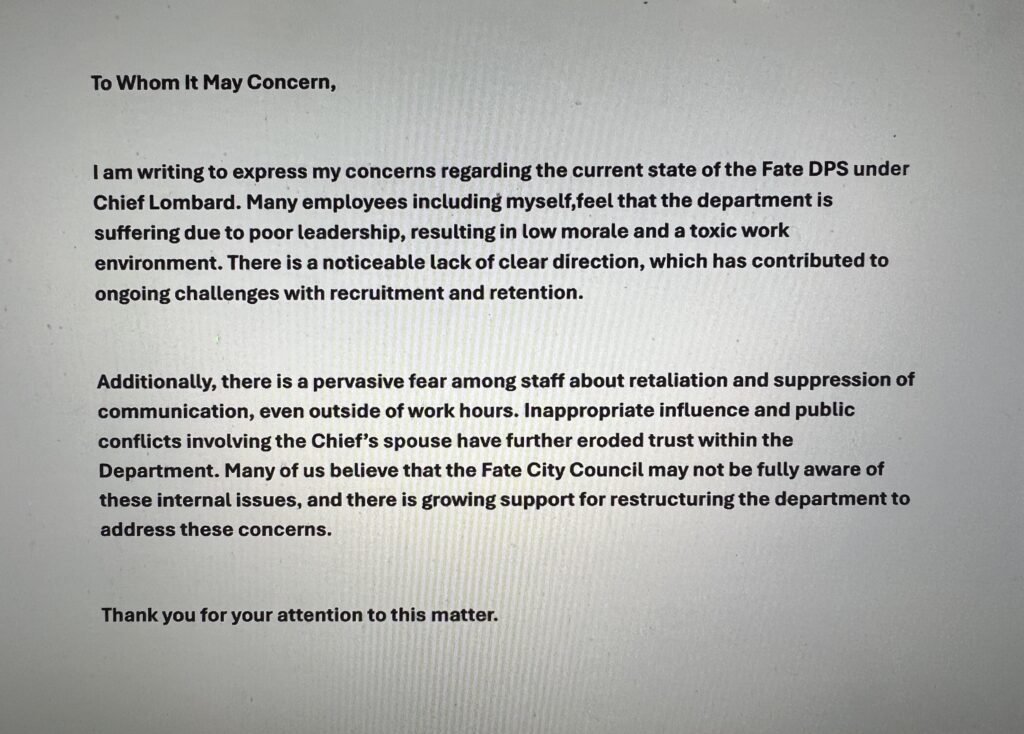
Their existence, however, does not resolve whether the City complied with the Texas Public Information Act. The central question is whether the City properly disclosed responsive records in response to a lawful request.
As of this publication, the City still has not disclosed the separate complaint letter that Kovacs later acknowledged receiving directly from a police officer. By his own admission, City Manager Michael Kovacs is the person responsible for the dissemination of records per State Law, and therefore he is the person who should be held accountable.
If Kovacs’ statement to investigators is accurate, that second complaint letter would have existed when the City’s response to the November 2025 Public Information Act request was prepared.
A New Public Information Request
In light of the newly disclosed information, Pipkins Reports has submitted another Texas Public Information Act request seeking all written complaints concerning Chief Lombard, including the complaint letter Kovacs acknowledged receiving from an officer, the complaint letter transmitted through Councilwoman Chinn, and any additional written complaints in the City’s possession.
The request states, in part:
“On 11/25/2025, as part of Open Records Request #R001735-112525, I requested ‘Copy of any written complaints against Chief Lombard within the last 12 months prior to termination.’ The City failed to provide any responsive documents, even though it was publicly known that at least one anonymous complaint letter existed.
During the ethics investigation conducted by Baker Robertson & O’Brien, Michael Kovacs stated that he received a complaint letter from a police officer. This admission indicates the City possessed an additional responsive document that was not disclosed.
The City did not seek an Attorney General ruling authorizing the withholding of either complaint letter. This request seeks both documents, together with any additional written complaints concerning Chief Lombard.”
Whether the City ultimately produces the records—or explains why they were not disclosed nearly eight months ago—may determine whether this story ends as an administrative oversight or raises more significant questions regarding the City’s compliance with the Texas Public Information Act.
This remains an ongoing investigation. Pipkins Reports will continue to report on developments as additional records become available.

Fate Council Dropped Case Before Reviewing
Fate, TX — An ethics investigation commissioned by the City of Fate concluded that former Councilwoman Codi Chinn violated the City’s Code of Ethics before the City Council voted earlier this month to discontinue the matter, according to documents obtained by Pipkins Reports through an Open Records Request.
The report, prepared by attorney Laura Mueller of the law firm Baker, Robertson & O’Brien, found that the allegation against Chinn was “substantiated, but with mitigating factors.”
The Executive Summary states:
“After investigation, my determination is that allegation of a violation of the Ethics Code is substantiated, but with mitigating factors.”
The report concludes that Chinn violated Section 2-309(10) of the City’s Code of Ethics after directing City employees to provide their concerns to her in writing.
“After reviewing the Charter, the Code of Ethics, and reviewing all of the evidence, my conclusion is that Ms. Chinn violated Section 2-309(10) of the Code of Ethics when she directed employees to provide information to her in writing.”
Mueller also concluded that mitigating circumstances should be considered because Chinn immediately informed City Manager Michael Kovacs about the employee concerns and because the employees ultimately submitted their written complaints directly to the City.
Council Ends Investigation
The ethics complaint summary report was scheduled to appear on the July 6 City Council agenda for executive session discussion.
Instead of going into Executive Session, the Council waived deliberative privilege and discussed the matter in open session where they ultimately voted to discontinue the ethics proceedings and drop the matter, before being presented with the findings from Mueller.
The Council did not impose any sanction against Chinn.
The following day, Pipkins Reports requested a copy of the complaint and the investigative report, and received it through an Open Records Request.
Investigation Details
According to the report, investigators interviewed Chinn, Councilman Mark Harper, City Manager Michael Kovacs, and other witnesses.
Regarding the allegations, Mueller wrote:
“In my interview with Ms. Chinn and Mr. Harper, we discussed the allegation. I questioned Ms. Chinn about her conversations with city employees and with Mr. Kovacs.”
According to the report, Chinn stated that city employees approached her seeking assistance and that she intended to present their concerns to the City Manager after compiling the information.
However, the report states that employees instead prepared a letter addressed to the City Council. Chinn then instructed them to provide the letter directly to the City Manager.
The report also summarizes Kovacs’ account of the events.
“Mr. Kovacs stated that he received the letter outlining the employee issues directly from an officer, but with the understanding that the information was given to him at the direction of Ms. Chinn.”
Previously, it was reported that Chinn provided a copy of an, “anonymous letter”, that she claims was provided by DPS officers to her. Chinn further states that she sent the letter to Michael Kovacs … who then forwarded it on to the rest of the Council. This report also states that Kovacs told investigators he had warned Chinn against communicating with employees in that manner.
Pipkins Reports continues to investigate this aspect of the situation … as the conditions shed new light on the events that have transpired with regard to the termination of DPS Chief Lyle Lombard.
Meanwhile, the city council’s decision effectively ended the ethics proceeding against Chinn without imposing any sanction or issuing any formal determination of its own regarding the investigator’s findings. While the Council possessed the authority to discontinue the matter, the decision also brought the ethics process to a close despite an independent investigation concluding that a violation of the City’s Code of Ethics had occurred.
For the complainant, Darcy Gildon, the Council’s action marked the end of a process that resulted in no public accountability beyond the release of the investigative report which Pipkins Reports has now provided.

Fate, TX – Just hours after Fate city leaders submitted a list of pointed legal questions to the city’s law firm, Messer Fort notified the city it was resigning as legal counsel.
Now, Mayor Andrew Greenberg has released those unanswered questions to the public, saying residents deserve to see exactly what city officials were asking before the firm’s departure.
The release comes amid months of political turmoil inside Fate City Hall. Since the recall of former Councilwoman Codi Chinn, ethics complaints have been filed against Mayor Andrew Greenberg and Councilman Mark Hatley, while they and two other current council members now face recall elections of their own, backed by political opponents, including Councilwoman Ashley Rains, Councilman Allen Robbins, and former Councilman Scott Kelley, along with former Mayor David Billings.
Messer Fort had been hired by the City of Fate to serve as its contracted city attorney in place of employing a full-time in-house attorney. Jennifer Riche has been the attorney from that firm who has represented Fate directly. During Messer Fort’s tenure, the firm became deeply involved in several high-profile disputes, including ethics investigations, Public Information Act requests, and legal advice surrounding those matters.
According to a statement released by Greenberg, Messer Fort invited council members to submit any questions they had regarding the firm’s representation of the city. The first seven questions were submitted on July 9. Later that same day, the firm informed the city it would resign, effective July 20. Additional questions were submitted before the firm’s departure, but Greenberg said Messer Fort has not responded.
“As I mentioned during today’s City Council meeting,” Greenberg wrote. “I believe transparency is important. In that spirit, I am sharing the questions exactly as they were submitted so our residents can see what information was being requested and judge for themselves.“
The questions cover several issues that have divided the city over the past year, including Messer Fort’s handling of Texas Attorney General rulings on open records requests, the legal basis for redactions made under the Texas Public Information Act, ethics investigations involving elected officials, the firm’s analysis of potential Texas Open Meetings Act issues, and the use of city legal resources in matters questioned by council members. They also seek documentation supporting legal conclusions that influenced city decisions and ethics proceedings.
Rather than releasing only selected excerpts, Greenberg published the complete list of questions submitted to Messer Fort. The documents allow residents to review the requests in full and draw their own conclusions regarding the issues council members wanted addressed before the firm’s resignation.
Editor’s Note: The questions were originally posted as images on Facebook, making them difficult to read and appearing out of sequence. Pipkins Reports reorganized the pages, enhanced readability where necessary, and compiled them into a single PDF so readers can review the complete document in its proper order.
You must be logged in to post a comment Login