Border Hoax Exposed: Abbott’s So-Called ‘Official Declaration’

Governor Greg Abbott has NOT “Officially Declared” an Invasion at the border.
A recent social media post by Texas Governor Greg Abbott sparked controversy and claims of deception, as the Governor proclaimed to have “officially declared an invasion at our border” on September 20, 2023. Governor Abbott’s statement raised eyebrows and ignited debate. But was it truthful?

In the social media post, Governor Abbott stated, “I officially declared an invasion at our border because of Biden’s policies. We deployed the Texas National Guard, DPS & local law enforcement. We are building a border wall, razor wire & marine barriers. We are also repelling migrants.” However, a closer examination of the facts reveals a lack of clarity and transparency in the Governor’s claims.
The heart of the controversy lies in the absence of an actual “declaration” of invasion. While many media outlets reported on Abbott’s statement, few bothered to scrutinize the timeline and documents associated with the Governor’s assertions (TLJ included). Following that, a comprehensive investigation by the Texas Liberty Journal has shed light on the matter, revealing that no official “declaration” exists in the sense described by Governor Abbott.
Every official document issued by the Governor falls under either an “Executive Order” or a “Proclamation.” The closest thing to an “official declaration of invasion” dates back to July 7, 2022, when Governor Abbott issued Executive Order EO-GA-41. In this order, the Governor authorized the Texas National Guard and the Texas Department of Public Safety to respond to illegal immigration by apprehending immigrants who crossed the border between ports of entry. This executive order contains no mention of an “invasion declaration.”
Furthermore, the executive order clearly stipulates, “This executive order may also be amended by proclamation of the governor.” However, no such proclamation has ever followed, raising questions about the Governor’s commitment to the declaration’s validity.
There was a proclamation issued on May 31, 2021, declaring a “disaster” at the border, and it has been renewed every month, as mandated by the Texas Constitution. Nevertheless, this proclamation does not constitute an “invasion declaration,” as the Governor’s recent social media post suggests.
In his letter to President Joe Biden dated November 16, 2022, Governor Abbott used the term “invoke” in reference to Article I, Section 10, Clause 3 of the United States Constitution, asserting the states’ right to protect themselves if the federal government fails to protect them from invasion. However, the term “invoke” is not a legal term and holds no legislative or governmental significance without backing from either a proclamation or an executive order. It is by either of these two methods that something is truely, “invoked”, or put into action.
The crux of the matter is that Governor Abbott’s claim of having “officially declared an invasion” appears to be, at best, a misrepresentation of his earlier executive order and, at worst, a deliberate deception to mislead the public. Such a significant declaration should be backed by transparent, legally binding documents, rather than vague references to strongly worded letters.
Operation Lone Star: Transparency and Accountability Questions Linger
Amid the ongoing border challenges, Operation Lone Star (OLS) remains a cornerstone of Texas’ approach to securing its southern border. OLS, operating under the banner of Executive Order EO-GA-41, was introduced to address the multifaceted issues of illegal immigration, the illegal drug trade, and human smuggling. However, concerns about transparency and accountability surround the operation, casting a shadow on its claimed success.
Governor Greg Abbott’s vision for Operation Lone Star, as laid out in the Executive Order, has been a costly endeavor. As of April 2022, the operation was expending approximately $2.5 million per week, with an estimated annual cost of $2 billion. While these expenses underscore the state’s commitment to border security, they raise questions about the efficiency and accountability of this vast undertaking.
At its zenith, Operation Lone Star mobilized approximately 10,000 National Guard members, providing critical support to the border region. By November 2022, this number had reduced to around 6,000. The Texas Liberty Journal was unable to get an exact count of the current number of troops that are deployed.
The reported results of Operation Lone Star are undeniably impressive. The operation is said to have led to 394,200 migrant apprehensions, 31,300 criminal arrests, including 29,100 felony charges, and the seizure of a staggering 422 million doses of fentanyl…according the governor’s office. However, questions regarding the fate of the apprehended individuals remain unanswered.
One of the critical concerns is the lack of transparency regarding the fate of migrants once they are apprehended. The State has been silent on whether individuals are genuinely returned to the point of entry or if they are simply processed and released, potentially being bussed to Democrat run “Sancturary Cities”, which is a good thing. However, this glaring lack of clarity undermines the transparency of OLS and raises questions about its true effectiveness in addressing border issues. Not a single image or video of illegal aliens being returned to a point of entry has been released. In the ongoing war of public opinion, and with an effort to dissuade individuals from crossing the border illegally, one would think such an image would be a powerful tool … if it existed.
As Texas confronts ongoing border challenges, Operation Lone Star serves as a symbol of the State’s commitment to security. Yet, its enormous costs and the absence of clear information regarding the treatment and outcomes of those apprehended highlight the need for greater transparency and accountability in the operation’s execution. With these concerns in mind, it is essential that Texas residents receive detailed answers about the operation’s outcomes and expenses to assess whether it genuinely serves their best interests.







Fate, TX
Exposed: City of Fate Withholds Documents from Disclosure Without Permission From Attorney General
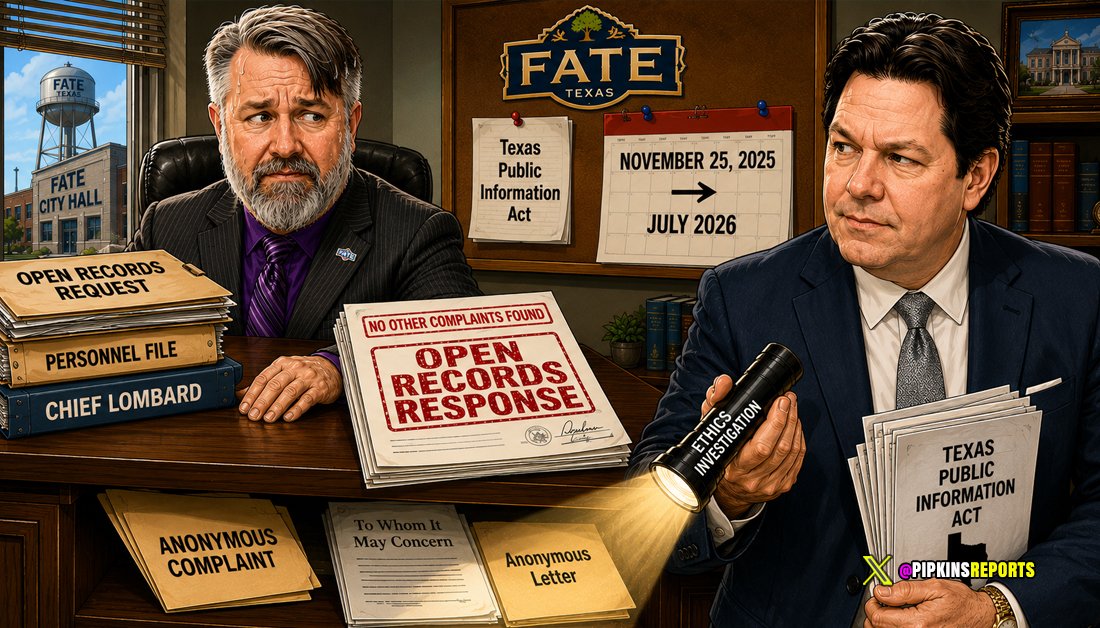
Ethics Investigation Raises New Questions About Fate’s Response to Open Records Request
Fate, TX — An ethics investigation into former Fate City Councilwoman Codi Chinn has uncovered evidence suggesting the City of Fate possessed at least one employee complaint against former Department of Public Safety Chief Lyle Lombard that it never disclosed in response to an Open Records Request submitted by Pipkins Reports.
The newly released investigative report also raises additional questions about whether City Manager Michael Kovacs fully described his receipt of employee complaint letters during his interview with the City’s outside investigator.
The documents establish the following timeline.
On November 25, 2025, Pipkins Reports submitted a Texas Public Information Act request seeking four categories of records related to Chief Lombard’s employment. Item No. 3 requested:
“Copy of any written complaints against Chief Lombard within the last 12 months prior to termination.”
On December 11, 2025, the City responded by producing Chief Lombard’s performance evaluations, termination documents, and the investigation initiated by City Manager Michael Kovacs. However, the city produced no employee complaint letters.
Because no complaint letters were produced, Pipkins Reports immediately contacted the City for clarification. The follow-up specifically noted that an anonymous employee complaint concerning Lombard had already become publicly known and requested that letter, along with any other anonymous or signed complaints concerning the former chief.
On December 16th, after Pipkins Reports challenged the City’s original response, Associate Attorney Paige Goins of Messer Fort acknowledged that one document—the anonymous letter already known to exist—had been inadvertently omitted and she sent that document to Pipkins Reports.
Then, on December 18, the City supplemented its response again by producing awards and commendations received by Lombard.
At the time, Pipkins Reports did not pursue the matter further. New information obtained through a subsequent ethics investigation has now renewed serious questions about whether the City’s response complied with the Texas Public Information Act.
Under the Texas Public Information Act, governmental bodies generally must either promptly produce responsive public records or seek a ruling from the Texas Attorney General if they believe the requested information falls within an exception to disclosure. If a governmental body fails to timely request an Attorney General ruling, the requested information is generally presumed to be public unless a compelling reason exists to withhold it. See Texas Government Code §§ 552.221, 552.301, and 552.302.
In this case, the City did not seek an Attorney General ruling authorizing its withholding of any documents.
Ethics Investigation Reveals New Information
Seven months later, in July of 2026, an unrelated ethics investigation would reveal information that casts new light on the City’s response.
The investigation originated from an ethics complaint filed by Fate resident Darcy Gildon, who alleged former Councilwoman Codi Chinn improperly involved herself in personnel matters by directing city employees to prepare written complaints concerning Chief Lombard.
Attorney Laura Mueller of Baker Robertson & O’Brien ultimately concluded that Chinn violated Section 2-309(10) of the city’s Code of Ethics by directing employees to provide information to her in writing. Pipkins Reports reported on that story … here.
More significant for purposes of this investigation, however, were the interviews conducted with the individuals involved.
According to the investigative report, Chinn told investigators that city employees approached her seeking assistance. She stated that she instructed them to put their concerns in writing so they could be presented to the City Council. Instead, according to her interview, the employees compiled a letter addressed to the entire City Council, after which she instructed them to deliver the letter to City Manager Michael Kovacs.
The investigative report summarizes Kovacs’ interview as follows:
“In my interview with Mr. Kovacs, we discussed his conversations with then Councilmember Chinn and the employees. Mr. Kovacs stated that he received the letter outlining the employee issues directly from an officer, but with the understanding that the information was given to him at the direction of Ms. Chinn. Mr. Kovacs also stated that Ms. Chinn kept him informed of the conversations she was having with the employees, but that he warned her against such communications.”
The report, however, does not discuss the original anonymous complaint letter that Pipkins Reports previously reported had been delivered to Kovacs through Councilwoman Chinn.
Taken together, the report’s statements—and its omissions—appear to indicate that Kovacs possessed at least two written employee complaints that would have been responsive to Pipkins Reports’ November 2025 Public Information Act request.
Two Letters, One Unanswered Question
Pipkins Reports has independently obtained copies of both complaint letters from sources outside City Hall. One anonymous letter begins with the words, “To Whom It May Concern.” The second letter is addressed to the entire City Council and was reportedly transmitted through Councilwoman Chinn.
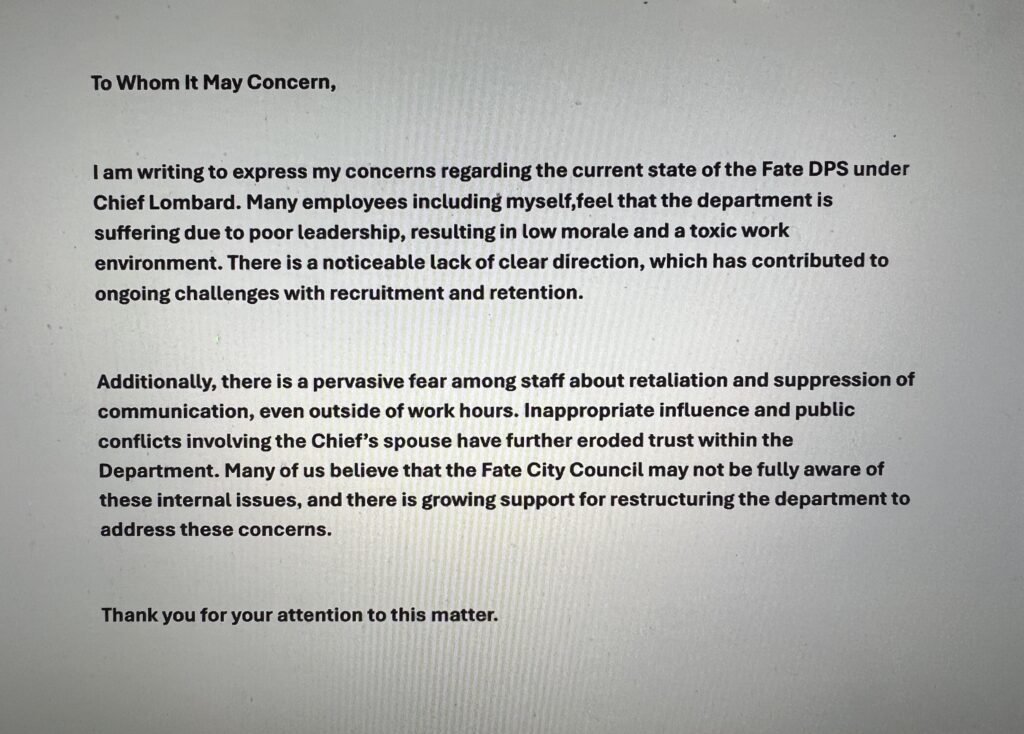
Their existence, however, does not resolve whether the City complied with the Texas Public Information Act. The central question is whether the City properly disclosed responsive records in response to a lawful request.
As of this publication, the City still has not disclosed the separate complaint letter that Kovacs later acknowledged receiving directly from a police officer. By his own admission, City Manager Michael Kovacs is the person responsible for the dissemination of records per State Law, and therefore he is the person who should be held accountable.
If Kovacs’ statement to investigators is accurate, that second complaint letter would have existed when the City’s response to the November 2025 Public Information Act request was prepared.
A New Public Information Request
In light of the newly disclosed information, Pipkins Reports has submitted another Texas Public Information Act request seeking all written complaints concerning Chief Lombard, including the complaint letter Kovacs acknowledged receiving from an officer, the complaint letter transmitted through Councilwoman Chinn, and any additional written complaints in the City’s possession.
The request states, in part:
“On 11/25/2025, as part of Open Records Request #R001735-112525, I requested ‘Copy of any written complaints against Chief Lombard within the last 12 months prior to termination.’ The City failed to provide any responsive documents, even though it was publicly known that at least one anonymous complaint letter existed.
During the ethics investigation conducted by Baker Robertson & O’Brien, Michael Kovacs stated that he received a complaint letter from a police officer. This admission indicates the City possessed an additional responsive document that was not disclosed.
The City did not seek an Attorney General ruling authorizing the withholding of either complaint letter. This request seeks both documents, together with any additional written complaints concerning Chief Lombard.”
Whether the City ultimately produces the records—or explains why they were not disclosed nearly eight months ago—may determine whether this story ends as an administrative oversight or raises more significant questions regarding the City’s compliance with the Texas Public Information Act.
This remains an ongoing investigation. Pipkins Reports will continue to report on developments as additional records become available.

Fate Council Dropped Case Before Reviewing
Fate, TX — An ethics investigation commissioned by the City of Fate concluded that former Councilwoman Codi Chinn violated the City’s Code of Ethics before the City Council voted earlier this month to discontinue the matter, according to documents obtained by Pipkins Reports through an Open Records Request.
The report, prepared by attorney Laura Mueller of the law firm Baker, Robertson & O’Brien, found that the allegation against Chinn was “substantiated, but with mitigating factors.”
The Executive Summary states:
“After investigation, my determination is that allegation of a violation of the Ethics Code is substantiated, but with mitigating factors.”
The report concludes that Chinn violated Section 2-309(10) of the City’s Code of Ethics after directing City employees to provide their concerns to her in writing.
“After reviewing the Charter, the Code of Ethics, and reviewing all of the evidence, my conclusion is that Ms. Chinn violated Section 2-309(10) of the Code of Ethics when she directed employees to provide information to her in writing.”
Mueller also concluded that mitigating circumstances should be considered because Chinn immediately informed City Manager Michael Kovacs about the employee concerns and because the employees ultimately submitted their written complaints directly to the City.
Council Ends Investigation
The ethics complaint summary report was scheduled to appear on the July 6 City Council agenda for executive session discussion.
Instead of going into Executive Session, the Council waived deliberative privilege and discussed the matter in open session where they ultimately voted to discontinue the ethics proceedings and drop the matter, before being presented with the findings from Mueller.
The Council did not impose any sanction against Chinn.
The following day, Pipkins Reports requested a copy of the complaint and the investigative report, and received it through an Open Records Request.
Investigation Details
According to the report, investigators interviewed Chinn, Councilman Mark Harper, City Manager Michael Kovacs, and other witnesses.
Regarding the allegations, Mueller wrote:
“In my interview with Ms. Chinn and Mr. Harper, we discussed the allegation. I questioned Ms. Chinn about her conversations with city employees and with Mr. Kovacs.”
According to the report, Chinn stated that city employees approached her seeking assistance and that she intended to present their concerns to the City Manager after compiling the information.
However, the report states that employees instead prepared a letter addressed to the City Council. Chinn then instructed them to provide the letter directly to the City Manager.
The report also summarizes Kovacs’ account of the events.
“Mr. Kovacs stated that he received the letter outlining the employee issues directly from an officer, but with the understanding that the information was given to him at the direction of Ms. Chinn.”
Previously, it was reported that Chinn provided a copy of an, “anonymous letter”, that she claims was provided by DPS officers to her. Chinn further states that she sent the letter to Michael Kovacs … who then forwarded it on to the rest of the Council. This report also states that Kovacs told investigators he had warned Chinn against communicating with employees in that manner.
Pipkins Reports continues to investigate this aspect of the situation … as the conditions shed new light on the events that have transpired with regard to the termination of DPS Chief Lyle Lombard.
Meanwhile, the city council’s decision effectively ended the ethics proceeding against Chinn without imposing any sanction or issuing any formal determination of its own regarding the investigator’s findings. While the Council possessed the authority to discontinue the matter, the decision also brought the ethics process to a close despite an independent investigation concluding that a violation of the City’s Code of Ethics had occurred.
For the complainant, Darcy Gildon, the Council’s action marked the end of a process that resulted in no public accountability beyond the release of the investigative report which Pipkins Reports has now provided.

Chinn and Billings Bash Senator Bob Hall
Fate, TX – The political firestorm over secret recordings inside Fate City Hall just took a sharp and deeply ironic turn. Pipkins Reports has obtained an audio recording that appears to show former Fate City Councilwoman Codi Chinn secretly recording a private telephone conversation with former Mayor David Billings, despite her later public criticism of the practice.
The recording, verified through multiple sources familiar with the matter, predates the recent controversy involving Mayor Andrew Greenberg‘s recorded conversation with Chinn and Councilman Mark Hatley‘s recording of a discussion with City Manager Michael Kovacs. The discovery raises uncomfortable questions about consistency, credibility, and whether Chinn’s outrage over recorded conversations has been driven more by politics, than principle.
Pipkins Reports received a copy of a 32-minute audio recording from an anonymous source who said it originated from a recording obtained through an Open Records Request submitted to the City of Fate.
Pipkins Reports has reviewed documentation related to that request and separately confirmed the recording’s authenticity through sources with knowledge of the file maintained by the city.
Much of the conversation centers around mundane talk about MUD districts. Pipkins Reports has edited the recording to a 2-minute, 47-second excerpt focusing on the discussion involving Texas Sen. Bob Hall because it is directly relevant to matters of public interest.
During the conversation, Chinn expresses frustration with Hall’s reluctance to support legislation to strengthen child protection in schools. Stating that he is, “not interested in having that conversation.” She continues, “He is interested in getting people all riled up, but when it comes time to actually do the work, and his job, he’s nowhere to be found.“
Billings echoes that frustration, and opines how he says Bob Hall, “fights dirty“, and how he has voted against cities 9 times. The conversation paints a picture of two local political figures who believe the longtime senator was not sufficiently responsive to their legislative priorities.
The policy disagreements themselves are not especially unusual. Elected officials often criticize one another behind closed doors. What makes this recording different is the hypocrisy of Chinn, stirring up outrage about “secret recordings” when she herself has been a proponent.
The Hall recording is not the only documented instance in which Chinn appears to have secretly recorded a conversation. Through a separate Open Records Request submitted by Pipkins Reports, this publication obtained a city copy of a recorded interview between Michael Pipkins and Chinn concerning her involvement in the dismissal of former Fate Department of Public Safety Chief Lyle Lombard.
That recording also predates the controversy that would inevitably follow.
According to the records produced by the City of Fate, Chinn recorded that interview without disclosing it during the conversation. The existence of multiple recordings attributed to Chinn adds additional context to the current debate over undisclosed recordings by public officials and further raises questions about the consistency between her past actions and her more recent public criticism of the practice.
But according to the evidence reviewed by Pipkins Reports, Chinn appears to have engaged, multiple times, in the very conduct she later condemned.
Texas is a one-party consent state under state law, meaning only one participant in a conversation generally must consent to its recording. If Chinn initiated or participated in the call, recording it would not necessarily violate Texas law. The issue presented here is not primarily a legal one.
It is political.
Opinion
Politics has a funny way of exposing selective outrage.
For months, Fate residents have heard lectures from Codi Chinn about how secret recordings destroy trust, poison relationships, and undermine good government. Fair enough. Those are arguments reasonable people can debate.
But what legitimate purpose would have been gained by Chinn recording a conversation with the Former Mayor?
Given this revelation, it’s possible that the recordings by others that followed Chinn, may have been a defense mechanism (even unconsciously), over a situation that they could feel was off. Couple that with the deceptions that we now know were taking place by Chinn, and other council members, as well as the city manager, and it appears that there might have been a valid justification for both Greenberg and Hatley to take the actions that they did.
There’s another layer here which is important to understand as to why Pipkins Reports chose to clip this section of the audio. Chinn and Billings were not merely venting about Sen. Hall. They were criticizing an elected state senator over legislation affecting Fate, as well as Rockwall County in general, and discussing his approach to measures involving child safety in schools. Voters deserve to hear how public officials truly feel about those issues, and how they discuss those issues when they believe no one else is listening.
This recording doesn’t settle every argument currently consuming City Hall. It does, however, remove any illusion that only one side has participated in private recordings.
Sometimes the loudest critics leave behind the clearest evidence.
You must be logged in to post a comment Login