Connect with us

Published

on

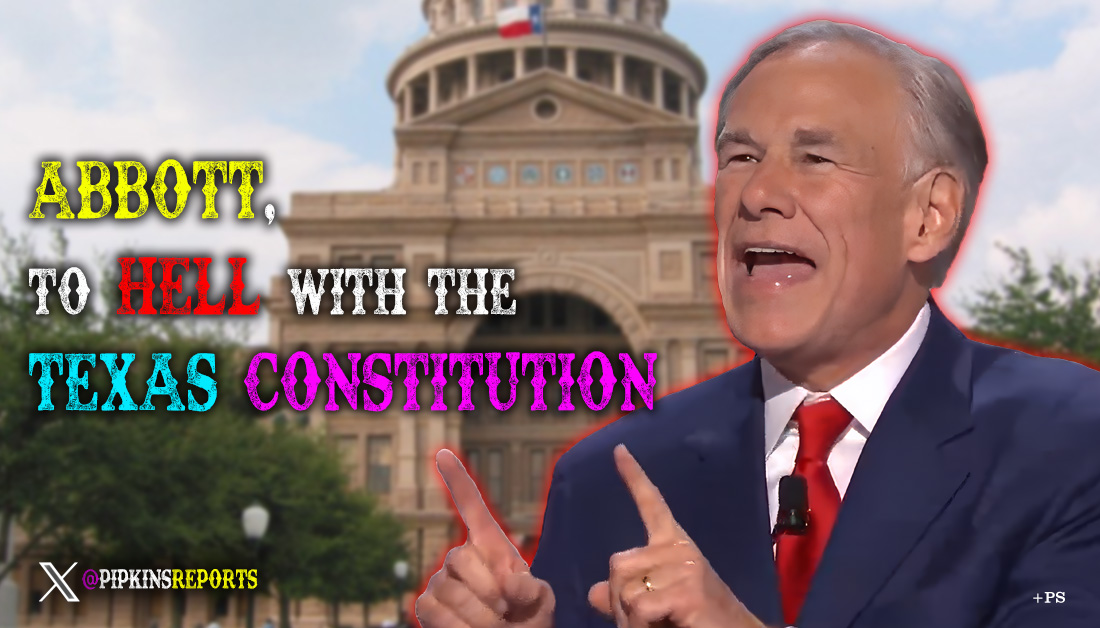
In a calculated maneuver that has sent shockwaves through grassroots conservative circles, Texas Governor Greg Abbott has bypassed the standard legislative confirmation process to install outgoing State Senator Kelly Hancock into the role of Texas Comptroller—without the public scrutiny, vetting, or constitutional confirmation typically required by law.

The move, which critics are calling a “legal sleight of hand” and a “raw power grab,” appears designed to give Hancock the advantage of incumbency ahead of the 2026 Republican primary, where he’ll face two formidable, independently-minded opponents: former State Senator Don Huffines and current Railroad Commissioner Christi Craddick.

But beyond its political implications, the scheme raises deeper questions about rule of law, the erosion of constitutional norms in Texas governance, and whether voters are being force-fed another establishment pick wrapped in a bow of bureaucratic trickery.

The Setup: Avoid the Constitution, Install a Loyalist

On June 19, Hancock formally resigned from the Texas Senate and was immediately sworn in—not as Comptroller—but as “chief clerk” of the Comptroller’s office by outgoing Comptroller Glenn Hegar. That title, while bureaucratically bland, comes with sweeping authority over the agency’s operations for the remainder of Hegar’s term, which runs through January 2027.

Hegar, who is leaving to become chancellor of the Texas A&M University System on July 1, heaped praise on Hancock and handed him the reins with the enthusiastic blessing of Abbott.

But here’s the catch: Abbott didn’t appoint Hancock as Comptroller—a move that would have triggered mandatory Senate confirmation under Texas law. Instead, Hancock’s insertion as “chief clerk” is a workaround—a newly invented interim title designed to give him all the power of the office, with none of the accountability.

The workaround skirts a 2002 legal opinion written by none other than then-Attorney General Greg Abbott himself. That opinion declared that a sitting legislator cannot be appointed to a position requiring Senate confirmation during the term for which they were elected. Hancock’s resignation was intended to dodge that prohibition, yet critics say he still falls under constitutional limits due to Texas’ “holdover” clause—a provision that allows legislators to technically retain office until a successor is qualified.

In plain terms: Hancock may not be legally out of the Senate yet, and therefore not legally eligible to hold this new office either.

The Real Goal: An Unelected Incumbency

Why the rush to appoint a placeholder Comptroller for a year and a half? The answer is pure politics: incumbency.

Abbott and his allies understand the power of incumbency in statewide races. Name recognition, official letterhead, media exposure, and the implied authority of office all combine to give Hancock a serious leg up over his grassroots challengers. By installing him now, Abbott ensures that his preferred successor runs not as a candidate—but as the sitting Comptroller.

Hancock wasted no time launching his campaign. Within hours of his swearing-in, he rolled out a slick announcement touting his legislative experience, fiscal conservatism, and support for border security. But that very record is already drawing fire from conservatives, especially his vote to impeach Attorney General Ken Paxton and his siding with Democrats to dilute a ban on taxpayer-funded lobbying.

That record hasn’t gone unnoticed by primary voters, either.

Don Huffines: “They Fear You”

Former State Senator Don Huffines didn’t mince words in his response.

“The political elite are manipulating the system to install another go-along-to-get-along lap dog as State Comptroller,” Huffines said. “They don’t just fear me—they fear you, the taxpayers.”

Huffines, who has already earned endorsements from U.S. Sen. Ted Cruz, Ron Paul, and a majority of the State Republican Executive Committee, framed the maneuver as part of a broader establishment pattern of undermining grassroots efforts and insulating power among insiders.

“They know that true transparency, the kind I’ve promised, would expose everything,” he said.

Huffines’ campaign is already tapping into the anti-establishment fervor that helped fuel Trump’s rise. He paints Hancock not as a fighter for fiscal integrity, but as a symbol of cronyism and cowardice—a man who lacked the courage to earn the job honestly and instead snuck in through the back door.

Christi Craddick: “I’ve Done the Job”

Current Railroad Commissioner Christi Craddick, a no-nonsense fiscal hawk with actual statewide executive experience, also entered the race undeterred by Hancock’s sudden rise to power.

“I’m the only candidate in this race with statewide experience and a proven record,” she said. “While others play games, I deliver results.”

Craddick has run one of the most revenue-critical agencies in Texas—the Railroad Commission—overseeing billions in oil and gas revenues that fund schools, roads, and law enforcement. She’s pledging to bring that same results-driven approach to the Comptroller’s office.

“I trust the voters to see through political gimmicks. They know what leadership looks like,” she said.

Legal Questions Linger

Beyond the optics and political fallout, constitutional questions still loom. Article XVI, Section 40 of the Texas Constitution prohibits a legislator from being appointed or employed in a civil office during their elected term. The Abbott-Hancock team contends that Hancock’s resignation makes the restriction moot.

But constitutional scholars and conservative legal minds aren’t so sure.

Because Hancock’s replacement hasn’t yet been elected in a special election, he may technically still be “holding over” his Senate seat. That would render his new role unconstitutional—even if it comes with a carefully worded job title designed to muddy the waters.

“This is a clear violation of both the spirit and the letter of the Texas Constitution,” said one former legislative attorney who asked not to be named due to potential backlash. “It’s a loophole engineered for a political ally, and it disrespects the very laws these men swore to uphold.”

Abbott’s Real Message to Texans

Governor Abbott’s rapid endorsement of Hancock—along with his backhanded swipe at Don Huffines as a “candidate who already lost to a Democrat”—reveals much about the governor’s priorities. Abbott appears less interested in an open, transparent race for the state’s chief financial officer and more focused on installing a loyalist who will support his education agenda, including school choice and other spending priorities.

The entire operation has the feel of a political chess game, with Abbott moving pieces behind the curtain to ensure control, compliance, and consolidation of power.

To many observers, the stunt feels less like governance and more like a monarchy: appointments made in private, authority granted by favor, and the people kept safely at arm’s length.

What’s at Stake in March 2026

The 2026 Republican primary for Comptroller is now shaping up to be more than just a contest for a relatively obscure financial office. It’s becoming a litmus test for whether grassroots conservatives still have a say in Texas politics—or whether power brokers like Abbott will continue to manipulate the machinery to protect their allies and sideline principled insurgents.

Texans should pay close attention. If the Comptroller’s office can be quietly handed to a hand-picked insider without constitutional confirmation or public scrutiny, what’s next? Attorney General? Land Commissioner? Lieutenant Governor?

The Hancock appointment is more than a cynical political move. It’s a bellwether. And if Texas conservatives don’t push back hard, they may wake up in a state where elections are merely formalities and public offices are auctioned behind closed doors.

This is about who runs Texas: the people, or the political class.

And in March 2026, the people will have their say—if they’re paying attention.

Michael Pipkins focuses on public integrity, governance, constitutional issues, and political developments affecting Texans. His investigative reporting covers public-record disputes, city-government controversies, campaign finance matters, and the use of public authority. Pipkins is a member of the Society of Professional Journalists (SPJ). As an SPJ member, Pipkins adheres to established principles of ethical reporting, including accuracy, fairness, source protection, and independent journalism.

Continue Reading
Click to comment

You must be logged in to post a comment Login

Leave a Reply

Election

Crockett Jumps Into Texas Senate Race in Futile Attempt to Flip Texas

Published

on

Jasmine Crockett Runs for Senate

Jasmine Crockett did not ease her way into the 2026 U.S. Senate race. She crashed through the door. Filing paperwork just hours before the deadline, the Dallas congresswoman made her move at the last possible moment, detonating what is already shaping up to be the most expensive and ideologically charged Senate contest in Texas history.

Crockett, 44, officially entered the Democratic primary for Texas’s U.S. Senate seat on December 8, 2025. With that filing, Crockett confirmed she will not seek reelection to her House seat in Texas’s 30th Congressional District, a seat she has held since January 2023 (NBC DFW).

The timing was no accident. Crockett’s entry came against the backdrop of mid-decade redistricting by Texas Republicans earlier in 2025, a move that significantly reshaped her district and made it extremely unlikely for her to win the district she currently represents. A lower-court challenge to those maps was paused in late November when the U.S. Supreme Court declined to block them for the 2026 cycle, effectively locking in the new lines (Fox 4 News).

With her House seat suddenly impossible to recapture, Crockett opted for a higher-risk, higher-reward gamble: a Senate seat that Democrats have not won since 1993.

The Democratic primary is scheduled for March 3, 2026, with runoffs expected in late May if no candidate clears 50 percent. The general election will be held on November 3, 2026 (Newsweek).

Crockett enters a Democratic field that was already forming before her filing. State Sen. James Talarico announced his bid in October and has emphasized crossover appeal with independents and moderate Republicans. Polling from the University of Houston and Texas Southern University places Crockett narrowly ahead with about 31 percent support, followed by Talarico at roughly 25 percent (The Grio). Early polling has also tested familiar Democratic names, including former Rep. Beto O’Rourke and Rep. Joaquin Castro, though neither had filed as of December 8.

Notably absent now is former Rep. Colin Allred. Allred, who announced his own Senate bid in July 2025, withdrew from the race earlier on the morning of December 8, opting instead to run for a House seat near Dallas after redistricting altered his political calculus. Multiple reports indicate Allred and Crockett discussed the race before his exit, clearing a path for her entry (Independent).

Crockett’s political résumé is relatively short but loud. Born in St. Louis in 1981, she earned her law degree from the University of Houston Law Center and worked as a public defender before founding a civil rights law firm. She gained prominence handling Black Lives Matter related cases pro bono, a credential that endears her to the Democratic activist class (Wikipedia).

After winning a Texas House seat in a 2020 special election, Crockett jumped to Congress in 2022 with the endorsement of retiring Rep. Eddie Bernice Johnson. In Washington, she became a fixture on cable news and social media, particularly through clashes with Republicans during House Oversight Committee hearings. Several of those exchanges went viral in 2024, fueling her national fundraising operation and boosting her profile among progressive donors (Independent).

That media presence is a key reason analysts expect her candidacy to shatter Texas fundraising records. Observers across the political spectrum predict the race could eclipse the $80 million-plus spent during the 2018 Cruz–O’Rourke contest (Dallas Morning News).

On the Republican side, the race is already turbulent. Sen. John Cornyn, 73, is seeking a fifth term after holding the seat since 2002. However, Texas Attorney General Ken Paxton filed to challenge him in the GOP primary in October and currently leads Cornyn in several early polls. Rep. Wesley Hunt entered the race in November and trails both men in polling (NBC DFW).

Initial reactions to Crockett’s filing were swift and predictably polarized. Conservative accounts on X mocked her candidacy and framed her entry as a gift to Republicans. Progressive activists celebrated her energy and national reach. Gov. Greg Abbott declared she would be “pummeled” by the eventual GOP nominee, while Cornyn posted a cheeky “Run Jasmine, run!” (Newsweek).

For Democrats, Crockett represents a bet that Texas can be nationalized, energized, and finally flipped through sheer turnout and confrontation politics. For Republicans, she is precisely the kind of progressive foil they believe plays poorly with statewide Texas voters.

Why did Crockett run? Her allies point to polling, redistricting, and opportunity. Critics see ambition colliding with reality. Either way, her late-hour filing ensured one thing: Texas’s 2026 Senate race will be loud, costly, and unforgiving. And for conservatives watching the state remain stubbornly red statewide, Crockett’s entry looks less like a breakthrough and more like another test case in how far progressive politics can stretch before they snap in Texas.

Continue Reading

Election

Jasmine Crockett’s District Got a Hard Reset – and She’s NOT in it Anymore.

Published

on

TX-30 District Redrawn

Dallas, TX – Fresh off her now-infamous CNN appearance where Rep. Jasmine Crockett sneered about white tears without so much as a raised eyebrow from the anchor, the freshman firebrand has bigger problems than cable-news backlash. The new congressional map — PLANC2333, has surgically removed Crockett from Texas District 30. Yes, her own district. The one she’s held for less than two years.

Let’s be clear: this isn’t a minor tweak. This is a full-on redistricting gut punch.

Under the old lines, TX-30 was a comfortably Democratic, majority-minority seat that stretched from downtown Dallas south almost to Red Oak—an anchor of Black political power in North Texas. 42% Black, 35% Hispanic, 16% White. Median income $71k. Poverty rate is pushing 16%. A district drawn, let’s be honest, to elect someone exactly like Jasmine Crockett, who would become the embodied spirit of the once race-baiting Shelia Jackson Lee (deceased).

The new TX-30 snakes along I-30 through downtown, clips the eastern edge at I-175, and hugs the Dallas County line to the south. The areas carved out (shown in red on Pipkins Reports map) were the heart of Crockett’s old base—south Dallas neighborhoods that reliably turned out for her. In their place (blue on the map) come whiter, more affluent precincts to the west. The demographic shift is brutal: Black voting-age population down, Hispanic share down, White share up. Translation? TX-30 just became a swing district masquerading as a D+20 stronghold.

And then there’s the real kicker: District 33, currently held by Marc Veasey, now swoops in like an upside-down U, wrapping around the new TX-30 and swallowing huge chunks of downtown Dallas. That new TX-33? It’s a demographic kaleidoscope—White, Black, and Hispanic populations are almost perfectly balanced. Turnout will decide everything. Good luck predicting who wins that one.

If Crocket chooses to continue on in TX-30, she is likely to face a tough road. This is what happens when you spend your first term auditioning for MSNBC panels instead of building goodwill back home. You rant about “white tears” on national television, you mock colleagues across the aisle, you forget that even safe seats can be made unsafe with a few strokes of a GIS pen. The Texas Legislature has sent a message, and it’s written in precinct-level data: play stupid games, win stupid prizes.

The Texas Secretary of State confirms the candidate filing window for the 2026 primaries opened Saturday, November 8, and closes at 6:00 p.m. on Monday, December 8, 2025—Crockett, Veasey, and every other incumbent now playing musical districts have less than a month to decide where (or if) they’re running.

Constitutional conservatives have been warning for years that the era of bulletproof, identity-carved districts was coming to an end. The courts demanded “compactness” and “communities of interest.” The GOP in Austin finally delivered. And the first casualty? A loudmouth progressive who thought performative rage was a substitute for legislating.

Marc Veasey’s seat is scrambled too, by the way. In fact, half of Dallas just woke up in a different congressional universe.

Continue Reading

Election

Texas Voters Accept VATREs — But Local Politicians Expose Themselves

Published

on

VATRE's Pass all over Texas


In a wave of school-district elections across North Texas and beyond this week, voters approved a number of Voter-Approval Tax-Ratification Elections (VATREs) — allowing independent school districts to raise their maintenance-and-operations (M&O) tax rates above the state-determined caps.

While the results reflect a clear willingness by taxpayers to fund local schools, they also expose a troubling pattern: the very officials who champion themselves as conservative guardians of the public trust now appear to be embracing tax increases and new spending. Pipkins Reports has been taking notes and when those elections come to pass, we will be reminding voters which politicians had their hands deep into taxpayers pockets.

Below is a summary of the key VATRE outcomes, followed by a discussion of the political implications and which public officials are already showing up in voters’ crosshairs.


VATREs That Passed – What Voters Approved

Here are the key districts where VATREs passed, with what was on the line and what the approval means.

  • Rockwall Independent School District (Rockwall ISD)
    Voters approved the district’s VATRE: 10,864 voted “For” (54.08 %) and 9,226 voted “Against” (45.92 %), in a total of 20,090 votes. Difference ≈ 1,638 (≈ 8 %).
  • Garland Independent School District (Garland ISD)
    Voters approved the district proposal (Proposition A) to raise the tax rate to $1.1709 per $100 valuation. That represents a 12-cent increase over the previous rate of $1.0509.
  • Carroll Independent School District (Carroll ISD)
    Voters approved the VATRE with 4,941 votes in favor and 3,625 opposed. The new tax rate change is expected to generate up to $4 million in additional revenue.
  • Hurst‑Euless‑Bedford Independent School District (HEB ISD)
    Voters approved a 3-cent rate increase (via the VATRE), generating about $12 million in new operational funding.
  • Denton Independent School District (Denton ISD)
    Voters approved the VATRE, which will generate approximately $26 million annually in additional revenue for the district.
  • Peaster Independent School District (Peaster ISD)
    Voters approved the VATRE, authorizing three “Golden Pennies,” providing about $280,000 in new local tax revenue.
  • Taylor Independent School District (Taylor ISD)
    Voters approved the VATRE (Prop B) alongside a bond (Prop A). Both passed. The VATRE will be used to generate operational revenue for student programs and corporate partnerships.
  • Liberty Hill Independent School District (Liberty Hill ISD)
    Voters approved the VATRE designed to provide $10.7 million for student programs ($7.2 m), safety & security ($1.3 m), and teacher/staff retention ($2.2 m).

VATREs That Did Not Pass – Rejections

  • Manor Independent School District (Manor ISD)
    The district placed three propositions (Prop A: $359.5 m for renovs & security; Prop B: $8.5 m tech; Prop C: $16.5 m performing arts), but the VATRE was rejected by voters.
  • Coupland Independent School District (Coupland ISD)
    VATRE (Prop A) would have generated approx. $240,939 for M&O, staff payments, supplies — rejected by voters.
  • Hays Consolidated Independent School District (Hays CISD)
    VATRE (Prop A) to increase M&O tax rate by 12 cents (~$26 m additional revenue) was rejected by voters.
  • Blanco Independent School District (Blanco ISD)
    Two-cent M&O rate increase rejected by voters.

What This Means — And What We Are Watching

From a constitutional conservative vantage point, several observations emerge:

  1. The Positive Side: Voters in many districts clearly were willing to approve higher taxes to fund education operations rather than just bond debt. That responsiveness suggests local communities see a need and are willing to step up.
  2. Inflation Predicted: These tax increases are ongoing revenue commitments. They are not one-time bonds, but continuous operational funding. Once the tax rate is increased, there is no mechanism to ever lower it back down. It is essentially eternal.
  3. Political Accountability: Many board members, superintendents, and district trustees who positioned themselves as fiscally prudent or conservative were seen as leading the charge for higher taxes. That reveals a mismatch between rhetoric and reality. The same goes for councilmen and mayors who chose to side with an increase in taxes. Excuses of, “It’s for the children” or “It’s for the teachers” will fall on deaf ears in future elections.
  4. The Power Players to Note:
    • In Garland ISD, the Board of Trustees and district leadership backed the 12-cent rate hike that will bring in ~$56 m annually. Voters and watchdogs (including us) will remember who voted for that.
    • Rockwall ISD’s trustees, various Rockwall County Mayors, nudged voters into approving a rate increase while trying to pretend they were ‘neutral’ . But we see them for who they are, and we will remind voters in future elections.
    • In Denton, HEB, Carroll, Peaster and Liberty Hill, local boards quietly advanced VATREs — again with minimal fanfare but major tax implications. We were watching. Changes will be made.
  5. The Contrast With Other Districts: Some districts rejected VATREs. Others such as Fair Independent School District, recently adopted lower tax rates for 2025-26 — a rarity worth highlighting.
  6. The Election Implications: For the upcoming school-board races and local council elections (many of which overlap with these districts), voters will evaluate not only candidates’ rhetorical conservatism but their tax-and-spending votes. At Pipkins Reports, we’ll publish scorecards of who supported VATREs and how their financing stacks up. We WILL do our part to inform the community and help remove the frauds in our local governments.

Conclusion: Clarity.

Texans are willing to support public education funding…for now. The approval of several VATREs around the state sends a signal: yes, we the taxpayers will step up — but what is going to happen in the next 2-3 years when taxpayers are hit with a huge dose of reality that the promised “insignificant” raise to fund teachers and students turns into a gigantic financial burden, on the order of thousands of dollars a year?

The real-world effects of all the VATRE’s cannot be hidden. The platitudes given during this campaign will soon sink to the bottom of the reality jar. The betrayal citizens will feel when election time comes back around will be immense … and we will be here to remind them of whom it was that put them in that position.

See you at the next election in May … thank you for your cooperation.


Continue Reading