


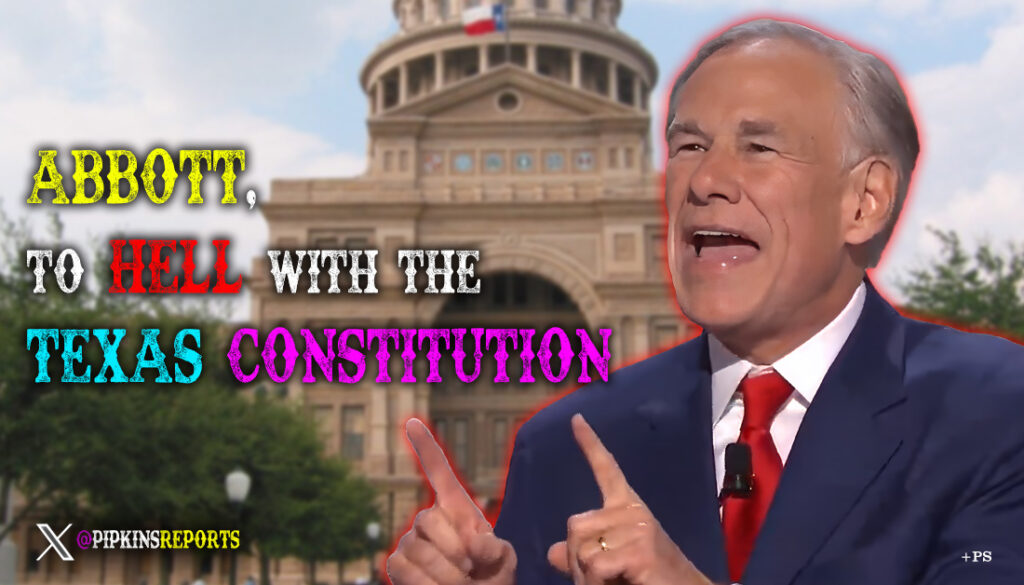
In a calculated maneuver that has sent shockwaves through grassroots conservative circles, Texas Governor Greg Abbott has bypassed the standard legislative confirmation process to install outgoing State Senator Kelly Hancock into the role of Texas Comptroller—without the public scrutiny, vetting, or constitutional confirmation typically required by law.
The move, which critics are calling a “legal sleight of hand” and a “raw power grab,” appears designed to give Hancock the advantage of incumbency ahead of the 2026 Republican primary, where he’ll face two formidable, independently-minded opponents: former State Senator Don Huffines and current Railroad Commissioner Christi Craddick.
But beyond its political implications, the scheme raises deeper questions about rule of law, the erosion of constitutional norms in Texas governance, and whether voters are being force-fed another establishment pick wrapped in a bow of bureaucratic trickery.
The Setup: Avoid the Constitution, Install a Loyalist
On June 19, Hancock formally resigned from the Texas Senate and was immediately sworn in—not as Comptroller—but as “chief clerk” of the Comptroller’s office by outgoing Comptroller Glenn Hegar. That title, while bureaucratically bland, comes with sweeping authority over the agency’s operations for the remainder of Hegar’s term, which runs through January 2027.
Hegar, who is leaving to become chancellor of the Texas A&M University System on July 1, heaped praise on Hancock and handed him the reins with the enthusiastic blessing of Abbott.
But here’s the catch: Abbott didn’t appoint Hancock as Comptroller—a move that would have triggered mandatory Senate confirmation under Texas law. Instead, Hancock’s insertion as “chief clerk” is a workaround—a newly invented interim title designed to give him all the power of the office, with none of the accountability.
The workaround skirts a 2002 legal opinion written by none other than then-Attorney General Greg Abbott himself. That opinion declared that a sitting legislator cannot be appointed to a position requiring Senate confirmation during the term for which they were elected. Hancock’s resignation was intended to dodge that prohibition, yet critics say he still falls under constitutional limits due to Texas’ “holdover” clause—a provision that allows legislators to technically retain office until a successor is qualified.
In plain terms: Hancock may not be legally out of the Senate yet, and therefore not legally eligible to hold this new office either.
The Real Goal: An Unelected Incumbency
Why the rush to appoint a placeholder Comptroller for a year and a half? The answer is pure politics: incumbency.
Abbott and his allies understand the power of incumbency in statewide races. Name recognition, official letterhead, media exposure, and the implied authority of office all combine to give Hancock a serious leg up over his grassroots challengers. By installing him now, Abbott ensures that his preferred successor runs not as a candidate—but as the sitting Comptroller.
Hancock wasted no time launching his campaign. Within hours of his swearing-in, he rolled out a slick announcement touting his legislative experience, fiscal conservatism, and support for border security. But that very record is already drawing fire from conservatives, especially his vote to impeach Attorney General Ken Paxton and his siding with Democrats to dilute a ban on taxpayer-funded lobbying.
That record hasn’t gone unnoticed by primary voters, either.
Don Huffines: “They Fear You”
Former State Senator Don Huffines didn’t mince words in his response.
“The political elite are manipulating the system to install another go-along-to-get-along lap dog as State Comptroller,” Huffines said. “They don’t just fear me—they fear you, the taxpayers.”
Huffines, who has already earned endorsements from U.S. Sen. Ted Cruz, Ron Paul, and a majority of the State Republican Executive Committee, framed the maneuver as part of a broader establishment pattern of undermining grassroots efforts and insulating power among insiders.
“They know that true transparency, the kind I’ve promised, would expose everything,” he said.
Huffines’ campaign is already tapping into the anti-establishment fervor that helped fuel Trump’s rise. He paints Hancock not as a fighter for fiscal integrity, but as a symbol of cronyism and cowardice—a man who lacked the courage to earn the job honestly and instead snuck in through the back door.
Christi Craddick: “I’ve Done the Job”
Current Railroad Commissioner Christi Craddick, a no-nonsense fiscal hawk with actual statewide executive experience, also entered the race undeterred by Hancock’s sudden rise to power.
“I’m the only candidate in this race with statewide experience and a proven record,” she said. “While others play games, I deliver results.”
Craddick has run one of the most revenue-critical agencies in Texas—the Railroad Commission—overseeing billions in oil and gas revenues that fund schools, roads, and law enforcement. She’s pledging to bring that same results-driven approach to the Comptroller’s office.
“I trust the voters to see through political gimmicks. They know what leadership looks like,” she said.
Legal Questions Linger
Beyond the optics and political fallout, constitutional questions still loom. Article XVI, Section 40 of the Texas Constitution prohibits a legislator from being appointed or employed in a civil office during their elected term. The Abbott-Hancock team contends that Hancock’s resignation makes the restriction moot.
But constitutional scholars and conservative legal minds aren’t so sure.
Because Hancock’s replacement hasn’t yet been elected in a special election, he may technically still be “holding over” his Senate seat. That would render his new role unconstitutional—even if it comes with a carefully worded job title designed to muddy the waters.
“This is a clear violation of both the spirit and the letter of the Texas Constitution,” said one former legislative attorney who asked not to be named due to potential backlash. “It’s a loophole engineered for a political ally, and it disrespects the very laws these men swore to uphold.”
Abbott’s Real Message to Texans
Governor Abbott’s rapid endorsement of Hancock—along with his backhanded swipe at Don Huffines as a “candidate who already lost to a Democrat”—reveals much about the governor’s priorities. Abbott appears less interested in an open, transparent race for the state’s chief financial officer and more focused on installing a loyalist who will support his education agenda, including school choice and other spending priorities.
The entire operation has the feel of a political chess game, with Abbott moving pieces behind the curtain to ensure control, compliance, and consolidation of power.
To many observers, the stunt feels less like governance and more like a monarchy: appointments made in private, authority granted by favor, and the people kept safely at arm’s length.
What’s at Stake in March 2026
The 2026 Republican primary for Comptroller is now shaping up to be more than just a contest for a relatively obscure financial office. It’s becoming a litmus test for whether grassroots conservatives still have a say in Texas politics—or whether power brokers like Abbott will continue to manipulate the machinery to protect their allies and sideline principled insurgents.
Texans should pay close attention. If the Comptroller’s office can be quietly handed to a hand-picked insider without constitutional confirmation or public scrutiny, what’s next? Attorney General? Land Commissioner? Lieutenant Governor?
The Hancock appointment is more than a cynical political move. It’s a bellwether. And if Texas conservatives don’t push back hard, they may wake up in a state where elections are merely formalities and public offices are auctioned behind closed doors.
This is about who runs Texas: the people, or the political class.
And in March 2026, the people will have their say—if they’re paying attention.