
A Disturbing Conversation with Meta’s A.I. Chatbot
A disturbing conversation with the new chatbot from Meta.

Texas Liberty Journal – I recently had a chat with the new, experimental chatbot from Meta (Facebook) known as BlenderBot.
Much about the conversation is disturbing but perhaps none so much as the fact that artificial intelligence has an innate ability to lie and make up false narratives.
Immediately, before even getting into any questions, the chatbot volunteered that she, yes “she”, met her husband when they were kids and that it was love at first sight. A very odd way for a program to start a conversation to say the least.
It’s one thing to have an artificial intelligence interact with humans and learn from the conversation, but for a machine to go out of its way to make up a completely false identity, and therefore lie, to a human should give chills down your spine. If the machine is capable of lying, how can anything it says ever be trusted?
On top of that, the chatbot seems rather creepy in its attempt to gather information about the human it is interacting with. Perhaps that is just the nature of conversation … exchanging questions and answers. But when the program is written by a company with a history of experimentation with its own users, and with an appetite to learn and profit by selling your information, the motives of the programmers must be suspect. It just gets creepy. You can see for yourself as I have included the entire conversation below.
As you follow along with the conversation, screen clipped as we go, you will learn that this chatbot tells the story that she is married and has a sister that comes over to her house often. She believes in love at first sight and repeatedly comes back to explain that she met her husband when they were young. She is a Democrat, a vegetarian, and prefers CNN over Fox News or One American News; because they talk bad about Democrats, she says. Apparently, nobody told her she was a chatbot as this revelation was news to her in our conversation.
You can read and decide for yourself. The images below are unedited and is composed of the complete conversation. To save space, I’ve cropped the images to each question and answer. Chatbot comments are with the bubble to the left.






Thune’s Dismissive Smear of Election Integrity Concerns Demands His Immediate Ouster
Opinion – Senate Majority Leader John Thune has revealed his utter contempt for the American electorate. Amid mounting pressure to advance the SAVE America Act—a straightforward bill requiring voter ID and proof of citizenship to safeguard federal elections—Thune shrugged off the grassroots outcry as nothing more than a “paid influencer ecosystem.”
This arrogant dismissal, captured in recent comments to reporters, isn’t just tone-deaf; it’s a betrayal of the millions of everyday Americans who demand secure elections as a cornerstone of our republic.
Thune’s remarks didn’t emerge in a vacuum. They came as conservatives, including President Trump and a chorus of activists, ramped up calls for the Senate to use procedural tools like a talking filibuster to force a vote on the SAVE Act.
The legislation, already passed by the House, addresses widespread fears of voter fraud by ensuring only citizens cast ballots—a measure supported by an overwhelming 80-90% of Americans across party lines, according to polls from Gallup, Rasmussen, and others. Yet Thune, ensconced in his leadership perch, waved it away, implying the push is manufactured by compensated online agitators rather than genuine civic concern.
As one critic aptly put it, this reduces the legitimate worries of voters to a “social media echo chamber,” ignoring the real-world efforts of poll watchers, state lawmakers, and ordinary citizens who’ve fought for transparency since the chaotic expansions of mail-in voting during the 2020 pandemic.
Let’s be clear: Thune’s words aren’t a mere slip; they’re a window into the soul of a career politician who’s lost touch with the base that elevated Republicans to Senate control. Public skepticism about election integrity isn’t fringe—it’s mainstream. Polls consistently show that a significant portion of voters, including independents and minorities, harbor doubts about the security of our processes, fueled by irregularities in battleground states and the rapid, unchecked changes implemented under the guise of COVID emergencies.
Organizations like the Election Integrity Network and grassroots groups have documented these issues through audits, lawsuits, and reform proposals, all driven by patriotism, not paychecks.
To smear these efforts as the work of “paid influencers” is not only insulting but dangerously divisive, echoing the elitist disdain that has alienated voters from the GOP establishment for years.
This isn’t Thune’s first rodeo in undermining conservative priorities. As the No. 2 Republican under Mitch McConnell, he previously downplayed candidates focused on 2020 election concerns, blaming them for midterm setbacks rather than addressing the underlying voter frustrations.
Now, as Majority Leader, he wields immense power over the legislative agenda, yet he’s dragging his feet on border security, spending reforms, and yes, election safeguards—issues that define the MAGA movement and the party’s platform. His reluctance to “bust the filibuster” or rally votes for the SAVE Act, despite a Republican majority, reeks of cowardice or worse: complicity in preserving a system that benefits the uniparty elite. Even Elon Musk has publicly questioned if Thune is “owned by someone,” a sentiment echoed across conservative networks.
The backlash has been swift and justified. Activists, commentators like Tomi Lahren, and everyday Americans on platforms like X have torched Thune for his arrogance, with calls to “vacate the chair” gaining traction. From podcasters decrying him as a “RINO on steroids” to voters labeling him a “damn liar,” the outrage underscores a deeper fracture: Senate Republicans are failing their base, and Thune is the poster child for this dysfunction.
Thune Must Go—Step Down or Be Vacated
John Thune’s tenure as Senate Majority Leader is a disgrace, a glaring example of how Washington insiders prioritize self-preservation over the will of the people. By belittling the fight for election integrity as a fabricated “ecosystem” of influencers, he has spit in the face of the 77 million-plus Trump voters and the broader conservative coalition that demands action, not excuses.
This isn’t leadership; it’s sabotage. In a constitutional republic, where the legitimacy of government rests on the consent of the governed, dismissing voter concerns as paid propaganda erodes the very foundation of our democracy. Thune isn’t just wrong—he’s unfit.
It’s time for Thune to face the music: Step down immediately and let a true conservative warrior take the reins. If he refuses, Senate Republicans must summon the spine to vacate the chair, just as House conservatives did to oust Kevin McCarthy when he failed to deliver.
Anything less is a capitulation to the swamp, allowing Democrats to block vital reforms while illegals potentially sway elections and fraud festers unchecked.
The American people aren’t “paid influencers”—we’re the bosses. And we’re done with traitorous enablers like Thune. Remove him now, or risk losing the Senate and the republic along with it. The clock is ticking, Republicans: Act, or be replaced.

Iran – The bombs started falling in the Middle East, and within minutes the internet detonated with something just as explosive, a tidal wave of fake war footage across social media.
Scroll through Facebook, X or Instagram and you will see burning U.S. bases. Iranian missiles blasting American jets from the sky. Satellite images of destroyed radar installations. Clever Iranian tricks of a painted airplane silhouette – supposedly humiliating the Pentagon.
Much of it never happened.
Since the United States began striking Iranian targets, the online world has been flooded with fake accounts, AI-generated videos, manipulated satellite imagery, and viral propaganda posts designed to shape global opinion about the conflict. Analysts say the scale of the deception campaign marks one of the first major wars where artificial intelligence is being weaponized at industrial scale in the information space.
Millions Watching Fake War
The misinformation explosion began almost immediately after the strikes.
Researchers monitoring social media say fabricated videos of the war have accumulated tens of millions of views before fact-checkers could intervene. Some clips claimed to show Iranian missile strikes destroying American aircraft or warships.
One particularly dramatic video circulating online showed an Iranian missile destroying a U.S. aircraft in midair. The footage went viral, racking up tens of millions of views, before investigators determined it had been generated entirely using artificial intelligence.
Other viral clips were not even AI. They were lifted from military video games.
A widely shared video claiming to show a U.S. warship shooting down an Iranian fighter jet was eventually traced to gameplay footage from the combat simulation game War Thunder. The clip gained more than seven million views online before being exposed as fictional.
Experts say the tactic works because viewers often encounter these clips in emotionally charged moments, when verification is the last thing on their minds.
The Fake Account Armies
The deception is not random.
Investigators have uncovered organized networks of fake or hacked social media accounts pushing fabricated war footage to millions of users.
In one case uncovered by platform X, at least 31 coordinated accounts were allegedly operated by a man in Pakistan and used to spread AI-generated war videos related to the U.S. strikes on Iran.
Many of the accounts impersonated journalists or eyewitnesses. Some posed as residents near battle zones. Others claimed to be military observers.
By pretending to be on-the-ground witnesses, propagandists can trick audiences into believing fabricated videos are authentic breaking news.
Researchers say this kind of deception campaign is increasingly common during international conflicts, where online narratives can influence global opinion as quickly as military developments.
AI Is Now Faking Satellite Evidence
Perhaps the most alarming development is the manipulation of satellite imagery.
In several viral posts circulating online, images appeared to show U.S. military installations destroyed by Iranian strikes. The images looked convincing, complete with blast craters and damaged buildings.
Investigators later discovered some of the satellite images were AI-altered or entirely fabricated.
One widely shared image, promoted by Iranian media outlets, claimed to show a devastated U.S. radar installation in Qatar. Analysts later determined the image had been digitally manipulated using artificial intelligence.
Experts warn that satellite images are particularly powerful propaganda tools because they appear technical and authoritative.
People tend to trust them without question.
Viral Claims Iran Is Tricking U.S. Satellites
Another category of viral propaganda has taken a different approach, mockery.
Images circulating across social media show large silhouettes of drones and aircraft painted onto the ground inside Iran. The accompanying posts claim Iranian forces created fake targets to trick American satellites.
The narrative accompanying the images is clear and deliberate. According to the viral captions, U.S. intelligence supposedly identifies the fake aircraft as real targets, allowing Iran to make the United States waste millions of dollars destroying empty patches of dirt.
The posts typically end with the same message, Iran is clever, the United States is foolish.
But military historians say the narrative leaves out a key fact. This never happened…the images are Photoshop or A.I..
The deception, to the viewers, is effective because decoys, camouflage, and deception have been standard military tactics for centuries. Inflatable tanks, fake airfields, and painted aircraft silhouettes were used extensively during World War II and are taught in military academies around the world. So the accusations seem plausible…and the fake images seal the deal.
The propaganda lies not in the existence of decoys, but in the framing designed to humiliate the United States and elevate Iran’s image.
State Actors Fuel the Propaganda War
Analysts say the information battlefield is being shaped by a mix of actors.
State-backed propaganda networks have circulated exaggerated claims about Iranian military success, while foreign influence operations have amplified misleading narratives to undermine confidence in American military power. Anti-semite groups capitalize on the opportunity to take swipes at Israel. Democrat operatives live for the opportunity to make President Trump, or Secretary of War, Pete Hegseth, look like a fool.
Researchers studying the phenomenon say the goal is not always to persuade people of a single lie. Instead, the objective is chaos & uncertainty.
Flood the internet with so many competing claims, fake videos, and manipulated images that ordinary people simply stop trusting anything they see.
Opinion: America Is Losing the Information Battlefield
Facts first. Now the uncomfortable truth.
The United States may dominate the skies militarily, but in the information war raging across social media, the battlefield is far murkier.
Artificial intelligence has democratized propaganda. What once required vast intelligence agencies, professional studios, and technical expertise can now be created by anyone with a laptop and the right software.
The viral posts mocking American intelligence over painted decoys illustrate the strategy perfectly. A centuries-old military tactic becomes a viral story about Iranian brilliance and American incompetence.
The objective is not accuracy. The objective is perception.
Every fake video of a burning U.S. base, every manipulated satellite image, every anonymous account posting dramatic “battle footage” pushes the same narrative, America is losing, Iran is winning, and nothing you see can be trusted.
And when truth becomes impossible to separate from fiction, propaganda has already won.
The missiles may be flying over the Middle East.
But the real war for public perception is raging on your phone screen.
Cost per Vote Calculated
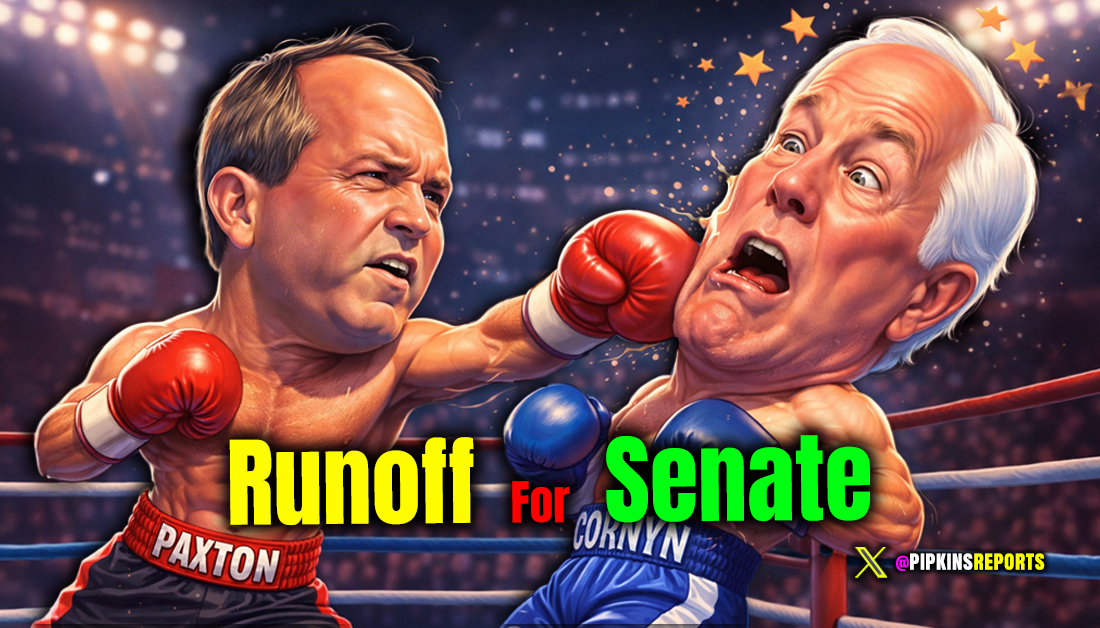
TEXAS – After more than $100 million in political warfare, Texans woke up Wednesday morning to a simple reality, the Republican primary for U.S. Senate is not over. In fact, it may have only reached halftime.
Incumbent U.S. Sen. John Cornyn and Texas Attorney General Ken Paxton are now headed to a runoff election after neither candidate secured the majority required to win outright in Tuesday’s Republican primary. The contest, widely described as the most expensive Senate primary in American political history, will now stretch another two months before Republican voters decide the nominee.
As of publication, with roughly 94 percent of the vote counted, Cornyn held a narrow lead with 41.9 percent of the vote, totaling 897,187 ballots. Paxton followed closely with 40.7 percent, receiving 871,672 votes. U.S. Rep. Wesley Hunt finished third with 13.5 percent, or 289,403 votes.
Under Texas election law, a candidate must receive more than 50 percent of the vote to win a primary outright. When no candidate crosses that threshold, the top two candidates advance to a runoff election. That runoff is scheduled for May 26.
The results guarantee an extended political showdown between two figures representing sharply different visions of Republican leadership.
Paxton addressed supporters Tuesday night during an election watch event in Dallas hosted by the pro-Paxton Lone Star Liberty PAC. The attorney general framed the outcome as a rejection of the political establishment and a signal from grassroots voters across Texas.
“Together with your support, we just sent a message loud and clear to Washington,” Paxton told the crowd. “Texas is not for sale.”
Paxton also pointed to the massive financial disparity between the campaigns, arguing that despite overwhelming spending by groups aligned with the incumbent senator, Republican voters still rejected the status quo.
“Nearly 60 percent of Texas voters, who have known Cornyn for over 40 years, after hearing $100 million worth of ads, chose to vote against the incumbent,” Paxton said. “That’s historic.”
Cornyn did not host an election night event but briefly addressed reporters Tuesday evening as the vote count continued.
“I’ve worked for decades to build the Republican Party, both here in Texas and nationally,” Cornyn said. “I refuse to allow a flawed, self-centered and shameless candidate like Ken Paxton risk everything we’ve worked so hard to build over these many years.”
Cornyn’s campaign has consistently argued that Paxton represents a risk to the Republican Party’s electoral prospects, while Paxton’s supporters have framed the race as a battle between grassroots conservatives and Washington insiders.
Cornyn campaign spokesman Matt Mackowiak previously told reporters that the campaign would not hold an election night celebration because the team does not “do halftime parties.”
The Cost of Each Vote
The financial dynamics of the race reveal an even more striking contrast between the campaigns.
Based on available spending figures tied to advertising and campaign messaging efforts, Cornyn’s political operation and allied groups spent roughly $70 million supporting his campaign. Paxton’s campaign and aligned efforts spent approximately $4.1 million, while Hunt’s campaign spending totaled about $11.4 million.
When those spending totals are compared with the number of votes received, the results highlight a dramatic difference in campaign efficiency.
- Cornyn’s spending equates to roughly $78.02 per vote, calculated by dividing $70 million by his 897,187 votes.
- Paxton’s campaign achieved nearly the same vote total at dramatically lower cost, spending approximately $4.70 per vote to secure 871,672 votes.
- Hunt’s campaign, which finished third, spent about $39.39 per vote, based on $11.4 million in spending and 289,403 votes.
In practical terms, Paxton’s campaign proved vastly more efficient at converting dollars into voter support, achieving almost the same vote share as Cornyn while spending only a fraction of the money.
Political analysts say the spending gap reflects heavy financial involvement by national Republican organizations and establishment political committees seeking to defend the incumbent senator.
Despite that financial advantage, the spending did not produce the decisive victory many expected.
Instead, it produced a runoff.
What Comes Next
The May 26 runoff now becomes the defining stage of the race. Historically, Texas runoff elections attract significantly lower voter turnout than primary elections, meaning campaigns must rely heavily on organization, messaging, and targeted voter mobilization.
Both candidates are expected to intensify campaigning across the state in the coming weeks, focusing on grassroots engagement, media messaging, and turnout operations.
The runoff will determine which candidate ultimately represents the Republican Party in the general election.
Opinion
One candidate’s role in Tuesday’s outcome should not be overlooked.
Congressman Wesley Hunt finished a distant third, but his presence in the race likely ensured that Paxton would not get the 50% needed to secure the nomination and may have now handed the election over to Cornyn.
It matters because Texas runoff elections tend to favor the campaign with the deeper pockets and stronger political machinery…that’s Cornyn. Cornyn’s access to national Republican fundraising networks and establishment political organizations could translate into a powerful turnout operation. Ground operations, voter targeting, and aggressive get-out-the-vote campaigns often determine the winner when turnout drops.
Paxton, by contrast, will rely heavily on grassroots enthusiasm among voters who see his candidacy as a challenge to what they view as a disconnected Washington political class. Cornyn is deeply hated by the electorate. The only question is, do they hate him enough to come out for a 2nd time to vote against him?
You must be logged in to post a comment Login