Connect with us

Published

on

Cost per Vote Calculated

TEXAS – After more than $100 million in political warfare, Texans woke up Wednesday morning to a simple reality, the Republican primary for U.S. Senate is not over. In fact, it may have only reached halftime.

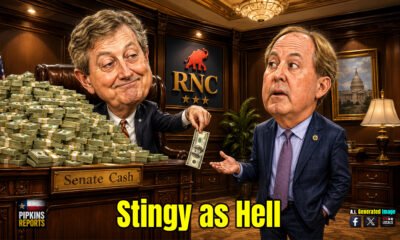
Incumbent U.S. Sen. John Cornyn and Texas Attorney General Ken Paxton are now headed to a runoff election after neither candidate secured the majority required to win outright in Tuesday’s Republican primary. The contest, widely described as the most expensive Senate primary in American political history, will now stretch another two months before Republican voters decide the nominee.

As of publication, with roughly 94 percent of the vote counted, Cornyn held a narrow lead with 41.9 percent of the vote, totaling 897,187 ballots. Paxton followed closely with 40.7 percent, receiving 871,672 votes. U.S. Rep. Wesley Hunt finished third with 13.5 percent, or 289,403 votes.

Under Texas election law, a candidate must receive more than 50 percent of the vote to win a primary outright. When no candidate crosses that threshold, the top two candidates advance to a runoff election. That runoff is scheduled for May 26.

The results guarantee an extended political showdown between two figures representing sharply different visions of Republican leadership.

Paxton addressed supporters Tuesday night during an election watch event in Dallas hosted by the pro-Paxton Lone Star Liberty PAC. The attorney general framed the outcome as a rejection of the political establishment and a signal from grassroots voters across Texas.

Together with your support, we just sent a message loud and clear to Washington,” Paxton told the crowd. “Texas is not for sale.

Paxton also pointed to the massive financial disparity between the campaigns, arguing that despite overwhelming spending by groups aligned with the incumbent senator, Republican voters still rejected the status quo.

Nearly 60 percent of Texas voters, who have known Cornyn for over 40 years, after hearing $100 million worth of ads, chose to vote against the incumbent,” Paxton said. “That’s historic.

Cornyn did not host an election night event but briefly addressed reporters Tuesday evening as the vote count continued.

I’ve worked for decades to build the Republican Party, both here in Texas and nationally,” Cornyn said. “I refuse to allow a flawed, self-centered and shameless candidate like Ken Paxton risk everything we’ve worked so hard to build over these many years.

Cornyn’s campaign has consistently argued that Paxton represents a risk to the Republican Party’s electoral prospects, while Paxton’s supporters have framed the race as a battle between grassroots conservatives and Washington insiders.

Cornyn campaign spokesman Matt Mackowiak previously told reporters that the campaign would not hold an election night celebration because the team does not “do halftime parties.”

The Cost of Each Vote

The financial dynamics of the race reveal an even more striking contrast between the campaigns.

Based on available spending figures tied to advertising and campaign messaging efforts, Cornyn’s political operation and allied groups spent roughly $70 million supporting his campaign. Paxton’s campaign and aligned efforts spent approximately $4.1 million, while Hunt’s campaign spending totaled about $11.4 million.

When those spending totals are compared with the number of votes received, the results highlight a dramatic difference in campaign efficiency.

  • Cornyn’s spending equates to roughly $78.02 per vote, calculated by dividing $70 million by his 897,187 votes.
  • Paxton’s campaign achieved nearly the same vote total at dramatically lower cost, spending approximately $4.70 per vote to secure 871,672 votes.
  • Hunt’s campaign, which finished third, spent about $39.39 per vote, based on $11.4 million in spending and 289,403 votes.

In practical terms, Paxton’s campaign proved vastly more efficient at converting dollars into voter support, achieving almost the same vote share as Cornyn while spending only a fraction of the money.

Political analysts say the spending gap reflects heavy financial involvement by national Republican organizations and establishment political committees seeking to defend the incumbent senator.

Despite that financial advantage, the spending did not produce the decisive victory many expected.

Instead, it produced a runoff.

What Comes Next

The May 26 runoff now becomes the defining stage of the race. Historically, Texas runoff elections attract significantly lower voter turnout than primary elections, meaning campaigns must rely heavily on organization, messaging, and targeted voter mobilization.

Both candidates are expected to intensify campaigning across the state in the coming weeks, focusing on grassroots engagement, media messaging, and turnout operations.

The runoff will determine which candidate ultimately represents the Republican Party in the general election.

Opinion

One candidate’s role in Tuesday’s outcome should not be overlooked.

Congressman Wesley Hunt finished a distant third, but his presence in the race likely ensured that Paxton would not get the 50% needed to secure the nomination and may have now handed the election over to Cornyn.

It matters because Texas runoff elections tend to favor the campaign with the deeper pockets and stronger political machinery…that’s Cornyn. Cornyn’s access to national Republican fundraising networks and establishment political organizations could translate into a powerful turnout operation. Ground operations, voter targeting, and aggressive get-out-the-vote campaigns often determine the winner when turnout drops.

Paxton, by contrast, will rely heavily on grassroots enthusiasm among voters who see his candidacy as a challenge to what they view as a disconnected Washington political class. Cornyn is deeply hated by the electorate. The only question is, do they hate him enough to come out for a 2nd time to vote against him?


Michael Pipkins focuses on public integrity, governance, constitutional issues, and political developments affecting Texans. His investigative reporting covers public-record disputes, city-government controversies, campaign finance matters, and the use of public authority. Pipkins is a member of the Society of Professional Journalists (SPJ). As an SPJ member, Pipkins adheres to established principles of ethical reporting, including accuracy, fairness, source protection, and independent journalism.

Election

Why the DOJ Will Never Find ‘Widespread Fraud’ in California Elections

Published

on

Pratt Loses Election

OPINION

California – Don’t expect a dramatic press conference from the Trump administration declaring California’s elections clean. More likely, the investigations will quietly fade into the background and eventually disappear from the headlines without any grand conclusion.

In my view, that outcome is almost inevitable. The reason is simple. California’s election laws have been written in such a way that many practices critics consider vulnerable to abuse are perfectly legal. If the conduct itself is authorized by law, federal investigators are unlikely to ever establish the kind of “widespread fraud” that many Americans are expecting them to uncover.

President Donald Trump recently accused Democrats of cheating in California’s primary election, prompting First Assistant U.S. Attorney Bill Essayli to announce that his office and the FBI have multiple election fraud investigations underway in Los Angeles. Essayli’s office also confirmed that Assistant U.S. Attorney Robert Renner visited a Los Angeles County ballot processing center to observe the vote counting process. Reports described the visit as routine and similar to those available to members of the public.

Those comments may sound encouraging to voters concerned about election integrity. But they are likely to produce exactly what previous investigations have produced … years of unanswered questions … followed by silence.

California Elections Code Section 3017 allows a voter who is unable to return a ballot to designate another person to do so. The designated person may hand deliver the ballot or place it in the mail. Criminal penalties exist for bribery, intimidation, tampering, and fraud, but the collection and delivery of ballots by third parties is itself legal.

Supporters argue the practice improves access for elderly and disabled voters. Critics call it legalized ballot harvesting.

Under California law, political organizations, activists, churches, unions, or nonprofit groups may legally collect ballots from voters. If investigators discovered nonprofit groups organizing ballot collection efforts among homeless populations, it would not automatically constitute criminal conduct. Unless prosecutors could prove bribery, coercion, or tampering, much of the activity critics complain about would be perfectly lawful.

Fox 11 recently reported that Essayli referenced a case involving a Marina del Rey woman accused of paying individuals, including homeless people on Skid Row, to register to vote. Brenda Lee Brown Armstrong, 64, also known as “Anika,” pleaded guilty to one federal count of paying another person to register to vote. She faces up to five years in prison when she is sentenced Aug. 31.

Authorities have not alleged that the conduct affected statewide races. Nevertheless, the case highlights concerns long raised by election integrity advocates.

Even if investigators were to uncover isolated examples involving ballots cast in the names of deceased individuals or by noncitizens, history suggests such cases would be treated as individual violations rather than evidence of a larger conspiracy. Officials and media outlets would almost certainly characterize them as statistically insignificant and insufficient to alter election outcomes.

Likewise, even if prosecutors managed to bring a handful of cases involving illegal voting, supporters of the system would likely point to those prosecutions as evidence that the safeguards are working. Critics, meanwhile, would argue that the cases merely expose vulnerabilities that are impossible to quantify.

That is because proving widespread election fraud requires more than finding isolated violations. Prosecutors would have to establish a coordinated effort on a massive scale. Such a burden is extraordinarily difficult to satisfy, especially after ballots have been separated from identifying information and mixed with millions of legitimate votes.

Critics need look no further than the Los Angeles mayoral race to understand why public confidence has eroded. Councilmember Nithya Raman climbed into second place on June 7, overtaking Spencer Pratt as post Election Day ballots continued to be counted. To skeptics, the distribution of those later ballots appeared anomalous, with Raman benefiting disproportionately while neither Karen Bass nor Pratt experienced comparable gains.

Some election integrity advocates view such swings as evidence that California’s system invites speculation that ballots collected through organized harvesting operations could be strategically submitted over time. There is no publicly available evidence demonstrating that such conduct occurred in this race… but the inability to either prove or definitively disprove those suspicions is itself part of the criticism leveled against California’s election laws.

The real debate, in my view, is not whether California elections are run according to the law. They are. The debate is whether the law itself creates conditions that make abuses difficult to detect and nearly impossible to prove after the fact.

That is why Bill Essayli’s statements strike me as little more than empty words. Announcing investigations sounds impressive, but prosecutors cannot prosecute conduct that lawmakers have already legalized. They cannot declare ballot harvesting fraudulent when California law expressly permits third party ballot collection.

Reuters and other news organizations have noted that election officials insist there is no evidence supporting claims of widespread fraud in the governor’s race or the Los Angeles mayor’s race. They may very well be correct according to the legal standards that currently exist. But that misses the point entirely.

Critics are not necessarily claiming that large numbers of people are breaking California law. They are arguing that California lawmakers have constructed a system that places convenience ahead of transparency and verification.

And if the rules themselves permit the conduct, federal investigators should not expect to uncover some giant criminal enterprise hiding in plain sight.

The most likely outcome is not a bombshell report. It is a slow fade. The investigations will drift out of public view, the headlines will move on, and Californians will continue voting under the same rules that produced the controversy in the first place.

Whether those rules deserve the public’s trust is another matter altogether.

Sources: California Elections Code §3017; Los Angeles Times; ABC7 Los Angeles; Fox 11 Los Angeles; Reuters.

Continue Reading

Citizens

Recall Organizer’s Prior Fraud Case Raises Questions About Transparency In Fate Political Fight

Published

on

Inspector gets Inspected - Rains

Fate, TX – A bitter political battle that has divided residents and fueled an effort to remove the Mayor of Fate and three sitting council members has taken an unexpected turn after court records revealed that one of the recall movement’s principal organizers, Christopher Allen Rains, previously pleaded guilty in a felony fraud case, a fact that appears to have been largely unknown to many local voters.

Court records reviewed by Pipkins Reports show that Rains entered a guilty plea in 2016 to a charge of Fraudulent Use or Possession of Identifying Information, a state jail felony under Texas law. Arrest records reviewed by Pipkins Reports show Rains was also arrested on charges of Tampering with a Government Record. However, the tampering allegation does not appear among the final court dispositions reviewed by Pipkins Reports.

[Images of Arrest, Mugshots, and Court Records of Christopher Allen Rains]

The revelation has drawn attention because the recall campaign has frequently centered on issues of ethics, accountability, transparency, and public trust in government. Critics of the current council have argued that elected officials should be held to a high standard of conduct, while supporters of the council have questioned the motives of those seeking their removal.

According to records from the 416th District Court in Collin County, Rains was indicted in 2014 and later pleaded guilty on Sept. 29, 2016, to Fraudulent Use or Possession of Identifying Information involving fewer than five items. The court placed him on deferred adjudication probation for five years and ordered 100 hours of community service.

Court documents state that the judge found sufficient evidence to support the charge but withheld a formal conviction under the terms of deferred adjudication. Records further show that Rains successfully completed probation requirements and was granted an early release from supervision in 2019.

The issue carries public interest not only because Rains helped organize the recall effort, but because his wife, Ashley Rains, currently serves on the Fate City Council and was politically involved in the recall movement while seeking elected office. Christopher Rains stated to Pipkins Reports that he did not form a relationship with his wife until after he had turned his life around, in 2020.

When contacted by Pipkins Reports, Rains did not dispute the court records or his guilty plea. Instead, he cooperated fully with our questions and described the events as occurring during a difficult period of substance abuse and personal struggles.

In 2013-2014, I was making IDs, checks, and credit cards. I was sentenced to 10 years of probation and 8 months of state jail. I was discharged 5 years early off probation“, Rains told Pipkins Reports.

Rains goes on to illustrate how he wasn’t in a good place in his life following that discharge and that his conduct during that period was connected to addiction, and does not reflect who he is today.

It’s nuanced, I was medically discharged from the military.” Referring to events just prior to his arrest.

My actions in active addiction aren’t who I am,” Rains told Pipkins Reports. “I own and run multiple businesses, write uncle Sam checks for six figures every single year. My two years of being an absolute dirt bag doesn’t define me in any way.

Rains further stated that he expected the issue would eventually become public and said he was not attempting to hide his past.

I absolutely knew it would come up,” he said. “I’m not afraid of anything anybody can say about me.

Rather than deny responsibility, Rains characterized the criminal case as part of a chapter of his life that he has worked to overcome.

I can not change the past,” Rains said. “I can not control who does what to me. I can only control how I respond. I am in no way the same person I was in 2014.

His comments are likely to resonate with residents who believe people deserve an opportunity to rebuild their lives after making serious mistakes.

At the same time, the newly disclosed records raise legitimate questions about transparency and public scrutiny. Rains did not publicly disclose his criminal history while gathering signatures for the recall effort. A recall movement that focused attention on the character, ethics, and judgment of elected officials. Voters may reasonably conclude that similar scrutiny should apply to the individuals leading those efforts.

Whether residents view the criminal case as disqualifying, irrelevant, or evidence of personal redemption will ultimately be a matter of individual judgment.

What is not in dispute is that court records show Rains pleaded guilty to a felony fraud charge, received deferred adjudication probation, completed the court’s requirements, and later obtained an early release from supervision. Those facts, now become part of the public record surrounding one of the most visible organizers in Fate’s ongoing political conflict.

Sources: Collin County District Court Case No. 416-82092-2014; Register of Actions; publicly available arrest records; Pipkins Reports interview with Christopher Rains;

Continue Reading

Council

Recalls, Recordings, and Ethics Complaints: Fate Council Faces Another Tumultuous Night

Published

on

Fate Circus

Fate, TX — Monday night’s Fate City Council meeting delivered another dose of controversy and intrigue. Residents who came expecting routine municipal business instead witnessed discussions involving a recall election, disputed recordings, ethics complaints, charter interpretations, and an ongoing struggle over the future direction of city government.

Among the most controversial topics was that of a proclamation declaring June as, “Nuclear Family Month”.

Many people showed up to express their displeasure with the Mayor’s Proclamation. Among the dissenters was former Councilman Mark Harper. Harper tried to express that the proclamation would be a First Amendment violation. In the days leading up to the meeting, Harper and his wife, Sonya, used social media to rally opposition to the proclamation.

Several advocates for the LGBTQIA+ community came out in protest. They believe that the proclamation was exclusionary to same-sex couples with children. But praising one model is not the same thing as declaring other models illegitimate, inferior under the law, or unworthy of respect.

Just as a city may issue a proclamation recognizing military families, such does not exclude civilian families. A city may celebrate small local businesses, but it doesn’t mean they are attacking large corporations. Governments frequently highlight specific groups, traditions, or institutions because they believe those groups have made valuable contributions. Recognition is not necessarily exclusion. This applies to same-sex couples.

Supporters of the proclamation reject claims that the Proclamation violated the First Amendment.

First, government officials are not required to be secular. The Supreme Court has repeatedly recognized that religious references are deeply embedded in American public life. Every City Council meeting opens with a prayer; virtually all of them from a Judeo-Christian perspective. Proclamations recognizing Christmas, Thanksgiving, National Days of Prayer, and similar observances have existed throughout American history. Our national motto is “In God We Trust.

Second, a proclamation is not a law. The Fate proclamation does not compel anyone to believe anything, attend church, adopt a particular family structure, marry, have children, or embrace Christianity. It creates no penalties, no regulations, and no government program. It is merely a symbolic expression of values. The Supreme Court has consistently distinguished between government coercion and government expression.

Third, elected officials have First Amendment rights too. Mayor Andrew Greenberg and the City Council are allowed to express viewpoints. Governments issue proclamations all the time recognizing Pride Month, Black History Month, Women’s History Month, Veterans Day, and countless other causes and constituencies. The fact that some residents in the LGBTQIA+ community disagree with the message does not make it unconstitutional. The First Amendment protects speech people dislike just as much as speech people support.

In fact, in this same meeting, Mayor Andrew Greenberg presented a proclamation to declare June 2nd, 2026, as Codi Chinn Day. This follows Chinn’s removal from office through the recall process earlier this year. Some residents have criticized Chinn’s social media activity, referring to her social media style as, “toxic”, while others have defended her conduct. Many residents question whether a recalled councilperson deserves an appreciation award at all.

Mayor Greenberg acknowledged that initially, he let his own personal anger and frustration get the better of him as he first decided that Chinn would not get a proclamation. He acknowledged that he made that decision as “Andrew”, not as, “Mayor”. After he settled on allowing the proclamation to go forth, he had missed the deadline for the previous meeting, thus causing a delay that some in the community interpreted as a slight. After reflection, he wanted to make it right.

Thus, a proclamation is not a law. It is a symbolic expression of opinion that residents are free to agree or disagree with.

Another significant action before the council was the consideration of an ordinance ordering a special election to determine whether Councilwoman Martha Huffman should be removed from office through the recall process. Huffman elected not to have a hearing over the matter, and thus her recall is the first to be considered. The motion passed, and her recall will be on the November general election ballot.

Mayor Andrew Greenberg presented information and research concerning charter provisions governing council vacancies, an issue that has arisen following the recall of former Councilwoman Codi Chinn. The presentation included discussion of Charter Review Commission deliberations, prior council actions, public records, meeting minutes, and constitutional considerations regarding the city’s vacancy procedures.

According to Greenberg’s presentation, several past appointments, including that of former Councilman Scott Kelley, may not have complied with the charter’s vacancy provisions.

Going forward, as the council follows the written & approved language of the charter, appointments will be made for only the 6-month period between November and May elections.

The council voted that an appointment will be made for Place 1, which will last until November, when an election will be held to finish out the unexpired term to May 2027 … which will then culminate in the regularly scheduled election for that seat.

Transparency was another major theme of the evening.

After Mayor and Council reports, the Council adjourned once again into executive session to discuss with attorney, matters of ethics complaints filed by Former Councilman Mark Harper against Mayor Greenberg, Ethics complaints against Mark Harper, and Codi Chinn by Darcy Gildon. This executive session ended just before midnight.

Upon return,  Councilman Allan Robbins moved to find that Greenberg had violated ethics and asked that the council proceed with sanctions against the mayor. The motion was 2nd by Councilwoman Ashley Gains. The mayor expressed that there was no credible evidence that was sufficiently explained. The motion failed on a 4-2 vote, ending the matter without sanctions against the mayor. The complaint is now closed.

Initial screening of ethics complaint against Codi Chinn by Darcy Gildon. The Council found that investigation of the complaint is sufficient and that an investigative report will be submitted to the Council at the July meeting.

Initial screening of ethics complaint against Mark Harper by Darcy Gildon. The Council voted to dismiss the complaint after determining that the evidence presented was insufficient to warrant further action. Motion submitted by Robbins and 2nd by Rains. Only Mark Hatley voted against the motion. The matter is now closed.

The meeting concluded Tuesday morning, just after midnight.

Continue Reading