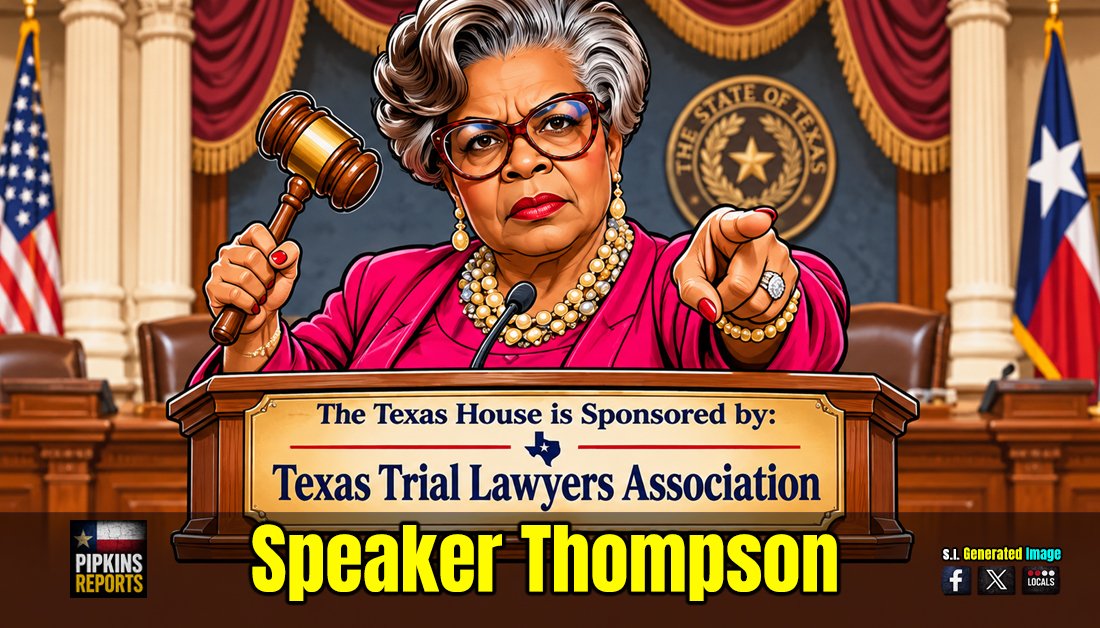
Senfronia Thompson – New Texas House Speaker’s Ties to TTLA

Houston, TX – Texas may soon have a new House Speaker, and the organization that has put $20,000 into the 87 year old Houston Democrat, Senfronia Thompson’s campaign, has a substantial interest in what happens under the speaker’s gavel. The Texas Trial Lawyers Association (TTLA) represents plaintiff-side attorneys whose business depends, in part, on the laws governing lawsuits, damages, liability, and access to civil courts.
Thompson says she has secured the support of 90 House members, including eight Republicans, to become Speaker when the 90th Legislature convenes in January 2027. The formal election has not occurred, but her principal competitor, Rep. Eddie Morales Jr., withdrew and endorsed her on November 6. If elected, Thompson would become the first woman and first Black person to hold the position.
And there is a financial relationship worth examining before that vote. According to campaign finance records compiled by QPQ Tracker, the TTLA PAC contributed $10,000 to Thompson on February 22, 2024, and another $10,000 on June 27, 2025. That’s $20,000 from an organization with a direct interest in legislation that could come before the Texas House during her speakership.
What does the trial lawyers’ association want?
The TTLA’s stated mission is to keep courthouse doors open and preserve fair access to the civil justice system. Its members represent people injured by defective products, negligent drivers, medical providers, employers, and businesses. The association generally opposes legislation that makes it harder for plaintiffs to bring claims or recover damages.
Its policy interests include medical malpractice, personal injury litigation, commercial trucking liability, product liability, insurance disputes, and restrictions on recoverable damages.
These are not abstract political questions. They can determine whether an injured Texan can afford to pursue a lawsuit, what evidence a jury may consider, and how much compensation a successful plaintiff can recover.
The Texas Constitution itself protects the right to a remedy through its open courts provision. The TTLA argues that additional restrictions can undermine that protection. Its opponents argue that excessive litigation and inflated damage awards increase costs for businesses, insurers, and ultimately consumers.
Both sides have legitimate policy arguments, and Texas voters have an interest in understanding who is financing them.
A fight already underway
During the 2025 legislative session, TTLA opposed Senate Bill 30 and House Bill 4806, measures backed by tort-reform advocates that sought to change how certain medical expenses and noneconomic damages could be presented and recovered in civil cases.
The bills became a major battleground between trial lawyers and business interests. The legislation was significantly revised in the House, and the effort ultimately failed to become law before the session ended.
TTLA also opposed SB 39 and HB 4688, which addressed liability involving commercial trucking companies and their drivers.
The association argued that companies should remain accountable for their own decisions and actions. Texans for Lawsuit Reform (TLR), its principal political adversary, supported additional restrictions, arguing that lawsuit abuse drives up costs and threatens Texas businesses.
This isn’t just a Democratic operation
One of the more interesting developments is TTLA’s willingness to finance candidates in both political parties.
QPQ Tracker records show the association’s PAC directed approximately $140,000 to Republican Rep. Ken King, $70,000 to Republican Rep. Charlie Geren, and $15,000 to Republican Sen. Joan Huffman. On the Democratic side, it directed $95,000 to Rep. Chris Turner and $40,000 to Sen. Judith Zaffirini. Thompson received only $20,000.
These are reported direct contributions, not allegations of improper payments. They demonstrate that TTLA’s political strategy extends beyond party loyalty.
The association’s president, former Democratic state representative Craig Eiland, has publicly described its mission as nonpartisan. Its lobbying operation includes James Fields, a longtime public affairs figure, and Danielle Delgadillo, among other registered representatives. Tiffany McGee serves as the association’s chief executive officer.
What could Thompson give them?
If elected Speaker, Thompson would have substantial influence over committee appointments, legislative referrals, scheduling, and conference committee selections.
The House Judiciary and Civil Jurisprudence Committee is particularly relevant. It handles legislation affecting civil liability, damages, and court procedures. Thompson would have authority to appoint its chairman and members.
She would also appoint leadership for the Calendars Committee, which determines when legislation receives consideration on the House floor.
That authority could benefit TTLA’s agenda without Thompson ever authoring a bill for the association. A favorable committee chairman, a particular committee referral, or a decision to advance or delay legislation can shape the outcome long before lawmakers cast a final vote.
Thompson’s longstanding advocacy for civil rights and protections for vulnerable Texans is broadly compatible with TTLA’s courthouse-access message. But her record does not establish that she agrees with the association on every tort-reform question.
There is also a notable political complication: QPQ Tracker records show Texans for Lawsuit Reform PAC contributed $2,500 to Thompson in December 2024. The two competing organizations have both supported her, although their policy objectives often conflict.
The question facing Texas
There is nothing inherently improper about an organization supporting candidates who share its legislative priorities. That is how political advocacy works. But Texans deserve transparency about the relationships surrounding the person who will control so much of the House’s legislative machinery.
Thompson has the opportunity to demonstrate that her speakership will serve the entire state, not simply the interests of the organizations and political networks that helped finance her career.
The right to petition government and the right to a fair day in court are fundamental principles. So is the obligation of elected officials to exercise public power independently.
The test will come when legislation affecting the trial lawyers, insurance companies, businesses, and injured Texans reaches her desk. The public should be watching who gets appointed, which bills receive hearings, and which interests get a seat closest to the Speaker’s office.
Questions & Answers
How much has the Texas Trial Lawyers Association PAC contributed to Senfronia Thompson?
The TTLA PAC contributed $20,000 in two reported transactions: $10,000 on February 22, 2024, and $10,000 on June 27, 2025, according to QPQ Tracker’s campaign finance records.
What does the Texas Trial Lawyers Association advocate for?
The TTLA advocates for access to civil courts and legal remedies for injured Texans. Its legislative interests include medical malpractice, personal injury claims, product liability, commercial trucking liability, and opposition to restrictions on recoverable damages.
What authority would Senfronia Thompson have over legislation affecting trial lawyers?
As Speaker, Thompson could appoint the Judiciary and Civil Jurisprudence Committee and Calendars Committee leadership, refer legislation, influence floor scheduling, and appoint House conference committee members. Those powers could affect the progress of legislation concerning civil liability and damages.
Does the Texas Trial Lawyers Association support Republicans as well as Democrats?
Yes. Its PAC has contributed to Republican lawmakers including Ken King and Charlie Geren, as well as Democratic lawmakers including Chris Turner and Judith Zaffirini. The association says its political advocacy is based on civil justice issues rather than party affiliation.
What are the sources for the Thompson and TTLA relationship?
Primary and secondary references include the Texas Ethics Commission campaign finance filings, QPQ Tracker’s transaction records, the Texas Tribune’s August 12, 2026 investigation of trial lawyers and Texans for Lawsuit Reform, the Texas Legislature’s SB 30 legislative history, and the Texas House Speaker’s documented powers.





Senate Race in Texas – The Statistical Model by County
What Do 254 Texas Counties Tell Us About the 2026 U.S. Senate Election? A Mathematical Model Examines the Numbers An...


Granbury Recall: Five Targets, Three Lawsuits, One Mess
Granbury, TX – Granbury taxpayers are now financing a legal fight against the very recall process designed to give them...


Beyond Paxton: The Other Republican Losses That Turned Texas Blue
Texas, USA – The November 3, 2026, Texas Republicans losses were considerably worse than just Ken Paxton‘s defeat by James...
You must be logged in to post a comment Login