
Connect with us

Published

on

Private conversations between former Mayor David Billings and City Manager Michael Kovacs raise new questions about influence, transparency, and who really had access to City Hall.

Fate, TX – Text messages obtained between former Fate Mayor David Billings and City Manager Michael Kovacs reveal a relationship that continued well after Billings left elected office—one in which the former mayor was regularly discussing active city business, asking for information unavailable to the public, and at times appearing to direct or advise the city’s chief executive officer.

The conversations, which span numerous topics, occurred between May 1, 2025 and December 31, 2025, paint the picture of a former elected official who maintained extraordinary access to City Hall without submitting Open Records Requests required of ordinary citizens.

While former elected officials frequently maintain friendships with city staff, these exchanges raise broader questions about whether Billings continued to wield informal influence over municipal operations after voters had elected a new city council.

Direct Access Outside the Open Records Process

Throughout the messages, Billings repeatedly asks Kovacs questions regarding ongoing city matters and receives prompt responses.

Rather than directing Billings to publicly available records or suggesting he submit an Open Records Request, Kovacs routinely answers questions directly, provides updates, and discusses city operations.

For residents seeking similar information, the City of Fate has frequently required formal Public Information Act requests, and in many instances has asserted legal exceptions to disclosure of city business.

The contrast between the public process and the private communications is likely to invite scrutiny.

Discussions of Active Public Safety Matters

Among the more striking conversations are discussions involving registered sex offenders.

Billings questions Kovacs about individuals living within the city and asks whether Fate has anyone violating local sexual offender restrictions.

According to the texts, Billings asks:

“Are you sure we have no one in violation of the Fate sexual offenders laws.”

Rather than declining to discuss an active law enforcement matter, Kovacs responds with detailed information about multiple individuals, explaining that one suspect had fled, another was moving away, and describing the status of investigations.

Kovacs also tells Billings that police were reviewing maps to determine whether additional offenders might be hiding within prohibited areas.

The conversation continues with Billings asking follow-up questions about which offender local residents were monitoring and commenting that he would remain silent regarding information not yet known publicly.

Later in the exchange, Billings promotes the value of automated license plate readers, noting from his own experience that they quickly tracked down criminals.

Whether any of this information was confidential under Texas law would ultimately depend on the status of the investigations and applicable law enforcement exceptions. Regardless, the exchange demonstrates that Billings was being briefed on ongoing public safety matters despite no longer serving in elected office.

A Former Mayor Giving Direction

The conversations also show Billings offering more than casual opinions.

On multiple occasions he appears to instruct or advise Kovacs regarding city operations.

Among the examples:

  • Billings tells Kovacs, “You should get Codi educated and onboard.”
  • Billings advises that the police chief “needs to take threats more seriously,” adding that he would explain later.
  • Billings offers recommendations regarding technology and law enforcement practices.
  • He regularly asks follow-up questions that resemble those of an active policymaker rather than a private citizen.

While city managers routinely receive advice from many individuals, these exchanges suggest Billings occupied a uniquely influential position long after his term ended.

The Discovery Warning

Perhaps the most revealing exchange comes when the discussion turns to Department of Public Safety matters.

Kovacs informs Billings that the text messages involving DPS (ie: Chief Lyle Lombard) will be captured during the discovery process.

Following that warning, the conversations regarding those subjects effectively stop.

For observers familiar with litigation, the significance is difficult to ignore.

Discovery is the legal process through which communications and documents become subject to production in lawsuits.

Whether Kovacs was simply acknowledging that the communications would eventually become public or signaling that sensitive discussions should no longer occur by text is open to interpretation.

What is evident is that once the prospect of discovery is raised, the subject matter changes.

For journalists, that transition may prove one of the more noteworthy portions of the exchange.

Access Not Available to Ordinary Citizens

Perhaps the broader issue raised by the messages is one of unequal access.

Residents seeking information from City Hall generally must:

  • Submit formal Open Records Requests.
  • Wait statutory response periods.
  • Potentially pay production fees.
  • Sometimes litigate withheld records.

Billings, by contrast, appears simply to send a text message directly to the City Manager.

The exchanges suggest that information concerning city operations, policing issues, development, and other municipal matters flowed privately between the city manager and a former elected official without the formal transparency mechanisms available to the public.

Whether that arrangement was appropriate is ultimately a matter for residents to decide.

Questions Raised

The messages raise several questions deserving public answers:

  • Why was a former mayor receiving updates on active city business instead of obtaining information through public channels?
  • What role, if any, did Billings continue to play in influencing municipal decisions after leaving office?
  • Were other former elected officials afforded similar access?
  • Were any discussions conducted outside the public record to avoid future disclosure?
  • Should communications between city leadership and former elected officials concerning municipal business be subject to greater transparency?

None of the texts, standing alone, establish wrongdoing.

However, they do provide an unusual window into the continuing relationship between the City’s top administrator and a former mayor whose official authority had already ended.

For a community that has increasingly questioned transparency at City Hall, the messages are likely to fuel renewed debate over who truly had access to the decision-makers—and whether some voices carried more weight than others.

Read the entire conversation of text messages we have obtained here:


(Edited: Higher Resolution File Uploaded: )

Edited: Additional pages that were corrupted from above:

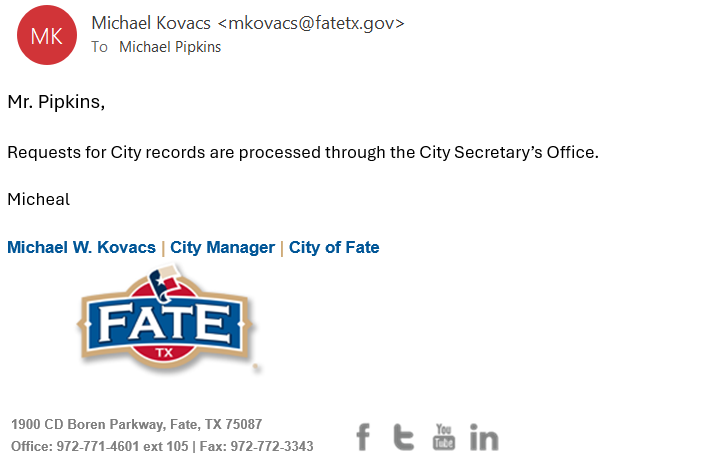
*Edited: Meanwhile, if you are a citizen, you get this:
Michael Pipkins focuses on public integrity, governance, constitutional issues, and political developments affecting Texans. His investigative reporting covers public-record disputes, city-government controversies, campaign finance matters, and the use of public authority. Pipkins is a member of the Society of Professional Journalists (SPJ). As an SPJ member, Pipkins adheres to established principles of ethical reporting, including accuracy, fairness, source protection, and independent journalism.

Council

Four Candidates Enter Fate City Council Place 1 Race

Published

on

The Replacements

Fate, TX – The race to fill the vacant Fate City Council Place 1 seat vacated by the recall of Codi Chinn, will consist of four candidates. Randy Long, Stephanie Delaine Adams, Joshua Martin and Donovan Heinrich.

Randy Long is a serves as the Rockwall County director for True Texas Project, a conservative grassroots organization.

Stephanie Delaine Adams served 12 years on the Rockwall ISD Board of Trustees, including two years as board president from 2017 to 2019. She is now a Realtor.

Joshua Martin has lived in Fate for approximately six years and is a recruiting manager with QXO. He previously served as president of the Old Shepard Place neighborhood association in Plano.

Donovan Heinrich previously ran for Fate City Council, Place 5, in 2021, receiving 288 votes, or 30.48%, against eventual winner Jim DeLand.

More to follow on each candidate in the upcoming days.

Continue Reading

Fate, TX

Fate Council Approves Settlement in Former DPS Chief Lyle Lombard’s Wrongful Termination Dispute

Published

on

Fate Lawsuit Settled

Fate, TX — The Fate City Council voted Monday night to approve a proposed settlement with former Department of Public Safety Chief Lyle Lombard, bringing what has been a months-long wrongful termination dispute one step closer to resolution.

The vote of 4 to approve and 2 abstentions followed an executive session in which council members met privately with legal counsel to discuss the arbitration matter. Returning to open session, the council approved the settlement, though the financial terms and other provisions of the agreement were not disclosed during the public meeting.

The settlement resolves Lombard’s wrongful termination claim, which has been proceeding through arbitration following his separation from the City of Fate. Unlike traditional court proceedings, arbitration generally occurs outside public view, leaving many details of the dispute undisclosed unless the parties choose to release them or disclosure is otherwise required by law.

As of publication, the City has not released the settlement agreement, and it remains unclear whether the document contains confidentiality provisions or other restrictions governing what information may become public. It is also unknown whether the agreement includes any admission of liability by either party, the amount of any monetary payments, or other negotiated terms.

Lombard served as the City’s Department of Public Safety Chief before his separation from the City, a decision that ultimately resulted in the arbitration proceedings. The dispute drew considerable public attention as questions surrounding the circumstances of his departure remained largely unanswered because of the confidential nature of the arbitration process.

Monday night’s vote concludes the council’s role in approving the negotiated resolution, but it may not immediately answer many of the questions residents have asked throughout the dispute. Depending on the terms of the agreement and applicable provisions of the Texas Public Information Act, some portions of the settlement could eventually become public, while other details may remain confidential if protected by law.

Pipkins Reports has submitted requests for records related to the settlement and will review any documents released by the City. Those records may provide additional information regarding the financial impact of the agreement, the obligations of each party, and the extent to which the dispute has been fully resolved.

Neither the City of Fate nor Lombard publicly commented on the settlement during Monday night’s meeting.

While the approval brings the arbitration to a close, it also marks the end of one of the most closely watched employment disputes in recent City history. Whether additional information becomes available will likely depend on the release of public records, the language of the settlement agreement, and any future statements made by the parties.

Pipkins Reports will continue following the story and will publish updates as additional records become available.

Continue Reading

Fate, TX

Exposed: City of Fate Withholds Documents from Disclosure Without Permission From Attorney General

Published

on

Kovacs Hiding Documents

Ethics Investigation Raises New Questions About Fate’s Response to Open Records Request

Fate, TX — An ethics investigation into former Fate City Councilwoman Codi Chinn has uncovered evidence suggesting the City of Fate possessed at least one employee complaint against former Department of Public Safety Chief Lyle Lombard that it never disclosed in response to an Open Records Request submitted by Pipkins Reports.

The newly released investigative report also raises additional questions about whether City Manager Michael Kovacs fully described his receipt of employee complaint letters during his interview with the City’s outside investigator.

The documents establish the following timeline.

On November 25, 2025, Pipkins Reports submitted a Texas Public Information Act request seeking four categories of records related to Chief Lombard’s employment. Item No. 3 requested:

“Copy of any written complaints against Chief Lombard within the last 12 months prior to termination.”

On December 11, 2025, the City responded by producing Chief Lombard’s performance evaluations, termination documents, and the investigation initiated by City Manager Michael Kovacs. However, the city produced no employee complaint letters.

Because no complaint letters were produced, Pipkins Reports immediately contacted the City for clarification. The follow-up specifically noted that an anonymous employee complaint concerning Lombard had already become publicly known and requested that letter, along with any other anonymous or signed complaints concerning the former chief.

On December 16th, after Pipkins Reports challenged the City’s original response, Associate Attorney Paige Goins of Messer Fort acknowledged that one document—the anonymous letter already known to exist—had been inadvertently omitted and she sent that document to Pipkins Reports.

Then, on December 18, the City supplemented its response again by producing awards and commendations received by Lombard.

At the time, Pipkins Reports did not pursue the matter further. New information obtained through a subsequent ethics investigation has now renewed serious questions about whether the City’s response complied with the Texas Public Information Act.

Under the Texas Public Information Act, governmental bodies generally must either promptly produce responsive public records or seek a ruling from the Texas Attorney General if they believe the requested information falls within an exception to disclosure. If a governmental body fails to timely request an Attorney General ruling, the requested information is generally presumed to be public unless a compelling reason exists to withhold it. See Texas Government Code §§ 552.221, 552.301, and 552.302.

In this case, the City did not seek an Attorney General ruling authorizing its withholding of any documents.

Ethics Investigation Reveals New Information

Seven months later, in July of 2026, an unrelated ethics investigation would reveal information that casts new light on the City’s response.

The investigation originated from an ethics complaint filed by Fate resident Darcy Gildon, who alleged former Councilwoman Codi Chinn improperly involved herself in personnel matters by directing city employees to prepare written complaints concerning Chief Lombard.

Attorney Laura Mueller of Baker Robertson & O’Brien ultimately concluded that Chinn violated Section 2-309(10) of the city’s Code of Ethics by directing employees to provide information to her in writing. Pipkins Reports reported on that story … here.

More significant for purposes of this investigation, however, were the interviews conducted with the individuals involved.

According to the investigative report, Chinn told investigators that city employees approached her seeking assistance. She stated that she instructed them to put their concerns in writing so they could be presented to the City Council. Instead, according to her interview, the employees compiled a letter addressed to the entire City Council, after which she instructed them to deliver the letter to City Manager Michael Kovacs.

The investigative report summarizes Kovacs’ interview as follows:

“In my interview with Mr. Kovacs, we discussed his conversations with then Councilmember Chinn and the employees. Mr. Kovacs stated that he received the letter outlining the employee issues directly from an officer, but with the understanding that the information was given to him at the direction of Ms. Chinn. Mr. Kovacs also stated that Ms. Chinn kept him informed of the conversations she was having with the employees, but that he warned her against such communications.”

[Link to Ethics Report]

The report, however, does not discuss the original anonymous complaint letter that Pipkins Reports previously reported had been delivered to Kovacs through Councilwoman Chinn.

Taken together, the report’s statements—and its omissions—appear to indicate that Kovacs possessed at least two written employee complaints that would have been responsive to Pipkins Reports’ November 2025 Public Information Act request.

Two Letters, One Unanswered Question

Pipkins Reports has independently obtained copies of both complaint letters from sources outside City Hall. One anonymous letter begins with the words, “To Whom It May Concern.” The second letter is addressed to the entire City Council and was reportedly transmitted through Councilwoman Chinn.

Their existence, however, does not resolve whether the City complied with the Texas Public Information Act. The central question is whether the City properly disclosed responsive records in response to a lawful request.

As of this publication, the City still has not disclosed the separate complaint letter that Kovacs later acknowledged receiving directly from a police officer. By his own admission, City Manager Michael Kovacs is the person responsible for the dissemination of records per State Law, and therefore he is the person who should be held accountable.

If Kovacs’ statement to investigators is accurate, that second complaint letter would have existed when the City’s response to the November 2025 Public Information Act request was prepared.

A New Public Information Request

In light of the newly disclosed information, Pipkins Reports has submitted another Texas Public Information Act request seeking all written complaints concerning Chief Lombard, including the complaint letter Kovacs acknowledged receiving from an officer, the complaint letter transmitted through Councilwoman Chinn, and any additional written complaints in the City’s possession.

The request states, in part:

“On 11/25/2025, as part of Open Records Request #R001735-112525, I requested ‘Copy of any written complaints against Chief Lombard within the last 12 months prior to termination.’ The City failed to provide any responsive documents, even though it was publicly known that at least one anonymous complaint letter existed.

During the ethics investigation conducted by Baker Robertson & O’Brien, Michael Kovacs stated that he received a complaint letter from a police officer. This admission indicates the City possessed an additional responsive document that was not disclosed.

The City did not seek an Attorney General ruling authorizing the withholding of either complaint letter. This request seeks both documents, together with any additional written complaints concerning Chief Lombard.”

Whether the City ultimately produces the records—or explains why they were not disclosed nearly eight months ago—may determine whether this story ends as an administrative oversight or raises more significant questions regarding the City’s compliance with the Texas Public Information Act.

This remains an ongoing investigation. Pipkins Reports will continue to report on developments as additional records become available.

Continue Reading