
Recall War in Fate: Councilwoman’s Past Disclosure Comes Back to Haunt Her
FATE, TX – Just two months after Councilwoman Codi Chinn publicly posted an unredacted recall affidavit that included citizens’ names and home addresses, she now refuses to release a similar document that would reveal her supporters. Her explanation for the change, however, appears to conflict with information provided by city officials.
The dispute centers on an “Affidavit of Petitioners’ Committee,” the formal document required to begin a recall process under Texas law. The affidavit lists the members of the committee seeking the recall, including their names and home addresses.
Earlier this year, such an affidavit was filed to initiate a recall election against Chinn. According to records obtained by Pipkins Reports, Chinn received the document through her city-issued email account and later posted the affidavit publicly on Facebook without authorization or redacting the listed addresses.
The disclosure drew widespread criticism from residents and local observers who argued that publishing citizens’ home addresses could expose them to harassment or intimidation. A police report later named Chinn as a suspect in a possible unlawful disclosure investigation, a matter previously reported by Pipkins Reports.
Among the individuals listed on that recall affidavit were Andrew Greenberg and several members of the Fate City Council.
At the time, Chinn denied wrongdoing and defended her decision to publish the document.
The political situation in Fate has since flipped.
Supporters aligned with Chinn recently filed their own recall affidavit targeting Greenberg along with council members Mark Hatley, Rick Maneval, and Martha Huffman.
When residents asked on social media whether Chinn would again release the affidavit publicly, she declined and suggested there was a key distinction between the two situations.
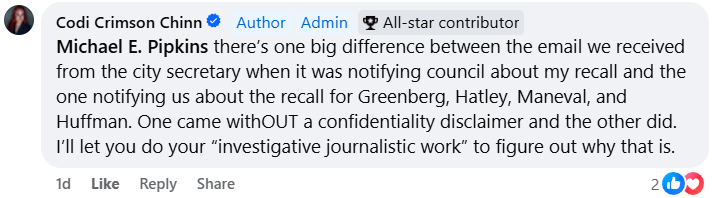
“… there’s one big difference between the email we received from the city secretary when it was notifying council about my recall and the one notifying us about the recall for Greenberg, Hatley, Maneval, and Huffman,” Chinn wrote online. “One came without a confidentiality disclaimer and the other did. I’ll let you do your ‘investigative journalist work’ to figure out why that is.”
So, we did. To verify the claim, Pipkins Reports contacted Fate City Manager Michael W. Kovacs to ask whether the city had changed the language used in emails sent to council members regarding recall documents.
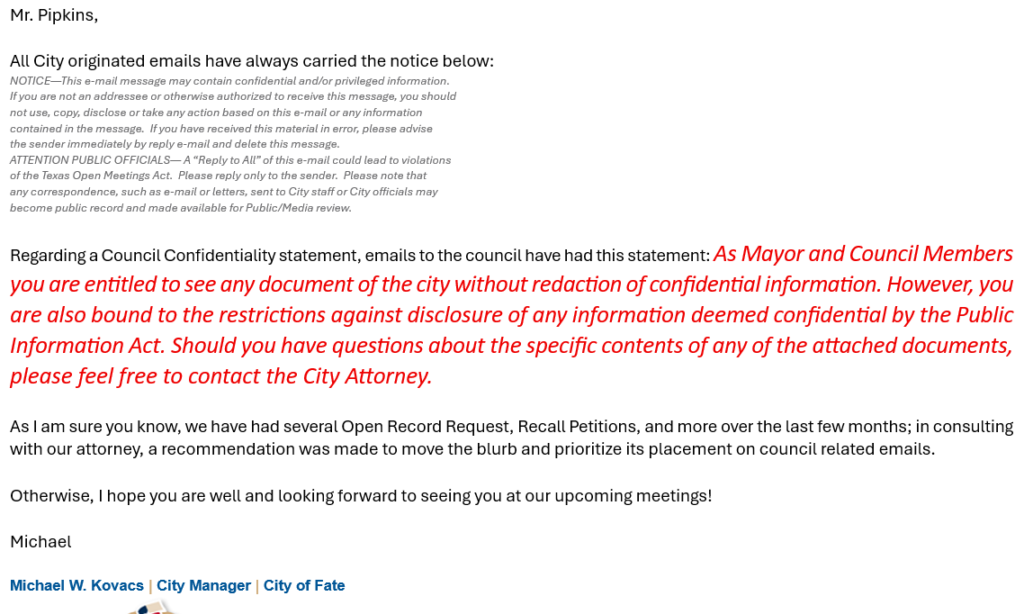
Kovacs said it had not. “All City originated emails have always carried the notice below,” Kovacs wrote in an email response.
The notice warns recipient that the message “may contain confidential and/or privileged information” and it cautions against copying or disclosing the contents if the recipient is not authorized.
In addition to the standard email disclaimer, Kovacs also noted that council members have long received additional guidance reminding them that although elected officials may view unredacted documents in their official capacity, they remain subject to restrictions on disclosing confidential information. The additional disclaimer says, “As Mayor and Council Members you are entitled to see any document of the city without redaction of confidential information,” Kovacs wrote. “However, you are also bound to the restrictions against disclosure of any information deemed confidential by the Public Information Act.”
Kovacs added that the city recently moved the confidentiality language higher in the email to emphasize the notice, following consultations with the city attorney during a period that included several recall petitions and open records requests. (ie: after Chinn disclosed the document)
Public records law and city policy
Under the Texas Public Information Act, most government records are presumed public unless they fall under specific statutory exceptions. The law requires government bodies to withhold certain categories of sensitive personal information, such as Social Security numbers, driver’s license numbers, financial account data, and some contact information. While a citizen’s name and address may appear in some public filings, many municipalities (including Fate) adopt internal practices designed to limit the disclosure of personal identifying information when documents are shared publicly. This includes the redaction of addresses of the public.
Opinion and analysis
The facts of the situation are relatively straightforward.
When the recall affidavit targeted Chinn, she had no problem releasing the document publicly on social media with citizens’ addresses intact. When a similar affidavit surfaced targeting her political opponents, the same kind of disclosure suddenly became off limits.
Chinn has attributed that difference to changes in the email disclaimer language. The city manager’s explanation suggests the warning language was not new, but rather long-standing. Only the prominent location of the language changed.
So it would appear that Chinn’s response is a case of political convenience.
Ultimately, voters in Fate will decide how they view the episode. But the unfolding recall battle has already delivered one clear lesson. In politics, the standard you apply to others often returns to test you.
### Pipkins Reports has requested a copy of the Affidavit of Petitioners’ Committee from the City of Fate. When received, we will provide that information to the public … redacted of course, as we did previously.
Business
San Angelo’s Data Center Fight Is Now a Recall Fight
San Angelo, TX – San Angelo’s battle over massive data centers has moved from City Hall chambers to the ballot box, and two council members could soon have to defend their seats before voters angry about how the city has handled the projects. What began as a fight over water, power, development and transparency is now a full-blown political revolt, with recall efforts targeting Council Members Harry Thomas and Joe Self.
And the controversy comes at an interesting moment for Texas. Gov. Greg Abbott has ordered state regulators to conduct a comprehensive audit of data centers moving through the state’s electric grid interconnection process, saying the review must be completed before any data center project moves forward. ERCOT subsequently told Fox News Digital that Abbott’s directive “effectively pauses all data center projects” while the state reviews their demands on the grid.
That means the questions being shouted at San Angelo City Hall are no longer merely local complaints from residents opposed to a particular development. Texas officials are now asking some of the same questions.
Abbott directed the Public Utility Commission of Texas and ERCOT to examine pending data center projects and gather information, including projected annual and peak electricity demand, water consumption, water sources, and whether facilities intend to generate some of their own electricity. ERCOT reported that roughly 90 percent of the 474 gigawatts of large-load interconnection requests currently under review are associated with data centers, more than five times Texas’ record peak electricity demand.
Back in San Angelo, the San Angelo Data Center Citizen Coalition has been pushing its own accountability campaign.
A petition seeking the recall of Council Member Harry Thomas, who represents Single Member District 3, was submitted July 15 with more than the required signatures. The city clerk later certified the petition after determining 53 signatures were sufficient, clearing the way for a recall election.
Following public comment, the City Council voted 6-1 to call the recall election.
Thomas has maintained that he has no intention of resigning.
“I weigh every decision I’ve ever made on behalf of the 100,000 citizens in San Angelo,” Thomas said after the petition was submitted. “Every time I vote, I vote for all the citizens. I have no plans to resign from my position.”
Self is now facing his own recall effort.
The coalition submitted an affidavit seeking Self’s recall and subsequently collected the signatures necessary to move forward. On Aug. 6, Self issued a statement saying he supports residents’ right to seek a recall but rejected what he described as misinformation about his involvement with data centers.
“I have not signed any non-disclosure agreements,” Self said. “I have not benefited financially. I have not voted in favor of a data center.”
Self said the council has instead voted on regulations that would apply if a data center is established in San Angelo.
That distinction between approving a specific project and approving regulations governing potential projects has become one of the central arguments in the political fight. San Angelo officials have considered rules addressing land use, water and wastewater issues as the city confronts proposals for large-scale data center development.
The proposed Skybox project has become particularly contentious. City officials have described it as a potential $7.2 billion investment, while opponents have raised concerns about water consumption, electricity demand, infrastructure, noise and transparency surrounding the development process.
The political consequences are spreading beyond San Angelo.
Residents in Temple and Granbury have also launched recall or charter efforts amid disputes over data center development. In Temple, opponents have cited concerns about land, water consumption and heat generated by facilities. In Granbury, activists gathered signatures seeking recalls involving the mayor and most members of the City Council.
Art & Culture
McKinney Approves Controversial Islamic Center After Marathon Meeting That Exposed Deep Divisions
McKinney, TX – After nearly six hours of emotional testimony, shouted applause, boos, and police intervention, the McKinney City Council unanimously approved plans Tuesday night for a new Islamic center, closing another chapter in a debate that has simmered in Collin County for years. The vote may have been unanimous, but it certainly wasn’t uncontroversial.
Just before 11:30 p.m. on August 4, the council voted 7-0 to approve the site plan for the McKinney Islamic Association‘s proposed campus on roughly 5.5 acres at Virginia Parkway and Crutcher Crossing. City officials repeatedly emphasized that the decision before them was not whether Islam should have a place of worship in McKinney, but whether the submitted site plan complied with existing city ordinances and development standards. According to council members, the property’s current planned development zoning already permits religious assembly, leaving the city with little legal discretion to deny an otherwise compliant application.
The approved project includes a roughly 15,000-square-foot sanctuary, a classroom building of approximately 10,000 square feet, a 7,000-square-foot multi-purpose gymnasium, parking, and related site improvements. The McKinney Islamic Association says its current facility, where it has served the community for decades, can no longer accommodate its growing congregation.
The meeting itself became the story.
More than 150 people registered to speak, forcing city officials to delay the start of the regular meeting while names were entered into the system. Supporters and opponents packed the council chambers, overflow rooms, and hallways, creating an atmosphere that multiple local news outlets described as tense and, at times, hostile.
Opponents raised a mix of concerns.
Some focused squarely on practical issues, including increased traffic, parking shortages, neighborhood compatibility, and whether a campus serving large numbers of worshippers could comfortably fit on the site. Others voiced broader objections rooted in concerns about Islamic doctrine, Sharia law, and the changing cultural landscape of North Texas. Congressman Keith Self, whose district includes McKinney, spoke against the proposal before public testimony began, warning of dangers he associates with extremist interpretations of Islam.
Supporters argued that the project involved a long-established congregation simply seeking room to grow. They pointed to constitutional protections for religious liberty and rejected accusations directed toward the association as prejudice against Muslim residents. Veterans, longtime community members, and faith leaders urged the council to evaluate the application based on municipal law rather than religious disagreement.
Former McKinney Mayor George Fuller received one of the night’s harshest public receptions after speaking in support of the project. He was booed by portions of the crowd, and according to WFAA, police escorted him from the building after a woman reportedly shoved a sign reading “Don’t Sharia My Texas” into his shirt while he exited the meeting.
Despite the emotional testimony, council members repeatedly returned to the same legal conclusion, the site plan either met the city’s development requirements or it did not. Planning and Zoning had already recommended approval in July, and council members indicated denying a compliant application would almost certainly expose the city to litigation it was unlikely to win. Previous proposals involving substantially larger facilities required rezoning and were rejected, but the revised plan fits within the property’s existing zoning framework.
The approval does not authorize immediate construction. The project must still complete platting requirements, undergo a traffic study, and obtain building permits before construction can begin.
Below is the list of the current city council that voted 7/0 to approve the project.
| Member Name | Title | |
|---|---|---|
| Bill Cox | Mayor | |
| Rick Franklin | Mayor Pro Tem – District 4 | |
| Justin Beller | Council Member – District 1 | |
| Patrick Cloutier | Council Member – District 2 | |
| Geré Feltus | Council Member – District 3 | |
| Ernest Lynch | Council Member – At Large 1 | |
| Michael Jones | Council Member – At Large 2 |
Council
Outside Investigation Found Ethics Violation by Former Councilwoman Codi Chinn
Fate Council Dropped Case Before Reviewing
Fate, TX — An ethics investigation commissioned by the City of Fate concluded that former Councilwoman Codi Chinn violated the City’s Code of Ethics before the City Council voted earlier this month to discontinue the matter, according to documents obtained by Pipkins Reports through an Open Records Request.
The report, prepared by attorney Laura Mueller of the law firm Baker, Robertson & O’Brien, found that the allegation against Chinn was “substantiated, but with mitigating factors.”
The Executive Summary states:
“After investigation, my determination is that allegation of a violation of the Ethics Code is substantiated, but with mitigating factors.”
The report concludes that Chinn violated Section 2-309(10) of the City’s Code of Ethics after directing City employees to provide their concerns to her in writing.
“After reviewing the Charter, the Code of Ethics, and reviewing all of the evidence, my conclusion is that Ms. Chinn violated Section 2-309(10) of the Code of Ethics when she directed employees to provide information to her in writing.”
Mueller also concluded that mitigating circumstances should be considered because Chinn immediately informed City Manager Michael Kovacs about the employee concerns and because the employees ultimately submitted their written complaints directly to the City.
Council Ends Investigation
The ethics complaint summary report was scheduled to appear on the July 6 City Council agenda for executive session discussion.
Instead of going into Executive Session, the Council waived deliberative privilege and discussed the matter in open session where they ultimately voted to discontinue the ethics proceedings and drop the matter, before being presented with the findings from Mueller.
The Council did not impose any sanction against Chinn.
The following day, Pipkins Reports requested a copy of the complaint and the investigative report, and received it through an Open Records Request.
Investigation Details
According to the report, investigators interviewed Chinn, Councilman Mark Harper, City Manager Michael Kovacs, and other witnesses.
Regarding the allegations, Mueller wrote:
“In my interview with Ms. Chinn and Mr. Harper, we discussed the allegation. I questioned Ms. Chinn about her conversations with city employees and with Mr. Kovacs.”
According to the report, Chinn stated that city employees approached her seeking assistance and that she intended to present their concerns to the City Manager after compiling the information.
However, the report states that employees instead prepared a letter addressed to the City Council. Chinn then instructed them to provide the letter directly to the City Manager.
The report also summarizes Kovacs’ account of the events.
“Mr. Kovacs stated that he received the letter outlining the employee issues directly from an officer, but with the understanding that the information was given to him at the direction of Ms. Chinn.”
Previously, it was reported that Chinn provided a copy of an, “anonymous letter”, that she claims was provided by DPS officers to her. Chinn further states that she sent the letter to Michael Kovacs … who then forwarded it on to the rest of the Council. This report also states that Kovacs told investigators he had warned Chinn against communicating with employees in that manner.
Pipkins Reports continues to investigate this aspect of the situation … as the conditions shed new light on the events that have transpired with regard to the termination of DPS Chief Lyle Lombard.
Meanwhile, the city council’s decision effectively ended the ethics proceeding against Chinn without imposing any sanction or issuing any formal determination of its own regarding the investigator’s findings. While the Council possessed the authority to discontinue the matter, the decision also brought the ethics process to a close despite an independent investigation concluding that a violation of the City’s Code of Ethics had occurred.
For the complainant, Darcy Gildon, the Council’s action marked the end of a process that resulted in no public accountability beyond the release of the investigative report which Pipkins Reports has now provided.
You must be logged in to post a comment Login