Connect with us

Published

on

Cost per Vote Calculated

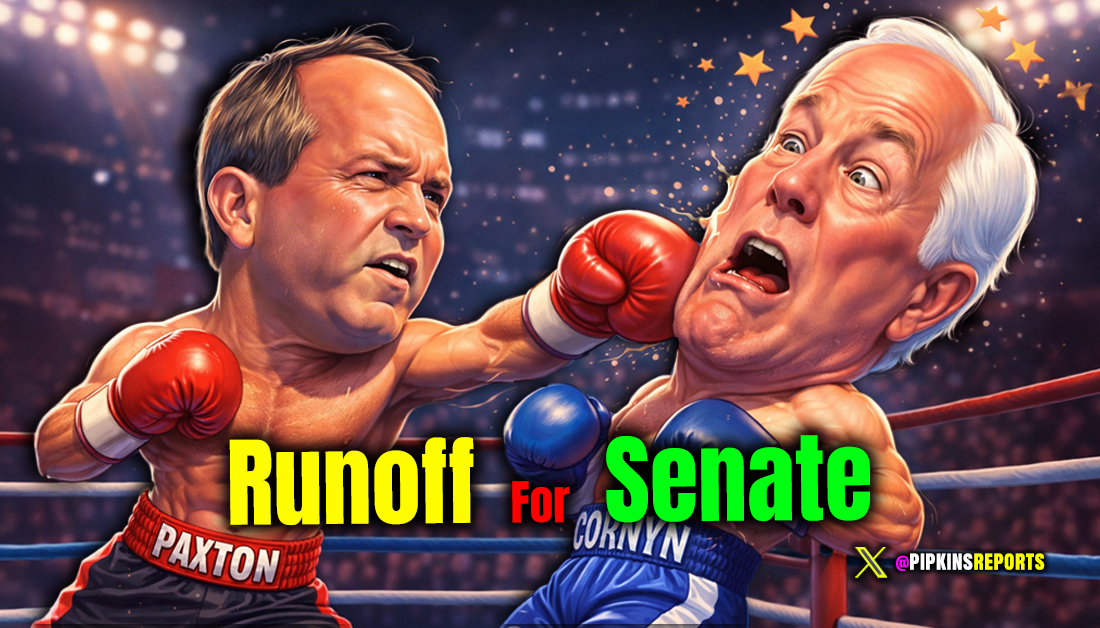
TEXAS – After more than $100 million in political warfare, Texans woke up Wednesday morning to a simple reality, the Republican primary for U.S. Senate is not over. In fact, it may have only reached halftime.

Incumbent U.S. Sen. John Cornyn and Texas Attorney General Ken Paxton are now headed to a runoff election after neither candidate secured the majority required to win outright in Tuesday’s Republican primary. The contest, widely described as the most expensive Senate primary in American political history, will now stretch another two months before Republican voters decide the nominee.

As of publication, with roughly 94 percent of the vote counted, Cornyn held a narrow lead with 41.9 percent of the vote, totaling 897,187 ballots. Paxton followed closely with 40.7 percent, receiving 871,672 votes. U.S. Rep. Wesley Hunt finished third with 13.5 percent, or 289,403 votes.

Under Texas election law, a candidate must receive more than 50 percent of the vote to win a primary outright. When no candidate crosses that threshold, the top two candidates advance to a runoff election. That runoff is scheduled for May 26.

The results guarantee an extended political showdown between two figures representing sharply different visions of Republican leadership.

Paxton addressed supporters Tuesday night during an election watch event in Dallas hosted by the pro-Paxton Lone Star Liberty PAC. The attorney general framed the outcome as a rejection of the political establishment and a signal from grassroots voters across Texas.

Together with your support, we just sent a message loud and clear to Washington,” Paxton told the crowd. “Texas is not for sale.

Paxton also pointed to the massive financial disparity between the campaigns, arguing that despite overwhelming spending by groups aligned with the incumbent senator, Republican voters still rejected the status quo.

Nearly 60 percent of Texas voters, who have known Cornyn for over 40 years, after hearing $100 million worth of ads, chose to vote against the incumbent,” Paxton said. “That’s historic.

Cornyn did not host an election night event but briefly addressed reporters Tuesday evening as the vote count continued.

I’ve worked for decades to build the Republican Party, both here in Texas and nationally,” Cornyn said. “I refuse to allow a flawed, self-centered and shameless candidate like Ken Paxton risk everything we’ve worked so hard to build over these many years.

Cornyn’s campaign has consistently argued that Paxton represents a risk to the Republican Party’s electoral prospects, while Paxton’s supporters have framed the race as a battle between grassroots conservatives and Washington insiders.

Cornyn campaign spokesman Matt Mackowiak previously told reporters that the campaign would not hold an election night celebration because the team does not “do halftime parties.”

The Cost of Each Vote

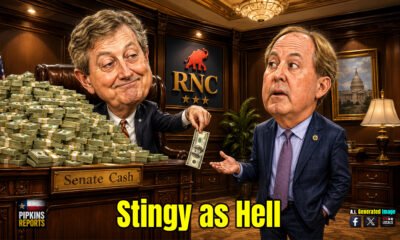
The financial dynamics of the race reveal an even more striking contrast between the campaigns.

Based on available spending figures tied to advertising and campaign messaging efforts, Cornyn’s political operation and allied groups spent roughly $70 million supporting his campaign. Paxton’s campaign and aligned efforts spent approximately $4.1 million, while Hunt’s campaign spending totaled about $11.4 million.

When those spending totals are compared with the number of votes received, the results highlight a dramatic difference in campaign efficiency.

  • Cornyn’s spending equates to roughly $78.02 per vote, calculated by dividing $70 million by his 897,187 votes.
  • Paxton’s campaign achieved nearly the same vote total at dramatically lower cost, spending approximately $4.70 per vote to secure 871,672 votes.
  • Hunt’s campaign, which finished third, spent about $39.39 per vote, based on $11.4 million in spending and 289,403 votes.

In practical terms, Paxton’s campaign proved vastly more efficient at converting dollars into voter support, achieving almost the same vote share as Cornyn while spending only a fraction of the money.

Political analysts say the spending gap reflects heavy financial involvement by national Republican organizations and establishment political committees seeking to defend the incumbent senator.

Despite that financial advantage, the spending did not produce the decisive victory many expected.

Instead, it produced a runoff.

What Comes Next

The May 26 runoff now becomes the defining stage of the race. Historically, Texas runoff elections attract significantly lower voter turnout than primary elections, meaning campaigns must rely heavily on organization, messaging, and targeted voter mobilization.

Both candidates are expected to intensify campaigning across the state in the coming weeks, focusing on grassroots engagement, media messaging, and turnout operations.

The runoff will determine which candidate ultimately represents the Republican Party in the general election.

Opinion

One candidate’s role in Tuesday’s outcome should not be overlooked.

Congressman Wesley Hunt finished a distant third, but his presence in the race likely ensured that Paxton would not get the 50% needed to secure the nomination and may have now handed the election over to Cornyn.

It matters because Texas runoff elections tend to favor the campaign with the deeper pockets and stronger political machinery…that’s Cornyn. Cornyn’s access to national Republican fundraising networks and establishment political organizations could translate into a powerful turnout operation. Ground operations, voter targeting, and aggressive get-out-the-vote campaigns often determine the winner when turnout drops.

Paxton, by contrast, will rely heavily on grassroots enthusiasm among voters who see his candidacy as a challenge to what they view as a disconnected Washington political class. Cornyn is deeply hated by the electorate. The only question is, do they hate him enough to come out for a 2nd time to vote against him?


Michael Pipkins focuses on public integrity, governance, constitutional issues, and political developments affecting Texans. His investigative reporting covers public-record disputes, city-government controversies, campaign finance matters, and the use of public authority. Pipkins is a member of the Society of Professional Journalists (SPJ). As an SPJ member, Pipkins adheres to established principles of ethical reporting, including accuracy, fairness, source protection, and independent journalism.

Council

Recall Petitions Verified Against Four Fate Officials, Elections to Follow

Published

on

Recall Mob Gets Signatures

FATE, TX — The political battle in Fate has escalated significantly, as Vickey Raduechel, the City Secretary for Fate, has completed her review and verified that the recall petition signatures submitted against four of the city’s top elected officials are “sufficient”.

According to official confirmation obtained by Pipkins Reports, the petitions to recall Mayor Andrew Greenberg, Councilman Rick Maneval, Councilman Mark Hatley, and Councilwoman Martha Huffman have now been verified following their submission on April 6, 2026.

With the verification process complete, the petitions have cleared a critical legal hurdle, setting the stage for recall elections that could reshape the city’s leadership.

Verified Signature Counts

As part of the certification process, the City Secretary validated the number of signatures submitted for each petition to ensure compliance with the city charter requirement of at least 351 qualified voters.

  • Andrew Greenberg, Mayor (contained 385 valid signatures)
  • Richard Maneval, Council Member Place 4 (contained 366 valid signatures)
  • Mark Hatley, Council Member Place 5 (contained 382 valid signatures)
  • Martha Huffman, Council Member Place 6 (contained 353 valid signatures)

*Update: The City of Fate responded to our inquiry and provided the verified signature counts above.

From Petition Drive to Certification

The now-verified petitions mark the culmination of a 30-day signature collection effort launched in early March. Organizers, led by local activists Christopher Rains, and Ashley Rains, who is running for City Council, initiated the recall campaign in response to actions taken by the same officials against Councilwoman Codi Chinn. Chinn is already scheduled to face voters in the May 2nd, 2026 election.

As previously reported by Pipkins Reports , the effort quickly mobilized residents, with organizers establishing signing locations and conducting outreach across the community.

Supporters of the recall effort have framed it as a necessary check on elected officials, while critics have argued it represents political retaliation. The certification of the petitions now shifts the debate from signature gathering to the ballot box.

What Happens Next

Under the Fate city charter, once recall petitions are certified as sufficient, the city council is required to formally call a recall election. That process includes setting an election date and coordinating with election officials to place the measure before voters. It is likely that the recall election will be set for November 2026. Estimates indicate this recall will cost taxpayers up to $15,000.

Unless one of the targeted officials resigns—and the vacancy is filled by the remaining council prior to any election—there is a credible risk of a temporary governance breakdown if voters remove all four members at once, a scenario explored in prior Pipkins Reports coverage examining how a full-scale recall could leave the city unable to function.

The outcome of these efforts could result in a significant shift in the composition of the city council—and potentially the mayor’s office—depending on how voters respond.

This is an ongoing story. Pipkins Reports will continue to provide updates as recall election dates are announced and additional details become available.

Continue Reading

Council

Fate City Council Finds “Credible Evidence” Against Mark Hatley, Moves Toward Hearing

Published

on

Hatley under Oath

FATE, TX — The Fate City Council voted Monday night to formally recognize what it called “credible evidence” that Councilman Mark Hatley may have violated the city’s Code of Ethics, setting the stage for a hearing and potential sanctions, and intensifying an already bitter political divide.

The decision came following an executive session on Monday night, and considered a motion by Councilman Scott Kelley, who was the person who filed the ethics complaint against Hatley. Kelley’s motion asserted that the council had sufficient basis to proceed under Section 2-309.10 of the Fate Code of Ethics and Section 3.093 of the City Charter.

The motion passed with support from Codi Chinn, Scott Kelley, Mark Harper, and Martha Huffman. Mayor Andrew Greenberg and Councilman Rick Maneval voted against the measure, according to the official meeting record and public proceedings.

It remains unclear from the meeting record whether Hatley voted on the motion concerning himself. He was not presented as voting in the negative, yet the Mayor made no mention of him abstaining either.

Mayor Greenberg highlighted that this process is political, not criminal.

Following the vote, Kelley introduced a second motion, requesting that Hatley provide a sworn affidavit within seven days addressing key questions tied to the investigation.

Those questions focused on whether Hatley had shared recorded conversations involving City Manager Michael Kovacs with anyone outside city government, including investigative journalist Michael Pipkins. The motion also sought to compel Hatley to cooperate with any additional information requests from the city’s Ethics Council.

Councilwoman Chinn clarified during the discussion that Hatley is not legally required to submit such an affidavit, implying the request is voluntary rather than enforceable under current rules.

The council set the public hearing for May 4, 2026.

That date falls after the city’s General Election on May 2, but before the results are officially canvassed on May 11, meaning the current council will still be seated at the time of the hearing.

Harper currently holds Place 2, a seat being sought by candidates Lorna Grove and Ashley Rains. Rains is one of the petition members seeking to remove multiple councilmembers, including Hatley, through a new recall effort.

Kelley holds Place 3, which is being sought by former Councilman Allen Robbins and Melinda McCarthy. Robbins is also aligned with those supporting the recall of the four councilmen, while McCarthy supported the recall of Codi Chinn, which is already on the ballot for May 2nd.

Early voting for that election is scheduled to begin April 20.

Continue Reading

Council

Mark Hatley Under Fire as Fate Council Launches Ethics Investigation Over Secret Recordings

Published

on

Mark Hatley in Hot Seat

FATE, TX – The City Council voted to investigate Councilman Mark Hatley, setting off a political drama that some view as a battle of power between two diametrically opposed groups.

At the center of the dispute is an ethics complaint filed March 25, 2026, by Councilman Scott Kelley against Deputy Mayor Pro Tem Mark Hatley, tied to audio recordings previously reported by Pipkins Reports. The Fate City Council took up the matter during its April 6 regular meeting at City Hall where members entered executive session to review the complaint under provisions of the Texas Open Meetings Act and personnel deliberation statutes.

According to the official agenda, council members met privately with legal counsel to conduct an initial screening of the complaint. The session relied on guidance from attorney Ross Fischer of Ross Fischer Law, PLLC, whose memorandum outlined potential violations of the city’s Code of Ethics. That memo, later made public by council vote, identified two allegations as sufficiently credible to warrant further investigation: interference in administrative matters and disclosure of confidential information.

[Memorandum from Ross Fischer]

The memorandum detailed specific excerpts from recorded conversations between Hatley and City Manager Michael Kovacs, including alleged remarks suggesting pressure or influence related to the police chief’s employment. In one instance cited in Fischer’s memorandum, Kelley asserts that Hatley allegedly warned Kovacs that the situation “would not bode well” for him, language the memo suggests could be interpreted as administrative interference under Section 2-309(10) of the city’s ethics code.

The second allegation centers on the release of the recordings themselves. Fischer’s analysis concluded that the audio contained discussions about personnel matters typically reserved for closed session, and therefore may constitute confidential information under Section 2-309(6). The memo notes that the City Council later voted to waive privilege and release the recordings officially, but that Hatley had allegedly distributed them prior to that authorization.

During the open session that followed, Councilman Mark Harper moved to make the executive session public, a motion seconded by Councilman Codi Chinn and approved unanimously, 7-0. Councilman Hatley voted in favor of that motion, joining the full council in opening the executive session discussion to the public for transparency.

Councilman Kelley then made a motion to proceed with a formal investigation into Hatley’s conduct, citing the findings outlined in the memo. In doing so, Kelley referred to Pipkins Reports as a “local opinion blogger,” a characterization that may be viewed by some as dismissive.

The council ultimately voted 5-2 to move forward with the investigation. Mayor Greenberg and Councilman Hatley cast the dissenting votes, while the remaining five supported the inquiry. According to Councilman Rick Maneval, Fischer indicated during executive session that he did not expect an investigation to uncover additional substantive facts beyond what was already known, aside from giving Hatley an opportunity to formally respond.

In a separate but related action, the council voted unanimously, 7-0, to dismiss a third allegation from the ethics complaint that falls under Section 2-309(5), which concerns granting special consideration or advantage. Fischer’s memo found that the claim lacked sufficient detail and failed to identify a specific beneficiary, rendering it inadequate under the city’s ethics standards.

The decisions come amid a broader political dispute, as one of the members of a recall petition is now also under investigation for ethics violations.

Mark Hatley is one of three councilmen, along with Rick Maneval and Martha Huffman, plus Mayor Andrew Greenberg, who are currently the subject of a circulating recall petition. Some residents have suggested that effort is, at least in part, a response to a separate recall targeting Councilman Codi Chinn, which is set to appear on the May ballot.

Chinn’s public supporters include Councilman Mark Harper and Councilman Scott Kelley, both of whom now play central roles in the current ethics dispute. Harper has been accused by City Manager Michael Kovacs of making threatening statements, an allegation that has not been adjudicated but adds another layer of tension to an already volatile situation.

From a procedural standpoint, the council’s vote will authorize Ross Fischer to conduct an investigation, as the City’s in-house attorney would have a conflict of interest.

** Mark Hatley couldn’t be reached for comment prior to publication.

Continue Reading