Texas Teachers Face Scrutiny Over Social Media Posts on Charlie Kirk
Free Speech or Professional Misconduct?
The assassination of Charlie Kirk, co-founder of Turning Point USA, has sent shockwaves through political and cultural institutions alike. In Texas, however, the fallout has taken on a particularly sharp edge. The Texas Education Agency (TEA) has announced that it is reviewing at least 180 complaints against public school teachers and staff accused of posting negative or celebratory comments about Kirk’s death.
For some, the TEA’s move represents a long-overdue step toward accountability for educators entrusted with shaping the next generation. For others, it is a dangerous government overreach—a “witch hunt,” as the Texas American Federation of Teachers (Texas AFT) put it.
The question looming over this controversy is one that cuts to the heart of both ethics and liberty: where does the professional responsibility of teachers end, and where does their personal right to free speech begin?
The Spark: Comments in the Wake of Assassination
Charlie Kirk, only 31 at the time of his death, was fatally shot on September 10, 2025, during a speaking event at Utah Valley University. Authorities identified 22-year-old Tyler Robinson as the alleged shooter. Kirk, a father of two, left behind a wife and two young children. His death not only stunned his supporters but also prompted an outpouring of vitriol online from detractors who despise him.
Among those who took to social media were Texas educators. Posts ranged from mocking Kirk’s death to characterizing him in deeply offensive terms. In one high-profile case, Klein ISD in the Houston area terminated a football coach after he called Kirk a “horrible f—–g human being” on Facebook. Other districts, including Jourdanton ISD and Wylie ISD, have also confirmed disciplinary actions against staff. Wylie ISD reported that two teachers resigned after facing scrutiny over their posts (Isaac Yu, Houston Chronicle, Sept. 15, 2025).
The backlash was swift. State Rep. Hillary Hickland, R-Belton, publicly called for the resignation of a Pflugerville ISD teacher who had labeled Kirk a “Nazi.” The district clarified the teacher had already retired in 2024, but the episode underscored how deeply the controversy has penetrated Texas politics.
Commissioner Morath Draws a Line
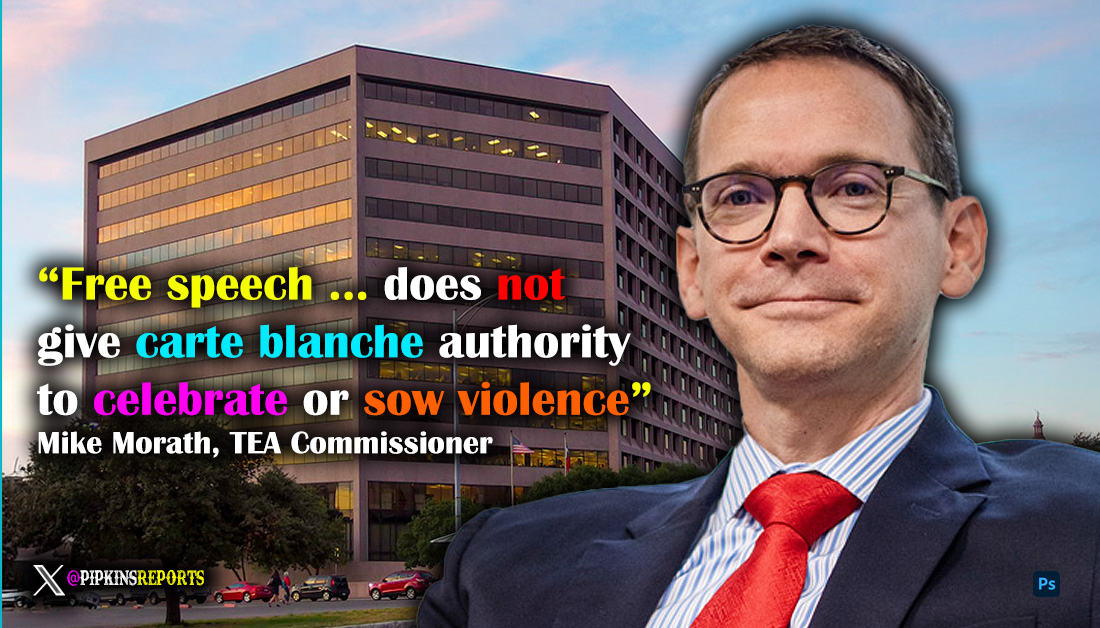
On September 12, TEA Commissioner Mike Morath issued a letter to Texas superintendents, warning that educators who engaged in “vile content” related to Kirk’s assassination could face investigation and discipline under the state’s Educators’ Code of Ethics.
“While the exercise of free speech is a fundamental right we are all blessed to share, it does not give carte blanche authority to celebrate or sow violence against those that share differing beliefs and perspectives,” Morath wrote. He emphasized the human cost of Kirk’s death: “Mr. Kirk was a father and a husband, and tragically, his children no longer have their father, and his wife no longer has her spouse” (Yu, Houston Chronicle).
Morath also signaled that consequences could be severe. He stated he would recommend not only termination for violators but also suspension of their teaching certifications, effectively barring them from future employment in Texas public schools.
Union Backlash: A “Witch Hunt”
Texas AFT quickly condemned Morath’s response, framing it as a politically motivated purge of dissenting voices. Zeph Capo, the union’s president, accused the state of weaponizing tragedy to silence educators.
“In short order, the LibsofTikTok agenda has become the policy of the State of Texas,” Capo said. “Here’s the thing about authoritarian regimes: They’ll take as much as the rest of us are willing to give them. It’s no surprise that, here in Texas, the purge of civil servants starts with teachers” (Aguirre, MySA).
Capo warned that the state’s posture could chill free expression among educators who already feel under siege in a political climate where schools are ground zero in culture wars. “If you value your freedom, now is the time to speak up and defend the rights of all Texans to exercise their constitutional right to have an opinion on matters of civil discourse,” he said.
The union represents 66,000 K-12 and community college educators, support staff, and retirees across Texas. Their denunciation of the TEA was as forceful as it was predictable, highlighting the growing divide between Texas conservatives and the state’s education establishment.
Political Fault Lines
Democrats quickly echoed the union’s criticisms. State Rep. Lauren Ashley Simmons, D-Houston, said she was “disgusted” by Morath’s directive. She accused him of selective outrage, claiming he did not react in a similar way to the recent assassination of Minnesota House Democratic Caucus Leader Melissa Hortman and her husband.
Republicans, meanwhile, largely defended Morath’s position. Conservative activists and organizations, including the 1776 Project, vowed to use the moment to shine a spotlight on what they see as pervasive bias within public schools. “We are committing $$$ to texting every parent exactly what their local teachers are saying about Charlie Kirk’s murder,” said Aiden Buzzetti, the group’s president. “It’s time for parents to know exactly who is teaching their children” (Yu, Houston Chronicle).
This duel of narratives—authoritarian censorship versus necessary accountability—will likely shape legislative debates in the next Texas legislative session.
The Code of Ethics Question
The central legal and ethical question is whether these social media posts constitute violations of the Texas Educators’ Code of Ethics. The code, while affirming free speech rights, also obliges teachers to maintain professional conduct, avoid harmful speech toward students and colleagues, and serve as positive role models in the community.
The TEA’s investigative division routinely handles cases ranging from inappropriate teacher-student relationships to criminal behavior. Under Morath’s guidance, posts that celebrate or mock political assassinations could fall into the same disciplinary pipeline. That process may result in dismissals, suspensions, or even placement on the state’s “do not hire” list.
For critics, that equation is excessive—conflating poor judgment on social media with crimes or abuses of authority. For supporters, however, the stakes are clear: if educators publicly display hatred or contempt for individuals based on ideology, parents have every reason to question whether their children are receiving impartial instruction.
Local Districts Act First
Though the TEA has not yet launched formal investigations, individual districts have acted swiftly. Klein ISD’s termination of its coach became a high-profile example, amplified by local media. Wylie ISD’s resignations showed that the controversy is not confined to large urban districts. Jourdanton ISD, a small district south of San Antonio, is also reportedly investigating one of its educators.
The decentralized nature of Texas education governance means that districts may choose to act independently even before TEA investigators weigh in. This patchwork of local responses further complicates the question of fairness and consistency.
What’s Really at Stake
The debate is not merely about Charlie Kirk, nor is it solely about teachers and their jobs. At its core, the controversy reveals how deeply fractured Texas has become over cultural and political identities.
For conservatives, the spectacle of taxpayer-funded educators mocking the assassination of a conservative leader represents an intolerable breach of public trust. It confirms suspicions that many public schools harbor ideological hostility toward traditional values and conservative families.
For progressives and unions, however, the investigation signals a creeping authoritarianism in Texas governance, where political loyalty tests are imposed on teachers in violation of their constitutional rights. To them, the TEA’s actions are not about professionalism—they are about silencing political opposition.
The Road Ahead
The TEA’s review process could stretch for months. If formal investigations proceed, cases will eventually be heard by the governor-appointed State Board of Educator Certification, where teachers may rely on union lawyers or private counsel. The outcomes of those hearings could establish precedents that shape the boundaries of teacher conduct—and free speech—for years to come.
Meanwhile, the controversy will continue to play out in school board meetings, union rallies, and legislative chambers. With school choice, parental rights, and curriculum fights already at the forefront in Texas politics, this battle over teacher speech will only add more fuel to the fire.
Conclusion
The assassination of Charlie Kirk has left more than just a grieving family and a mourning conservative movement. It has exposed fault lines in Texas education and politics that run deeper than many realized.
Whether the TEA’s response is viewed as an act of accountability or authoritarian overreach depends largely on one’s political vantage point. But one fact is undeniable: in a state already polarized over education policy, the line between professional ethics and personal liberty has never been more contested.
And as Texas weighs how to handle 180 complaints against its educators, the rest of the nation is watching closely. The outcome will not only determine the careers of dozens of teachers but may also set a precedent for how America reconciles free speech with professional responsibility in its classrooms.
Featured
CENTCOM Commander Provides Update on Operation Epic Fury
VIDEO
PENTAGON – United States Central Command released a new operational update on Operation Epic Fury. In a March 11 briefing, U.S. Navy Adm. Brad Cooper addressed the public with the latest details on the rapidly developing mission. Speaking on behalf of the command, Cooper outlined current military actions, operational goals, and the strategic posture of U.S. forces in the region. The update offers a rare inside look at how CENTCOM is executing Epic Fury, and what commanders say comes next as the operation continues to unfold.
Featured
Fake War Footage – Propagandizing You for Clicks.
Iran – The bombs started falling in the Middle East, and within minutes the internet detonated with something just as explosive, a tidal wave of fake war footage across social media.
Scroll through Facebook, X or Instagram and you will see burning U.S. bases. Iranian missiles blasting American jets from the sky. Satellite images of destroyed radar installations. Clever Iranian tricks of a painted airplane silhouette – supposedly humiliating the Pentagon.
Much of it never happened.
Since the United States began striking Iranian targets, the online world has been flooded with fake accounts, AI-generated videos, manipulated satellite imagery, and viral propaganda posts designed to shape global opinion about the conflict. Analysts say the scale of the deception campaign marks one of the first major wars where artificial intelligence is being weaponized at industrial scale in the information space.
Millions Watching Fake War
The misinformation explosion began almost immediately after the strikes.
Researchers monitoring social media say fabricated videos of the war have accumulated tens of millions of views before fact-checkers could intervene. Some clips claimed to show Iranian missile strikes destroying American aircraft or warships.
One particularly dramatic video circulating online showed an Iranian missile destroying a U.S. aircraft in midair. The footage went viral, racking up tens of millions of views, before investigators determined it had been generated entirely using artificial intelligence.
Other viral clips were not even AI. They were lifted from military video games.
A widely shared video claiming to show a U.S. warship shooting down an Iranian fighter jet was eventually traced to gameplay footage from the combat simulation game War Thunder. The clip gained more than seven million views online before being exposed as fictional.
Experts say the tactic works because viewers often encounter these clips in emotionally charged moments, when verification is the last thing on their minds.
The Fake Account Armies
The deception is not random.
Investigators have uncovered organized networks of fake or hacked social media accounts pushing fabricated war footage to millions of users.
In one case uncovered by platform X, at least 31 coordinated accounts were allegedly operated by a man in Pakistan and used to spread AI-generated war videos related to the U.S. strikes on Iran.
Many of the accounts impersonated journalists or eyewitnesses. Some posed as residents near battle zones. Others claimed to be military observers.
By pretending to be on-the-ground witnesses, propagandists can trick audiences into believing fabricated videos are authentic breaking news.
Researchers say this kind of deception campaign is increasingly common during international conflicts, where online narratives can influence global opinion as quickly as military developments.
AI Is Now Faking Satellite Evidence
Perhaps the most alarming development is the manipulation of satellite imagery.
In several viral posts circulating online, images appeared to show U.S. military installations destroyed by Iranian strikes. The images looked convincing, complete with blast craters and damaged buildings.
Investigators later discovered some of the satellite images were AI-altered or entirely fabricated.
One widely shared image, promoted by Iranian media outlets, claimed to show a devastated U.S. radar installation in Qatar. Analysts later determined the image had been digitally manipulated using artificial intelligence.
Experts warn that satellite images are particularly powerful propaganda tools because they appear technical and authoritative.
People tend to trust them without question.
Viral Claims Iran Is Tricking U.S. Satellites
Another category of viral propaganda has taken a different approach, mockery.
Images circulating across social media show large silhouettes of drones and aircraft painted onto the ground inside Iran. The accompanying posts claim Iranian forces created fake targets to trick American satellites.
The narrative accompanying the images is clear and deliberate. According to the viral captions, U.S. intelligence supposedly identifies the fake aircraft as real targets, allowing Iran to make the United States waste millions of dollars destroying empty patches of dirt.
The posts typically end with the same message, Iran is clever, the United States is foolish.
But military historians say the narrative leaves out a key fact. This never happened…the images are Photoshop or A.I..
The deception, to the viewers, is effective because decoys, camouflage, and deception have been standard military tactics for centuries. Inflatable tanks, fake airfields, and painted aircraft silhouettes were used extensively during World War II and are taught in military academies around the world. So the accusations seem plausible…and the fake images seal the deal.
The propaganda lies not in the existence of decoys, but in the framing designed to humiliate the United States and elevate Iran’s image.
State Actors Fuel the Propaganda War
Analysts say the information battlefield is being shaped by a mix of actors.
State-backed propaganda networks have circulated exaggerated claims about Iranian military success, while foreign influence operations have amplified misleading narratives to undermine confidence in American military power. Anti-semite groups capitalize on the opportunity to take swipes at Israel. Democrat operatives live for the opportunity to make President Trump, or Secretary of War, Pete Hegseth, look like a fool.
Researchers studying the phenomenon say the goal is not always to persuade people of a single lie. Instead, the objective is chaos & uncertainty.
Flood the internet with so many competing claims, fake videos, and manipulated images that ordinary people simply stop trusting anything they see.
Opinion: America Is Losing the Information Battlefield
Facts first. Now the uncomfortable truth.
The United States may dominate the skies militarily, but in the information war raging across social media, the battlefield is far murkier.
Artificial intelligence has democratized propaganda. What once required vast intelligence agencies, professional studios, and technical expertise can now be created by anyone with a laptop and the right software.
The viral posts mocking American intelligence over painted decoys illustrate the strategy perfectly. A centuries-old military tactic becomes a viral story about Iranian brilliance and American incompetence.
The objective is not accuracy. The objective is perception.
Every fake video of a burning U.S. base, every manipulated satellite image, every anonymous account posting dramatic “battle footage” pushes the same narrative, America is losing, Iran is winning, and nothing you see can be trusted.
And when truth becomes impossible to separate from fiction, propaganda has already won.
The missiles may be flying over the Middle East.
But the real war for public perception is raging on your phone screen.
Election
$100 Million, No Winner: Cornyn and Paxton Head to High-Stakes Texas Senate Runoff
Cost per Vote Calculated
TEXAS – After more than $100 million in political warfare, Texans woke up Wednesday morning to a simple reality, the Republican primary for U.S. Senate is not over. In fact, it may have only reached halftime.
Incumbent U.S. Sen. John Cornyn and Texas Attorney General Ken Paxton are now headed to a runoff election after neither candidate secured the majority required to win outright in Tuesday’s Republican primary. The contest, widely described as the most expensive Senate primary in American political history, will now stretch another two months before Republican voters decide the nominee.
As of publication, with roughly 94 percent of the vote counted, Cornyn held a narrow lead with 41.9 percent of the vote, totaling 897,187 ballots. Paxton followed closely with 40.7 percent, receiving 871,672 votes. U.S. Rep. Wesley Hunt finished third with 13.5 percent, or 289,403 votes.
Under Texas election law, a candidate must receive more than 50 percent of the vote to win a primary outright. When no candidate crosses that threshold, the top two candidates advance to a runoff election. That runoff is scheduled for May 26.
The results guarantee an extended political showdown between two figures representing sharply different visions of Republican leadership.
Paxton addressed supporters Tuesday night during an election watch event in Dallas hosted by the pro-Paxton Lone Star Liberty PAC. The attorney general framed the outcome as a rejection of the political establishment and a signal from grassroots voters across Texas.
“Together with your support, we just sent a message loud and clear to Washington,” Paxton told the crowd. “Texas is not for sale.”
Paxton also pointed to the massive financial disparity between the campaigns, arguing that despite overwhelming spending by groups aligned with the incumbent senator, Republican voters still rejected the status quo.
“Nearly 60 percent of Texas voters, who have known Cornyn for over 40 years, after hearing $100 million worth of ads, chose to vote against the incumbent,” Paxton said. “That’s historic.”
Cornyn did not host an election night event but briefly addressed reporters Tuesday evening as the vote count continued.
“I’ve worked for decades to build the Republican Party, both here in Texas and nationally,” Cornyn said. “I refuse to allow a flawed, self-centered and shameless candidate like Ken Paxton risk everything we’ve worked so hard to build over these many years.”
Cornyn’s campaign has consistently argued that Paxton represents a risk to the Republican Party’s electoral prospects, while Paxton’s supporters have framed the race as a battle between grassroots conservatives and Washington insiders.
Cornyn campaign spokesman Matt Mackowiak previously told reporters that the campaign would not hold an election night celebration because the team does not “do halftime parties.”
The Cost of Each Vote
The financial dynamics of the race reveal an even more striking contrast between the campaigns.
Based on available spending figures tied to advertising and campaign messaging efforts, Cornyn’s political operation and allied groups spent roughly $70 million supporting his campaign. Paxton’s campaign and aligned efforts spent approximately $4.1 million, while Hunt’s campaign spending totaled about $11.4 million.
When those spending totals are compared with the number of votes received, the results highlight a dramatic difference in campaign efficiency.
- Cornyn’s spending equates to roughly $78.02 per vote, calculated by dividing $70 million by his 897,187 votes.
- Paxton’s campaign achieved nearly the same vote total at dramatically lower cost, spending approximately $4.70 per vote to secure 871,672 votes.
- Hunt’s campaign, which finished third, spent about $39.39 per vote, based on $11.4 million in spending and 289,403 votes.
In practical terms, Paxton’s campaign proved vastly more efficient at converting dollars into voter support, achieving almost the same vote share as Cornyn while spending only a fraction of the money.
Political analysts say the spending gap reflects heavy financial involvement by national Republican organizations and establishment political committees seeking to defend the incumbent senator.
Despite that financial advantage, the spending did not produce the decisive victory many expected.
Instead, it produced a runoff.
What Comes Next
The May 26 runoff now becomes the defining stage of the race. Historically, Texas runoff elections attract significantly lower voter turnout than primary elections, meaning campaigns must rely heavily on organization, messaging, and targeted voter mobilization.
Both candidates are expected to intensify campaigning across the state in the coming weeks, focusing on grassroots engagement, media messaging, and turnout operations.
The runoff will determine which candidate ultimately represents the Republican Party in the general election.
Opinion
One candidate’s role in Tuesday’s outcome should not be overlooked.
Congressman Wesley Hunt finished a distant third, but his presence in the race likely ensured that Paxton would not get the 50% needed to secure the nomination and may have now handed the election over to Cornyn.
It matters because Texas runoff elections tend to favor the campaign with the deeper pockets and stronger political machinery…that’s Cornyn. Cornyn’s access to national Republican fundraising networks and establishment political organizations could translate into a powerful turnout operation. Ground operations, voter targeting, and aggressive get-out-the-vote campaigns often determine the winner when turnout drops.
Paxton, by contrast, will rely heavily on grassroots enthusiasm among voters who see his candidacy as a challenge to what they view as a disconnected Washington political class. Cornyn is deeply hated by the electorate. The only question is, do they hate him enough to come out for a 2nd time to vote against him?
You must be logged in to post a comment Login