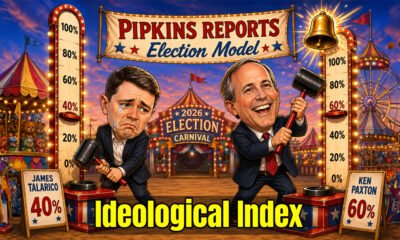
The 20 Articles of Impeachment for Ken Paxton
The impeachment trial will start Tuesday, September 5, 2024. Lieutenant Governor Dan Patrick will assume the role of the presiding judge.
Here is a summary of the 20 charges against him.
A historic resolution passed by the Texas House of Representatives has sent shockwaves through the Lone Star State’s political landscape. The resolution, brought forth by the House of Representatives of the State of Texas, officially impeaches Attorney General Warren Kenneth Paxton Jr. on a multitude of charges, backed by a series of meticulously detailed articles of impeachment.
The impeachment trial will start Tuesday, September 5, 2024. Lieutenant Governor Dan Patrick will assume the role of the presiding judge, while the senators will act as jurors. According to the established rules, if Paxton is found guilty on any of the impeachment charges, he will be ousted from his position for the remainder of his four-year term, set to conclude in 2026. Furthermore, such a conviction could result in a permanent prohibition from holding any public office within the state.
ARTICLE I: Disregard of Official Duty – Protection of Charitable Organization
In this first article, it is alleged that Paxton failed to fulfill his role as the guardian of charitable organizations, as mandated by Chapter 123 of the Property Code. It is claimed that Paxton’s actions adversely affected the Roy F. & JoAnn Cole Mitte Foundation in favor of Nate Paul.
ARTICLE II: Disregard of Official Duty – Abuse of the Opinion Process
Article II accuses Paxton of abusing his official power by manipulating the issuance of legal opinions. It is alleged that Paxton used his position to obstruct foreclosure sales related to properties linked to Nate Paul, concealing his actions through a convoluted scheme involving a Senate committee chair.
ARTICLE III: Disregard of Official Duty – Abuse of the Open Records Process
Paxton is further accused in Article III of misusing his authority under Chapter 552 of the Government Code, ordering his staff to act against the law regarding public information requests. This included refusing proper decisions and issuing decisions that contravened the law and legal precedents.
ARTICLE IV: Disregard of Official Duty – Misuse of Official Information
Article IV alleges that Paxton improperly accessed non-public information for the benefit of Nate Paul.
ARTICLE V: Disregard of Official Duty – Engagement of Cammack
Paxton is charged with engaging Brandon Cammack in an investigation based on a baseless complaint in Article V. This resulted in over 30 grand jury subpoenas being issued, all seemingly in favor of Nate Paul or his business interests.
ARTICLE VI: Disregard of Official Duty – Termination of Whistleblowers
Article VI contends that Paxton violated whistleblower laws (Chapter 554 of the Government Code) by terminating employees who had reported his illegal actions to law enforcement authorities. This was allegedly done in retaliation, with Paxton also engaging in a campaign to damage the whistleblowers’ professional reputations.
ARTICLE VII: Misapplication of Public Resources – Whistleblower Investigation and Report
Paxton is accused of directing the use of public resources in Article VII to conduct a sham investigation into whistleblower complaints and produce a lengthy report containing false or misleading statements in his defense.
ARTICLE VIII: Disregard of Official Duty – Settlement Agreement
Article VIII asserts that Paxton concealed his wrongful acts connected to whistleblower complaints, entering into a settlement agreement paid from public funds. This delay was allegedly advantageous to Paxton, depriving voters of critical information when voting for attorney general.
ARTICLE IX: Constitutional Bribery – Paul’s Employment of Mistress
Paxton is charged with constitutional bribery in Article IX, benefiting from Nate Paul’s employment of a woman with whom Paxton was having an extramarital affair, allegedly resulting in favorable legal assistance for Paul.
ARTICLE X: Constitutional Bribery – Paul’s Providing Renovations to Paxton Home
Article X alleges Paxton benefited from renovations provided to his home by Nate Paul, again resulting in favorable legal assistance for Paul.
ARTICLE XI: Obstruction of Justice – Abuse of Judicial Process
Paxton is accused of abusing the judicial process in Article XI, using it to delay the trial related to his indictment for securities fraud, allegedly depriving voters of an informed choice during the election.
ARTICLE XII: Obstruction of Justice – Interference with Prosecutors
Article XII claims that Paxton benefited from a lawsuit filed by Jeff Blackard, a campaign donor, which disrupted payment to prosecutors involved in his criminal securities fraud case, causing further delays in the trial.
ARTICLE XIII: False Statements in Official Records – State Securities Board Investigation
Article XIII charges Paxton with making false statements to the State Securities Board during their investigation into his failure to register as required by law.
ARTICLE XIV: False Statements in Official Records – Personal Financial Statements
Article XIV accuses Paxton of failing to accurately disclose his financial interests in his personal financial statements, required by law.
ARTICLE XV: False Statements in Official Records – Whistleblower Response Report
Paxton is charged with making multiple false or misleading statements in the response report issued by his office in relation to whistleblower allegations.
ARTICLE XVI: Conspiracy and Attempted Conspiracy
Article XVI alleges Paxton conspired or attempted to conspire to commit acts described in one or more articles.
ARTICLE XVII: Misappropriation of Public Resources
Paxton is charged with misusing his official powers to have employees of his office perform services for his benefit and that of others.
ARTICLE XVIII: Dereliction of Duty
Article XVIII contends that Paxton violated the Texas Constitution, his oaths of office, statutes, and public policy against public officials acting contrary to the public interest.
ARTICLE XIX: Unfitness for Office
In Article XIX, it is alleged that Paxton engaged in misconduct, public or private, indicative of his unfitness for office.
ARTICLE XX: Abuse of Public Trust
The final article, Article XX, accuses Paxton of using his official powers to subvert the government’s lawful operation and obstruct justice, damaging the Office of Attorney General’s reputation and public confidence.
As this impeachment process unfolds, it promises to be a landmark event in the political history of the State of Texas, with ramifications that could extend far beyond its borders.
Council
Fate Council Opens the Door on Executive Session Secrets, Revealing Why Greenberg Was Cleared
Fate, TX – Monday night’s Fate City Council meeting pulled back the curtain on something that had puzzled residents for weeks.
Why would four members of the council vote against finding an ethics violation or imposing sanctions against Mayor Andrew Greenberg after attorney Ross Fischer had concluded there was probable cause to believe Greenberg may have violated the city’s code of ethics?
The answer, it turns out, was hidden behind deliberative privilege that some members of the Fate City Council didn’t want you to know about.
City Council Meeting for June 15, 2026, Agenda items 6G and 6H called for the council to consider waiving attorney-client privilege concerning ethics complaints involving Mayor Andrew Greenberg, former Councilman Mark Harper, and former Councilwoman Codi Chinn… for the June 1st meeting. The council voted 4-2 to waive deliberative privilege and allow discussion of what had previously occurred behind closed doors.
The June 1 vote had left many residents, particularly those of Karen Keiser, who supported the recall effort against Greenberg, confused. Council members had voted 4-2 not to pursue sanctions or make findings of an ethics violation, with Councilman Allen Robbins and Councilwoman Ashley Rains voting in the minority.
What the public, and Mrs. Keiser, didn’t know was that in executive session, there was great disagreement about the Ross Fischer report.
According to a phone interview Pipkins Reports had with Mayor Greenberg on Tuesday, one of the central issues involved allegations that he had improperly disclosed confidential employee information concerning former City DPS Chief Lyle Lombard to this investigative journalist, by releasing audio of a phone conversation he had with Councilwoman Codi Chinn.
In a conversation with Greenberg on Tuesday, Greenberg said that attorneys within the Texas Attorney General’s Office had previously determined that only three minutes (approximately) of an audio recording between Greenberg and Chinn contained personal or confidential information, none of which formed the basis of these ethics allegations as stipulated by Fischer.
Greenberg further argued that Fischer’s conclusions relied on assumptions rather than evidence showing that any “deliberative” information had actually been provided. Even more, Mr. Fischer refused to seek guidance from the Attorney General to determine if any of his assertions about confidential information were actually “deliberative”.
For context, the words, “deliberative information” are in reference to any “confidential” information that city officials might discuss regarding a city employee. But not all information about an employee is to be considered “confidential”, and this is a very important point of the discussion.
Under the Texas Public Information Act (Government Code Chapter 552), information concerning public employees is presumed public unless a statute or recognized exception applies. Merely discussing an employee does not make the information “deliberative” or “confidential”, unless and until the city requests and receives an exemption from the Attorney General. In this case, none of the information alleged by Mr. Fischer was determined by the Attorney General to be “confidential” or permitted to be withheld.
Sidebar: How did Autumn Lobinsky know what was in those three minutes that were never released to the public?
Texas Government Code §552.111 protects certain interagency and intra-agency memoranda reflecting advice, recommendations, opinions, and policymaking discussions. This is often called the “deliberative process privilege.”
However, the exception generally applies only to communications involving policymaking, not routine personnel matters. The Texas Attorney General has repeatedly distinguished between:
- Policy deliberations → potentially protected.
- Routine administrative or personnel matters → generally not protected.
Thus, discussions about: performance evaluations, discipline, complaints, hiring decisions, salary matters, are not automatically considered to be “deliberative information.”
Therefore, the Council Members argued in executive session that Fischer failed to make the case that the information exchanged met those qualifications.
Furthermore, Fischer’s investigation provided no other corroborating evidence.
Emails between Michael Pipkins and Ross Fischer show that Fischer sought information from Pipkins concerning the investigation. In a May 27 email, Fischer volunteered to Pipkins that Greenberg had acknowledged allowing Pipkins access to the recording, and asked whether Greenberg had provided a copy or merely played portions of the audio.
(Would Fischer’s release of information to Pipkins about his conversation with Greenberg be a release of confidential information? )
Regardless, Pipkins declined to answer, citing journalistic policy and the protection of confidential sources absent a subpoena or court order. Fischer then acknowledged to Pipkins that Greenberg had admitted playing portions of the recording and indicated he was attempting to verify Greenberg’s account. Part of this exchange was cited in Fischer’s report. We are providing the full context of the email exchange below.


[Email Exchange Between Ross Fischer and Michael Pipkins]
According to Greenberg, no evidence was produced showing that any of the information disclosed by Greenberg was in fact, “deliberative information” (ie: confidential). Yet, Mr. Fisher’s report would go on to recommend that he violated the City’s Code of Ethics, regardless of the actual fact that none of the information had been, or would be, considered privileged.
“Conclusion. Assuming Mayor Greenberg’s response is accurate, he still released deliberative information about personnel decisions a month before Council waived that
privilege. Based on Mayor Greenberg’s admissions alone, there is credible evidence that he violated Section 2-309(6) of the City’s Code of Ethics.”
Ross Fischer Report
[Copy of the report by Ross Fischer. ]
Armed with information that the report was potentially faulty, four members of the council ultimately voted against finding a violation or imposing sanctions against Greenberg. Now we know why the council voted the way they did.
Meanwhile, another controversy emerged during public comments in the June 15th meeting.
Residents Lance and Lorne Megyesi addressed the council concerning the ongoing recall effort. While Lorne attempted to chastise and lecture the council, Lance cited Sections 3.06 and 3.10 of the City Charter and argued that government could continue functioning even if four council members are removed in November.
Section 3.06 clearly states that a quorum must consist of four council members. while Section 3.10 indicates that a majority of the council is considered a quorum.
“Governments cannot be allowed to collapse due to vacancies,” Megyesi told the council.
Megyesi argued that a group smaller than the normal quorum would possess limited authority to restore a quorum through appointments or by ordering an election. He further stated that a Texas Attorney General opinion supported that position, though he provided no opinion number or supporting document to substantiate his claim, and the evidence discovered by Pipkins Reports, indicates the exact opposite.
As a relevant sideline, former Mayor David Billings recently advanced a similar argument in a Rockwall Times opinion piece titled “The City Will Go On,” arguing that a successful recall would not halt Fate city government.
That assertion, however, has drawn criticism from residents who argue that elected offices are far more than ceremonial titles, as the former “retired” mayor would suggest.
Under Section 2.09 of the City Charter, the City Council possesses authority to compromise and settle claims and lawsuits involving the city. (ie: Wrongful Termination Lawsuits). Section 2.13 authorizes the council to require bonds from city officials and employees. (ie: New hires) The council also possesses authority over appointments and hiring decisions involving key city personnel.
Critics note that if a loss of quorum persisted and the city manager, city secretary, or city attorney departed unexpectedly, there would be no mechanism for replacing those positions without council action. And without a quorum, that simply can’t happen.
The mayor’s office also carries real statutory responsibilities beyond just presiding over meetings.
Under Section 32-45 of the city code, the mayor serves as floodplain administrator or appoints a designee. In addition, Section 10-20 establishes the mayor as the city’s emergency management director. What happens if the City suffers a natural disaster?
Billings argues that essential functions of government would continue and that legal mechanisms exist to preserve continuity. Opponents counter that continuity and normal governance are not the same thing.
Consider the precedent of the 2004 Haltom City recall, where the recall and loss of a quorum of five of seven council members effectively halted normal council operations for three months (Feb – May) until elections restored the vacancies. In that situation, Attorney General Opinion GA-0175, concluded that recalled officials did not hold over and that the city effectively was without a quorum until elections restored the vacancies.
Haltom City’s Charter is not that different to that of Fate.
Critics of the recall note that Fate could face an even longer period of uncertainty. If four members were removed in November and vacancies were not filled until the next uniform election date in May, the city could potentially spend roughly six months without a fully functioning council… unless a district judge were to step in and order an election.
While day-to-day city services would likely continue, critics argue that Billings characterizing the loss of a majority of the governing body as little more than an inconvenience understates the practical consequences. Settlements, appointments, policy decisions, and unforeseen emergencies do not operate on election calendars.
And while contingency plans can be devised for almost anything, critics contend that improvisation in the middle of a crisis is hardly the same thing as having a fully functioning government.
Government may survive without a quorum. Haltom City proved that. But survival and governance are not the same thing, and it is the citizens who will suffer by being caught in the middle.
Opinion
There is something remarkable about the coalition that has formed around the effort to remove Mayor Andrew Greenberg and three sitting council members, Mark Hatley, Martha Huffman and Rick Maneval.
Councilwoman Ashley Rains and Councilman Allan Robbins support the effort. Former Mayor David Billings supports the recall and uses his platform to assert that the city government would continue uninterrupted after a successful recall. Former Councilman Lance Megyesi and his brother, former Mayor Lorne Megyesi, support the recall and have publicly discussed their own legal theories concerning how a reduced council might restore a quorum through “appointments”. Former Councilman Mark Harper and former Councilwoman Codi Chinn have likewise remained active voices in the city’s political battles.
Residents can draw their own conclusions, but the cast of characters is familiar. These are all current and former officeholders; they are all political allies; they are all responsible for the current state of social unrest as well as the development disaster that grips Fate at this time. And they have all united in a common cause to oust the current council and restore their power. They appear to be, to a common observer, as bitter, angry individuals hell-bent on revenge. Their childish antics on social media and feigned outrage at the podium are proof of that.
Make no mistake, these are not strangers united by coincidence. They are experienced political figures with a common bias and a shared interest in their vision of the future direction of the city. A vision that does not match that of the current council majority. In my opinion, citizens are witnessing an orchestrated coup in real time. Many people don’t even know that they are being manipulated by a group of washed-up, failed politicians.
Supporters of the recall have been convinced that they are trying to save Fate from an unethical council. And supporters of the current council argue the exact opposite. They see the current recall effort and false ethics complaints as an attempt by a network of present and former officials to reverse political defeats that occurred at the ballot box.
Why is it that the new and former members of the Council consistently advocate for Less Open Government, instead of More Open Government? Why are their supporters so angry and hateful on social media?
One fact should concern every voter, regardless of whose sign sits in their front yard.
This group organizing the recall is already trying to steer the conversation away from whether four officials should be removed to what happens afterward, how a quorum could be restored, and what powers a reduced council might possess. That is not an academic debate. It is a debate about who governs. And they are positioning themselves to be “appointed” to fill that gap.
And that’s where citizens should become very skeptical.
Because in a republic, political power is supposed to flow from elections, not from creative interpretations, procedural maneuvers, or the hope that voters won’t notice the difference.
The people of Fate have every right to vote to remove elected officials, or to retain them, as they see fit when they go into the polling place.
But when people go into that voting booth, they should take stock of which side has been fighting for actual transparency, reporting facts, and working to do what is right for the citizens, and which side is for keeping things behind closed doors, acting like children … and trying to stir up anger among the citizens.
Featured
America’s Forgotten First Constitution: The Articles Came Before the Constitution
HISTORY – As Americans prepare to celebrate the 250th anniversary of the Declaration of Independence, it’s worth remembering something many school textbooks and social media historians tend to skip these days. The Constitution that hangs behind glass in the Rotunda for the Charters of Freedom, was not America’s first constitution.
It was the second.
Long before James Madison and the delegates gathered in Philadelphia in 1787, the young nation experimented with another system of government, one born amid war, shaped by distrust of centralized authority, and ultimately abandoned when its flaws became impossible to ignore.
On July 4, 1776, the Continental Congress adopted the Declaration of Independence, formally announcing that the Thirteen Colonies of Britain considered themselves free and independent states. Yet true independence would have to be won on the battlefield.
The Revolutionary War had already begun more than a year earlier with the battles of Lexington and Concord in April 1775. For eight years, General George Washington‘s Continental Army fought the British Empire through defeats, shortages, and brutal winters. Victory was never guaranteed. It would end with Britain’s surrender at Yorktown in October 1781, although the war was formally concluded with the Treaty of Paris in September 1783.
However, while the war was still raging, Congress recognized that the new nation, if it were to be successful in its rebellion, needed a framework for government.
Delegates drafted the Articles of Confederation in November 1777. After years of debate among the states, the Articles were finally ratified on March 1, 1781, becoming America’s first constitution.
The Articles established what was essentially a loose alliance of 13 sovereign states. Congress could conduct diplomacy, declare war, and manage western territories, but its powers were intentionally limited. There was no president. No national judiciary. Congress could request money from the states, but had no authority to compel payment or levy taxes.
At the time, the arrangement made sense.
Americans were still fighting for independence, and few had any appetite for creating a strong national government that might resemble the British system they were trying to escape. Nobody wanted to trade George III for another distant authority. So the states retained most of their power, and Congress remained intentionally weak.
But peace exposed weaknesses that war had masked.
States often ignored Congress. They imposed tariffs against one another, printed competing currencies, and frequently refused to contribute money to the national government. War debts mounted. Foreign powers questioned whether the United States could survive as a unified nation. There was no executive branch to enforce laws and no national courts to settle disputes.
Then came Shays’ Rebellion in 1786.
Shays’ Rebellion erupted in western Massachusetts in the fall of 1786, when farmers burdened by debt and heavy taxes faced foreclosures and possible imprisonment. Many were Revolutionary War veterans who believed they had sacrificed for independence only to find themselves losing their farms.
Led by former Continental Army captain Daniel Shays, groups of armed men shut down courts to prevent foreclosures and, in January 1787, attempted to seize the federal arsenal at Springfield. The uprising was ultimately suppressed by a privately funded state militia, but the episode sent shockwaves throughout the country. To many national leaders, the rebellion exposed the inability of the Confederation government to maintain order or provide for the common defense.
The uprising by Massachusetts farmers alarmed George Washington, James Madison, and Alexander Hamilton. Washington even wrote in a letter to Henry Lee that he was, “mortified beyond expression” and worried that Americans were proving incapable of self-government. James Madison viewed the rebellion as proof that excessive democracy and weak national authority endangered republican government, and Alexander Hamilton practically used the rebellion as Exhibit A to propose a stronger central government. It became painfully clear that merely tweaking the Articles would not solve the problem.
So delegates assembled in Philadelphia in May 1787 with the stated purpose of revising the Articles of Confederation. But instead, they scrapped them altogether.
Over the course of four months, the Constitutional Convention produced an entirely new framework. Completed in September 1787, the United States Constitution officially took effect on March 4, 1789. It created three branches of government, gave Congress the power to tax and regulate commerce, and established a system of checks and balances intended to preserve liberty while providing enough national authority to hold the republic together.
Most importantly, the States regained most of their independence. With the Federal Government becoming the arbitrator of conflict between them. Any power not specifically specified as belonging to the federal government is reserved for the States, or the People.
Over the years, many amendments have been made. Perhaps the most disastrous amendment that is still in effect today is the 17th amendment … which stripped away representation by the States, which were so important to our founding fathers.
Opinion
Modern political debates often treat the Constitution as though it sprang into existence fully formed in 1787, but those of us who follow history understand another side of the story.
With the Articles of Confederation, the Founders first tried a decentralized system that left most authority with the States. But they learned through experience that a weak national government could be nearly as dangerous as one that is too strong.
That doesn’t mean they intended to create the sprawling administrative state Americans know today. Far from it. Their goal was balance, national unity without sacrificing liberty, federal authority restrained by checks, balances, and state sovereignty.
As the nation approaches its semiquincentennial (250th anniversary), Americans should remember that the Constitution itself was born from a humble trial and error. The Founders recognized when their first attempt wasn’t working, and had the wisdom to take steps and fix it.
It’s a reminder that self-government requires both principle and the willingness to confront reality when facts demand it.
Featured
Why America Should Repeal the 17th Amendment and Give the States Their Voice Back
OPINION
The United States of America – The framers of our Constitution weren’t building a pure democracy; they were building a balancing act. And they knew exactly what they were doing.
The original Constitution divided political power among different interests. The People elected the House of Representatives. State legislatures selected Senators. The Executive branch was headed by a President chosen through the Electoral College. Everybody had skin in the game. Everybody had a seat at the table. And nobody got all the power.
That arrangement wasn’t some accident buried in old parchment. It was deliberate.
Article I, Section 3 of the Constitution plainly stated that senators would be “chosen by the Legislature” of each state. According to James Madison in Federalist No. 62, appointment by state legislatures was designed to create a direct connection between the states and the federal government. He wrote that this method would “form a convenient link between the two systems.” The Senate was never intended to represent the passions of the public. The House already did that. The Senate represented the states themselves.
And that’s because the United States was formed by sovereign states entering into a union, not by Washington handing power down from on high.
During the Constitutional Convention of 1787, delegates spent weeks fighting over representation. Large states wanted population-based representation. Smaller states feared being steamrolled. The eventual Connecticut Compromise created two chambers, one representing the People and one representing the States. It was a compromise that helped save the convention from collapse. Benjamin Franklin himself urged concessions to preserve the union.
Madison argued repeatedly that the Senate’s structure would act as a stabilizing force. The upper chamber would provide experience and continuity while insulating the country from sudden swings in public opinion. The U.S. Senate’s own historical records note that senators were intentionally made older and selected by state legislatures to provide stability and restraint.
Then came 1913.
The Seventeenth Amendment fundamentally changed the arrangement by transferring the election of senators from state legislatures to popular vote. Supporters argued it would reduce corruption and legislative deadlocks. It certainly changed things, but it also removed the states themselves from direct representation in Washington. The National Constitution Center describes the amendment as the only major constitutional change affecting the structure of Congress since the Bill of Rights.
Since then, senators have become national politicians rather than ambassadors of their state governments. Their incentives changed. Governors and legislatures may protest federal mandates, but their senators often answer first to national donors, party leadership and television cameras.
That’s a very different system than the one the founders designed.
State governments today have no institutional voice inside Congress. They sue Washington. They lobby Washington. They beg Washington. But they no longer possess representation within Washington itself, which is exactly what the original Senate provided.
Supporters of the Seventeenth Amendment point to corruption scandals that occurred before 1913. Those problems were real. But replacing one flaw with another doesn’t necessarily count as progress, history is full of reforms that created new problems while solving old ones.
The Constitution was built on competing interests checking one another. The House represented the people. The Senate represented the states. The president represented the nation as a whole. It wasn’t complicated.
We’ve drifted far from that arrangement.
Today Washington treats states less like partners and more like administrative districts. Federal agencies dictate policy, Congress spends borrowed money with abandon, and senators spend more time chasing campaign cash than defending state sovereignty.
Maybe the old system wasn’t perfect. Nothing designed by human beings ever is. But the framers understood something modern politicians often forget… Power needs rivals.
Repealing the Seventeenth Amendment wouldn’t weaken democracy. It would restore federalism. It would give state governments a genuine stake in the game again and force Washington to remember that the states created the federal government, not the other way around.
We shouldn’t expect the people who benefit from the current arrangement to voluntarily surrender power. Congress is not likely to repeal the Seventeenth Amendment, and senators certainly aren’t inclined to vote themselves out of their present status. The framers anticipated moments like this.
That’s why Article V of the Constitution gives the states another path, a convention for proposing amendments called by two-thirds of the state legislatures. If Americans truly want to restore federalism and return the states to their rightful place in the constitutional order, the answer probably won’t come from Washington. It’ll have to come from the states themselves, from the People. The people created the states, the states created the federal government, and sometimes it’s necessary to remind Washington who’s really supposed to be in charge.
For those who believe the time has come to restore the constitutional balance our founders envisioned, organizations like Convention of States Action are already leading the fight. Visit https://conventionofstates.com/, get informed, and get involved, because Washington isn’t going to limit itself unless the states and the people demand it.
Sources: Article I of the Constitution, James Madison’s Federalist No. 62, Madison’s notes from the Constitutional Convention, and historical material from the U.S. Senate and Library of Congress.
You must be logged in to post a comment Login