
$100 Million, No Winner: Cornyn and Paxton Head to High-Stakes Texas Senate Runoff

Cost per Vote Calculated
TEXAS – After more than $100 million in political warfare, Texans woke up Wednesday morning to a simple reality, the Republican primary for U.S. Senate is not over. In fact, it may have only reached halftime.
Incumbent U.S. Sen. John Cornyn and Texas Attorney General Ken Paxton are now headed to a runoff election after neither candidate secured the majority required to win outright in Tuesday’s Republican primary. The contest, widely described as the most expensive Senate primary in American political history, will now stretch another two months before Republican voters decide the nominee.
As of publication, with roughly 94 percent of the vote counted, Cornyn held a narrow lead with 41.9 percent of the vote, totaling 897,187 ballots. Paxton followed closely with 40.7 percent, receiving 871,672 votes. U.S. Rep. Wesley Hunt finished third with 13.5 percent, or 289,403 votes.
Under Texas election law, a candidate must receive more than 50 percent of the vote to win a primary outright. When no candidate crosses that threshold, the top two candidates advance to a runoff election. That runoff is scheduled for May 26.
The results guarantee an extended political showdown between two figures representing sharply different visions of Republican leadership.
Paxton addressed supporters Tuesday night during an election watch event in Dallas hosted by the pro-Paxton Lone Star Liberty PAC. The attorney general framed the outcome as a rejection of the political establishment and a signal from grassroots voters across Texas.
“Together with your support, we just sent a message loud and clear to Washington,” Paxton told the crowd. “Texas is not for sale.”
Paxton also pointed to the massive financial disparity between the campaigns, arguing that despite overwhelming spending by groups aligned with the incumbent senator, Republican voters still rejected the status quo.
“Nearly 60 percent of Texas voters, who have known Cornyn for over 40 years, after hearing $100 million worth of ads, chose to vote against the incumbent,” Paxton said. “That’s historic.”
Cornyn did not host an election night event but briefly addressed reporters Tuesday evening as the vote count continued.
“I’ve worked for decades to build the Republican Party, both here in Texas and nationally,” Cornyn said. “I refuse to allow a flawed, self-centered and shameless candidate like Ken Paxton risk everything we’ve worked so hard to build over these many years.”
Cornyn’s campaign has consistently argued that Paxton represents a risk to the Republican Party’s electoral prospects, while Paxton’s supporters have framed the race as a battle between grassroots conservatives and Washington insiders.
Cornyn campaign spokesman Matt Mackowiak previously told reporters that the campaign would not hold an election night celebration because the team does not “do halftime parties.”
The Cost of Each Vote
The financial dynamics of the race reveal an even more striking contrast between the campaigns.
Based on available spending figures tied to advertising and campaign messaging efforts, Cornyn’s political operation and allied groups spent roughly $70 million supporting his campaign. Paxton’s campaign and aligned efforts spent approximately $4.1 million, while Hunt’s campaign spending totaled about $11.4 million.
When those spending totals are compared with the number of votes received, the results highlight a dramatic difference in campaign efficiency.
- Cornyn’s spending equates to roughly $78.02 per vote, calculated by dividing $70 million by his 897,187 votes.
- Paxton’s campaign achieved nearly the same vote total at dramatically lower cost, spending approximately $4.70 per vote to secure 871,672 votes.
- Hunt’s campaign, which finished third, spent about $39.39 per vote, based on $11.4 million in spending and 289,403 votes.
In practical terms, Paxton’s campaign proved vastly more efficient at converting dollars into voter support, achieving almost the same vote share as Cornyn while spending only a fraction of the money.
Political analysts say the spending gap reflects heavy financial involvement by national Republican organizations and establishment political committees seeking to defend the incumbent senator.
Despite that financial advantage, the spending did not produce the decisive victory many expected.
Instead, it produced a runoff.
What Comes Next
The May 26 runoff now becomes the defining stage of the race. Historically, Texas runoff elections attract significantly lower voter turnout than primary elections, meaning campaigns must rely heavily on organization, messaging, and targeted voter mobilization.
Both candidates are expected to intensify campaigning across the state in the coming weeks, focusing on grassroots engagement, media messaging, and turnout operations.
The runoff will determine which candidate ultimately represents the Republican Party in the general election.
Opinion
One candidate’s role in Tuesday’s outcome should not be overlooked.
Congressman Wesley Hunt finished a distant third, but his presence in the race likely ensured that Paxton would not get the 50% needed to secure the nomination and may have now handed the election over to Cornyn.
It matters because Texas runoff elections tend to favor the campaign with the deeper pockets and stronger political machinery…that’s Cornyn. Cornyn’s access to national Republican fundraising networks and establishment political organizations could translate into a powerful turnout operation. Ground operations, voter targeting, and aggressive get-out-the-vote campaigns often determine the winner when turnout drops.
Paxton, by contrast, will rely heavily on grassroots enthusiasm among voters who see his candidacy as a challenge to what they view as a disconnected Washington political class. Cornyn is deeply hated by the electorate. The only question is, do they hate him enough to come out for a 2nd time to vote against him?









FATE, TX – Fate voters are heading into a May 2 election that could fundamentally rearrange the city’s governing body.
Two City Council seats are open, with no incumbents seeking reelection. At the same time, residents will weigh a recall question targeting sitting Council Member Codi Chinn. If the recall succeeds, the newly seated council, whatever its composition after the election, would appoint someone to fill the resulting vacancy.
Taken together, the ballot presents more than routine municipal housekeeping. It presents a potential structural reset.
Who Is On The Ballot
For Council Member, Place 2, voters will choose between Lorna Grove and Ashley Rains. The seat is currently held by Mark Harper, who opted not to run for another term.
For Council Member, Place 3, Melinda McCarthy faces Allen Robbins, a former Fate councilman. That seat is currently held by Scott Kelley, who also chose not to seek reelection.
In addition, the ballot includes a recall measure concerning Council Member Codi Chinn. Under Texas municipal law, recall elections allow voters to decide whether an elected official should remain in office before the end of a term. If a majority supports removal, the position becomes vacant.
What Happens If The Recall Succeeds
If voters approve the recall, the City Council would be responsible for appointing a replacement to serve out the remainder of the term, unless the city council calls a special election. In Fate’s case, the council has authority to fill a vacancy by appointment.
That means the composition of the council immediately after May 2 will matter significantly. The same body that voters help shape at the ballot box would select the individual who fills the recalled member’s seat.
In practical terms, voters are not only choosing two new council members. They may also be indirectly influencing who could become a third.

Texas Senate Primaries Show Early Leads for Crockett and Paxton
AUSTIN, Texas – A new poll released by The Texas Tribune indicates that Jasmine Crockett and Ken Paxton are leading their respective primary races for the U.S. Senate seat in Texas. The survey, published on February 9, 2026, highlights the early momentum for both candidates as they vie for their party nominations in a closely watched election cycle. The results point to strong voter recognition and support for Crockett in the Democratic primary and Paxton in the Republican primary.
The poll, conducted among likely primary voters across the state, shows Crockett holding a significant lead over her Democratic challenger James Talarico, while Paxton maintains a commanding position among Republican contenders John Cornyn & Wesley Hunt.
According to the poll, Ken Paxton leads with 38 percent of likely GOP primary voters, pulling ahead of incumbent John Cornyn, who trails at 31 percent, while Wesley Hunt remains a distant third at 17 percent. The survey indicates Paxton would hold a commanding advantage in a runoff scenario and currently outperforms Cornyn across nearly every key Republican demographic group, with Latino voters the lone exception, where Cornyn maintains a seven-point edge.
Among Democrats, the poll shows Jasmine Crockett opening a notable lead, capturing 47 percent of likely primary voters compared to 39 percent for James Talarico—a meaningful shift from earlier polling that had Talarico in the lead. While still early, the numbers suggest momentum is consolidating ahead of primaries that will determine the general election matchups.
Jasmine Crockett, a sitting U.S. Representative whose district lines were redrawn out from under her, has responded to political extinction with a desperate lurch toward the U.S. Senate. Her campaign, widely criticized as race-baiting and grievance-driven, has leaned heavily on inflaming urban Democratic turnout while cloaking thin policy substance in fashionable slogans about healthcare and “equity.”
By contrast, Ken Paxton enters the race with a long, battle-tested record as Texas Attorney General, earning fierce loyalty from conservatives for his aggressive defense of state sovereignty, constitutional limits, and successful legal challenges to federal overreach. Though relentlessly targeted by opponents, Paxton’s tenure reflects durability, clarity of purpose, and an unapologetic alignment with the voters he represents—qualities that define his standing in the contest.
The Texas U.S. Senate race draws national attention, as the state remains a critical battleground in determining the balance of power in Congress. With incumbent dynamics and shifting voter demographics at play, the primary outcomes will set the stage for a potentially contentious general election. The Texas Tribune poll serves as an initial benchmark, though voter sentiment could evolve as campaigns intensify and debates unfold in the coming weeks.
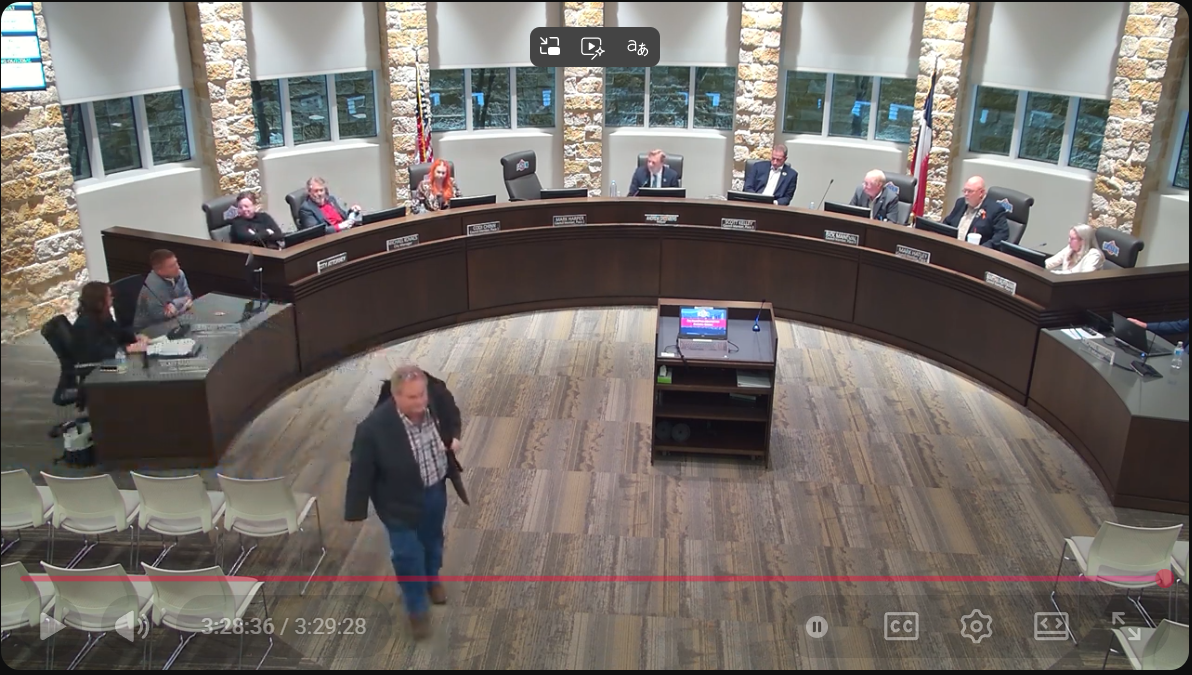
Councilman Mark Harper walks out of meeting before adjournment.
FATE, TX – The Fate City Council voted late Monday night to waive deliberative privilege, opening the door to the public release of secret audio recordings that may have driven a recall election against Councilwoman Codi Chinn. The decision came after hours of public criticism, procedural friction, and a lengthy executive session with legal counsel.
The meeting, held Monday, February 2, was streamed live by the city and is available on YouTube at: https://www.youtube.com/live/zQVN0i-d8C0 (Embedded Below)
(Source: City of Fate, official meeting broadcast)
Timeline for Readers
- 00:33:52 – Public comments begin, largely focused on the recall election of Councilwoman Codi Chinn.
- 00:56:10 – Councilman Harper interrupts public Comment.
- 00:57:00 – Councilman Harper interrupts public Comment.
- 00:58:00 – Councilman Harper interrupts public Comment.
- 02:21:00 – Executive Session – Council enters closed session to consult with legal counsel.
- 03:22:52 – Council reconvenes in open session.
- Primary motion – Council votes to “waive deliberative privilege”, allowing release of disputed audio recordings.
Public Comment and Visible Strain
Public comments began just after the 33 minute mark and quickly centered on the recall election. Speaker after speaker questioned the conduct of city officials and demanded transparency regarding audio recordings that have circulated privately but remained unavailable to the public.
During one speaker’s remarks, critical of Councilwoman Chinn, procedural tension became visible. Three separate times, Councilman Mark Harper interrupted to remind Mayor Andrew Greenberg that the speaker had exceeded the three-minute time limit. Each time, Mayor Greenberg thanked Harper for the reminder, then directed the speaker to continue.
The exchange stood out. While council rules clearly limit speakers to three minutes, the mayor’s repeated decision to allow the speaker to proceed suggested an effort to avoid the appearance of silencing criticism during a highly charged meeting.
Clarifying the Recordings
Contrary to some early assumptions, the audio recordings at issue were not recordings of executive sessions. Instead, they are one-party consent recordings, the existence of which has been previously reported and alluded to on Pipkins Reports. Their precise origin has not been publicly detailed, but their contents have been referenced repeatedly by both supporters and critics of the recall effort.
Behind Closed Doors
Following the public meeting, the council entered executive session to consult with legal counsel. After about an hour, members returned to open session at approximately 3:22:52 .
The primary motion coming out of that session was to “waive deliberative privilege“. The effect of the vote was to remove a legal obstacle to releasing the secret audio recordings that have been at the center of the controversy.
No excerpts were played, and no conclusions were announced. The council did not rule on the legality of the recordings, nor did it weigh in on the merits of the recall election itself.
Why the Vote Matters
The decision does not resolve the recall of Councilwoman Chinn. It does not validate or refute claims made by either side. What it does is shift the debate away from rumor and secondhand accounts.
According to guidance from the Texas Municipal League, governing bodies may waive certain privileges when transparency is deemed to serve the public interest, particularly when litigation risk is balanced against public trust (Texas Municipal League, Open Meetings Act resources).
Opinion and Perspective
The council’s action was a necessary step. Secret recordings, selectively referenced and strategically leaked, undermine confidence in local government. So does a refusal to confront them directly.
Transparency is not about protecting officials from embarrassment. It is NOT the job of the council to assist the city in concealing information that may be used against it in legal proceedings when the City Manager, or Councilmen, may have done bad things. It is about protecting citizens from manipulation. If the recordings exonerate those involved, their release will restore credibility. If they raise concerns, voters deserve to hear them unfiltered before making decisions in a recall election.
Monday night in Fate did not end the controversy. It ended the excuse for keeping the public in the dark.
You must be logged in to post a comment Login