Wendy Bell Exposes Busloads of Supporters Hidden from Public View at Kamala Harris’ Campaign Stop

On Friday, August 16, 2024, Wendy Bell, a conservative radio talk show host with a growing national audience, dropped a political bombshell on her program. Bell revealed that a source close to her claimed that a major cleanup operation at Pittsburgh International Airport was underway. But this wasn’t just any typical maintenance. According to the source, the airport was making space in an airplane hanger for an influx of tour buses filled with supporters for Vice President Kamala Harris, all in a bid to manufacture the appearance of a local groundswell of support during her upcoming campaign stop in Pittsburgh.
Bell, whose no-holds-barred commentary has made her a favorite among conservative listeners, shared the details with her audience, raising questions about the authenticity of Harris’s public support. The source, described by Bell as a friend who keeps their own plane in the hanger in question, stated that the airport hangar needed to be cleared out, with all aircraft moved outside to make room for the incoming buses.
The Allegation: Smoke and Mirrors in Pittsburgh?
According to Bell’s account, the operation was carefully planned and executed to shield the presence of the tour buses. The idea was to create the impression that Harris had a natural, enthusiastic base of support waiting for her in Pittsburgh. The organizers purportedly feared that if the buses were visible, it would spark questions about whether the crowd was artificially bolstered, rather than genuinely local.
Bell’s broadcast struck a nerve with her audience, many of whom are already skeptical of mainstream narratives and the political establishment. The host, who has earned a reputation for uncovering stories that the mainstream media often ignores, posed a question that resonated with many conservatives: How much of the public support for Kamala Harris is real, and how much of it is staged?
Vice President Harris’s Campaign and Pittsburgh: A Key Stop in 2024
According to the Pennsylvania Star Capital Newspaper, “Vice President and Democratic presidential nominee Kamala Harris and her running mate, Minnesota Gov. Tim Walz will kick off a bus tour of Pennsylvania in Pittsburgh on Sunday… It will be the pair’s first campaign appearance in western Pennsylvania, after Harris introduced Walz at a rally in Philadelphia on Aug. 6. They’ll be joined by their spouses Doug Emhoff and Gwen Walz.
The campaign said the tour would focus on “meeting voters where they are” in community settings, with stops to include canvassing kick off events and local retail stops.”
A Pattern of Manufactured Support?
This isn’t the first time allegations of manufactured support have surfaced surrounding the Harris campaign. In fact, recent online accusations suggest the campaign may be using artificial intelligence (AI) to alter photos and videos of their rallies, further inflating the perception of her popularity. Several eagle-eyed internet sleuths have pointed out suspicious anomalies in images and footage from Harris’s events.
Experts who have examined these visuals say they display telltale signs of AI-generated artifacts, such as individuals with multiple limbs, cloned figures in the crowd, and unnaturally squished faces – common glitches in AI-manipulated imagery. These findings have fueled speculation that the Harris campaign might be using digital manipulation to bolster its appearance of widespread support, raising even more questions about the authenticity of the campaign’s public image.
Harris Campaign Response: Silence So Far
As of this writing, neither the Harris campaign nor Pittsburgh International Airport has publicly addressed Bell’s allegations. The vice president’s team has remained focused on her Pittsburgh event, emphasizing her message of economic revitalization and equality.
The lack of response from Harris’s camp has only fueled speculation. On social media, the story has already gained traction, with conservative commentators and influencers picking up on Bell’s broadcast and calling for transparency from the Harris campaign.
The Bigger Picture: Media, Trust, and the 2024 Election
Bell’s story is likely to reverberate beyond Pittsburgh. The 2024 election is shaping up to be one of the most contentious in recent memory, with the political landscape more polarized than ever. Allegations like these – whether true or not – have the potential to sway public opinion and deepen existing divides.
In an era where trust in institutions, including the media, is at an all-time low, stories like Bell’s gain traction because they tap into a broader sense of skepticism. Conservatives, in particular, have grown increasingly wary of what they see as a coordinated effort by the mainstream media and political elites to control the narrative.
Wendy Bell, known for her bold and often controversial takes, has positioned herself as a voice for those who feel disenfranchised by the current system. Her latest revelation about the Harris campaign will likely embolden her supporters, while drawing ire from her critics.
One thing is clear: Wendy Bell’s revelation has opened up yet another front in the battle for the 2024 election. As both sides gear up for what promises to be an intense campaign season, stories like these will continue to shape the narrative – and the outcome – of this critical race.


Business
Big Brother Just Leveled Up: If You Thought Flock Cameras Tracked Your Car, SignalTrace Tracks You

Your Town, USA – For years, Americans have debated the rapid expansion of automatic license plate reader (ALPR) systems like Flock Safety. Supporters argued the cameras simply photographed license plates visible from public roads. Critics warned they were quietly building a nationwide database of vehicle movements and violating the rights of every single American.
Now comes the next evolution.
Instead of merely tracking the vehicle, a new technology called SignalTrace™ is designed to identify and follow the person inside it by creating what its manufacturer calls a unique electronic fingerprint assembled from the wireless devices they carry and the electronic systems built into their vehicle.
If Flock Cameras know where your car has been, SignalTrace is designed to know where you have been—even if you change vehicles, remove your license plate, attempt to conceal your identity or just walk down the street.
Developed by Leonardo US Cyber and Security Solutions, LLC under its ELSAG brand, SignalTrace represents a significant expansion in surveillance technology. The system can combine traditional license plate recognition with passive radio-frequency collection to correlate dozens of electronic signals into a single profile that investigators can search historically or monitor in real time.
Beyond the License Plate
Traditional ALPR systems capture a photograph of a license plate along with the date, time, and location. SignalTrace expands that concept dramatically.
According to Leonardo’s product literature, the system installs sensors alongside existing ELSAG ALPR cameras (or it can operate independently) that continuously listen for publicly broadcast wireless signals emitted by nearby electronic devices.
Those signals are then correlated with nearby license plates.
Over time, the software learns which devices consistently travel together.
Instead of simply identifying a Toyota Camry with Texas plate ABC-1234, SignalTrace may recognize something far more specific:
- iPhone
- Apple Watch
- AirPods
- Vehicle tire pressure sensors
- Vehicle infotainment system
- Wi-Fi hotspot
- Bluetooth-enabled dashboard components
Collectively, those devices become what Leonardo calls an “electronic fingerprint.”
That fingerprint becomes associated with a particular vehicle, license plate, date, time, and location. Once established, investigators can potentially locate that same electronic fingerprint again—even if the vehicle’s plate changes or disappears.
How SignalTrace Works
Unlike wiretaps or cell-phone intercept devices, SignalTrace does not claim to capture communications. Instead, it passively listens for the electronic “handshakes” devices routinely broadcast into the air. According to Leonardo, the sensors detect publicly available radio-frequency identifiers from technologies.
The software then applies algorithms to identify groups of devices that repeatedly appear together across multiple locations and times. Leonardo describes this process as recognizing “convoys” of electronic devices. Those recurring combinations are linked to ALPR camera detections whenever a license plate is available.
All of the resulting information is stored within Leonardo’s ELSAG Enterprise Operations Center (EOC), allowing investigators to perform historical searches or monitor activity as new detections occur.
The sensors are not limited to highways. Leonardo says they can also be deployed in:
- Shopping centers
- Malls
- Stadiums
- Event venues
- Rail stations
- Parking facilities
- Virtually anywhere people gather
That greatly expands surveillance beyond traditional roadway cameras.
What Devices Can It Detect?
Perhaps the most striking aspect of SignalTrace is the sheer number of electronic devices that may contribute to a person’s digital fingerprint. Leonardo’s documentation lists several categories.
Bluetooth Devices
Nearly everyone carries Bluetooth-enabled electronics. These include:
- Smartphones
- Smartwatches
- Fitness trackers
- Wireless earbuds
- Wireless headphones
Wi-Fi Devices
The system can also detect Wi-Fi sources such as:
- Smartphones
- Tablets
- Laptops
- Vehicle Wi-Fi hotspots
Vehicle Electronics
Modern vehicles constantly broadcast signals from numerous onboard systems. SignalTrace can associate identifiers from:
- Tire Pressure Monitoring System (TPMS) sensors
- Vehicle safety systems
- Security sensors
- Infotainment systems
RFID Devices
Radio-frequency identification tags also become part of the picture. Examples include:
- Employee key cards
- Asset tracking tags
- Warehouse pallet transmitters
- Pet microchips
- Toll Tags
Individually, many of these identifiers may not uniquely identify someone. Together, however, they become remarkably distinctive. A phone alone may be common.
A phone plus a smartwatch, wireless earbuds, vehicle TPMS sensors, infotainment system, and Wi-Fi hotspot traveling together every morning creates an electronic signature that is far more difficult to confuse with someone else’s.
An Electronic Fingerprint
Leonardo openly markets this capability. Rather than relying upon one device, SignalTrace builds a composite identity. Imagine two identical pickup trucks.
Their license plates differ. Their owners both carry iPhones. Traditional ALPR systems distinguish them only by plate. But SignalTrace instead recognizes that one truck consistently travels with:
- Phone A
- Apple Watch A
- AirPods A
- TPMS Set A
- Infotainment System A
The other truck carries:
- Phone B
- Samsung Galaxy Watch
- Bose headphones
- TPMS Set B
- Vehicle hotspot B
Those collections become unique fingerprints. Even if one owner changes license plates—or drives another vehicle while carrying the same electronics—the fingerprint may remain recognizable.
In effect, investigators are no longer simply tracking a vehicle. They’re tracking the collection of electronic devices that travels with a person.
Law Enforcement Benefits
Leonardo promotes SignalTrace as an investigative force multiplier. Among its advertised capabilities:
- Integrates directly with existing ELSAG ALPR infrastructure.
- Identifies suspects through recurring electronic signatures.
- Recognizes vehicles using electronic fingerprints.
- Detects movement patterns and recurring travel.
- Identifies convoys.
- Assists investigations involving gangs.
- Supports human trafficking investigations.
- Expands surveillance beyond fixed ALPR locations.
- Enables both real-time monitoring and historical searches.
The company says sensors can be added to existing deployments, reducing implementation costs for agencies already operating ELSAG license plate readers.
Leonardo Says It’s Privacy Respecting
Leonardo argues SignalTrace remains privacy conscious because it captures only publicly broadcast signals. According to the company, the system:
- Does not decrypt communications.
- Does not intercept phone calls.
- Does not read text messages.
- Does not capture email contents.
- Does not access files stored on devices.
Instead, it collects only identifiers that devices voluntarily transmit over public radio frequencies. Leonardo compares the process to photographing a visible license plate on a public road.
From the company’s perspective, it is simply observing information already being broadcast into public space.
Privacy Advocates See Something Different
Privacy organizations and technology researchers have expressed far greater concern.
Critics argue SignalTrace fundamentally changes what ALPR systems are capable of doing. Instead of merely documenting where a vehicle traveled, they contend the technology enables persistent tracking of individuals through the electronic devices they carry every day.
Several researchers note that while modern smartphones increasingly randomize Bluetooth and Wi-Fi MAC addresses to reduce tracking, not every broadcast identifier is randomized.
Vehicle tire pressure monitoring systems, for example, often transmit fixed identifiers.
Likewise, combining multiple partially stable identifiers into one composite fingerprint may overcome many of the privacy protections built into individual devices. In other words, even if one identifier changes periodically, the surrounding collection of devices may remain recognizable.
Privacy advocates argue that this transforms anonymous radio emissions into something much closer to a persistent personal identifier.
Current Deployment
As of mid-2026, Leonardo is actively marketing SignalTrace and promoting it as an enhancement for existing ELSAG ALPR customers.
Public documentation indicates the sensors are intended to integrate with existing deployments, although no specific police department or municipality has publicly confirmed an operational deployment.
The underlying technology received a U.S. patent in March 2024 and was previously marketed in related forms under the name EOC Plus.
The Bigger Question
Supporters will argue SignalTrace is simply another investigative tool—one that relies only upon publicly available radio signals rather than private communications.
Critics see something far more consequential.
For decades, the debate centered on whether government should be able to track where your vehicle travels. SignalTrace moves beyond the automobile. It creates a persistent electronic identity assembled from the devices most Americans carry every day.
For decades, this author has maintained that there is no technology that exists, that the government will not eventually use against its own citizens.
Featured
Fauci Takes the Fifth, Democrats Rush to His Defense While Sidestepping His Own Pandemic Diary
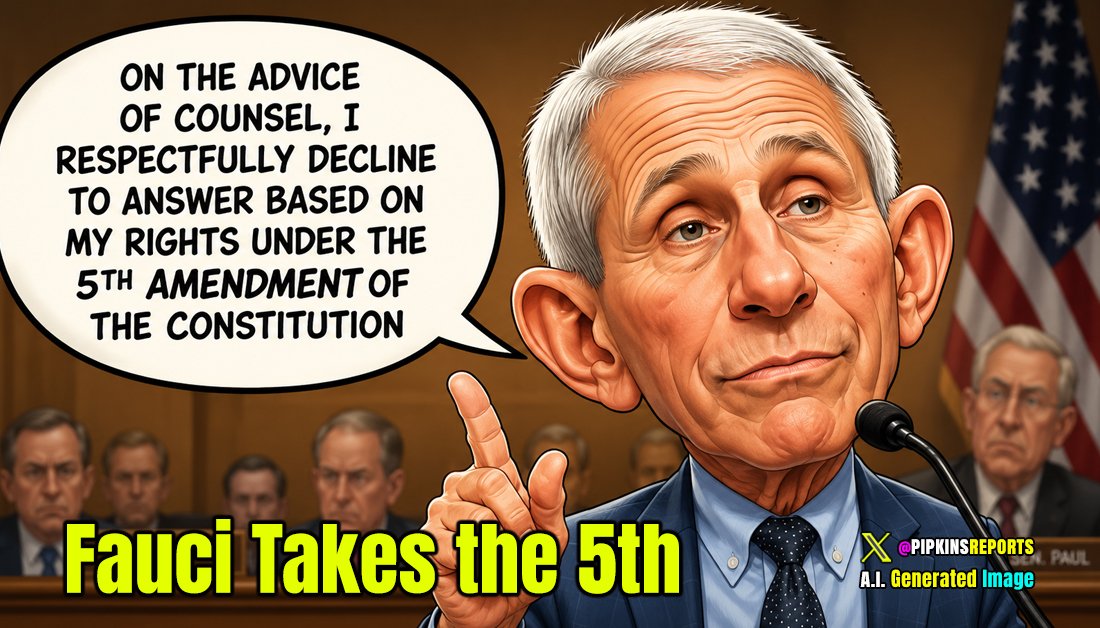
Washington, D.C. — One of the most recognizable faces of the COVID-19 pandemic sat before a U.S. Senate committee Wednesday, raised no dramatic objections, launched no fiery defense of his decisions, and then declined to answer lawmakers’ questions by invoking the Fifth Amendment. It was a moment that instantly became one of the defining political images of the post-pandemic era.
Dr. Anthony Fauci, the former director of the National Institute of Allergy and Infectious Diseases, appeared under subpoena before the Republican-led Senate Homeland Security and Governmental Affairs Committee after being called by Sen. Rand Paul, R-Ky. Rather than respond to questions about his role during the pandemic, Fauci told the committee he was following the advice of counsel and would invoke his constitutional right against self-incrimination.
The hearing quickly became a familiar partisan clash.
Paul argued that Fauci should answer questions surrounding government funding for research connected to the Wuhan Institute of Virology, shifting public statements regarding COVID-19’s origins, and decisions that shaped federal pandemic policy. Democrats, led by Ranking Member Sen. Gary Peters, D-Mich., countered that the hearing was little more than political theater designed to relitigate the pandemic instead of addressing current national security concerns.
But amid hours of defending Fauci’s reputation, Democratic members largely avoided discussing one subject that has increasingly drawn attention in recent days: Fauci’s own pandemic diary.
Before Wednesday’s hearing, Paul released more than 1,000 pages of Fauci’s government-maintained diary covering key periods of the pandemic. The senator argued that the private entries reveal inconsistencies between Fauci’s internal assessments and his public messaging during COVID-19.
[ Read and Download the Diary Here ]
Paul wrote on X that Fauci’s diary showed “what he wrote privately and what he told the country are two different stories.“
Some entries reportedly document uncertainty during the earliest weeks of the outbreak, uncertainty that many scientists shared as information rapidly evolved. Portions of those same observations had previously appeared in Fauci’s 2024 memoir and public interviews, according to the Associated Press. Other critics argue the diary raises additional questions deserving public examination.
Yet during Wednesday’s hearing, Democratic senators spent little time addressing the contents of the diary itself. Instead, much of their defense centered on Fauci’s decades of public service and repeated assertions that there is no credible evidence proving he committed criminal wrongdoing.
Scientists and public health officials likewise defended Fauci ahead of the hearing. More than 150 infectious disease experts signed a public letter rejecting accusations against him and urging Congress to end what they characterized as political attacks. Fauci has consistently denied misleading Congress and has maintained that the available scientific evidence favors a natural origin for COVID-19 rather than a laboratory leak.
Paul, however, has argued the hearing was necessary because Congress still has unanswered questions. He also noted that invoking the Fifth Amendment prevents lawmakers from obtaining sworn testimony that could either confirm or refute allegations surrounding Fauci’s public statements.
Fauci’s attorney, David Schertler, called Paul’s accusations “false and disgraceful” and said they would consider legal options in response.
The hearing also unfolded against an unusual legal backdrop. Former President Joe Biden previously granted Fauci a presidential pardon covering potential federal offenses tied to his government service, though legal scholars have noted that such pardons do not shield a witness from future perjury or contempt allegations arising from new testimony. That reality made Fauci’s decision to invoke the Fifth all the more politically significant, regardless of the legal reasons offered by his attorneys.
Whether Republicans ultimately pursue a contempt referral remains uncertain.
What is certain is that Wednesday’s hearing added another chapter to one of the most divisive political debates in modern American history.

HISTORY – As Americans prepare to celebrate the 250th anniversary of the Declaration of Independence, it’s worth remembering something many school textbooks and social media historians tend to skip these days. The Constitution that hangs behind glass in the Rotunda for the Charters of Freedom, was not America’s first constitution.
It was the second.
Long before James Madison and the delegates gathered in Philadelphia in 1787, the young nation experimented with another system of government, one born amid war, shaped by distrust of centralized authority, and ultimately abandoned when its flaws became impossible to ignore.
On July 4, 1776, the Continental Congress adopted the Declaration of Independence, formally announcing that the Thirteen Colonies of Britain considered themselves free and independent states. Yet true independence would have to be won on the battlefield.
The Revolutionary War had already begun more than a year earlier with the battles of Lexington and Concord in April 1775. For eight years, General George Washington‘s Continental Army fought the British Empire through defeats, shortages, and brutal winters. Victory was never guaranteed. It would end with Britain’s surrender at Yorktown in October 1781, although the war was formally concluded with the Treaty of Paris in September 1783.
However, while the war was still raging, Congress recognized that the new nation, if it were to be successful in its rebellion, needed a framework for government.
Delegates drafted the Articles of Confederation in November 1777. After years of debate among the states, the Articles were finally ratified on March 1, 1781, becoming America’s first constitution.
The Articles established what was essentially a loose alliance of 13 sovereign states. Congress could conduct diplomacy, declare war, and manage western territories, but its powers were intentionally limited. There was no president. No national judiciary. Congress could request money from the states, but had no authority to compel payment or levy taxes.
At the time, the arrangement made sense.
Americans were still fighting for independence, and few had any appetite for creating a strong national government that might resemble the British system they were trying to escape. Nobody wanted to trade George III for another distant authority. So the states retained most of their power, and Congress remained intentionally weak.
But peace exposed weaknesses that war had masked.
States often ignored Congress. They imposed tariffs against one another, printed competing currencies, and frequently refused to contribute money to the national government. War debts mounted. Foreign powers questioned whether the United States could survive as a unified nation. There was no executive branch to enforce laws and no national courts to settle disputes.
Then came Shays’ Rebellion in 1786.
Shays’ Rebellion erupted in western Massachusetts in the fall of 1786, when farmers burdened by debt and heavy taxes faced foreclosures and possible imprisonment. Many were Revolutionary War veterans who believed they had sacrificed for independence only to find themselves losing their farms.
Led by former Continental Army captain Daniel Shays, groups of armed men shut down courts to prevent foreclosures and, in January 1787, attempted to seize the federal arsenal at Springfield. The uprising was ultimately suppressed by a privately funded state militia, but the episode sent shockwaves throughout the country. To many national leaders, the rebellion exposed the inability of the Confederation government to maintain order or provide for the common defense.
The uprising by Massachusetts farmers alarmed George Washington, James Madison, and Alexander Hamilton. Washington even wrote in a letter to Henry Lee that he was, “mortified beyond expression” and worried that Americans were proving incapable of self-government. James Madison viewed the rebellion as proof that excessive democracy and weak national authority endangered republican government, and Alexander Hamilton practically used the rebellion as Exhibit A to propose a stronger central government. It became painfully clear that merely tweaking the Articles would not solve the problem.
So delegates assembled in Philadelphia in May 1787 with the stated purpose of revising the Articles of Confederation. But instead, they scrapped them altogether.
Over the course of four months, the Constitutional Convention produced an entirely new framework. Completed in September 1787, the United States Constitution officially took effect on March 4, 1789. It created three branches of government, gave Congress the power to tax and regulate commerce, and established a system of checks and balances intended to preserve liberty while providing enough national authority to hold the republic together.
Most importantly, the States regained most of their independence. With the Federal Government becoming the arbitrator of conflict between them. Any power not specifically specified as belonging to the federal government is reserved for the States, or the People.
Over the years, many amendments have been made. Perhaps the most disastrous amendment that is still in effect today is the 17th amendment … which stripped away representation by the States, which were so important to our founding fathers.
Opinion
Modern political debates often treat the Constitution as though it sprang into existence fully formed in 1787, but those of us who follow history understand another side of the story.
With the Articles of Confederation, the Founders first tried a decentralized system that left most authority with the States. But they learned through experience that a weak national government could be nearly as dangerous as one that is too strong.
That doesn’t mean they intended to create the sprawling administrative state Americans know today. Far from it. Their goal was balance, national unity without sacrificing liberty, federal authority restrained by checks, balances, and state sovereignty.
As the nation approaches its semiquincentennial (250th anniversary), Americans should remember that the Constitution itself was born from a humble trial and error. The Founders recognized when their first attempt wasn’t working, and had the wisdom to take steps and fix it.
It’s a reminder that self-government requires both principle and the willingness to confront reality when facts demand it.
You must be logged in to post a comment Login