
The Penny Is Dead — And Retailers Are Already Collecting the Round-Up

Analysis / Opinion – In a scene that echoes the comical greed of Richard Pryor’s character in Superman III, American retailers are quietly positioning themselves to benefit from the rounding of your change. Not by stealing half-cents into a secret bank account, but by tweaking prices so that, when the cash register closes, the rounding always favors them. With the penny officially retired, their little profits are set to add up fast.
Yes, the coin that has jingled in your couch cushions for generations is gone. On November 12, 2025, the United States Mint struck the final circulating penny, ending a 232-year run. The move, ordered by the Brandon Beach-led Treasury, was justified by rising production costs. It costs 3.69 cents to mint a one-cent coin that is worth only a cent, and has dwindling practical use.
That penny may be gone, but rounding rules remain. Pennies are still legal tender, but with no more being minted, their circulation will shrink. Many economists and officials expect cash transactions to be rounded to the nearest nickel when pennies disappear from everyday use.
For retailers, that isn’t a bug. It’s an opportunity.
How Pricing Will Tilt the Rounding to Retailers’ Favor
With pennies gone, the rounding of cash totals becomes inevitable. But the outcome, whether customers lose change or not, depends on how retailers price items. And with modern tools, they can tilt it heavily in their favor.
Using local tax rates (for example, a hypothetical 8.25 %) and simple rounding rules, pricing strategists, now aided by artificial intelligence, can adjust individual item prices down to the cent so that, after tax and rounding, the final cash-register total ends in .03 or .08 (or at worst .04 or .09). Under standard rounding to the nearest nickel, those endings give retailers a gain of one or two cents. Over thousands or millions of transactions, those cents become real money.
For instance:
- A product at $1.92 before tax ends up as $2.08 total — rounding up to $2.10, giving the retailer 2 extra cents while the customer sees a lower sticker price.
- A $9.96 item produces a post-tax total that rounds up, unlike $9.99, which might round down.
- A clean $20 price tag may shift to $19.98 — a small tweak that creates a favorable rounding outcome.
Retailers who price each item carefully — rather than basing price on “market norms” like .99 or .95 — can systematically harvest these rounding gains. It’s the arithmetic equivalent of payroll for pennies, just like how Gus Gorman was shocked to discover his fortune in Superman III.
Who Gains — And Who Loses
This pricing strategy is most lucrative in contexts with frequent low-item cash purchases: convenience stores, gas stations, coffee shops, small retail outlets. In those environments, the rounding on each sale matters. Large grocery carts or mixed baskets tend to average out, though retailers still benefit overall from any skew.
Digital payments — credit cards, mobile wallets, and contactless transactions are unaffected. Totals still settle to the exact cent. So the benefit accrues only when the customer pays with cash. But given how many transactions in the U.S. still involve cash, especially among lower- and middle-income shoppers, the strategy still has broad potential.
Legally, there’s nothing wrong with the approach. The government stopped making pennies because it cost more to produce them than their face value. They left the rounding rules to states and businesses. Still, some retailers and industry groups worry about the fairness of the shift. As reported, many businesses were caught off guard when penny shipments abruptly stopped, with no central guidance on rounding policies.
That means even well-meaning merchants might adopt rounding-up strategies by default, simply because that’s what the pricing tools they buy suggest.
The Penny’s End — And the Subtle Rise of the Rounding Dividend
Yes, the penny is gone. Production stopped. The smallest unit of U.S. currency no longer emerges from Mint presses. The rounding rules may seem harmless, perhaps even trivial. But with the precision of modern pricing analytics and the institutional muscle of retail chains, that triviality becomes systematic.
What the consumer loses is too small to notice. A penny here, two cents there. But over time, it accumulates. Much like the fictional windfall of Gus Gorman, the rounding profits will build quietly until they become significant, collected not by thieves in a basement, but by retailers behind bright fluorescent lights and bar-code scanners.
The penny’s death may be an act of fiscal efficiency. But the rounding dividend is the beginning of a price-structure redesign that advantages those who control the register.



Google Co-Founder Heads to Florida
Sacramento, CA. – A seismic shift in California’s economic landscape is quietly underway as lawmakers and union backers push a controversial billionaire wealth tax. What was pitched as a modest 5 percent levy on the ultra-wealthy has exposed more serious threats to innovation and property rights — and it has already driven one of the state’s most famous founders out of California. Google co-founder Larry Page has relocated to Florida, driven in part by provisions in the tax that could assess billions of dollars on unrealized gains tied to super-voting Class B stock.
The proposal — officially titled the 2026 Billionaire Tax Act — would impose a one-time 5 percent charge on the net worth of individuals whose worldwide assets exceed $1 billion as of January 1, 2026. Supporters frame it as a targeted revenue source for healthcare, food assistance, and education, critics warn the tax’s mechanics could reshape American capital formation.
What the Proposal Actually Does
Under the initiative, wealth is defined as total global net worth, including publicly traded stocks, private business interests, intellectual property, and other assets — excluding most real estate and certain retirement accounts. Rather than taxing only realized income, the tax includes unrealized gains in asset value. That means founders may owe tax on increases in stock value they have never sold.
The language of the proposal goes a step further: it treats voting power as though it were equivalent to economic ownership for founders with dual-class stock structures. In Silicon Valley, it is common for founders to hold Class B super-voting shares that confer control with far less economic interest than voting interest. Under the initiative’s valuation rules, a founder with 3 percent of a company’s economic shares but 30 percent voting control could be treated, for tax purposes, as owning 30 percent of the company — multiplying their taxable wealth many times over.
Economists have pointed out that this “voting power equals ownership” assumption effectively taxes phantom wealth — value that exists on paper but is not proportionate to actual economic ownership. The result: tax bills far greater than a simple 5 percent of net worth might suggest, particularly for founders of tech companies structured around dual-class stock.
Exodus of Billionaires Begins
The reaction among California’s wealthy has been dramatic. Larry Page, whose super-voting Class B shares give him outsized control at Alphabet, has purchased multiple high-value properties in Florida and moved many business entities out of California. His relocation comes amid widespread concerns that the wealth tax could penalize founders disproportionately based on voting shares rather than actual economic stake.
Venture capitalist Peter Thiel has also publicly mobilized against the tax, donating millions to efforts to defeat it and shifting aspects of his business operations to Miami. Other tech leaders and investors are reconsidering their California footprint, with some establishing offices or residences in states like Texas or Florida.
Economic and Legal Concerns
Economists and legal scholars caution that enforcing a tax on unrealized gains is inherently complex. Valuing privately held assets and dual-class stock structures invites disputes and litigation. The retroactive assessment based on residency at a fixed date could expose residents to significant tax bills even if they had intended to leave the state before the tax was implemented.
Critics also argue that using voting power as a proxy for economic value could violate constitutional protections against uncompensated takings, as it effectively treats control rights — not purely economic interest — as taxable property. Legal challenges are almost certain if the measure qualifies for the ballot and is approved by voters.
Political Clash
Supporters, including union leaders and some progressive advocates, say the tax would help fill budget gaps in healthcare and social services created by federal spending cuts. They maintain that the ultra-wealthy have benefited disproportionately from California’s economy and should contribute more.
Governor Gavin Newsom (D), has distanced himself from the proposal, warning that it threatens investment and could accelerate capital flight. Business groups such as the California Chamber of Commerce and the California Business Roundtable have echoed those warnings, describing the tax as a “dangerous wealth tax” that could harm the state’s competitiveness.
Broader Implications
California’s billionaire tax debate has quickly transcended local politics to become a national test case. If approved by voters in November 2026, it could encourage similar initiatives elsewhere, particularly in high-tax states. At the same time, the backlash has highlighted the risks of taxing unrealized gains — a feature that economists and tax policy experts say is untested and could disrupt capital formation.
For states like Texas and Florida, which champion low taxes and economic freedom, California’s experiment presents both a contrast and an opportunity. As capital and executives reassess their domiciles, the business climate and economic growth of states without such wealth taxes may benefit.
Larry Page’s move to Florida is not just a personal choice. It is a symbolic indicator of where capital flows in response to policy. Once talent and wealth leave, they seldom return. California’s experiment in wealth taxation should give pause not only to its voters but to every state considering similar schemes.
Sources:
Tax Foundation, “The Proposed California Wealth Tax Is Far Higher than 5 Percent,” January 2026.
California Attorney General Initiative Text, “2026 Billionaire Tax Act.”
Business Insider, “Larry Page Continues His California Exile with Florida Property Purchases,” January 2026.
Yahoo Finance, “Peter Thiel’s $3 Million Donation to Defeat California Wealth Tax,” January 2026.
WebProNews, “Dual-Class Voting Share Valuation Sparks Silicon Valley Outrage,” January 2026.
Business
Trump and Cornyn Get It Wrong: New Data Shows H-1B Visas Are Replacing American Workers, Not Filling Shortages

Washington, DC – President Trump shocked many of his own supporters this month when he doubled down on his defense of the H-1b visa program, insisting that American companies “need access to the best talent in the world.” For Texans, who’ve watched this program undercut the wages of their neighbors for decades, the remarks landed with a thud. Even more frustrating is that the loudest longtime champion of the H-1b system isn’t a Democrat at all, but Texas Senator John Cornyn—Congress’s most reliable ally to the outsourcing lobby and a consistent advocate for expanding H-1b allotments and giving good-paying American jobs to foreign workers.
The FY 2024 Labor Condition Application data, the mandatory filings companies submit before importing H-1b workers, tells a story very different from what the political class sells.
For years, the public has been told these visas fill “critical shortages.” The numbers show the opposite. According to federal LCA filings for FY 2024, employers sought more than 223,000 foreign workers in the Professional, Scientific, and Technical Services sector alone. That sector, known by its NAICS code 54, accounts for more than half of all H-1B activity in the United States. And when you drill down, it becomes clear that these are not exotic, rarefied roles requiring knowledge unavailable in the American labor pool. They are overwhelmingly standard computer jobs that tens of thousands of Americans are already trained to perform.
The data reveals that more than 90 percent of all H-1b roles in NAICS 54 are computer-related: software engineers, developers, data analysts, and project managers. The top job title, Software Engineer, accounted for 27,875 cases. Software Developer followed with over 20,000. Senior engineers, architects, data scientists, and business analysts rounded out the list.
These are not obscure specialties. They are the backbone of the modern American workforce. For decades, U.S. universities have produced more graduates in these fields than the market will absorb, leaving many Americans struggling to compete against corporations that prefer cheaper, visa-dependent workers.
Outside the tech sector, the top industries importing H-1b labor also contradict the “skills shortage” narrative. After Professional, Scientific, and Technical Services, the next-largest sectors were Information; Machinery and Equipment Manufacturing; Finance and Insurance; Educational Services; Retail; Health Care and Social Assistance; and Materials Manufacturing.
These industries requested tens of thousands of foreign workers. The average salaries attached to these filings—ranging from $118,000 to well over $160,000 in many categories—show the financial motive at play. These are not low-wage jobs Americans refuse to do. They are well-paid jobs that companies would rather fill with workers who cannot negotiate, unionize, or threaten to leave without risking deportation.
In the number-one sector alone, the breakdown of job titles shatters any illusion that Americans “can’t” do this work. Corporations filed for 5,777 Senior Software Engineers, 3,323 Data Engineers, 3,093 mid-level Software Development Engineers, and more than a 1,000 DevOps professionals. Many of these positions mirror exactly the roles American workers have been laid off from in recent years, only to watch their own jobs filled by imported labor. Some have even been forced to train their replacements before being shown the door. Yet corporate lobbyists continue insisting that the domestic talent pool is insufficient.
The federal data paints a clear picture: the H-1B program is not filling shortages—it is creating them. And policymakers like Senator Cornyn have helped build this reality. Cornyn has spent years pushing expansions of the visa program, arguing that American competitiveness depends on foreign labor pipelines. His advocacy has aligned closely with the interests of multinational consulting firms and outsourcing giants, many of which are among the top H-1b filers each year. The H-1b program has become a subsidy for companies that want highly skilled labor without paying highly skilled wages.
That context makes the President’s recent remarks even more uncomfortable for voters who believed he would stand with American workers. Trump’s instinct has always been to support U.S. industry, but on this particular issue, industry has misled him. Corporations insist they need imported talent because they cannot find qualified Americans, but never mention that federal data contradicts them. They don’t mention that wages in many of these fields have stagnated even as demand supposedly soars. They don’t mention that the program legally allows companies to pay foreign workers below the median market wage.
The “why” is simple: companies want leverage. H-1b workers are tied to their employers. They cannot easily switch jobs, demand raises, or push back against exploitative conditions. American workers can—and do. The H-1b program shifts bargaining power away from citizens and toward multinational firms, and Congress has allowed this system to grow because corporate donors prefer it that way.
If President Trump truly wants to put American workers first, and Make America Great Again, this is the moment to look past the talking points and confront what the data reveals. And if John Cornyn wants to defend the Texas workforce he claims to represent, he could start by acknowledging that the H-1b program he championed is now a mechanism for replacing Americans, not empowering them. The numbers are in. The shortage isn’t talent. The shortage is honesty.
(The Center Square) – By Bethany Blankley, with analysis by Michael Pipkins
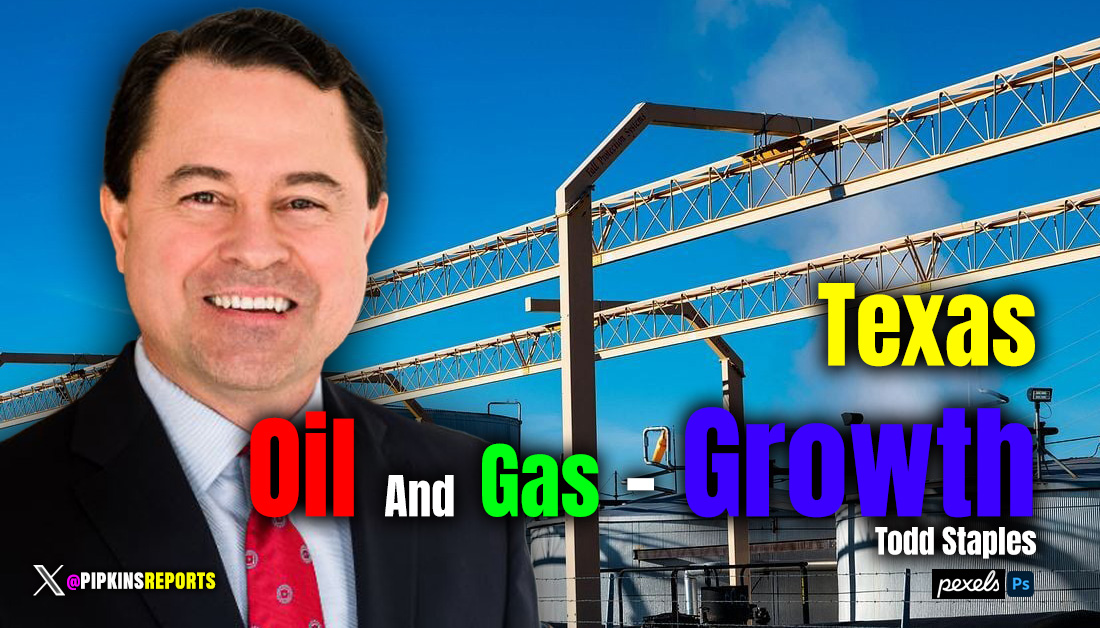
Texas once again leads the nation in job creation, shattering employment records in August, according to the latest data reported by The Center Square. The numbers reveal more than just raw job growth—they tell the story of a state whose economic engine continues to run on oil, gas, and energy innovation, even as Washington policies, global uncertainty, and environmental pressure threaten to slow it down.
At the center of this resilience is the Texas upstream oil and natural gas industry. After losing 1,400 jobs in July, the sector regained traction in August, adding 200 upstream jobs. While modest, that uptick pushed total upstream employment to 205,100. The numbers reflect an internal shift: 200 fewer oil and gas extraction jobs, but 400 more in oilfield services.
The Texas Oil & Gas Workers Association put those figures into perspective:
“Growth for this calendar year so far remains a positive 4,200 upstream jobs, and at 205,100 upstream jobs, compared to the same month in the prior year, August 2025 jobs were up by 2,000, or 1.0%.”
That 1% growth may seem small in isolation, but it is part of a longer arc showing how Texas continues to outperform national trends. The state’s energy workers are still earning some of the highest wages in the country, averaging $128,000 annually in 2024, even as other industries stagnate under inflationary pressures.
Understanding the Upstream Engine
The term “upstream” in oil and gas refers to the front end of the energy cycle—exploration, drilling, and extraction. In Texas, that means rigs in the Permian Basin, wells in the Eagle Ford Shale, and operators spread across the Panhandle.
What upstream doesn’t cover is equally important: refining, petrochemicals, pipelines, utilities, and oilfield equipment manufacturing. Those sectors—considered “midstream” and “downstream”—are vital, but they depend on the foundation upstream provides. Without upstream extraction, Texas would not be able to power its refineries, fill its pipelines, or support its vast export infrastructure.
In effect, upstream is the tip of the spear. Its performance signals the health of the entire Texas energy economy.
Resilience in a Time of Uncertainty
August’s rebound is notable precisely because it came after two straight months of job losses. In June and July, the sector shed a combined 2,000 jobs, reflecting global price volatility and forecasts of supply-demand imbalances.
Todd Staples, president of the Texas Oil & Gas Association (TXOGA), emphasized that August’s slight gains show the industry is adapting:
“The August employment gains are a welcome sign of the Texas oil and natural gas industry’s resilience. Despite forecasts of a supply and demand imbalance and persistent global uncertainties, companies are adapting to manage risk and continue delivering the reliable energy that powers modern life.”
Those “global uncertainties” are not small. OPEC+ production cuts, geopolitical conflicts, and regulatory bottlenecks in Washington all weigh on the sector. Add to that environmentalist pressure to “phase out fossil fuels,” and Texas operators face a landscape in which success is anything but guaranteed.
Yet, rather than retreat, Texas firms continue to innovate, hedge against risk, and deploy new technologies that make drilling safer and more efficient.
The Labor Market: Job Postings Surge
Employment data from the Texas Independent Producers and Royalty Owners Association (TIPRO) reveals just how hungry the market is for skilled labor.
In August, Texas posted 10,154 unique oil and gas job openings, compared to 8,853 in July. Of those, 3,806 were new postings. By contrast, Pennsylvania had fewer than 3,000 postings, California just over 2,500, Ohio 2,322, and Illinois 2,014.
Nationwide, nearly 60,000 job postings were listed across the oil and natural gas sector last month, including more than 20,000 new openings. Texas not only dominated the numbers but also the geography of opportunity. The top four cities for job postings—Houston, Midland, Dallas, and Odessa—were all in Texas.
Among the 19 industry subsectors TIPRO tracks, the most job listings came from Support Activities for Oil and Gas Operations. Other leading subsectors included Gasoline Stations with Convenience Stores, Petroleum Refineries, and Pipeline Transportation of Natural Gas.
Ed Longanecker, TIPRO’s president, said the trends point toward continued growth:
“The Texas oil and natural gas industry remains vital for job creation, innovation, and energy security, with 2025 employment trends driven by a variety of dynamic factors. Federal policies, including faster permitting and expanded LNG export approvals, along with transformative investment in AI-driven data centers, will support increased export activity, creating high-paying jobs in midstream, gas-fired generation and export infrastructure in the coming years.”
Longanecker’s reference to AI-driven data centers highlights an underappreciated aspect of the energy story: the digital revolution runs on electricity, and that electricity still overwhelmingly comes from natural gas. Far from being “obsolete,” fossil fuels are powering the very technologies that environmentalists say will define the future.
Tax Revenue Surges with Production
Texas’ energy sector doesn’t just provide jobs—it fills the state’s coffers. In August, oil producers paid $445 million in oil production taxes, the highest level in six months. Natural gas producers paid $194 million in production taxes, representing a 143% increase over the year.
Those tax revenues flow into the state’s General Revenue Fund and the Economic Stabilization Fund—better known as the “Rainy Day Fund.” In practical terms, every barrel pumped in the Permian helps pay for Texas schools, roads, and infrastructure.
For a state that prides itself on low taxes and fiscal conservatism, the oil and gas sector’s tax contributions remain indispensable.
Texas vs. Washington: Competing Visions
While Texas celebrates job growth, Washington has charted a different course. The previous Biden administration had leaned heavily into green energy subsidies, EPA regulations, and restrictions on leasing federal lands for drilling. Critics argue that these policies undermine U.S. energy independence, making America more reliant on foreign sources.
Texas, by contrast, has doubled down on fossil fuels, while also investing in renewable energy where market conditions make sense. The result is a hybrid model that secures reliable baseload power while fostering innovation.
The data suggests Texans aren’t waiting for federal permission. They are drilling, producing, hiring, and exporting—driving both the state and national economy forward.
What It Means for Texans
For everyday Texans, the numbers translate into several realities:
- High-paying jobs: At an average salary of $128,000, upstream jobs remain a path to middle-class stability and upward mobility.
- Local prosperity: Towns like Midland and Odessa live and die by energy cycles. August’s rebound means more paychecks, more tax revenue, and stronger local economies.
- Energy security: The more Texas produces, the less America must import from unstable regimes abroad.
- Political leverage: With Texas leading in production and job creation, the state carries significant influence in national energy debates.
At the same time, challenges remain. Energy jobs are cyclical, tied to commodity prices. Inflation continues to eat into wages. And environmental policy battles show no sign of abating.
A Broader Economic Picture
Texas’ leadership in job creation isn’t confined to energy, but energy remains its backbone. The latest employment data proves that when oil and gas thrive, the broader Texas economy benefits.
As global markets shift and federal policies evolve, Texas will continue to chart its own path—balancing innovation with tradition, and resilience with risk.
The August rebound may look like a blip on a chart. In reality, it is a reminder that Texas’ economic future remains intertwined with the industry that put it on the map. Oil and gas are not relics of the past. They are the foundation of a modern, growing, and increasingly dynamic state.
Attribution: Original reporting by Bethany Blankley of The Center Square. Additional analysis and commentary by Michael Pipkins.
You must be logged in to post a comment Login