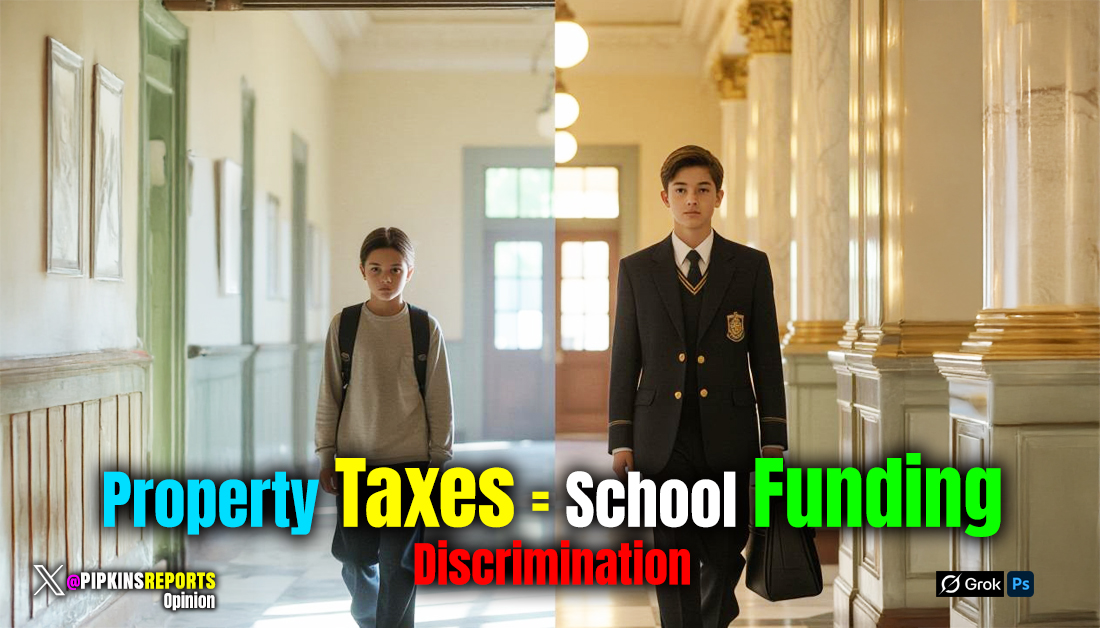
Texas’s School Funding Scandal: Why Ditching Property Taxes for 100% State Cash Is a Game-Changer

Opinion / Advocacy – Texas boasts one of the largest public education systems in the nation, serving over 5.5 million students across more than 1,200 school districts. Yet, the way we fund our K-12 schools remains a patchwork of state contributions and local property taxes—a dual mechanism that perpetuates inequities, burdens homeowners, and complicates accountability. As we navigate fiscal year 2025, with state coffers bolstered by economic growth, it’s time to advocate for a bold reform: eliminating school property taxes entirely and providing 100% of K-12 funding through state sources. This shift would promote fairness, streamline administration, and ensure every Texas child has access to quality education regardless of their zip code.
The Dual Funding Mechanism: A System Ripe for Reform
Texas’s K-12 funding operates under a dual structure, blending state and local revenues to meet the constitutional mandate for a “general diffusion of knowledge.” At its core is the Foundation School Program (FSP), which calculates a baseline funding level per student and divides the responsibility between the state and local districts.
- State Share: The state provides funding through formulas that account for student needs, such as special education or economically disadvantaged populations. This includes “Tier 1” funding for basic allotments and “Tier 2” for enrichment. The state aims to equalize funding by reducing aid to wealthier districts and recapturing excess local revenue—often called the “Robin Hood” system—to redistribute to poorer ones.
- Local Share: School districts levy property taxes on residential and commercial properties within their boundaries to cover the remainder. These taxes fund operations, maintenance, and sometimes debt for facilities. Local contributions typically make up 50-60% of total K-12 funding, with the state covering the balance plus federal aid (around 10-18%). This local reliance creates disparities: Wealthy districts with high property values generate more revenue at lower tax rates, while property-poor districts struggle even with higher rates.
This dual approach, rooted in laws like Chapter 48 of the Texas Education Code, was designed to balance local control with state oversight. However, it has led to persistent inequities. In FY 2025, the average funding per student is approximately $15,503, covering teacher salaries, student services, and operations. But this figure masks wide variations—some districts receive far more due to robust local tax bases, while others rely heavily on state aid amid rising property values that outpace homeowner incomes.
Critics argue the system is outdated, especially with Texas’s booming population and economy. The “Robin Hood” recapture mechanism alone is projected to collect nearly $5 billion from districts in 2025, redistributing it statewide. While intended to promote equity, it often feels punitive to growing suburbs and fails to fully address underfunded rural or urban schools.
State-Administered Programs: The Backbone of Current Funding
Drawing from the Texas Education Compensation 2025 spreadsheet—a detailed ledger of state appropriations—the state’s role in K-12 funding is substantial, totaling an estimated $38.4 billion in FY 2025. These funds are administered primarily through the Texas Education Agency (TEA) and flow via targeted programs. Here’s a breakdown of key state-administered initiatives based on the data:
- School Apportionment – Foundation Program (Object Code 7602): The largest slice at approximately $30.1 billion, this is the core of the FSP. It includes $26.98 billion from the Foundation School Fund and $3.11 billion from the Available School Fund, ensuring baseline per-student allotments adjusted for district needs.
- Grants to Elementary and Secondary Schools (Object Code 7601): Around $7.9 billion, encompassing federal pass-throughs like $3.84 billion from Health/Ed/Welfare funds (e.g., Title I for low-income students) and $2.81 billion from the Federal School Lunch program. State contributions add $745 million from general revenue and $397 million from instructional materials funds.
- Payments/Grants to Counties and Other Political Subdivisions (Object Codes 7612/7613): About $434 million, including $168.5 million in federal grants to subdivisions and $194.5 million in state general revenue for various local supports, such as compensatory education.
- Grants – Community Service Programs (Object Code 7623): $43.97 million from TEA’s general revenue, supporting extracurricular and community-based initiatives.
These programs highlight the state’s commitment, but they only tell half the story. The spreadsheet excludes local revenues, focusing solely on state and federal disbursements.
The Hidden Burden: Local Property Taxes Fill the Gaps
While the state provides a significant portion, local property taxes shoulder 50-60% of the load—estimated at $30-35 billion annually in recent years. In FY 2023, total property tax collections statewide exceeded $81.4 billion, with nearly half ($39.5 billion) going to school districts. Projections for FY 2025 suggest similar or higher figures, driven by rising property values despite recent relief efforts. For instance, the TEA reports that combined state and local FSP revenue per student reached $13,405 in FY 2025, up 49% from 2014, with locals contributing heavily.
This reliance on property taxes exacerbates issues: Homeowners in high-value areas face skyrocketing bills, while commercial properties often benefit from abatements. In 2025, despite $51 billion allocated for property tax cuts over two years—including $17.5 billion for rate compression and increased homestead exemptions—local taxes remain a core funding source. These measures provide partial relief, such as raising senior exemptions to $200,000 (effectively eliminating school taxes for many elderly Texans), but fall short of systemic change.
The Case for 100% State Funding: Equity, Efficiency, and Economic Sense
It’s time to eliminate school property taxes and fund K-12 entirely through state sources. Texas has the resources: Lawmakers entered the 2025 session with at least $21 billion in available general revenue and $23 billion in the Economic Stabilization Fund. Shifting the full burden to the state—potentially via sales taxes, severance taxes on energy, or reallocating surplus—would yield transformative benefits:
- Promoting Equity: Ending local taxes would dismantle disparities tied to property wealth. No more “Robin Hood” recapture draining billions from districts; instead, a uniform state formula ensures consistent funding statewide.
- Relieving Homeowners: Property taxes are regressive, hitting fixed-income families hardest. Full elimination could save the average homeowner thousands annually, boosting economic mobility and homeownership.
- Simplifying Administration: Districts could focus on education rather than tax collection. The state already handles major programs efficiently—expanding this to 100% would reduce bureaucratic overlap.
- Investing in the Future: With a $10 billion funding boost in 2025 (including a $55 per-student increase), Texas schools are improving, but tying it to property relief would amplify impact. Proposals like House Bill 9 (exempting business personal property) and constitutional amendments for higher exemptions show momentum toward relief—why not go further?
Critics may cite costs, but with projections of sustained revenue growth, Texas can afford it. States like Vermont and Hawaii have minimized local taxes for schools with positive results. In Texas, this reform would honor our commitment to education while unburdening taxpayers.
Conclusion: A Call to Action for 100% State-Funded Schools
Texas’s dual funding model has served its purpose, but in 2025, it’s clear we can do better. By leveraging the state’s robust programs and surplus, eliminating school property taxes is not just feasible—it’s essential for a fairer, more efficient system. Lawmakers should prioritize this in future sessions, ensuring every student’s potential isn’t limited by local tax rolls. The future of Texas education depends on it.







Montgomery, AL – The woman who spent years telling America which organizations were dangerous has now been arrested by the federal government in a fraud case involving secret payments, extremist informants, alleged shell companies and donor money.
Heidi Beirich, former director of the Southern Poverty Law Center’s Intelligence Project and former chief financial officer, was arrested Wednesday in California as the Justice Department’s criminal investigation into the SPLC widened. Beirich faces charges of wire fraud conspiracy, conspiracy to make false statements to a federally insured bank and conspiracy to conceal money laundering.
That’s quite a turn for someone whose professional career was built around exposing other people’s alleged extremism.
According to federal prosecutors, the case involves an SPLC informant identified in court documents as “F-9,” who operated inside the National Alliance, a white supremacist organization. The Justice Department alleges the SPLC secretly funneled approximately $1.2 million to F-9 over more than two decades as part of its intelligence-gathering operation.
The indictment does not name Beirich. Instead, it identifies a former senior SPLC employee as “Employee-2,” describing that person as someone who would later become director of the organization’s Intelligence Project. Multiple news organizations, including The Associated Press, have identified Employee-2 as Beirich. Her attorney, Michael Proctor, confirmed Wednesday that she had been charged in the federal case.
And the allegations get considerably stranger from there.
Prosecutors allege Beirich and F-9 were romantically involved and shared a residence and two bank accounts. Between 2015 and 2021, roughly $140,000 in SPLC donor money allegedly flowed into those joint accounts. The indictment says that money accounted for about 66 percent of the deposits into the accounts and was used to pay the couple’s personal living expenses.
Federal prosecutors also allege that SPLC officials helped establish bank accounts using fictitious company names to disguise the source and purpose of payments to informants.
This wasn’t simply a matter of paying someone for information. According to the indictment, the government believes the financial arrangements were deliberately structured to conceal what was happening from banks and donors. The original federal indictment against the SPLC alleges that, between 2014 and 2023, the organization secretly funneled more than $3 million to people associated with violent extremist groups, including the Ku Klux Klan, Aryan Nations and the National Socialist Party of America.
The SPLC itself was indicted in April on 11 counts involving wire fraud, false statements to a federally insured bank and conspiracy to commit concealment money laundering. The FBI investigated with assistance from IRS Criminal Investigation.
Beirich’s attorney has rejected the prosecution as politically motivated, saying that the justice system should not be used against political opponents. The SPLC has also maintained that its informant program was legitimate intelligence work designed to gather information about extremist organizations.
Beirich left the SPLC after leading its Intelligence Project from 2012 through 2019. She later co-founded the Global Project Against Hate and Extremism and continued to appear publicly as an expert on political extremism.
Austin
Texas GOP Wants Closed Primaries. New Secretary of State Robert Howden Is Preparing to Fight Them.

Austin, TX – Texas Republicans spent years demanding control of their own primary. Now they have a new Secretary of State, Robert S. Howden, appointed by Republican Governor Greg Abbott, and the man taking over the state’s election machinery is inheriting a lawsuit in which his office is expected to defend the very open primary system the GOP wants to dismantle.
The Republican Party of Texas filed the federal lawsuit in September 2025, arguing that Texas’ open primary system violates the party’s First Amendment right of association. Under the current system, Texas voters do not register by party and may choose which party’s primary to vote in during an election cycle. The GOP wants only registered Republicans participating in Republican primaries.
The case is pending in federal court in Amarillo before U.S. District Judge Matthew Kacsmaryk.
And Robert S. Howden has now inherited it.
Howden Steps Into the Fight
Gov. Abbott appointed Howden as Texas’ 116th secretary of state on July 17, effective July 18. Howden previously served as Abbott’s senior adviser and director of legislative affairs and has worked in the administrations of four Republican governors. As secretary of state, he is Texas’ chief elections officer.
Abbott has been quite clear about where he stands.
At the 2026 Republican Party convention, he said Texas would eventually make clear that “only Republicans vote in Republican primaries.” Abbott has also said lawmakers “can and should be more responsive to Republicans than a judge may be,” indicating that he expects the Legislature to address the issue during the 2027 session.
But that doesn’t mean the Secretary of State’s office is supposed to simply surrender in court.
That was the position taken by Howden’s predecessor, Jane Nelson.
Nelson argued that changing Texas’ primary system was a job for the Legislature, not a federal judge. In an October 2025 statement, she said it was her responsibility to defend existing election laws and that she would implement whatever changes the Legislature lawfully enacted.
The Attorney General’s office took the opposite position.
Attorney General Ken Paxton sided with the Texas GOP, asking the federal court to strike down portions of the Texas Election Code governing open primaries. According to reporting by The Texas Tribune, Nelson’s lawyers said Paxton’s office gave them less than an hour’s notice before taking the opposing position.
So the Republican Party sued the Republican-controlled state government. The Republican Attorney General joined the plaintiffs. And the Republican Secretary of State fought the lawsuit.
That’s not exactly the tidy party unity politicians like to advertise.
The Real Fight Is Over Who Controls the Nomination
The GOP argues that crossover voting allows Democrats and independents to influence Republican nominations, potentially helping candidates who are less conservative than the party base.
The lawsuit specifically pointed to the 2024 Republican primaries involving former House Speaker Dade Phelan and Rep. Gary VanDeaver. Both won their races by fewer than 800 votes, and the party argued that crossover voters helped determine the outcomes.
The party has already made closing primaries an official priority. Republicans adopted rules supporting closed primaries in 2024 and renewed that push at their 2026 convention.
But changing the system is not as simple as flipping a switch.
Texas has more than 18 million registered voters, and the state’s registration system was never designed around party registration. Moving to closed primaries could require new registration procedures, computer-system changes and a method for existing voters to establish party affiliation.
The GOP wants the courts to clear the way, preferably in time for 2028.

San Angelo, TX – San Angelo’s battle over massive data centers has moved from City Hall chambers to the ballot box, and two council members could soon have to defend their seats before voters angry about how the city has handled the projects. What began as a fight over water, power, development and transparency is now a full-blown political revolt, with recall efforts targeting Council Members Harry Thomas and Joe Self.
And the controversy comes at an interesting moment for Texas. Gov. Greg Abbott has ordered state regulators to conduct a comprehensive audit of data centers moving through the state’s electric grid interconnection process, saying the review must be completed before any data center project moves forward. ERCOT subsequently told Fox News Digital that Abbott’s directive “effectively pauses all data center projects” while the state reviews their demands on the grid.
That means the questions being shouted at San Angelo City Hall are no longer merely local complaints from residents opposed to a particular development. Texas officials are now asking some of the same questions.
Abbott directed the Public Utility Commission of Texas and ERCOT to examine pending data center projects and gather information, including projected annual and peak electricity demand, water consumption, water sources, and whether facilities intend to generate some of their own electricity. ERCOT reported that roughly 90 percent of the 474 gigawatts of large-load interconnection requests currently under review are associated with data centers, more than five times Texas’ record peak electricity demand.
Back in San Angelo, the San Angelo Data Center Citizen Coalition has been pushing its own accountability campaign.
A petition seeking the recall of Council Member Harry Thomas, who represents Single Member District 3, was submitted July 15 with more than the required signatures. The city clerk later certified the petition after determining 53 signatures were sufficient, clearing the way for a recall election.
Following public comment, the City Council voted 6-1 to call the recall election.
Thomas has maintained that he has no intention of resigning.
“I weigh every decision I’ve ever made on behalf of the 100,000 citizens in San Angelo,” Thomas said after the petition was submitted. “Every time I vote, I vote for all the citizens. I have no plans to resign from my position.”
Self is now facing his own recall effort.
The coalition submitted an affidavit seeking Self’s recall and subsequently collected the signatures necessary to move forward. On Aug. 6, Self issued a statement saying he supports residents’ right to seek a recall but rejected what he described as misinformation about his involvement with data centers.
“I have not signed any non-disclosure agreements,” Self said. “I have not benefited financially. I have not voted in favor of a data center.”
Self said the council has instead voted on regulations that would apply if a data center is established in San Angelo.
That distinction between approving a specific project and approving regulations governing potential projects has become one of the central arguments in the political fight. San Angelo officials have considered rules addressing land use, water and wastewater issues as the city confronts proposals for large-scale data center development.
The proposed Skybox project has become particularly contentious. City officials have described it as a potential $7.2 billion investment, while opponents have raised concerns about water consumption, electricity demand, infrastructure, noise and transparency surrounding the development process.
The political consequences are spreading beyond San Angelo.
Residents in Temple and Granbury have also launched recall or charter efforts amid disputes over data center development. In Temple, opponents have cited concerns about land, water consumption and heat generated by facilities. In Granbury, activists gathered signatures seeking recalls involving the mayor and most members of the City Council.
You must be logged in to post a comment Login