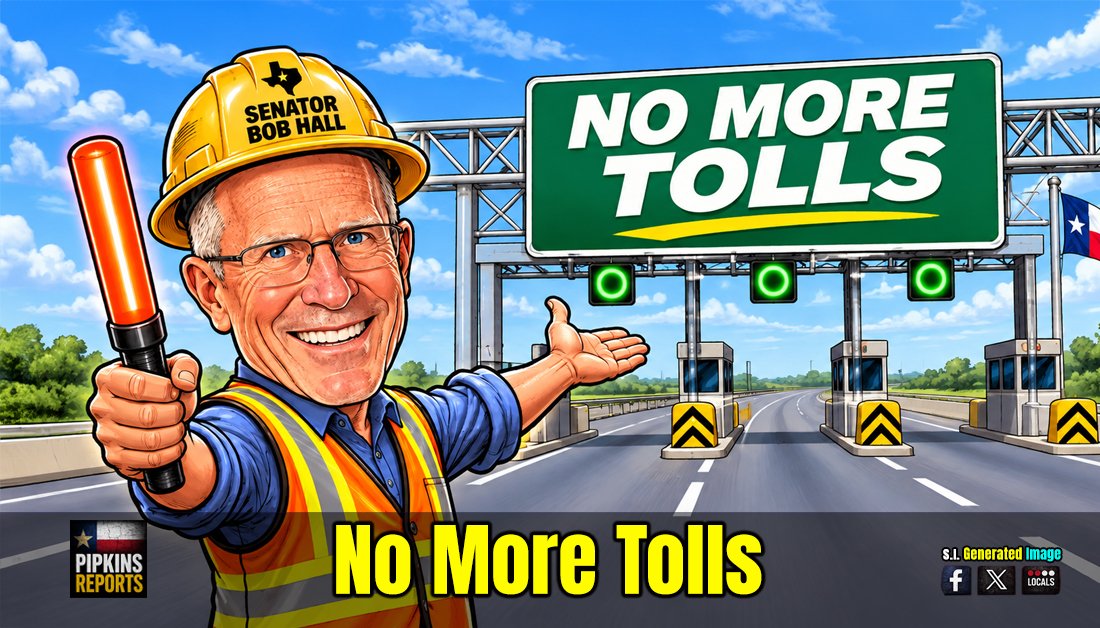
Texas Senator Bob Hall Wants to End Toll Roads

Rockwall, TX – State Senator Bob Hall, a Republican representing Senate District 2, filed Senate Bill 437 on November 19, 2026, ahead of the 90th Texas Legislature. He proposes ending tolls once qualifying construction and financing obligations are satisfied, prohibiting new toll projects, and preventing TxDOT from converting existing free state highways and lanes into toll facilities.
It’s an ambitious proposal. And unlike the usual legislative promises about making life more affordable, this one comes with actual changes to the Texas Transportation Code.
Hall Says Toll Roads Cost Texans More
Hall has been publicly criticizing Texas toll-road policy for months. In a January 14 interview with KLTV in Tyler, he described tolls as a “regressive tax,” arguing that they place a heavier burden on lower-income drivers than wealthy motorists.
“It’s more impactful on the less fortunate than it is on the wealthy,” Hall told KLTV.
He also questioned the expense of maintaining separate tolling entities and their collection operations.
“I think it costs us actually more money in the long run to have an entity doing the tolling and then operating the toll roads and all the expenses that are associated with it be unnecessary,” Hall said.
His proposed alternative was straightforward: “We just need to man up to the fact that roads are going to cost money, and we put that in our normal taxing operation and pay for the roads.“
Those comments came months before SB 437 was filed. They provide some insight into the thinking behind the legislation, although Hall has not publicly explained every financial detail of the new proposal.
Three Major Changes in SB 437
The first provision would require toll project entities to stop collecting tolls once acquisition and construction costs have been paid and all associated bonds and interest have either been paid or secured in a trust fund. The bill also prohibits financing or contractual changes designed to postpone that deadline.
In other words, an operator couldn’t simply restructure its financing to keep a paid-for road collecting tolls indefinitely.
The second provision would prohibit toll project entities from constructing new toll projects or entering into agreements to construct them. Projects already in the procurement process receive protection under the bill’s grandfathering provisions.
The third would restrict TxDOT from converting existing nontolled state highways, including certain general-purpose, exclusive and high-occupancy vehicle lanes, into toll projects.
SB 437 also removes several existing statutory provisions allowing surplus revenue from one toll project to support other transportation projects. That’s a significant change to the financing arrangements used by certain toll authorities.
Who Maintains the Roads After the Tolls End?
Here’s where the legislation gets interesting, and where taxpayers should start asking questions.
SB 437 does not assume every paid-off toll road automatically becomes a state responsibility. Under proposed Transportation Code Section 372.060, the Legislative Budget Board would determine whether the state has sufficient resources to operate and maintain a qualifying project.
A county could also request approval to take over a road. If neither the state nor a county assumes responsibility, the existing operating entity must maintain the road without collecting tolls.
The bill does not appropriate replacement maintenance funding.
And roads don’t maintain themselves. Pavement, bridges, drainage systems, lighting and other infrastructure still require money long after the construction bonds are retired.
The state Comptroller projects the Texas Economic Stabilization Fund, commonly called the Rainy Day Fund, will hold approximately $28.48 billion at the end of fiscal 2027, absent additional appropriations. Whether any portion could legally and practically be used to accelerate toll-debt retirement is a question lawmakers should examine. SB 437 does not propose such an appropriation.
The Other Side of the Argument
Not everyone agrees with Hall’s assessment.
In the January KLTV report, Jori Liu, a spokesperson for the Central Texas Regional Mobility Authority, defended toll roads as a user-fee financing model.
“Tolling is not a tax,” Liu said. “It’s a user fee collected in exchange for a service.“
Liu argued that toll financing allows transportation projects to be built sooner instead of waiting decades for traditional gas-tax funding. She also pointed out that drivers generally retain the option of using nontolled general-purpose lanes.
That’s a legitimate financing argument, but it doesn’t answer the question of how long Texans should continue paying tolls after a road’s construction and financing obligations have been satisfied.
The Fight Is Just Beginning
SB 437 is not law. It has been filed and awaits the legislative process, with the 90th Legislature scheduled to convene January 12, 2027. If passed without the required two-thirds vote in each chamber for immediate effect, the bill would take effect September 1, 2027.
It also directs TxDOT, working with the Legislative Budget Board, to produce a statewide study by September 1, 2028, identifying toll roads, projected toll-cessation dates and estimated operating and maintenance costs.
For Texas drivers, the underlying issue is bigger than a monthly toll statement. It is about how government finances public infrastructure, how long citizens should remain obligated to pay for a project, and whether public authorities are accountable for the money they collect.
A road is infrastructure, not a perpetual subscription service. Texans deserve to know what they are paying for, how much debt remains, and what happens when that debt is gone.
Hall has put the question on the table. Now the Legislature needs to show Texans the numbers.
Questions & Answers
1. What is Texas Senate Bill 437, and who introduced it?
SB 437 is legislation filed November 19, 2026, by Republican State Senator Bob Hall. It proposes ending toll collection after specified construction costs and bond obligations are satisfied, prohibiting new toll projects, and restricting conversion of free state highways into toll facilities.
2. When would Texas toll roads become free under SB 437?
Not immediately. A project would have to satisfy the acquisition, construction and bond repayment requirements, or have sufficient money placed in a trust to cover outstanding bond obligations and interest.
3. Who would pay to maintain Texas toll roads after toll collection ends?
Under proposed Section 372.060, responsibility could transfer to TxDOT if the Legislative Budget Board determines the state has sufficient resources, or to an approved county. Otherwise, the existing operating entity must maintain the road without toll revenue.
4. Has Senator Bob Hall explained why he wants to eliminate toll roads?
Yes. In a January 14, 2026, interview with KLTV, Hall called tolls a “regressive tax” and argued that tolling and operating expenses can make the system more expensive. He advocated paying for roads through conventional public revenue sources.
5. What are the sources for the SB 437 reporting?
The principal references are the introduced text of Texas SB 437, the Texas Legislature’s official filing record, the January 14 KLTV interview with Bob Hall, and the Texas Comptroller’s 2026–27 Certification Revenue Estimate. These sources establish the bill’s provisions, filing status, Hall’s public statements and the projected Rainy Day Fund balance. KLTV, January 14, 2026, Bob Hall interview. KLTV, November 24, 2026, SB 437 report










Texas Election Audit Passes First Test: No Second Round Needed
Austin, TX – Texas has completed its first statewide risk-limiting audit (RLA) of a general election, and the initial results...


Ashley Rains Declares Emergency in Fate
EDITORIAL Fate, TX – Two Fate City Council members, Ashley Rains and Allen Robbins declare a State of Emergency for...


Cornyn Blocks Trump Nomination for Texas Judge Elliot Gaiser
Washington DC – Texas has an important judicial vacancy that could have been filled before Democrats take control of the...
You must be logged in to post a comment Login