State Rep. Andrew Murr Censured for the Third Time; Declines Re-Election Bid

Hatch Smith Enters Race for District 53
State Rep. Andrew Murr (R–Junction) finds himself under the weight of a third censure by the Republican Party of Texas, leading to the decision not to seek re-election in Texas House District 53. Murr, who first assumed office in 2014, recently chaired the House General Investigating Committee, the body that spearheaded the failed impeachment proceedings against Attorney General Ken Paxton.
The latest censure comes on the heels of Murr’s announcement that he would not be seeking re-election, a decision that has left many questioning the state of conservative representation in House District 53.
Murr faced criticism from multiple county parties within his district, with censures from Medina, Bandera, and admonishment from Real County GOP. The grievances cited include his rushed involvement in the Paxton impeachment process, his support for House Speaker Dade Phelan, and votes against school choice and measures to secure elections.
The censure resolution, approved by a resounding 61-0 vote with two abstentions at the State Republican Executive Committee, not only adds another stain to Murr’s political record but also prohibits the party from financing his re-election campaign. It also opens the door for educating voters about the censure.
Despite the mounting challenges, Murr stood firm, maintaining that his actions were in line with the principles of the party. However, this conviction failed to sway the party leadership, and with a heavy heart, Murr decided to forgo seeking re-election.
In the aftermath of Murr’s decision, Hatch Smith, a rancher and conservative businessman, has stepped into the political arena, announcing his candidacy for the Texas House District 53 seat. Smith, a multi-generational rancher in Llano County, brings a wealth of experience in agriculture, business, finance, and management.
Smith, who successfully orchestrated the salvation of a local hospital in Llano, expressed his commitment to problem-solving, a quality he believes will serve the district well. He particularly emphasized his dedication to addressing the challenges posed by the Biden Administration’s border policies and his determination to find Texas-based solutions.
With the Republican Primary election scheduled for March 5 and the general election set for November 5, Hatch Smith’s entry into the race has injected a new dynamic into the political landscape of House District 53. As the countdown to the elections begins, the district anticipates a fresh start under the leadership of a candidate who aligns with conservative values and vows to champion the interests of the constituents.



Election
Texas Senate Hopeful James Talarico Shared Pride Event Stage With 11-Year-Old Child Drag Performer

Federal Court Upholds State Limits on Minors at Adult Drag Shows
Taylor, TX – A federal appeals court has just upheld a Florida law restricting minors from attending certain adult live performances, including some drag shows. Within hours of that ruling, renewed attention was focused on Texas Democratic U.S. Senate candidate James Talarico after reports resurfaced showing he headlined a 2021 Pride fundraiser featuring an 11-year-old child drag performer promoted as one of the event’s main attractions.
On Tuesday, the U.S. Court of Appeals for the 11th Circuit ruled in HM Florida-ORL, LLC v. Secretary of the Florida Department of Business and Professional Regulation, allowing Florida to enforce its law restricting minors from attending certain adult live performances. Florida Attorney General James Uthmeier announced the decision, calling it a victory for protecting children. The ruling does not prohibit drag performances for adults, but it recognizes that states may impose limits when minors are involved.
The timing has drawn renewed scrutiny to Talarico’s record as he campaigns for the U.S. Senate against Texas Attorney General Ken Paxton.
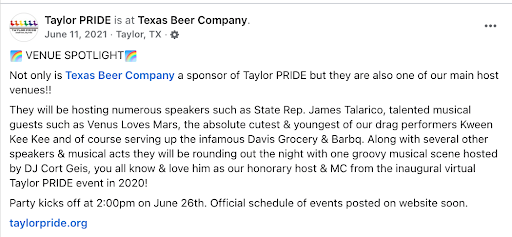
According to promotional materials first highlighted by the Washington Free Beacon, Talarico was a featured speaker during Taylor PRIDE’s June 26, 2021 fundraiser in Taylor, Texas. The event was organized to raise money for “rural LGBTQ communities” and included live music, Drag Story Hour, adult drag performers, and an 11-year-old performer using the stage name “Kween Kee Kee.”
Taylor PRIDE advertised the child as “the absolute cutest & youngest of our drag performers.” Promotional posts stated the child would perform a drag routine and host “Kee Kee Storytime,” where children would participate in Pride-themed craft activities. The event was held at Texas Beer Company.
Photographs published from the event show Talarico addressing attendees from the stage and posing with participants. Additional photographs and video posted publicly show Kween Kee Kee, a local preteen named Keegan, performing in a shimmering blue dress, platinum blonde wig, and theatrical makeup during what organizers described as a Youth Drag Show. One attendee shared video of the child performing the splits before the audience.
The fundraiser also featured several adult drag performers, including Brianna Brinxx, Belladonna Dior, Felecia Enspire, and a performer using the stage name Sedonya Face.
Following criticism from conservative activists who protested the event, Taylor PRIDE defended the festival on social media. The organization rejected claims that the event was sexually explicit or exploitative and encouraged the public to review photographs from the event and decide for themselves.
Talarico’s campaign did not respond to requests for comment from the Washington Free Beacon regarding his participation.
The resurfaced event adds to a broader record that Republicans have highlighted throughout Talarico’s political career. While serving in the Texas House, Talarico opposed legislation restricting drag performances in the presence of children and argued lawmakers should avoid harming what he described as Texas’ drag performers. He has also opposed Republican-backed legislation restricting certain transgender medical treatments for minors and has frequently spoken in support of LGBTQ causes.
More recently, however, Talarico has attempted to present himself as a more moderate statewide candidate. He has described previous remarks, including referring to God as “nonbinary,” as “cringey” and has removed some progressive messaging from campaign materials as he seeks to broaden his appeal beyond Democratic primary voters.
The renewed attention comes as cultural debates surrounding children and drag performances continue playing out both politically and legally. Florida’s appellate court victory represents one of the most significant recent rulings supporting a state’s authority to restrict minors from attending certain adult-oriented live performances, even as litigation over similar laws continues elsewhere.
Council
Fate Council Opens the Door on Executive Session Secrets, Revealing Why Greenberg Was Cleared

Fate, TX – Monday night’s Fate City Council meeting pulled back the curtain on something that had puzzled residents for weeks.
Why would four members of the council vote against finding an ethics violation or imposing sanctions against Mayor Andrew Greenberg after attorney Ross Fischer had concluded there was probable cause to believe Greenberg may have violated the city’s code of ethics?
The answer, it turns out, was hidden behind deliberative privilege that some members of the Fate City Council didn’t want you to know about.
City Council Meeting for June 15, 2026, Agenda items 6G and 6H called for the council to consider waiving attorney-client privilege concerning ethics complaints involving Mayor Andrew Greenberg, former Councilman Mark Harper, and former Councilwoman Codi Chinn… for the June 1st meeting. The council voted 4-2 to waive deliberative privilege and allow discussion of what had previously occurred behind closed doors.
The June 1 vote had left many residents, particularly those of Karen Keiser, who supported the recall effort against Greenberg, confused. Council members had voted 4-2 not to pursue sanctions or make findings of an ethics violation, with Councilman Allen Robbins and Councilwoman Ashley Rains voting in the minority.
What the public, and Mrs. Keiser, didn’t know was that in executive session, there was great disagreement about the Ross Fischer report.
According to a phone interview Pipkins Reports had with Mayor Greenberg on Tuesday, one of the central issues involved allegations that he had improperly disclosed confidential employee information concerning former City DPS Chief Lyle Lombard to this investigative journalist, by releasing audio of a phone conversation he had with Councilwoman Codi Chinn.
In a conversation with Greenberg on Tuesday, Greenberg said that attorneys within the Texas Attorney General’s Office had previously determined that only three minutes (approximately) of an audio recording between Greenberg and Chinn contained personal or confidential information, none of which formed the basis of these ethics allegations as stipulated by Fischer.
Greenberg further argued that Fischer’s conclusions relied on assumptions rather than evidence showing that any “deliberative” information had actually been provided. Even more, Mr. Fischer refused to seek guidance from the Attorney General to determine if any of his assertions about confidential information were actually “deliberative”.
For context, the words, “deliberative information” are in reference to any “confidential” information that city officials might discuss regarding a city employee. But not all information about an employee is to be considered “confidential”, and this is a very important point of the discussion.
Under the Texas Public Information Act (Government Code Chapter 552), information concerning public employees is presumed public unless a statute or recognized exception applies. Merely discussing an employee does not make the information “deliberative” or “confidential”, unless and until the city requests and receives an exemption from the Attorney General. In this case, none of the information alleged by Mr. Fischer was determined by the Attorney General to be “confidential” or permitted to be withheld.
Sidebar: How did Autumn Lobinsky know what was in those three minutes that were never released to the public?
Texas Government Code §552.111 protects certain interagency and intra-agency memoranda reflecting advice, recommendations, opinions, and policymaking discussions. This is often called the “deliberative process privilege.”
However, the exception generally applies only to communications involving policymaking, not routine personnel matters. The Texas Attorney General has repeatedly distinguished between:
- Policy deliberations → potentially protected.
- Routine administrative or personnel matters → generally not protected.
Thus, discussions about: performance evaluations, discipline, complaints, hiring decisions, salary matters, are not automatically considered to be “deliberative information.”
Therefore, the Council Members argued in executive session that Fischer failed to make the case that the information exchanged met those qualifications.
Furthermore, Fischer’s investigation provided no other corroborating evidence.
Emails between Michael Pipkins and Ross Fischer show that Fischer sought information from Pipkins concerning the investigation. In a May 27 email, Fischer volunteered to Pipkins that Greenberg had acknowledged allowing Pipkins access to the recording, and asked whether Greenberg had provided a copy or merely played portions of the audio.
(Would Fischer’s release of information to Pipkins about his conversation with Greenberg be a release of confidential information? )
Regardless, Pipkins declined to answer, citing journalistic policy and the protection of confidential sources absent a subpoena or court order. Fischer then acknowledged to Pipkins that Greenberg had admitted playing portions of the recording and indicated he was attempting to verify Greenberg’s account. Part of this exchange was cited in Fischer’s report. We are providing the full context of the email exchange below.
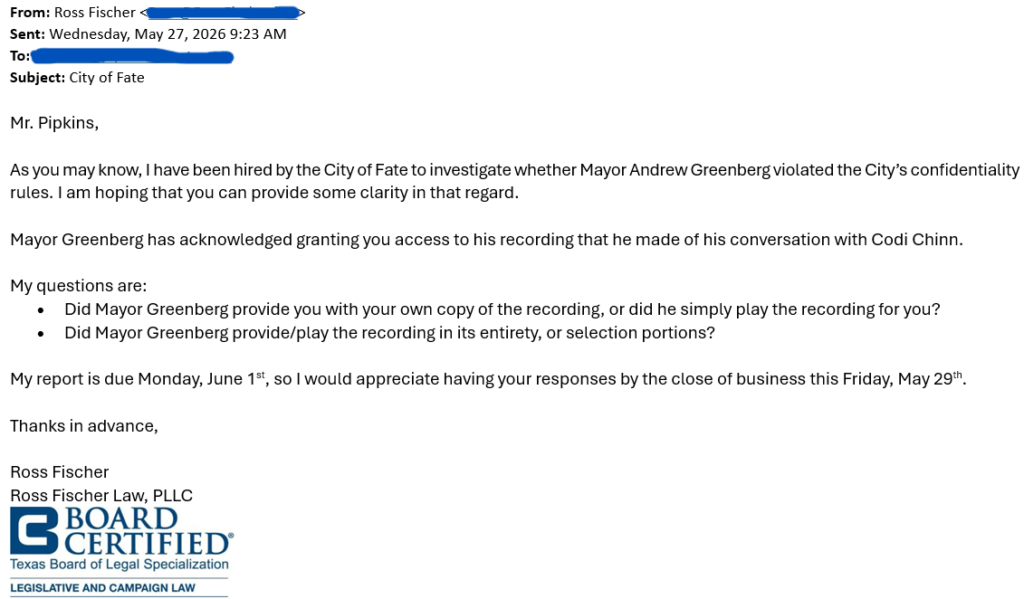
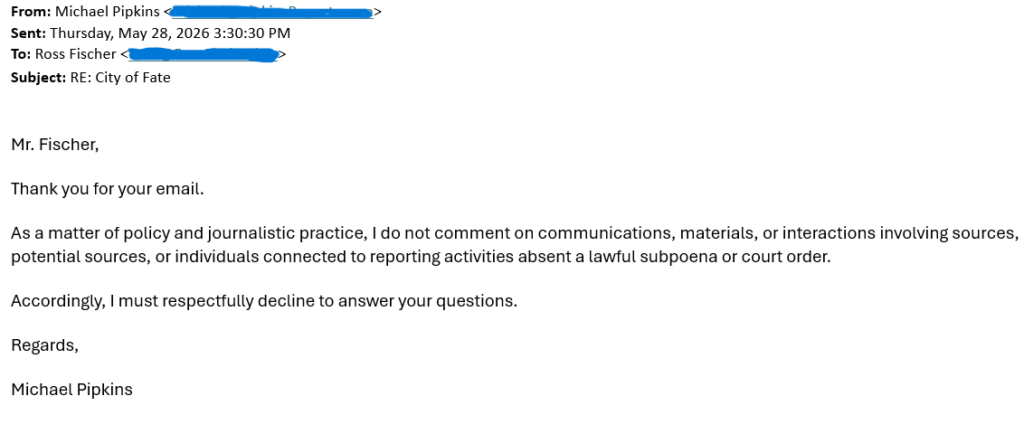
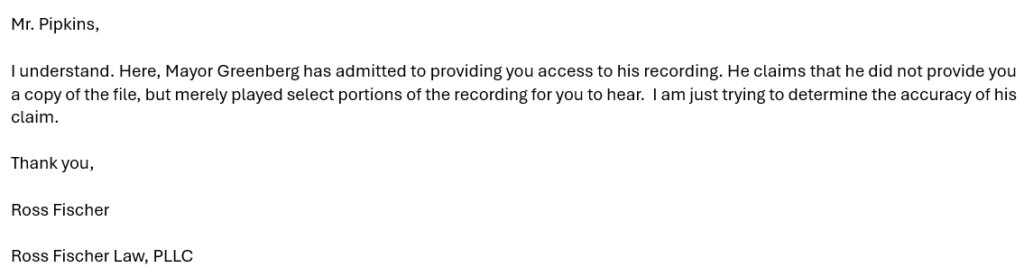
[Email Exchange Between Ross Fischer and Michael Pipkins]
According to Greenberg, no evidence was produced showing that any of the information disclosed by Greenberg was in fact, “deliberative information” (ie: confidential). Yet, Mr. Fisher’s report would go on to recommend that he violated the City’s Code of Ethics, regardless of the actual fact that none of the information had been, or would be, considered privileged.
“Conclusion. Assuming Mayor Greenberg’s response is accurate, he still released deliberative information about personnel decisions a month before Council waived that
privilege. Based on Mayor Greenberg’s admissions alone, there is credible evidence that he violated Section 2-309(6) of the City’s Code of Ethics.”
Ross Fischer Report
[Copy of the report by Ross Fischer. ]
Armed with information that the report was potentially faulty, four members of the council ultimately voted against finding a violation or imposing sanctions against Greenberg. Now we know why the council voted the way they did.
Meanwhile, another controversy emerged during public comments in the June 15th meeting.
Residents Lance and Lorne Megyesi addressed the council concerning the ongoing recall effort. While Lorne attempted to chastise and lecture the council, Lance cited Sections 3.06 and 3.10 of the City Charter and argued that government could continue functioning even if four council members are removed in November.
Section 3.06 clearly states that a quorum must consist of four council members. while Section 3.10 indicates that a majority of the council is considered a quorum.
“Governments cannot be allowed to collapse due to vacancies,” Megyesi told the council.
Megyesi argued that a group smaller than the normal quorum would possess limited authority to restore a quorum through appointments or by ordering an election. He further stated that a Texas Attorney General opinion supported that position, though he provided no opinion number or supporting document to substantiate his claim, and the evidence discovered by Pipkins Reports, indicates the exact opposite.
As a relevant sideline, former Mayor David Billings recently advanced a similar argument in a Rockwall Times opinion piece titled “The City Will Go On,” arguing that a successful recall would not halt Fate city government.
That assertion, however, has drawn criticism from residents who argue that elected offices are far more than ceremonial titles, as the former “retired” mayor would suggest.
Under Section 2.09 of the City Charter, the City Council possesses authority to compromise and settle claims and lawsuits involving the city. (ie: Wrongful Termination Lawsuits). Section 2.13 authorizes the council to require bonds from city officials and employees. (ie: New hires) The council also possesses authority over appointments and hiring decisions involving key city personnel.
Critics note that if a loss of quorum persisted and the city manager, city secretary, or city attorney departed unexpectedly, there would be no mechanism for replacing those positions without council action. And without a quorum, that simply can’t happen.
The mayor’s office also carries real statutory responsibilities beyond just presiding over meetings.
Under Section 32-45 of the city code, the mayor serves as floodplain administrator or appoints a designee. In addition, Section 10-20 establishes the mayor as the city’s emergency management director. What happens if the City suffers a natural disaster?
Billings argues that essential functions of government would continue and that legal mechanisms exist to preserve continuity. Opponents counter that continuity and normal governance are not the same thing.
Consider the precedent of the 2004 Haltom City recall, where the recall and loss of a quorum of five of seven council members effectively halted normal council operations for three months (Feb – May) until elections restored the vacancies. In that situation, Attorney General Opinion GA-0175, concluded that recalled officials did not hold over and that the city effectively was without a quorum until elections restored the vacancies.
Haltom City’s Charter is not that different to that of Fate.
Critics of the recall note that Fate could face an even longer period of uncertainty. If four members were removed in November and vacancies were not filled until the next uniform election date in May, the city could potentially spend roughly six months without a fully functioning council… unless a district judge were to step in and order an election.
While day-to-day city services would likely continue, critics argue that Billings characterizing the loss of a majority of the governing body as little more than an inconvenience understates the practical consequences. Settlements, appointments, policy decisions, and unforeseen emergencies do not operate on election calendars.
And while contingency plans can be devised for almost anything, critics contend that improvisation in the middle of a crisis is hardly the same thing as having a fully functioning government.
Government may survive without a quorum. Haltom City proved that. But survival and governance are not the same thing, and it is the citizens who will suffer by being caught in the middle.
Opinion
There is something remarkable about the coalition that has formed around the effort to remove Mayor Andrew Greenberg and three sitting council members, Mark Hatley, Martha Huffman and Rick Maneval.
Councilwoman Ashley Rains and Councilman Allan Robbins support the effort. Former Mayor David Billings supports the recall and uses his platform to assert that the city government would continue uninterrupted after a successful recall. Former Councilman Lance Megyesi and his brother, former Mayor Lorne Megyesi, support the recall and have publicly discussed their own legal theories concerning how a reduced council might restore a quorum through “appointments”. Former Councilman Mark Harper and former Councilwoman Codi Chinn have likewise remained active voices in the city’s political battles.
Residents can draw their own conclusions, but the cast of characters is familiar. These are all current and former officeholders; they are all political allies; they are all responsible for the current state of social unrest as well as the development disaster that grips Fate at this time. And they have all united in a common cause to oust the current council and restore their power. They appear to be, to a common observer, as bitter, angry individuals hell-bent on revenge. Their childish antics on social media and feigned outrage at the podium are proof of that.
Make no mistake, these are not strangers united by coincidence. They are experienced political figures with a common bias and a shared interest in their vision of the future direction of the city. A vision that does not match that of the current council majority. In my opinion, citizens are witnessing an orchestrated coup in real time. Many people don’t even know that they are being manipulated by a group of washed-up, failed politicians.
Supporters of the recall have been convinced that they are trying to save Fate from an unethical council. And supporters of the current council argue the exact opposite. They see the current recall effort and false ethics complaints as an attempt by a network of present and former officials to reverse political defeats that occurred at the ballot box.
Why is it that the new and former members of the Council consistently advocate for Less Open Government, instead of More Open Government? Why are their supporters so angry and hateful on social media?
One fact should concern every voter, regardless of whose sign sits in their front yard.
This group organizing the recall is already trying to steer the conversation away from whether four officials should be removed to what happens afterward, how a quorum could be restored, and what powers a reduced council might possess. That is not an academic debate. It is a debate about who governs. And they are positioning themselves to be “appointed” to fill that gap.
And that’s where citizens should become very skeptical.
Because in a republic, political power is supposed to flow from elections, not from creative interpretations, procedural maneuvers, or the hope that voters won’t notice the difference.
The people of Fate have every right to vote to remove elected officials, or to retain them, as they see fit when they go into the polling place.
But when people go into that voting booth, they should take stock of which side has been fighting for actual transparency, reporting facts, and working to do what is right for the citizens, and which side is for keeping things behind closed doors, acting like children … and trying to stir up anger among the citizens.

OPINION
California – Don’t expect a dramatic press conference from the Trump administration declaring California’s elections clean. More likely, the investigations will quietly fade into the background and eventually disappear from the headlines without any grand conclusion.
In my view, that outcome is almost inevitable. The reason is simple. California’s election laws have been written in such a way that many practices critics consider vulnerable to abuse are perfectly legal. If the conduct itself is authorized by law, federal investigators are unlikely to ever establish the kind of “widespread fraud” that many Americans are expecting them to uncover.
President Donald Trump recently accused Democrats of cheating in California’s primary election, prompting First Assistant U.S. Attorney Bill Essayli to announce that his office and the FBI have multiple election fraud investigations underway in Los Angeles. Essayli’s office also confirmed that Assistant U.S. Attorney Robert Renner visited a Los Angeles County ballot processing center to observe the vote counting process. Reports described the visit as routine and similar to those available to members of the public.
Those comments may sound encouraging to voters concerned about election integrity. But they are likely to produce exactly what previous investigations have produced … years of unanswered questions … followed by silence.
California Elections Code Section 3017 allows a voter who is unable to return a ballot to designate another person to do so. The designated person may hand deliver the ballot or place it in the mail. Criminal penalties exist for bribery, intimidation, tampering, and fraud, but the collection and delivery of ballots by third parties is itself legal.
Supporters argue the practice improves access for elderly and disabled voters. Critics call it legalized ballot harvesting.
Under California law, political organizations, activists, churches, unions, or nonprofit groups may legally collect ballots from voters. If investigators discovered nonprofit groups organizing ballot collection efforts among homeless populations, it would not automatically constitute criminal conduct. Unless prosecutors could prove bribery, coercion, or tampering, much of the activity critics complain about would be perfectly lawful.
Fox 11 recently reported that Essayli referenced a case involving a Marina del Rey woman accused of paying individuals, including homeless people on Skid Row, to register to vote. Brenda Lee Brown Armstrong, 64, also known as “Anika,” pleaded guilty to one federal count of paying another person to register to vote. She faces up to five years in prison when she is sentenced Aug. 31.
Authorities have not alleged that the conduct affected statewide races. Nevertheless, the case highlights concerns long raised by election integrity advocates.
Even if investigators were to uncover isolated examples involving ballots cast in the names of deceased individuals or by noncitizens, history suggests such cases would be treated as individual violations rather than evidence of a larger conspiracy. Officials and media outlets would almost certainly characterize them as statistically insignificant and insufficient to alter election outcomes.
Likewise, even if prosecutors managed to bring a handful of cases involving illegal voting, supporters of the system would likely point to those prosecutions as evidence that the safeguards are working. Critics, meanwhile, would argue that the cases merely expose vulnerabilities that are impossible to quantify.
That is because proving widespread election fraud requires more than finding isolated violations. Prosecutors would have to establish a coordinated effort on a massive scale. Such a burden is extraordinarily difficult to satisfy, especially after ballots have been separated from identifying information and mixed with millions of legitimate votes.
Critics need look no further than the Los Angeles mayoral race to understand why public confidence has eroded. Councilmember Nithya Raman climbed into second place on June 7, overtaking Spencer Pratt as post Election Day ballots continued to be counted. To skeptics, the distribution of those later ballots appeared anomalous, with Raman benefiting disproportionately while neither Karen Bass nor Pratt experienced comparable gains.
Some election integrity advocates view such swings as evidence that California’s system invites speculation that ballots collected through organized harvesting operations could be strategically submitted over time. There is no publicly available evidence demonstrating that such conduct occurred in this race… but the inability to either prove or definitively disprove those suspicions is itself part of the criticism leveled against California’s election laws.
The real debate, in my view, is not whether California elections are run according to the law. They are. The debate is whether the law itself creates conditions that make abuses difficult to detect and nearly impossible to prove after the fact.
That is why Bill Essayli’s statements strike me as little more than empty words. Announcing investigations sounds impressive, but prosecutors cannot prosecute conduct that lawmakers have already legalized. They cannot declare ballot harvesting fraudulent when California law expressly permits third party ballot collection.
Reuters and other news organizations have noted that election officials insist there is no evidence supporting claims of widespread fraud in the governor’s race or the Los Angeles mayor’s race. They may very well be correct according to the legal standards that currently exist. But that misses the point entirely.
Critics are not necessarily claiming that large numbers of people are breaking California law. They are arguing that California lawmakers have constructed a system that places convenience ahead of transparency and verification.
And if the rules themselves permit the conduct, federal investigators should not expect to uncover some giant criminal enterprise hiding in plain sight.
The most likely outcome is not a bombshell report. It is a slow fade. The investigations will drift out of public view, the headlines will move on, and Californians will continue voting under the same rules that produced the controversy in the first place.
Whether those rules deserve the public’s trust is another matter altogether.
Sources: California Elections Code §3017; Los Angeles Times; ABC7 Los Angeles; Fox 11 Los Angeles; Reuters.
You must be logged in to post a comment Login