
Recall Roulette: How a “Successful” Fate City Hall Purge Could Freeze the City in Place

FATE, Texas — A growing recall effort targeting four of the seven members of the Fate City Council is being framed by supporters as a necessary corrective to alleged misconduct. But if the effort succeeds, the consequences could extend far beyond a reshuffling of elected officials. In fact, under a straightforward reading of municipal governance rules and typical Texas city procedures, a full recall victory could leave Fate functionally unable to govern itself for months.
At the center of the issue is a simple but critical number: FOUR. That is both the number of council members being targeted and the number required to maintain a quorum on a seven-member council. Remove all four at once, and the remaining body drops to three—below the threshold needed to legally conduct city business.
What follows is not a political argument, but a procedural reality with tangible implications for residents, developers, and city operations.
What Happens If the Recall Petition Succeeds
If recall organizers gather enough valid signatures under the city’s charter, the targeted officials would be placed on the ballot for a recall election, likely in November. Voters would then decide whether each of the four officials should be removed from office.
If voters reject the recall, the matter ends there.
But if voters approve all four recalls, the result is immediate and structural: upon canvassing of the election results, those four seats are vacated simultaneously.
That leaves three sitting council members—insufficient to meet quorum requirements.
The Quorum Problem: Government at a Standstill
In Texas municipalities, a quorum is generally defined as a majority of the governing body. For a seven-member council, that means at least four members must be present to conduct official business.
Without a quorum, the council cannot:
- Pass ordinances
- Approve budgets or expenditures
- Conduct public hearings
- Approve or deny development applications
- Rule on zoning or land-use changes
- Hear appeals on code enforcement actions
- Enter into contracts
- Take formal votes of any kind
In short, the machinery of local government STOPS.
Routine administrative functions carried out by staff may continue in a limited capacity, but any action requiring council approval would be frozen.
Two Possible Paths Forward—and Both Have Consequences
Once a quorum is lost, Fate would face two options, neither of which provides an immediate solution.
Option 1: Wait Until the Next Regular Election (May)
One possibility is that the city simply waits until the next scheduled municipal election in May to fill the vacant seats.
This approach avoids the cost and complexity of a special election, but it comes with a significant downside: a governance vacuum lasting several months.
From November to May, the city would effectively operate without a functioning legislative body. During that period:
- No new development projects could receive approval
- Zoning changes would be stalled indefinitely
- Builders and investors would face uncertainty or delay
- Residents would have no elected body to address grievances requiring council action
- ZERO Budget adjustments or emergency appropriations could not be made. Without a budget for the upcoming fiscal year, layoffs might ensue. DPS might lose equipment. The new buildings can’t go forward. For a fast-growing city like Fate, such a pause could have ripple effects across the local economy.
Option 2: Seek a Court-Ordered Special Election
Alternatively, the city could petition a court to authorize a special election to fill the unexpired terms.
This route is more proactive but still far from immediate.
The process would likely involve:
- Legal action to establish the need for a special election
- Court review and issuance of an order
- Coordination with election authorities
- Scheduling and conducting the election
Even under an expedited timeline, this process could take weeks or months, during which the city would still lack a quorum.
In other words, while a special election may shorten the disruption, it does not eliminate it.
The Development Freeze: Real-World Impact
One of the most immediate and visible consequences of a non-functioning council would be a halt in development activity.
Fate, like many North Texas cities, relies on council approvals for:
- Site plans
- Plat approvals
- Zoning changes
- Variances and special exceptions
Without a quorum, none of these items can move forward.
Developers could find themselves in limbo, unable to proceed with projects that may already be in progress. That uncertainty can lead to:
- Delayed construction timelines
- Increased costs
- Potential withdrawal of investment
- Lawsuits against the city
For a city positioning itself for controlled growth, even a temporary freeze could have lasting effects.
Zoning, Enforcement, and Appeals: No Relief Valve
Beyond development, the absence of a quorum would also affect everyday governance.
Residents seeking to:
- Appeal zoning decisions
- Challenge code enforcement actions
- Request variances or accommodations
would have no forum for resolution.
This creates a situation where administrative decisions stand without recourse, not because they are unchallengeable, but because the body that hears those challenges cannot convene.
Budgetary Constraints and Financial Oversight
Municipal budgets are not static documents. Councils routinely:
- Amend budgets
- Approve expenditures
- Allocate funds for unexpected needs
Without a quorum, these functions are suspended.
While some essential services may continue under previously approved budgets, the city would have limited flexibility to respond to changing conditions.
Representation Gap: Citizens Without a Voice
Perhaps the most fundamental issue is representation.
City councils serve as the primary interface between residents and local government. They are the venue where citizens:
- Speak during public comment
- Petition for change
- Hold officials accountable
If the council cannot meet, that channel effectively disappears.
For months, residents could find themselves without a functioning body to hear concerns or take action.
A Structural Risk, Not a Hypothetical One
The scenario outlined here is not speculative in the abstract—it is a direct consequence of how quorum requirements and recall mechanisms intersect.
Recall is a legitimate democratic tool, designed to give voters a mechanism to remove officials they believe are not serving in the public interest.
But like any tool, its use carries consequences.
When applied to a majority of a governing body simultaneously, recall has the potential to disable the very institution it seeks to reform, at least temporarily.
The Central Question for VotersAs the recall effort unfolds, voters may ultimately face a decision that goes beyond the merits of individual officials.
The question becomes:
- Is the perceived benefit of removing four council members worth the potential for a months-long interruption in city governance?
That is not a legal question, but a practical one—one that weighs accountability against continuity.
Conclusion: Accountability vs. Continuity
Be careful what you wish for, you might get it. The Fate recall effort highlights a tension inherent in local governance: the balance between holding officials accountable and maintaining the continuity of government operations.
A successful recall could achieve the former, but at the cost of the latter—at least in the short term.
For residents, businesses, and stakeholders, the implications are clear. The outcome of the recall, if it proceeds, will not only determine who sits on the council, but whether the council can function at all in the months that follow.



Fate Council Dropped Case Before Reviewing
Fate, TX — An ethics investigation commissioned by the City of Fate concluded that former Councilwoman Codi Chinn violated the City’s Code of Ethics before the City Council voted earlier this month to discontinue the matter, according to documents obtained by Pipkins Reports through an Open Records Request.
The report, prepared by attorney Laura Mueller of the law firm Baker, Robertson & O’Brien, found that the allegation against Chinn was “substantiated, but with mitigating factors.”
The Executive Summary states:
“After investigation, my determination is that allegation of a violation of the Ethics Code is substantiated, but with mitigating factors.”
The report concludes that Chinn violated Section 2-309(10) of the City’s Code of Ethics after directing City employees to provide their concerns to her in writing.
“After reviewing the Charter, the Code of Ethics, and reviewing all of the evidence, my conclusion is that Ms. Chinn violated Section 2-309(10) of the Code of Ethics when she directed employees to provide information to her in writing.”
Mueller also concluded that mitigating circumstances should be considered because Chinn immediately informed City Manager Michael Kovacs about the employee concerns and because the employees ultimately submitted their written complaints directly to the City.
Council Ends Investigation
The ethics complaint summary report was scheduled to appear on the July 6 City Council agenda for executive session discussion.
Instead of going into Executive Session, the Council waived deliberative privilege and discussed the matter in open session where they ultimately voted to discontinue the ethics proceedings and drop the matter, before being presented with the findings from Mueller.
The Council did not impose any sanction against Chinn.
The following day, Pipkins Reports requested a copy of the complaint and the investigative report, and received it through an Open Records Request.
Investigation Details
According to the report, investigators interviewed Chinn, Councilman Mark Harper, City Manager Michael Kovacs, and other witnesses.
Regarding the allegations, Mueller wrote:
“In my interview with Ms. Chinn and Mr. Harper, we discussed the allegation. I questioned Ms. Chinn about her conversations with city employees and with Mr. Kovacs.”
According to the report, Chinn stated that city employees approached her seeking assistance and that she intended to present their concerns to the City Manager after compiling the information.
However, the report states that employees instead prepared a letter addressed to the City Council. Chinn then instructed them to provide the letter directly to the City Manager.
The report also summarizes Kovacs’ account of the events.
“Mr. Kovacs stated that he received the letter outlining the employee issues directly from an officer, but with the understanding that the information was given to him at the direction of Ms. Chinn.”
Previously, it was reported that Chinn provided a copy of an, “anonymous letter”, that she claims was provided by DPS officers to her. Chinn further states that she sent the letter to Michael Kovacs … who then forwarded it on to the rest of the Council. This report also states that Kovacs told investigators he had warned Chinn against communicating with employees in that manner.
Pipkins Reports continues to investigate this aspect of the situation … as the conditions shed new light on the events that have transpired with regard to the termination of DPS Chief Lyle Lombard.
Meanwhile, the city council’s decision effectively ended the ethics proceeding against Chinn without imposing any sanction or issuing any formal determination of its own regarding the investigator’s findings. While the Council possessed the authority to discontinue the matter, the decision also brought the ethics process to a close despite an independent investigation concluding that a violation of the City’s Code of Ethics had occurred.
For the complainant, Darcy Gildon, the Council’s action marked the end of a process that resulted in no public accountability beyond the release of the investigative report which Pipkins Reports has now provided.
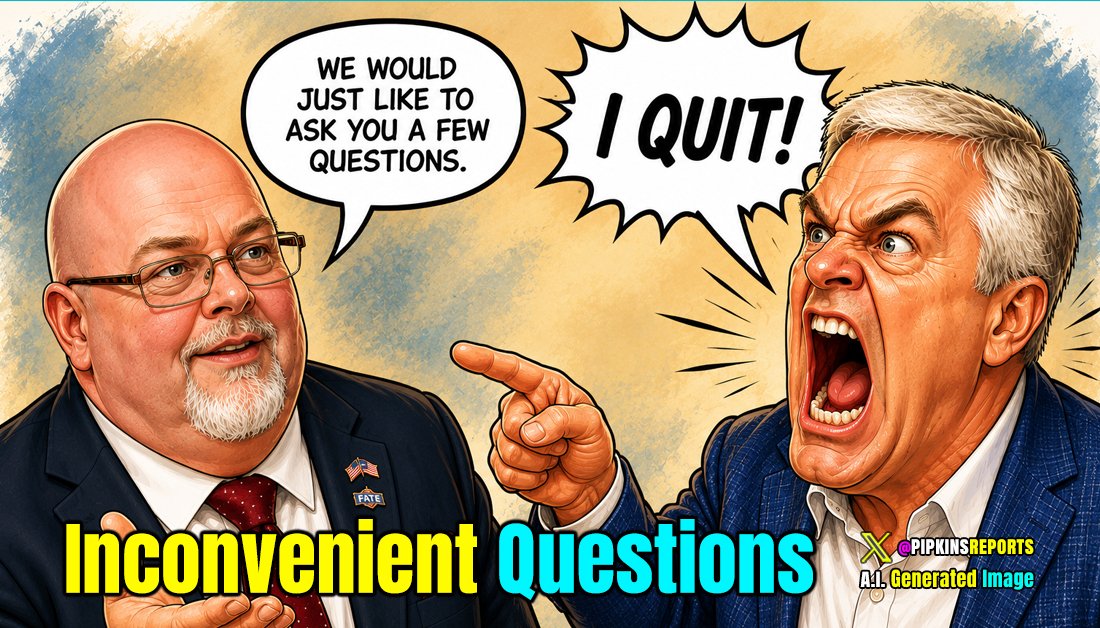
Fate, TX – Just hours after Fate city leaders submitted a list of pointed legal questions to the city’s law firm, Messer Fort notified the city it was resigning as legal counsel.
Now, Mayor Andrew Greenberg has released those unanswered questions to the public, saying residents deserve to see exactly what city officials were asking before the firm’s departure.
The release comes amid months of political turmoil inside Fate City Hall. Since the recall of former Councilwoman Codi Chinn, ethics complaints have been filed against Mayor Andrew Greenberg and Councilman Mark Hatley, while they and two other current council members now face recall elections of their own, backed by political opponents, including Councilwoman Ashley Rains, Councilman Allen Robbins, and former Councilman Scott Kelley, along with former Mayor David Billings.
Messer Fort had been hired by the City of Fate to serve as its contracted city attorney in place of employing a full-time in-house attorney. Jennifer Riche has been the attorney from that firm who has represented Fate directly. During Messer Fort’s tenure, the firm became deeply involved in several high-profile disputes, including ethics investigations, Public Information Act requests, and legal advice surrounding those matters.
According to a statement released by Greenberg, Messer Fort invited council members to submit any questions they had regarding the firm’s representation of the city. The first seven questions were submitted on July 9. Later that same day, the firm informed the city it would resign, effective July 20. Additional questions were submitted before the firm’s departure, but Greenberg said Messer Fort has not responded.
“As I mentioned during today’s City Council meeting,” Greenberg wrote. “I believe transparency is important. In that spirit, I am sharing the questions exactly as they were submitted so our residents can see what information was being requested and judge for themselves.“
The questions cover several issues that have divided the city over the past year, including Messer Fort’s handling of Texas Attorney General rulings on open records requests, the legal basis for redactions made under the Texas Public Information Act, ethics investigations involving elected officials, the firm’s analysis of potential Texas Open Meetings Act issues, and the use of city legal resources in matters questioned by council members. They also seek documentation supporting legal conclusions that influenced city decisions and ethics proceedings.
Rather than releasing only selected excerpts, Greenberg published the complete list of questions submitted to Messer Fort. The documents allow residents to review the requests in full and draw their own conclusions regarding the issues council members wanted addressed before the firm’s resignation.
Editor’s Note: The questions were originally posted as images on Facebook, making them difficult to read and appearing out of sequence. Pipkins Reports reorganized the pages, enhanced readability where necessary, and compiled them into a single PDF so readers can review the complete document in its proper order.

Chinn and Billings Bash Senator Bob Hall
Fate, TX – The political firestorm over secret recordings inside Fate City Hall just took a sharp and deeply ironic turn. Pipkins Reports has obtained an audio recording that appears to show former Fate City Councilwoman Codi Chinn secretly recording a private telephone conversation with former Mayor David Billings, despite her later public criticism of the practice.
The recording, verified through multiple sources familiar with the matter, predates the recent controversy involving Mayor Andrew Greenberg‘s recorded conversation with Chinn and Councilman Mark Hatley‘s recording of a discussion with City Manager Michael Kovacs. The discovery raises uncomfortable questions about consistency, credibility, and whether Chinn’s outrage over recorded conversations has been driven more by politics, than principle.
Pipkins Reports received a copy of a 32-minute audio recording from an anonymous source who said it originated from a recording obtained through an Open Records Request submitted to the City of Fate.
Pipkins Reports has reviewed documentation related to that request and separately confirmed the recording’s authenticity through sources with knowledge of the file maintained by the city.
Much of the conversation centers around mundane talk about MUD districts. Pipkins Reports has edited the recording to a 2-minute, 47-second excerpt focusing on the discussion involving Texas Sen. Bob Hall because it is directly relevant to matters of public interest.
During the conversation, Chinn expresses frustration with Hall’s reluctance to support legislation to strengthen child protection in schools. Stating that he is, “not interested in having that conversation.” She continues, “He is interested in getting people all riled up, but when it comes time to actually do the work, and his job, he’s nowhere to be found.“
Billings echoes that frustration, and opines how he says Bob Hall, “fights dirty“, and how he has voted against cities 9 times. The conversation paints a picture of two local political figures who believe the longtime senator was not sufficiently responsive to their legislative priorities.
The policy disagreements themselves are not especially unusual. Elected officials often criticize one another behind closed doors. What makes this recording different is the hypocrisy of Chinn, stirring up outrage about “secret recordings” when she herself has been a proponent.
The Hall recording is not the only documented instance in which Chinn appears to have secretly recorded a conversation. Through a separate Open Records Request submitted by Pipkins Reports, this publication obtained a city copy of a recorded interview between Michael Pipkins and Chinn concerning her involvement in the dismissal of former Fate Department of Public Safety Chief Lyle Lombard.
That recording also predates the controversy that would inevitably follow.
According to the records produced by the City of Fate, Chinn recorded that interview without disclosing it during the conversation. The existence of multiple recordings attributed to Chinn adds additional context to the current debate over undisclosed recordings by public officials and further raises questions about the consistency between her past actions and her more recent public criticism of the practice.
But according to the evidence reviewed by Pipkins Reports, Chinn appears to have engaged, multiple times, in the very conduct she later condemned.
Texas is a one-party consent state under state law, meaning only one participant in a conversation generally must consent to its recording. If Chinn initiated or participated in the call, recording it would not necessarily violate Texas law. The issue presented here is not primarily a legal one.
It is political.
Opinion
Politics has a funny way of exposing selective outrage.
For months, Fate residents have heard lectures from Codi Chinn about how secret recordings destroy trust, poison relationships, and undermine good government. Fair enough. Those are arguments reasonable people can debate.
But what legitimate purpose would have been gained by Chinn recording a conversation with the Former Mayor?
Given this revelation, it’s possible that the recordings by others that followed Chinn, may have been a defense mechanism (even unconsciously), over a situation that they could feel was off. Couple that with the deceptions that we now know were taking place by Chinn, and other council members, as well as the city manager, and it appears that there might have been a valid justification for both Greenberg and Hatley to take the actions that they did.
There’s another layer here which is important to understand as to why Pipkins Reports chose to clip this section of the audio. Chinn and Billings were not merely venting about Sen. Hall. They were criticizing an elected state senator over legislation affecting Fate, as well as Rockwall County in general, and discussing his approach to measures involving child safety in schools. Voters deserve to hear how public officials truly feel about those issues, and how they discuss those issues when they believe no one else is listening.
This recording doesn’t settle every argument currently consuming City Hall. It does, however, remove any illusion that only one side has participated in private recordings.
Sometimes the loudest critics leave behind the clearest evidence.
Pingback: Recall Petitions Verified Against Four Fate Officials, Elections to Follow – pipkinsreports.com