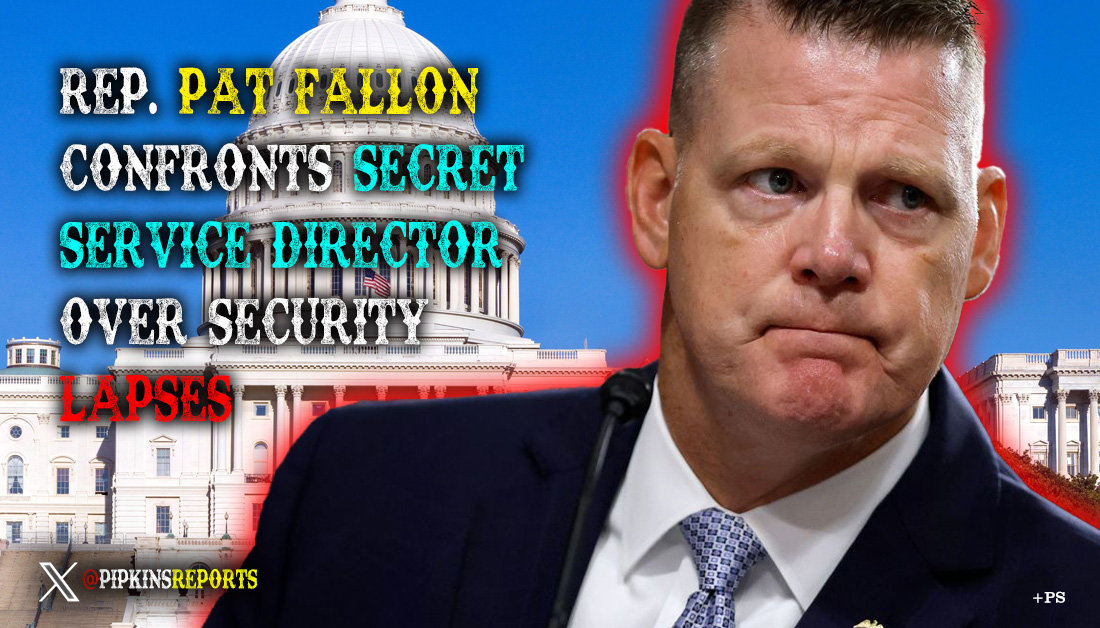
Heated Congressional Clash: Rep. Pat Fallon Confronts Secret Service Director Over Security Lapses
Washington, D.C. — A congressional hearing turned fiery when Texas Republican Rep. Pat Fallon clashed with acting Secret Service Director Ronald Rowe over the agency’s recent controversies and alleged politicization of its operations. The bipartisan task force, investigating assassination attempts on President-elect Donald Trump, convened to scrutinize security failures, but tensions escalated as Fallon accused Rowe of neglecting his duties during a high-profile 9/11 memorial event.
At the heart of the confrontation was a photo of Rowe at the memorial, standing in close proximity to Vice President Kamala Harris, President Joe Biden, and Vice President-elect J.D. Vance. Fallon pointedly questioned whether Rowe’s position compromised the protective detail for Trump, who was also present at the event in New York City.
“Who is usually, at an event like this, closest to the president of the United States, security-wise?” Fallon asked Rowe.
Rowe, deflecting from directly addressing his own role, stated that the special agent in charge (SAC) is typically positioned closest to the president. However, Fallon pressed further, asking if Rowe himself was acting as the SAC during the event. Rowe avoided a clear response, asserting that he attended to honor Secret Service members who perished on September 11, 2001.
Accusations of Politicization
Fallon, a staunch advocate for transparency and accountability within federal agencies, challenged Rowe’s motives for attending the event. He suggested Rowe’s presence near high-profile political figures might signal aspirations to secure a permanent appointment as Secret Service director under the Biden administration.
“This isn’t about showing respect for the fallen,” Fallon said. “You endangered lives—those of President Biden, Vice President Harris, and President-elect Trump—by misaligning your agents. This was a political audition, plain and simple.”
Rowe, visibly agitated, pushed back against Fallon’s assertions, calling them “out of line.” The acting director defended his record, emphasizing his service at Ground Zero after the 9/11 attacks and accusing Fallon of politicizing the tragedy.
“Do not invoke 9/11 for political purposes,” Rowe retorted, raising his voice.
Fallon fired back, refusing to back down. “Don’t try to bully me. I am an elected member of Congress, and I am asking serious questions. You’re playing politics and failing in your duties.”
Fallout from Security Failures
The confrontation comes on the heels of a major scandal for the Secret Service. On July 13, a gunman, Thomas Matthew Crooks, managed to access a rooftop near a campaign rally in Butler, Pennsylvania, and opened fire. President-elect Trump was wounded in the attack, along with two attendees, one of whom later died. The incident highlighted glaring security lapses within the agency, prompting the resignation of former Secret Service Director Kimberly Cheatle.
Rowe, who was appointed as acting director following Cheatle’s departure, admitted to failures during the hearing. “July 13 was a failure of the Secret Service to adequately secure the Butler Farm Show site and protect President-elect Trump,” Rowe stated in his opening remarks. “We did not meet the expectations of the American public, Congress, or our protectees.”
Despite acknowledging these shortcomings, Rowe’s testimony did little to assure lawmakers, particularly Fallon, that the agency had learned from its mistakes. The congressman lambasted Rowe for what he described as a pattern of political maneuvering and lack of accountability.
A Texas Voice for Accountability
For Fallon, a representative known for his commitment to constitutional principles and government transparency, the stakes of the hearing went beyond partisan politics. The Texas congressman argued that the Secret Service’s apparent politicization poses a direct threat to national security.
“This isn’t about partisan loyalty—it’s about whether the American people can trust their government to safeguard their leaders,” Fallon stated after the hearing. “When those in power prioritize personal ambitions over their sworn duties, we all lose.”
Rowe’s future as acting director appears uncertain, with the task force’s findings expected to heavily influence Trump’s eventual nomination of a permanent Secret Service director. As the investigation continues, Fallon has vowed to hold the agency accountable, underscoring the need for reforms that prioritize safety over politics.
The clash between Fallon and Rowe encapsulates broader concerns about trust and integrity within federal agencies, a pressing issue for many Americans—and a rallying cry for constitutional conservatives demanding accountability in Washington.
Featured
Clintons in Contempt
WASHINGTON, DC — The Clinton political machine, long accustomed to dictating the terms of engagement, ran headlong this week into an institution that does not negotiate its constitutional authority. In a rare and politically explosive move, the House Committee on Oversight and Government Reform voted on a bipartisan basis to advance contempt of Congress resolutions against former President Bill Clinton and former Secretary of State Hillary Clinton for defying lawful subpoenas tied to the Jeffrey Epstein investigation.
The January 21 vote clears the way for the full House to consider whether to formally hold the Clintons in contempt, a step that could result in criminal referrals to the Department of Justice. While neither Clinton has been accused of a crime related to Epstein, lawmakers framed the issue more narrowly and more starkly: whether elite political figures are subject to the same compulsory process as everyone else when Congress demands sworn testimony.
The subpoenas arise from Congress’s ongoing investigation into how Epstein operated a vast international sex trafficking network for years while avoiding meaningful accountability. Epstein allegedly died by suicide in a New York jail in 2019 as he awaited trial, but subsequent court filings and document releases revealed his deep and troubling access to political, financial, and cultural power centers. Bill Clinton, and numerous other influential figures appear in those records.
Oversight Committee Chairman James Comer, R-Ky., said the subpoenas issued to the Clintons were approved unanimously last summer by Republicans and Democrats alike. Bill Clinton’s deposition was initially scheduled for October 14, 2025, then moved to December 17, and later reset for January 13, 2026. Hillary Clinton followed a similar trajectory, declining multiple proposed dates before failing to appear for a January 14 deposition. In each instance, the committee said it offered flexibility if the Clintons would propose firm alternative dates. They did not.
Instead, the Clintons’ attorneys countered with what Comer described as an unacceptable proposal. Under that offer, Comer would travel to New York to speak with Bill Clinton alone, without placing him under oath, without producing an official transcript, and without allowing other members of Congress to participate. Comer rejected the proposal, arguing that it amounted to special treatment unavailable to any other witness.
“Subpoenas are not mere suggestions,” Comer said during the hearing. “They carry the force of law and require compliance.”
The committee emphasized that sworn, transcribed testimony is essential to transparency and accountability. Oversight investigators have already released transcripts of interviews with former Attorney General Bill Barr and former Labor Secretary Alex Acosta, both of whom had direct dealings with Epstein during earlier stages of his prosecution. Allowing the Clintons to substitute informal conversations or written statements, Comer argued, would erode the integrity of the investigation and leave the public dependent on competing recollections rather than a fixed record.
Democrats on the committee were divided. Some argued the subpoenas lacked a legitimate legislative purpose, while others conceded that Congress cannot selectively enforce its authority based on party loyalty. Rep. Robert Garcia of California said no current or former president should be categorically immune from oversight. Several Democrats stressed that full transparency in the Epstein case demands uniform standards, even when politically inconvenient.
Recent history undercuts claims that contempt powers are merely symbolic. Steve Bannon, former Trump campaign and White House strategist, was convicted in 2022 of contempt of Congress after defying a subpoena from the House January 6 committee. Peter Navarro, another former Trump White House adviser, was likewise charged and later imprisoned after refusing to provide testimony to the same panel. Both cases demonstrated that contempt citations can and do result in criminal penalties, including incarceration.
The Clintons have argued through counsel that the subpoenas are invalid and that they possess little relevant information. In a letter to the committee, they described Epstein’s crimes as “horrific” and said they had cooperated in good faith by offering written declarations outlining their limited interactions with him. The committee rejected that approach, noting that Hillary Clinton’s tenure as secretary of state gives her direct knowledge of federal anti trafficking initiatives and that both Clintons maintained documented personal and social ties to Epstein and his associate Ghislaine Maxwell.
Historically, contempt of Congress has been used sparingly, particularly against high profile political figures. No former president has ever been successfully compelled to testify before Congress. However, legal analysts note that the Clintons are private citizens and cannot claim executive privilege protections that might apply to a sitting president.
The contempt resolutions now move to the full House, where passage will require a majority vote. Even if approved, the Justice Department retains discretion over whether to pursue prosecution. That uncertainty has not dampened the broader significance of the moment.
At its core, the dispute is not about partisan score settling or retroactive guilt. It is about whether Congress’s investigative power means what the Constitution says it means. For decades, the Clintons operated within a political ecosystem that treated them as exceptions. The Oversight Committee’s vote suggests that era may be ending.
If subpoenas bind only the unfavored and the powerless, they bind no one at all. The House must now decide whether the rule of law applies equally, even when the names on the subpoena are Clinton.
Election
Recall Moves Closer: Signatures Verified. Recall Election of Codi Chinn Moves Forward
Fate, Texas — The City of Fate has completed its review of the recall petition targeting City Councilwoman Codi Chinn, formally verifying the petition as valid and clearing the way for a recall election to be ordered by the City Council.
City officials confirmed that 396 signatures from registered Fate voters were verified and accepted, exceeding the 351 signatures required under the city’s home rule charter. With the verification process complete, the matter now advances to the City Council on Monday, January 26th, which is legally required to call a recall election in accordance with Texas election law.
Under the charter, the action is administerial and the council has no discretion to reject or delay a properly presented petition. Chinn will be given an opportunity for a hearing to address the council, if she chooses, but it will not change the fact that a recall election must be held.
A Stark Electoral Comparison
The verified signature count carries added political significance when viewed against the backdrop of Chinn’s original election.
In June 2024, Chinn prevailed in a runoff election against challenger Cinnamon Krause, winning by a margin of 835 votes (56.92%) to 632 votes (43.08%). The recall petition, which gathered over 400 signatures in approximately one week, represents almost half the total number of votes Chinn received citywide in her election.
While a recall petition is not a direct proxy for voter intent, the comparison underscores the speed and scale of the opposition effort, as well as citizen dissatisfaction with Chinn, particularly in a city where municipal turnout is typically modest and electoral margins are measured in the hundreds, rather than the thousands.
From Certification to the Ballot
With the petition signatures verified and considered “Sufficient”, the recall effort now enters its next—and most consequential—phase. If the council follows the standard timeline, the recall election is expected to be placed on the May ballot, coinciding with regularly scheduled municipal elections for City Council Place 2 (Mark Harper) and Place 3 (Scott Kelley).
Harper and Kelley have not yet announced if they intend to run for reelection.
The recall ballot will present voters with a single question: whether Codi Chinn should be removed from office before the expiration of her term in May 2027. A simple majority is required for removal. If the recall succeeds, the resulting vacancy would be filled by appointment of the council. If it fails, Chinn would retain her seat for the remainder of her term.
Election
Texas AI Attack Ad Sparks Outrage After Showing Jasmine Crockett and John Cornyn Dancing “Washington Waltz” in Heated Senate Race
AUSTIN, Texas — A controversy over the use of artificial intelligence in political advertising has erupted in the Texas U.S. Senate race, after a newly released AI-generated video depicts Congresswoman Jasmine Crockett and Senator John Cornyn dancing together in stylized scenes meant to satirize their relationship in Washington, D.C. The ad, issued by Texas Attorney General and GOP Senate contender Ken Paxton’s campaign, has drawn criticism from across the political spectrum and underscored growing concerns about the use of synthetic media in elections.
The ad, which circulated online beginning around January 16, 2026, shows AI-rendered versions of Crockett and Cornyn engaged in choreographed dancing inside what appears to be a dance hall and in front of the U.S. Capitol. According to reporting, the visuals are meant to reference past remarks in which Cornyn described Crockett as his “dance partner” in the Senate in a metaphorical sense, highlighting their occasional bipartisan cooperation.
What Happened
Ken Paxton’s campaign released the ad titled “Partner” as part of his broader effort to define Cornyn as a weak Republican and to draw contrasts with other candidates in the GOP Senate primary. The video pairs the AI imagery with music and imagery that suggests a partnership out of step with conservative values, implying that Cornyn’s willingness to work across the aisle weakens his Republican bona fides.
The ad appears on social media platforms rather than traditional television and it includes a small disclaimer noting that parts of the video were generated using artificial intelligence. A move supporters say aims to satisfy transparency concerns even though Texas law does not require such disclosure outside of defined electioneering periods.
NEW AD: John Cornyn has been dancing the night way with liberal lunatics like Jasmine Crockett and selling us out every step of the way.
— Attorney General Ken Paxton (@KenPaxtonTX) January 16, 2026
That’s why he called Crockett his “dance partner” and she said Cornyn was her “best partner” in the Senate. pic.twitter.com/b2LeuBfRYX
The Candidates Involved
- Jasmine Crockett, a Democratic congresswoman from Texas’ 30th District, which has been redefined by the Texas Legislature, is running in the Democratic primary for the U.S. Senate seat currently held by Cornyn. She has toured parts of the state campaigning on issues such as opioid crisis intervention, hunger, and broader economic concerns. She is currently running behind her Democratic challenger, James Talarico.
- John Cornyn is the incumbent Republican U.S. Senator seeking re-election in 2026. Polling shows him falling behind his rival, Ken Paxton, and may even come in third, behind Wesley Hunt.
Reactions From Campaigns
Crockett’s campaign has pushed back against Paxton’s framing, with spokespeople noting that the focus on bipartisanship is not a substantive attack on her record but an attempt to weaponize generative media against her. Supporters say Crockett’s actual work on issues like the opioid crisis and food insecurity demonstrates cross-party cooperation in service of Texans, not political theater.
Cornyn’s team has so far declined to directly comment on the ad, according to reporting, leaving a vacuum that has allowed digital discourse to flourish largely unchecked on social platforms.
Legal and Ethical Implications
The use of AI to depict real political figures doing things they never actually did raises significant legal and ethical questions. Texas law includes provisions that make it a misdemeanor to distribute a “deep fake” video within 30 days of an election with intent to influence the outcome, although enforcement of such statutes is untested and subject to interpretation.
Experts and advocates warn that generative content in political advertising could mislead voters, erode trust in legitimate campaigning, and outpace current regulatory frameworks. There is no federal requirement that ads containing AI-generated content carry clear labels, and states vary widely in how — or whether — they regulate synthetic media in political contexts.
Public and Political Response
The ad has quickly become a topic of discussion on digital forums and social media. Commenters have described it variously as humorous, cringe-inducing, or disturbing, with discussions often centering on broader fears that AI will drown political discourse in manipulated content. Some observers on platforms like Reddit note that the synthetic depictions could backfire on Paxton, especially among voters who see bipartisanship as a virtue.
Republican and Democratic voters alike have expressed frustration online that artificial intelligence is being used to blur the line between satire and misinformation in an already polarized political environment.
Context Within the 2026 Senate Race
The Texas Senate contest in 2026 remains highly competitive. Polls show Cornyn’s support varying across matchups against Democratic contenders, including Crockett and others, with some surveys indicating narrow leads or possible runoff scenarios in the Republican primary.
This ad is one of the earliest signals that the 2026 cycle will ably test the boundaries of campaign messaging technology, and it arrives amidst broader debates about whether legislative or judicial action is needed to govern the use of AI in political communications.
Why This Matters
The “Washington Waltz” style ad exemplifies how rapidly advancing technology is reshaping political campaigns — for better or worse. It forces voters and lawmakers to ask whether current laws are equipped to preserve truthful discourse, or whether new guardrails are required to prevent deceptive content from influencing elections.
For constitutional conservatives and civic activists alike, this incident highlights a deeper tension between free speech protections and the need for electoral integrity. The stakes extend beyond the characters in this particular Senate race; they speak to a future in which digital manipulation can construct realities that never occurred.
As the 2026 primaries approach, voters in Texas — and observers nationwide — will be watching not just who wins or loses, but how campaigns wield revolutionary tools of persuasion in a hypercharged political era.
You must be logged in to post a comment Login