Fate Tribune Challenges City’s Transparency Over DPS Bond Communications
Fate, TX – In the wake of the November 2024 election, where voters approved the City of Fate’s Department of Public Safety (DPS) bond initiative of $20,000,000.00, the Fate Tribune continues to face roadblocks in its quest for transparency regarding the bond’s development and internal discussions. The Tribune’s Open Records Request (ORR) for communications about the bond has been met with stiff resistance from the City’s legal representatives, who have withheld documents under the pretext of attorney-client privilege.
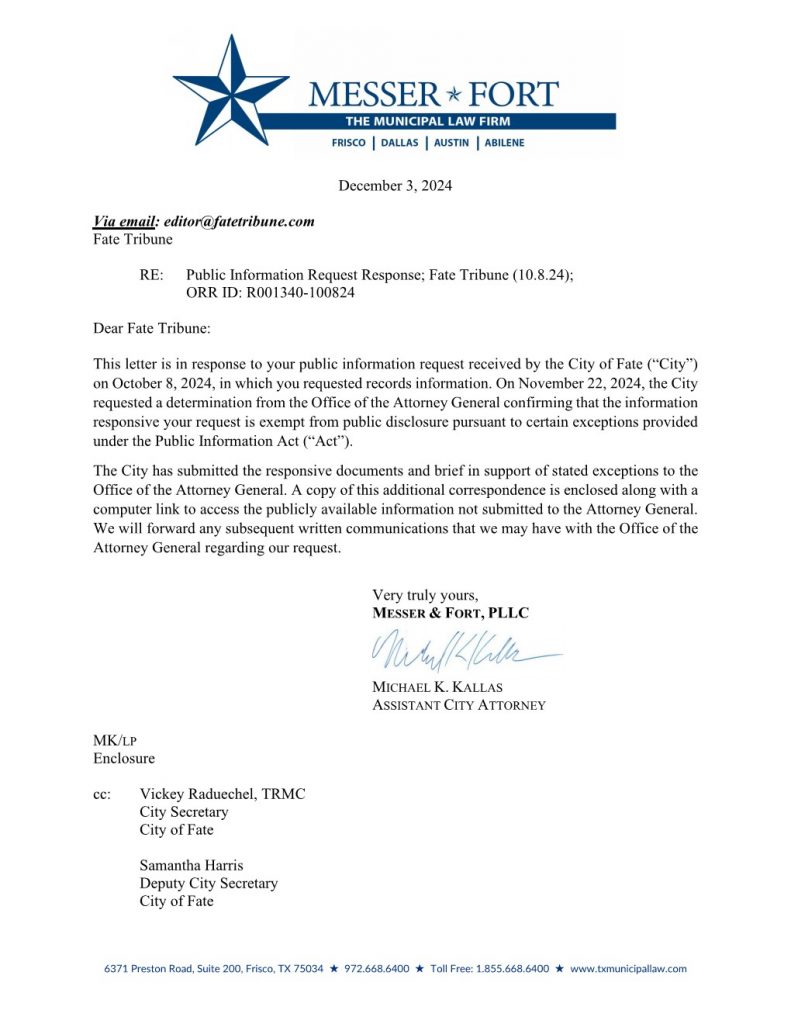
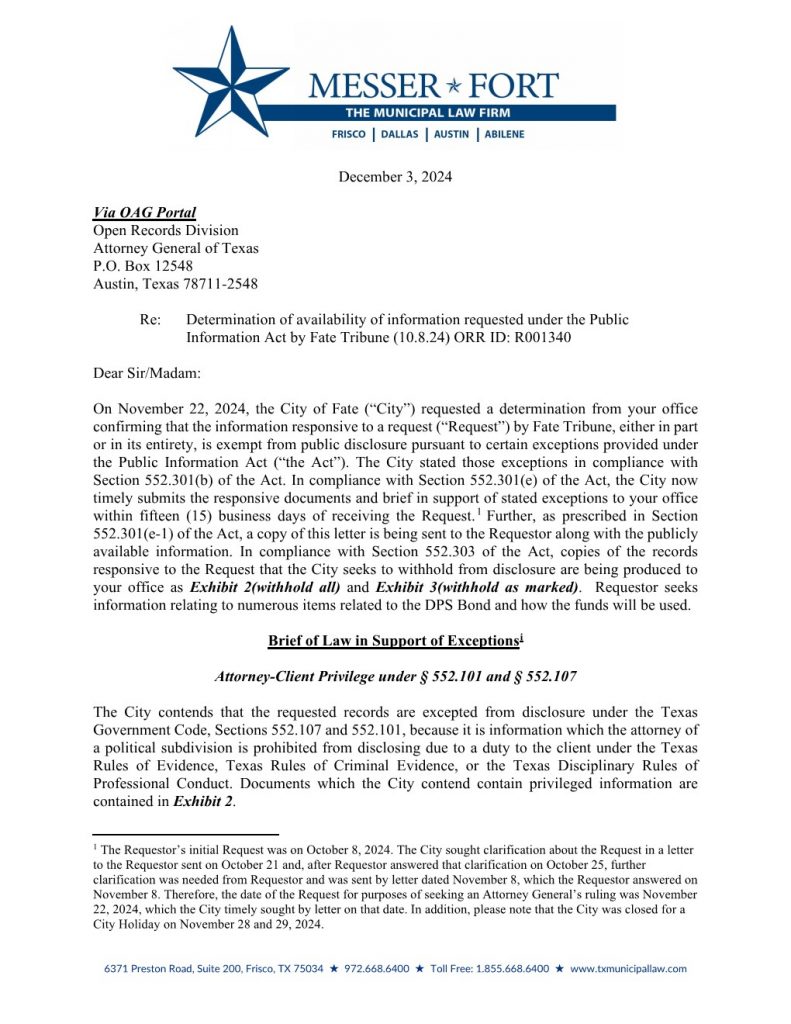
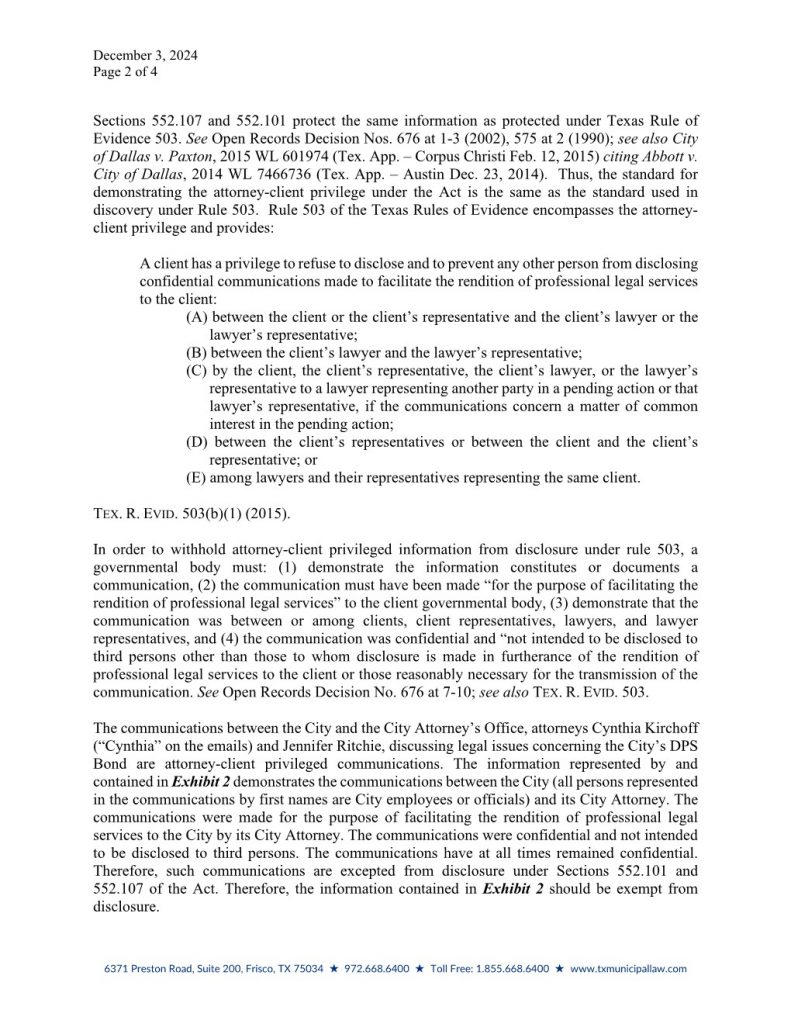
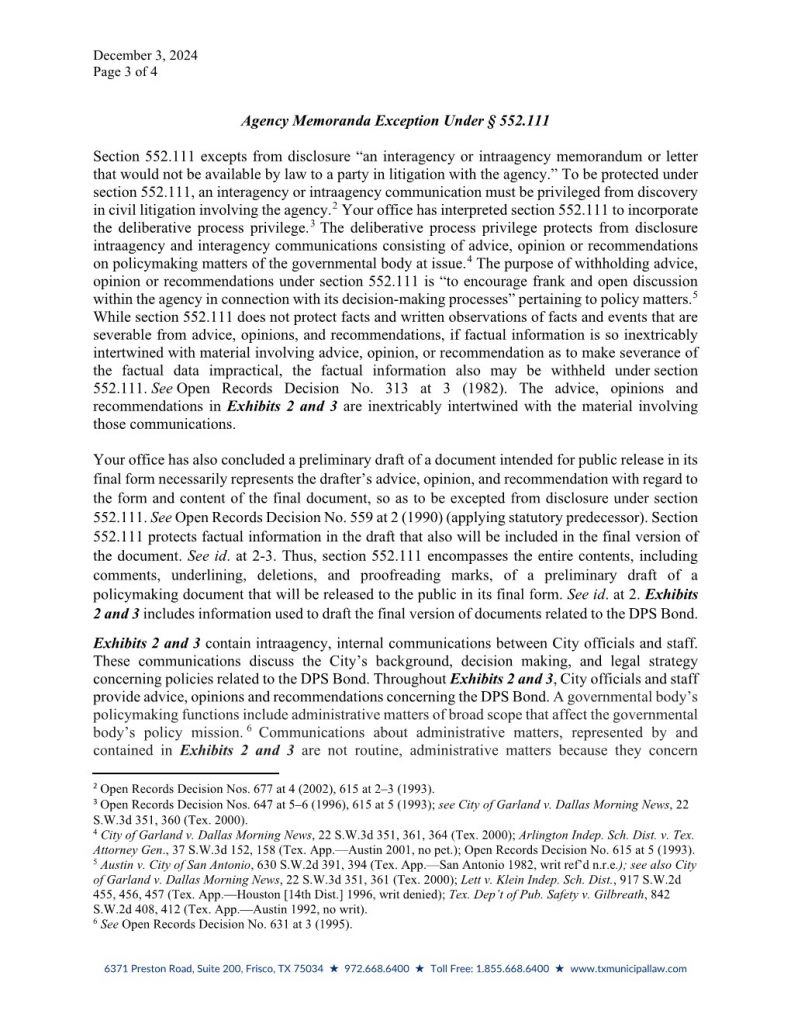
The City, represented by Michael Kallas of Messer & Fort, PLLC, claims that nearly all communications related to the bond initiative are exempt from disclosure under the Texas Government Code. However, the Tribune argues that this sweeping use of exemptions not only undermines the public’s right to know but also fails to meet the legal standards for confidentiality. The full response submitted by the Fate Tribune to the Texas Attorney General is included below, outlining their case for public access to these critical records.
The City’s Claim of Privilege
In a letter dated December 3, 2024, Assistant City Attorney Michael Kallas confirmed that the City requested a determination from the Texas Attorney General’s Office to withhold documents responsive to the ORR. The City argues that these records fall under attorney-client privilege and are therefore exempt from public disclosure under Section 552.107 of the Texas Government Code.
However, the Tribune’s initial review of the heavily redacted records provided by the City reveals that many communications do not involve legal counsel. Instead, emails between city employees and council members, in which legal representation was neither a participant nor copied, were also withheld under the same claim of privilege. This blanket redaction raises serious questions about the legitimacy of the City’s argument.
The Fate Tribune’s Response to the Attorney General
Yesterday, the Fate Tribune filed its formal response to the Attorney General of Texas, contesting the City’s reliance on attorney-client privilege. Editor Michael E. Pipkins argued the following points:
- Attorney-Client Privilege Requires Strict Confidentiality
For communications to qualify for attorney-client privilege, they must remain confidential and involve only privileged parties. The City appears to have included individuals outside the scope of this relationship in their correspondence, breaking the chain of confidentiality and invalidating the claim of privilege. - Waiver of Privilege Through Dissemination
The inclusion of non-privileged individuals, such as certain city employees, in these communications constitutes a waiver of attorney-client privilege under Texas law. Without maintaining strict confidentiality, the City cannot rely on this exemption to withhold records. - The Public’s Right to Know
Public safety bonds involve taxpayer dollars and long-term financial obligations that demand accountability and transparency. The improper withholding of records undermines public trust and the democratic process.
The full text of the Fate Tribune’s response is as follows:
To: The Honorable Attorney General of Texas
The Fate Tribune respectfully submits this response in regard to the City of Fate’s request for exemption under Texas law, citing attorney-client privilege to withhold certain documents related to a bond proposal for the Department of Public Safety. Our position is that the City has failed to maintain the confidentiality necessary for the privilege to apply and thus cannot justify withholding these records from public scrutiny.
Summary of the Issue
The City of Fate received an Open Records Request (ORR) from the Fate Tribune seeking communications related to the proposed bond. While some records were provided, they were heavily redacted. Additionally, the City notified us of its intent to request an exemption from the Attorney General’s Office to withhold other documents under the attorney-client privilege exemption in the Texas Public Information Act (TPIA), codified in Texas Government Code §552.107.
However, based on the limited but redacted records we received, it is apparent that the City included individuals who are not direct participants in the attorney-client relationship in their communications. This undermines the privilege and renders the exemption inapplicable.
Legal Argument
- Attorney-Client Privilege Requires Strict Confidentiality
Under Texas Government Code §552.107, communications may be withheld if they constitute confidential attorney-client communications. For this privilege to apply, the communication must:- Be made between privileged parties (e.g., the attorney and client or their agents acting within the scope of the privilege).
- Be intended to remain confidential.
- The City’s Actions Demonstrate a Waiver of Privilege
A review of the redacted documents reveals that communications involving the City’s legal counsel were disseminated to parties who are not privileged participants, including city employees and possibly third parties whose roles do not establish them as agents within the attorney-client relationship. This dissemination breaks the chain of confidentiality and constitutes a waiver of the privilege.Texas courts consistently hold that the privilege is lost when a client voluntarily discloses the content of the communication to a third party, even if those individuals work for the client organization. To preserve the privilege within an organizational setting, the individuals involved must have a direct need to know the legal advice provided. Based on our examination, it appears that the City did not adhere to this standard. - The Public’s Right to Know Outweighs Improper Claims of Privilege
The TPIA presumes that government information is open to the public unless an applicable exemption applies. In cases involving public bonds, transparency is paramount, as such measures involve taxpayer funds and long-term obligations affecting the entire community. Improper withholding of information undermines public trust and the democratic process.If the City included unprivileged parties in its communications, its claim of exemption is not only legally deficient but also contrary to the spirit of transparency that underpins the TPIA.
Request for Relief
Given these facts, the Fate Tribune respectfully requests that the Office of the Attorney General deny the City of Fate’s request for exemption and compel the City to release the requested documents in their entirety.
Transparency in government is a cornerstone of our democracy, and the citizens of Fate deserve to understand the full context and rationale behind decisions regarding a public safety bond proposal.
Respectfully submitted,
Michael E. Pipkins
Editor, Fate Tribune
The Fight for Transparency
The Fate Tribune remains committed to holding the City of Fate accountable and ensuring that taxpayers have access to the information they are entitled to under the law. The outcome of this dispute will set a critical precedent for transparency in local government as cities across Texas grapple with similar issues of public trust.
The Tribune will continue to provide updates as the Attorney General evaluates the City’s request.
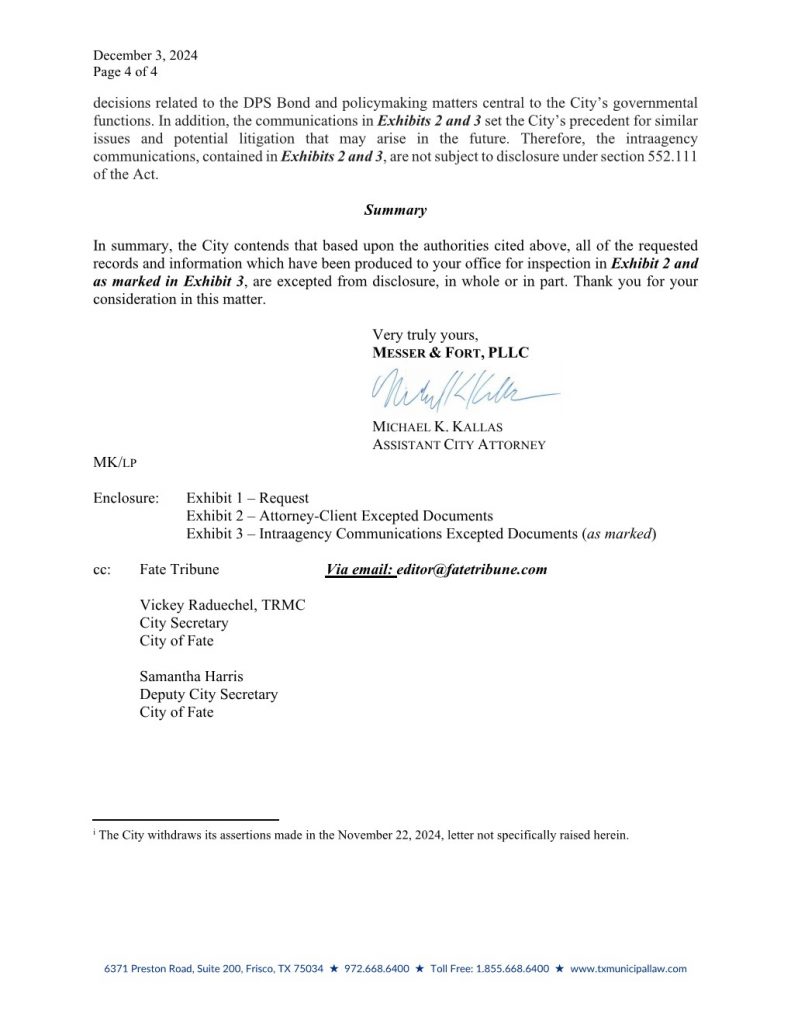
Letter from City Attorney to the Texas Attorney General
Council
Fate City Council Votes to Release Secret Recordings
Councilman Mark Harper walks out of meeting before adjournment.
FATE, TX – The Fate City Council voted late Monday night to waive deliberative privilege, opening the door to the public release of secret audio recordings that may have driven a recall election against Councilwoman Codi Chinn. The decision came after hours of public criticism, procedural friction, and a lengthy executive session with legal counsel.
The meeting, held Monday, February 2, was streamed live by the city and is available on YouTube at: https://www.youtube.com/live/zQVN0i-d8C0 (Embedded Below)
(Source: City of Fate, official meeting broadcast)
Timeline for Readers
- 00:33:52 – Public comments begin, largely focused on the recall election of Councilwoman Codi Chinn.
- 00:56:10 – Councilman Harper interrupts public Comment.
- 00:57:00 – Councilman Harper interrupts public Comment.
- 00:58:00 – Councilman Harper interrupts public Comment.
- 02:21:00 – Executive Session – Council enters closed session to consult with legal counsel.
- 03:22:52 – Council reconvenes in open session.
- Primary motion – Council votes to “waive deliberative privilege”, allowing release of disputed audio recordings.
Public Comment and Visible Strain
Public comments began just after the 33 minute mark and quickly centered on the recall election. Speaker after speaker questioned the conduct of city officials and demanded transparency regarding audio recordings that have circulated privately but remained unavailable to the public.
During one speaker’s remarks, critical of Councilwoman Chinn, procedural tension became visible. Three separate times, Councilman Mark Harper interrupted to remind Mayor Andrew Greenberg that the speaker had exceeded the three-minute time limit. Each time, Mayor Greenberg thanked Harper for the reminder, then directed the speaker to continue.
The exchange stood out. While council rules clearly limit speakers to three minutes, the mayor’s repeated decision to allow the speaker to proceed suggested an effort to avoid the appearance of silencing criticism during a highly charged meeting.
Clarifying the Recordings
Contrary to some early assumptions, the audio recordings at issue were not recordings of executive sessions. Instead, they are one-party consent recordings, the existence of which has been previously reported and alluded to on Pipkins Reports. Their precise origin has not been publicly detailed, but their contents have been referenced repeatedly by both supporters and critics of the recall effort.
Behind Closed Doors
Following the public meeting, the council entered executive session to consult with legal counsel. After about an hour, members returned to open session at approximately 3:22:52 .
The primary motion coming out of that session was to “waive deliberative privilege“. The effect of the vote was to remove a legal obstacle to releasing the secret audio recordings that have been at the center of the controversy.
No excerpts were played, and no conclusions were announced. The council did not rule on the legality of the recordings, nor did it weigh in on the merits of the recall election itself.
Why the Vote Matters
The decision does not resolve the recall of Councilwoman Chinn. It does not validate or refute claims made by either side. What it does is shift the debate away from rumor and secondhand accounts.
According to guidance from the Texas Municipal League, governing bodies may waive certain privileges when transparency is deemed to serve the public interest, particularly when litigation risk is balanced against public trust (Texas Municipal League, Open Meetings Act resources).
Opinion and Perspective
The council’s action was a necessary step. Secret recordings, selectively referenced and strategically leaked, undermine confidence in local government. So does a refusal to confront them directly.
Transparency is not about protecting officials from embarrassment. It is NOT the job of the council to assist the city in concealing information that may be used against it in legal proceedings when the City Manager, or Councilmen, may have done bad things. It is about protecting citizens from manipulation. If the recordings exonerate those involved, their release will restore credibility. If they raise concerns, voters deserve to hear them unfiltered before making decisions in a recall election.
Monday night in Fate did not end the controversy. It ended the excuse for keeping the public in the dark.
Election
Bob Hall Faces Old Allegations as Supporters of His Opponent Stir Controversy in Rockwall
ROCKWALL, TX — Texas State Sen. Bob Hall appeared before voters at Rockwall County’s Final Friday Night Forum, on Friday. The appearance renewed online criticism from supporters of his primary challenger which brought attention back to a decades-old allegation from a former marriage and also to social-media comments allegidily attributed to Hall’s wife.
The renewed discussion did not stem from new legal filings, court actions, or investigative reporting. Instead, it followed social-media posts by individuals publicly supporting Hall’s opponent, Jason Eddington, including Fate City Councilwoman Codi Chinn, whose sharply worded statements have drawn attention for both their substance and tone.
The Forum and the Race
The forum was hosted by Blue Ribbon News in partnership with the Rockwall County Republican Party, and held at the Rockwall County Courthouse. It marked the final event in a series intended to give Republican voters an opportunity to hear directly from candidates ahead of the March primary.
Other candidates in attendance included:
- Rockwall County Judge
- Frank New
- Scott Muckensturm
- County Commissioner, Precinct 4
- John Stacy
- James Branch
- Lorne Megyesi
- Justice of the Peace, Precinct 2
- Victor Carrillo
- Chris Florance
Pipkins Reports could find no official transcript or video of the forum. According to available coverage, the event proceeded without public discussion of personal controversies, and no candidate addressed the matter from the stage.
Background on the Allegations
The most damaging allegations currently being recirculated date back to divorce proceedings in Florida in the early 1990s, during which Hall’s former wife, Jane Hall, made claims in court filings alleging physical, verbal, and sexual abuse during their marriage.
The allegations, raised during a contested divorce, as they often do. Bob Hall has denied the allegations. No criminal charges were filed. No court ruled against Hall or issued a finding of abuse. The filings did not result in convictions, injunctions, or adverse judgments.
The allegations became publicly discussed during Hall’s first Senate campaign in 2014 and have resurfaced intermittently during contested elections. Their latest reappearance coincides with the current Republican primary and has been driven by individuals openly advocating for Hall’s opponent.
Explicit Attribution and Political Context
Following the January 30 forum, Fate City Councilwoman Codi Chinn, who has publicly endorsed Jason Eddington, posted a statement on social media criticizing Hall and urging Republican voters to support Eddington.
In her post, Chinn wrote:
“Senator Bob Hall I expect you will be making a statement issuing an apology on behalf of your wife for body shaming a woman simply because you don’t ideologically agree with her. These comments are shameful and your silence is deafening. Being Republican shouldn’t mean being small minded. I hope Republican Primary voters will pick the true Conservative Jason Eddington, Candidate for Texas Senate, District 2!”
Critics of Chinn, including some local Republican activists, say the post reflects what they describe as a pattern of caustic and confrontational rhetoric directed at individuals she opposes politically. It’s ironic that Chinn requests accountability for language of others, while she herself asks for forgiveness of her digressions in her bid to not be recalled. Supporters of Chinn, by contrast, characterize her comments as blunt advocacy and a willingness to publicly challenge those with whom she disagrees.
Amplification by a Political Social Media Page
On January 31 at 10:57 p.m., the Facebook page Rockwall County News First published a post calling on the Rockwall County Republican Party to condemn comments attributed to Hall’s wife. The page credited Codi Crimson Chinn as the source of screenshots included in the post.
The post stated:
“We hope that Rockwall County Republican Party will join us in condemning Senator Bob Hall’s wife in her comments.”
The screenshots included in the post purport to show comments written by Kay Hall, Senator Hall’s wife. The screenshots have not been independently authenticated by this publication. According to the screenshots, the comments attributed to Kay Hall read:
“Oh, yes, so disgusting to see Jill get up an speak. She and all of the TFRW little people are in their element. Wish I had recorded her speech, or even more wish I had stood up in the room to tell everyone how she got the Democrats to vote for her in the election. The pictures are very flattering to her because she has gained weight and really looked aged. I am sitting across from Bob near the podium. too, close!!!”
As of publication, neither Senator Hall nor his wife has publicly confirmed the authenticity of the screenshots or issued a statement regarding the comments.
Hall’s Position and Current Status
Hall has not publicly addressed the social-media posts and did not respond to our request for comment. He has previously stated, during earlier campaigns, that efforts to revive allegations from his former marriage are politically motivated and unrelated to any legal findings or his conduct in office.
Hall is currently married to Sarah Kay Smith Hall, with whom he has three children. There are no legal actions or criminal allegations involving his current marriage. The current controversy centers on online posts circulated by political opponents and their supporters.
Conclusion
The Final Friday Night Forum was intended to focus voter attention on policy differences among Republican candidates. In the days following the event, however, the race shifted toward personal disputes fueled by online posts from supporters of Hall’s challenger, including commentary that some observers describe as emblematic of an increasingly sharp-edged political style.
As the March primary approaches, voters in Senate District 2 must weigh not only policy and legislative records, but also the motivations and methods used by campaigns and their advocates. Whether the renewed criticism is viewed as relevant scrutiny or as opposition-driven escalation remains a question for the electorate to decide.
Council
Councilwoman’s Husband Makes Outlandish Claim Against Fate Mayor, and Pipkins Reports
The dispute began publicly in Fate, Texas, when I was accused by Councilwoman Codi Chinn’s husband, William Marcus Chinn, of concealing material facts. WM Chinn asserted that I “knew” that Mayor Andrew Greenberg was responsible for placing Chief of DPS Lyle Lombard into executive session long before a controversial letter ever surfaced, and (he asserts) that I was deliberately lying to protect him … as well as shedding false light on his wife.
So I did what journalists are supposed to do when confronted with claims that purport to be factual. I pulled the records.
What those records show is not a cover-up or collusion, but a collapse of a narrative. Click here for further information regarding the timeline of events.
The Claim
Mr. Chinn asserted that Mayor Greenberg initiated an executive session involving Chief Lombard on or before November 10, 2025, well before later events that have since become the subject of political dispute. He further claimed the mayor supported Lombard’s firing, and accused me of knowingly concealing those facts.
Those are serious allegations against a sitting mayor and a journalist. They are also verifiable.
The Records
On January 15, 2026, I filed an open records request with the City of Fate seeking all emails from Mayor Greenberg calling for an executive session to discuss Lyle Lombard prior to November 11, 2025. The City of Fate Public Records Office acknowledged the request and produced responsive documents through its public records portal.
The emails produced do not support the accusations made by Mr. Chinn.
Instead, the correspondence shows a discussion in late September 2025, specifically September 22 and 23, between City Manager Michael Kovacs, Councilman Mark Harper, and Mayor Greenberg. The topic was not the discipline, termination, or performance of Chief Lombard. It was regarding the DPS as a whole, and whether or not it should be separated into distinct divisions.
The email exchange centered on “Executive Session Meeting for DPS“, not Lyle Lombard. Under Texas law, such matters are commonly discussed in executive session due to personnel and strategic considerations. Kovacs even goes further to include that “IF” the discussion moves into discussing Lombard, they will have to make changes to the forum.
There is no evidence in the records that Mayor Greenberg sought to discuss Lombard personally, or that he anticipated the executive session would involve anything beyond the DPS split.
On the Record Confirmation
To remove any ambiguity, I spoke directly with Mayor Greenberg, on the record. He confirmed that his sole interest in the executive session discussion was the potential separation of the DPS into standalone Police and Fire departments. He stated he did not believe, at the time, that the executive session would be used to address Chief Lombard personally.
His statement aligns with the documentary evidence.
What Changed, and Who Changed It
Email we received on November 25, 2025 from Shelbi Stofer, PIO Officer for the City of Fate, states the facts, “Below you will see the press release regarding our leadership change at the City of Fate. Additionally, you asked about the councilmembers that [sic: who] asked for the agenda item and they were Councilmember Chinn and Councilmember Kelley (2nd).” Referring to the councilmen who requested that the chief be placed into executive session.
The email concluded with the public “Announcement of Leadership Transition” (Lyle Lombard)
The records show no mayoral email initiating an executive session for the purpose of discussing Lombard. The testimony and sources indicate the executive session was desired by Councilwoman Chinn, seconded by Councilman Kelley. The records reviewed do not substantiate the accusations made by WM Chinn or Councilwoman Codi Chinn that the Mayor had any involvement. By association, Pipkins Reports can’t have had any other knowledge to the contrary.
The Rhetoric Behind the Scenes
Politics is rarely polite, and Fate is no exception.
According to sources, after the council meeting in October 2025, Councilman Mark Harper referred to Mayor Greenberg as a “sellout” during internal discussions, a remark that reflects political frustration rather than documented fact. Separately, in a later recorded conversation with Pipkins Reports, Councilwoman Chinn referred to the mayor as a “Ken Doll,” adding a crude remark and referencing the doll’s genitalia as a metaphor regarding the mayor’s lack of courage. (We are paraphrasing, of course.)
Those statements are not evidence of wrongdoing. They are evidence of animus against the Mayor for his desire not to be involved with an employee dispute, which falls under the purview of the City Manager.
Opinion and Analysis
Here is where interpretation belongs.
What this episode reveals is not a secret scheme, but a familiar tactic. Make a claim forcefully enough, shout it into a microphone in a city hall meeting, and hope the accusation itself becomes the evidence. When challenged, attack the journalist. When records contradict the story, change the subject.
Texas open records law exists to protect the public from exactly this kind of political fog. When the documents are pulled, narratives either stand or fall. In this case, they fell.
No evidence has emerged showing Mayor Andrew Greenberg initiated an executive session to target Chief Lombard. No records show he supported Lombard’s termination prior to the events already publicly known. Those facts matter, regardless of personal grievances or political alliances.
If Councilwoman Chinn, her husband, or anyone else possesses documentary evidence to the contrary, it should be produced. Until then, accusations remain accusations, and the record remains clear.
You must be logged in to post a comment Login