
Fate, Texas, Chooses Andrew Greenberg as Mayor in Resounding Win

Fate, TX – Fate citizens have selected Andrew Greenberg as their next mayor, affirming a vision of principled, conservative leadership. In a race that highlighted the city’s dedication to its values, Greenberg’s triumph reflects a clear mandate for transparent governance, sustainable growth, and steadfast public safety. His opponent, Lorna Grove, mounted a respectable campaign but ultimately stepped back, recognizing Greenberg’s conservative credentials and readiness to lead. Fate’s voters have entrusted their city to a man whose priorities align with its small-town charm and forward-looking aspirations.
The unofficial results are Greenberg (903 votes) – 78.66% to Grove (245 voted) – 21.34%.
Greenberg, a government and economics professor and Rockwall GOP Precinct Chair, has called Fate home since 2018, raising three daughters alongside his wife in a community he cherishes. His campaign, grounded in constitutional conservatism, emphasized preserving Fate’s unique character while managing growth responsibly. As a professor, he brings a disciplined mind to the complexities of municipal governance, promising to balance development with the city’s identity by carefully addressing infrastructure and business expansion.
Transparency defined Greenberg’s platform, resonating with residents weary of opaque government processes. His commitment to open town halls, regular updates, and accessible city operations struck a chord, offering a refreshing antidote to distrust in institutions. Voters saw in him a leader determined to make local government approachable and accountable, ensuring residents are informed about every decision affecting their lives.
Public safety, a point of pride for Fate as Texas’s sixth-safest city in 2024, remains a cornerstone of Greenberg’s agenda. His pledge to equip police, fire, and emergency services with robust resources reassured a community that views security as non-negotiable. This focus underscored his understanding of Fate as a haven for families and citizens across generations.
Lorna Grove, Greenberg’s opponent, brought her own conservative bona fides, earning admiration from many. Initially skeptical of a professor in the mayor’s race, she discovered Greenberg’s rare conservative perspective in academia, dubbing him a “unicorn.” Her near-endorsement of him signaled a shared commitment to Fate’s future, and while she may run again, her current focus on family and her dignified campaign won her widespread respect.
As Andrew Greenberg prepares to lead, Fate faces the challenge of growth without sacrificing its soul. With a mayor rooted in conservative principles—limited government, personal freedom, and community pride—residents can trust that their city will remain a beacon of tradition and opportunity. Greenberg’s election is a reaffirmation of Fate’s values and a bold step toward a future that honors its past.








Fate, TX
Fate Council Approves Settlement in Former DPS Chief Lyle Lombard’s Wrongful Termination Dispute

Fate, TX — The Fate City Council voted Monday night to approve a proposed settlement with former Department of Public Safety Chief Lyle Lombard, bringing what has been a months-long wrongful termination dispute one step closer to resolution.
The vote of 4 to approve and 2 abstentions followed an executive session in which council members met privately with legal counsel to discuss the arbitration matter. Returning to open session, the council approved the settlement, though the financial terms and other provisions of the agreement were not disclosed during the public meeting.
The settlement resolves Lombard’s wrongful termination claim, which has been proceeding through arbitration following his separation from the City of Fate. Unlike traditional court proceedings, arbitration generally occurs outside public view, leaving many details of the dispute undisclosed unless the parties choose to release them or disclosure is otherwise required by law.
As of publication, the City has not released the settlement agreement, and it remains unclear whether the document contains confidentiality provisions or other restrictions governing what information may become public. It is also unknown whether the agreement includes any admission of liability by either party, the amount of any monetary payments, or other negotiated terms.
Lombard served as the City’s Department of Public Safety Chief before his separation from the City, a decision that ultimately resulted in the arbitration proceedings. The dispute drew considerable public attention as questions surrounding the circumstances of his departure remained largely unanswered because of the confidential nature of the arbitration process.
Monday night’s vote concludes the council’s role in approving the negotiated resolution, but it may not immediately answer many of the questions residents have asked throughout the dispute. Depending on the terms of the agreement and applicable provisions of the Texas Public Information Act, some portions of the settlement could eventually become public, while other details may remain confidential if protected by law.
Pipkins Reports has submitted requests for records related to the settlement and will review any documents released by the City. Those records may provide additional information regarding the financial impact of the agreement, the obligations of each party, and the extent to which the dispute has been fully resolved.
Neither the City of Fate nor Lombard publicly commented on the settlement during Monday night’s meeting.
While the approval brings the arbitration to a close, it also marks the end of one of the most closely watched employment disputes in recent City history. Whether additional information becomes available will likely depend on the release of public records, the language of the settlement agreement, and any future statements made by the parties.
Pipkins Reports will continue following the story and will publish updates as additional records become available.
Fate, TX
Exposed: City of Fate Withholds Documents from Disclosure Without Permission From Attorney General

Ethics Investigation Raises New Questions About Fate’s Response to Open Records Request
Fate, TX — An ethics investigation into former Fate City Councilwoman Codi Chinn has uncovered evidence suggesting the City of Fate possessed at least one employee complaint against former Department of Public Safety Chief Lyle Lombard that it never disclosed in response to an Open Records Request submitted by Pipkins Reports.
The newly released investigative report also raises additional questions about whether City Manager Michael Kovacs fully described his receipt of employee complaint letters during his interview with the City’s outside investigator.
The documents establish the following timeline.
On November 25, 2025, Pipkins Reports submitted a Texas Public Information Act request seeking four categories of records related to Chief Lombard’s employment. Item No. 3 requested:
“Copy of any written complaints against Chief Lombard within the last 12 months prior to termination.”
On December 11, 2025, the City responded by producing Chief Lombard’s performance evaluations, termination documents, and the investigation initiated by City Manager Michael Kovacs. However, the city produced no employee complaint letters.
Because no complaint letters were produced, Pipkins Reports immediately contacted the City for clarification. The follow-up specifically noted that an anonymous employee complaint concerning Lombard had already become publicly known and requested that letter, along with any other anonymous or signed complaints concerning the former chief.
On December 16th, after Pipkins Reports challenged the City’s original response, Associate Attorney Paige Goins of Messer Fort acknowledged that one document—the anonymous letter already known to exist—had been inadvertently omitted and she sent that document to Pipkins Reports.
Then, on December 18, the City supplemented its response again by producing awards and commendations received by Lombard.
At the time, Pipkins Reports did not pursue the matter further. New information obtained through a subsequent ethics investigation has now renewed serious questions about whether the City’s response complied with the Texas Public Information Act.
Under the Texas Public Information Act, governmental bodies generally must either promptly produce responsive public records or seek a ruling from the Texas Attorney General if they believe the requested information falls within an exception to disclosure. If a governmental body fails to timely request an Attorney General ruling, the requested information is generally presumed to be public unless a compelling reason exists to withhold it. See Texas Government Code §§ 552.221, 552.301, and 552.302.
In this case, the City did not seek an Attorney General ruling authorizing its withholding of any documents.
Ethics Investigation Reveals New Information
Seven months later, in July of 2026, an unrelated ethics investigation would reveal information that casts new light on the City’s response.
The investigation originated from an ethics complaint filed by Fate resident Darcy Gildon, who alleged former Councilwoman Codi Chinn improperly involved herself in personnel matters by directing city employees to prepare written complaints concerning Chief Lombard.
Attorney Laura Mueller of Baker Robertson & O’Brien ultimately concluded that Chinn violated Section 2-309(10) of the city’s Code of Ethics by directing employees to provide information to her in writing. Pipkins Reports reported on that story … here.
More significant for purposes of this investigation, however, were the interviews conducted with the individuals involved.
According to the investigative report, Chinn told investigators that city employees approached her seeking assistance. She stated that she instructed them to put their concerns in writing so they could be presented to the City Council. Instead, according to her interview, the employees compiled a letter addressed to the entire City Council, after which she instructed them to deliver the letter to City Manager Michael Kovacs.
The investigative report summarizes Kovacs’ interview as follows:
“In my interview with Mr. Kovacs, we discussed his conversations with then Councilmember Chinn and the employees. Mr. Kovacs stated that he received the letter outlining the employee issues directly from an officer, but with the understanding that the information was given to him at the direction of Ms. Chinn. Mr. Kovacs also stated that Ms. Chinn kept him informed of the conversations she was having with the employees, but that he warned her against such communications.”
The report, however, does not discuss the original anonymous complaint letter that Pipkins Reports previously reported had been delivered to Kovacs through Councilwoman Chinn.
Taken together, the report’s statements—and its omissions—appear to indicate that Kovacs possessed at least two written employee complaints that would have been responsive to Pipkins Reports’ November 2025 Public Information Act request.
Two Letters, One Unanswered Question
Pipkins Reports has independently obtained copies of both complaint letters from sources outside City Hall. One anonymous letter begins with the words, “To Whom It May Concern.” The second letter is addressed to the entire City Council and was reportedly transmitted through Councilwoman Chinn.
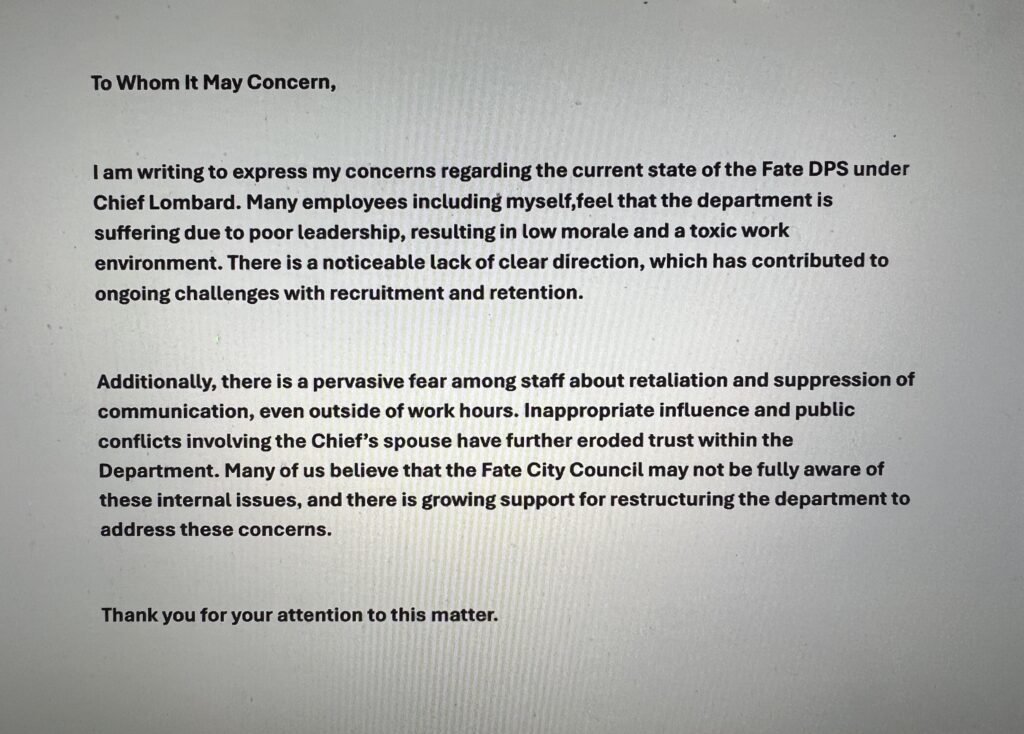
Their existence, however, does not resolve whether the City complied with the Texas Public Information Act. The central question is whether the City properly disclosed responsive records in response to a lawful request.
As of this publication, the City still has not disclosed the separate complaint letter that Kovacs later acknowledged receiving directly from a police officer. By his own admission, City Manager Michael Kovacs is the person responsible for the dissemination of records per State Law, and therefore he is the person who should be held accountable.
If Kovacs’ statement to investigators is accurate, that second complaint letter would have existed when the City’s response to the November 2025 Public Information Act request was prepared.
A New Public Information Request
In light of the newly disclosed information, Pipkins Reports has submitted another Texas Public Information Act request seeking all written complaints concerning Chief Lombard, including the complaint letter Kovacs acknowledged receiving from an officer, the complaint letter transmitted through Councilwoman Chinn, and any additional written complaints in the City’s possession.
The request states, in part:
“On 11/25/2025, as part of Open Records Request #R001735-112525, I requested ‘Copy of any written complaints against Chief Lombard within the last 12 months prior to termination.’ The City failed to provide any responsive documents, even though it was publicly known that at least one anonymous complaint letter existed.
During the ethics investigation conducted by Baker Robertson & O’Brien, Michael Kovacs stated that he received a complaint letter from a police officer. This admission indicates the City possessed an additional responsive document that was not disclosed.
The City did not seek an Attorney General ruling authorizing the withholding of either complaint letter. This request seeks both documents, together with any additional written complaints concerning Chief Lombard.”
Whether the City ultimately produces the records—or explains why they were not disclosed nearly eight months ago—may determine whether this story ends as an administrative oversight or raises more significant questions regarding the City’s compliance with the Texas Public Information Act.
This remains an ongoing investigation. Pipkins Reports will continue to report on developments as additional records become available.

Fate Council Dropped Case Before Reviewing
Fate, TX — An ethics investigation commissioned by the City of Fate concluded that former Councilwoman Codi Chinn violated the City’s Code of Ethics before the City Council voted earlier this month to discontinue the matter, according to documents obtained by Pipkins Reports through an Open Records Request.
The report, prepared by attorney Laura Mueller of the law firm Baker, Robertson & O’Brien, found that the allegation against Chinn was “substantiated, but with mitigating factors.”
The Executive Summary states:
“After investigation, my determination is that allegation of a violation of the Ethics Code is substantiated, but with mitigating factors.”
The report concludes that Chinn violated Section 2-309(10) of the City’s Code of Ethics after directing City employees to provide their concerns to her in writing.
“After reviewing the Charter, the Code of Ethics, and reviewing all of the evidence, my conclusion is that Ms. Chinn violated Section 2-309(10) of the Code of Ethics when she directed employees to provide information to her in writing.”
Mueller also concluded that mitigating circumstances should be considered because Chinn immediately informed City Manager Michael Kovacs about the employee concerns and because the employees ultimately submitted their written complaints directly to the City.
Council Ends Investigation
The ethics complaint summary report was scheduled to appear on the July 6 City Council agenda for executive session discussion.
Instead of going into Executive Session, the Council waived deliberative privilege and discussed the matter in open session where they ultimately voted to discontinue the ethics proceedings and drop the matter, before being presented with the findings from Mueller.
The Council did not impose any sanction against Chinn.
The following day, Pipkins Reports requested a copy of the complaint and the investigative report, and received it through an Open Records Request.
Investigation Details
According to the report, investigators interviewed Chinn, Councilman Mark Harper, City Manager Michael Kovacs, and other witnesses.
Regarding the allegations, Mueller wrote:
“In my interview with Ms. Chinn and Mr. Harper, we discussed the allegation. I questioned Ms. Chinn about her conversations with city employees and with Mr. Kovacs.”
According to the report, Chinn stated that city employees approached her seeking assistance and that she intended to present their concerns to the City Manager after compiling the information.
However, the report states that employees instead prepared a letter addressed to the City Council. Chinn then instructed them to provide the letter directly to the City Manager.
The report also summarizes Kovacs’ account of the events.
“Mr. Kovacs stated that he received the letter outlining the employee issues directly from an officer, but with the understanding that the information was given to him at the direction of Ms. Chinn.”
Previously, it was reported that Chinn provided a copy of an, “anonymous letter”, that she claims was provided by DPS officers to her. Chinn further states that she sent the letter to Michael Kovacs … who then forwarded it on to the rest of the Council. This report also states that Kovacs told investigators he had warned Chinn against communicating with employees in that manner.
Pipkins Reports continues to investigate this aspect of the situation … as the conditions shed new light on the events that have transpired with regard to the termination of DPS Chief Lyle Lombard.
Meanwhile, the city council’s decision effectively ended the ethics proceeding against Chinn without imposing any sanction or issuing any formal determination of its own regarding the investigator’s findings. While the Council possessed the authority to discontinue the matter, the decision also brought the ethics process to a close despite an independent investigation concluding that a violation of the City’s Code of Ethics had occurred.
For the complainant, Darcy Gildon, the Council’s action marked the end of a process that resulted in no public accountability beyond the release of the investigative report which Pipkins Reports has now provided.
You must be logged in to post a comment Login