Connect with us

Published

on

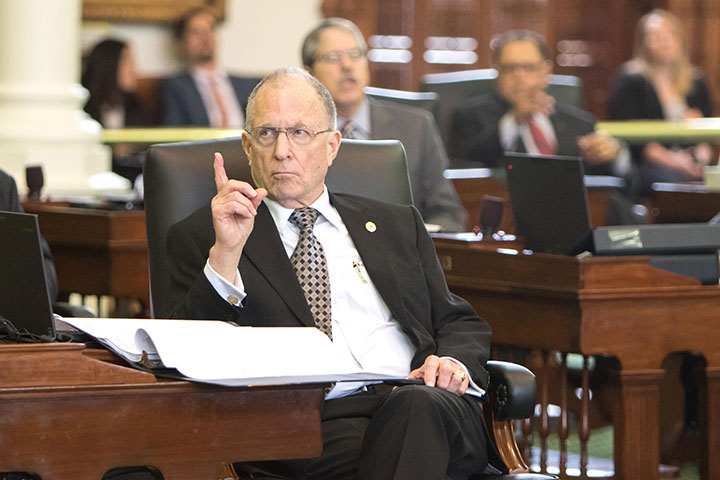
Texas Senator Bob Hall: Championing Conservative Values and Legislative Action

Fate, Texas – September 25, 2023

In the heart of Texas, Senator Bob Hall is making a profound impact in the Lone Star State by championing a conservative agenda rooted in core principles and unwavering values. Serving as a Republican Senator for District 2, Fate, Texas, Senator Hall’s career has been marked by a strong commitment to his country, his community, and his conservative ideals.

Senator Hall’s background is a testament to his dedication to service. A retired US Air Force Captain and successful business owner, he brings a wealth of experience and a deep love for America to his role as a legislator. Since 2015, he has served as a member of the Texas Senate, earning a reputation for his open-mindedness in discussing ideas while remaining steadfast in his core conservative principles and Judeo-Christian values.

One of Senator Hall’s foundational beliefs is in upholding the Declaration of Independence and faithfully following the Constitution. He is a proponent of pro-life policies, Second Amendment rights, personal liberty, property rights, and limited government. Additionally, he is a staunch advocate of the free market and fiscal responsibility, ensuring that Texas remains a bastion of economic opportunity.

Among Senator Hall’s significant achievements is his instrumental role in making Texas a 2nd Amendment Sanctuary State, safeguarding the rights of law-abiding gun owners. Furthermore, he has been a staunch defender of religious organizations and churches, ensuring they are protected from government overreach.

In the 88th Legislature, Senator Hall authored an impressive 134 bills, many of which focused on patients’ rights. His dedication to protecting children from genital mutilation, gender reassignment without consent, and the sexualization of children in schools is unwavering. He championed legislation that empowers parents to be informed about what their children are taught in schools and requires parental consent for psychological or psychiatric examinations and treatments conducted by school district employees.

Senator Hall has also been a vocal opponent of mask and vaccine mandates, advocating for informed consent and the right of individuals to refuse vaccination. He supported physicians’ rights to prescribe medications like ivermectin and hydroxychloroquine sulfate, ensuring access to a range of treatments. Notably, he proposed a constitutional amendment recognizing an individual’s right to refuse vaccination, safeguarding personal health choices.

One of Senator Hall’s most notable bills, SB 302, aimed to protect employees from adverse health events resulting from employer-mandated vaccines. Although it faced challenges in the State Affairs Committee, chaired by Republican Todd Hunter, Senator Hall’s commitment to individual liberties remained steadfast.

Senator Hall’s dedication to common-sense legislation is evident in SB 1082, which put an end to the confusion surrounding genderism by providing a legal definition of “male” and “female” for government documentation. He also introduced SB 1583, prohibiting “gain of function” research in Texas institutions of higher learning, with criminal penalties for violations.

Despite the breadth of his legislative endeavors, Senator Hall’s focus has consistently been on meaningful policy rather than mere recognition. This dedication to substantive change sets him apart from others in the political arena.

Senator Bob Hall’s tireless work in the Texas Senate is a testament to his unwavering commitment to conservative principles and Judeo-Christian values. Through his legislative efforts, he continues to champion the rights and liberties of the people of Texas, ensuring a brighter future for generations to come. The citizens of Fate and Rockwall County have a fine representative in Senator Hall, who tirelessly fights for their interests and values on the state stage.


Michael Pipkins focuses on public integrity, governance, constitutional issues, and political developments affecting Texans. His investigative reporting covers public-record disputes, city-government controversies, campaign finance matters, and the use of public authority. Pipkins is a member of the Society of Professional Journalists (SPJ). As an SPJ member, Pipkins adheres to established principles of ethical reporting, including accuracy, fairness, source protection, and independent journalism.

Continue Reading
Click to comment

You must be logged in to post a comment Login

Leave a Reply

Colleyville

Zee Wilcox vs. the GOP Establishment: Inside the HD-98 Legal Showdown

Published

on

Zee Wilcox - HD98

TEXAS – It began quietly, the way many insider power plays do, with paperwork, phone calls, and closed doors. But within days, the Republican primary for Texas House District 98 erupted into a public spectacle involving court orders, barred debates, and accusations that party elites were deciding elections before voters ever had their say.

At the center of the fight is Zee Wilcox, a Southlake Republican running for the open HD-98 seat, a district that includes Southlake, Grapevine, Keller, and Colleyville. The seat is currently held by Rep. Giovanni Capriglione, who is not seeking reelection. In a district that reliably votes Republican, the March GOP primary will almost certainly determine the next state representative.

Wilcox is not the candidate party insiders expected, or wanted. That, she argues, is precisely the problem.

Removed From the Ballot, Then Restored by Judges

On January 7, 2026, Wilcox was removed from the Republican primary ballot by Tarrant County GOP Chairman Tim Davis. The stated reason was technical: Wilcox filed her candidate application using a federal form rather than the Texas state form. The two documents are nearly identical, with the primary distinction being that the state form includes a clause acknowledging Texas’s nepotism laws.

Wilcox maintains that the issue was non-substantive and correctable. The form was notarized and accepted at the time of submittal. She says she attempted to resolve the matter after being notified, and that she had already acknowledged nepotism laws through other required filings, including the appointment of a campaign treasurer. Nevertheless, her name was struck from the ballot by Davis.

Within days, Wilcox sued.

On January 12, a Tarrant County district judge granted her a temporary restraining order, halting further action against her candidacy. Three days later, Judge Ken Curry went further, ruling that Davis could not continue efforts to remove Wilcox from the ballot. Unless appealed, the injunction keeps her in the race.

I thought campaigning was going to be hard,” Wilcox told the Fort Worth Report. “I didn’t know that I was actually going to have to fight my own party.

Davis has defended his actions publicly as a matter of election integrity, denying any conspiracy or political motivation. He declined to comment further following the court’s ruling, according to the Fort Worth Report, which first covered the case in detail.

Barred From Debates and Public Forums

While the ballot fight played out in court, Wilcox says she faced a second, quieter form of exclusion.

According to Wilcox, Republican-aligned organizations, including the Metroplex Republican Women and the Colleyville Conservative Club, hosted public candidate forums and debates for HD-98, but denied her the opportunity to participate. She says she was explicitly told she could submit written answers but would not be allowed to speak or appear alongside the other candidates.

Wilcox showed up anyway.

She says her presence was meant to alert voters that a legally qualified candidate was being intentionally silenced. Organizers later claimed she arrived improperly dressed or left early. Wilcox disputes that account and says she has emails and messages documenting her exclusion on her Facebook Page.

The clubs have characterized themselves as private organizations with discretion over their events. Wilcox counters that once an organization advertises a candidate forum to the public and invites voters, it crosses into what courts have long recognized as a limited public forum, where viewpoint discrimination is prohibited under First Amendment law.

She has publicly stated her intent to pursue legal action over the exclusions.

The Insider Connections Drawing Scrutiny

The controversy does not exist in a vacuum. Wilcox is running against Keller Mayor Armin Mizani and Colleyville businessman Fred Tate. Both have strong ties to local GOP leadership.

Davis, the county GOP chairman who ordered Wilcox’s removal, has acknowledged a personal friendship with Mizani and previously donated $10,000 to his campaign. Mizani has also received high-profile support from party insiders.

Complicating matters further, the president of the Texas Federation of Republican Women, is Jill Tate, who is the spouse of Fred Tate, another candidate in the same race. While no illegality has been established, the overlapping relationships have fueled Wilcox’s argument that the process was designed to narrow the field, not expand voter choice.

Wilcox has gone further, alleging that Mizani was promised the HD-98 seat if he exited a separate State Senate race, clearing the way for another preferred candidate. With Wilcox in the race, she argues, the plan breaks down, likely forcing a runoff.

That, she says, is why she had to be removed.

A Broader Pattern, Not an Isolated Case

The Wilcox case unfolded amid broader ballot challenges across Tarrant County. Davis also challenged multiple Democratic judicial candidates, prompting retaliatory challenges from the local Democratic Party against GOP candidates. The result has been widespread uncertainty heading into early voting, which begins February 17.

In court, Wilcox represented herself, arguing that election laws are meant to ensure fair access, not operate as a “gotcha” system used selectively against disfavored candidates. Judges appeared to agree, at least in her case.

Opinion: When the Party Forgets the Voters

What makes this story larger than one candidate is not the paperwork dispute or even the courtroom drama. It is the underlying question of who controls Republican primaries in Texas.

Conservatives have long argued that sunlight, open debate, and voter choice are antidotes to corruption. Yet in HD-98, those principles appear to have collided with a culture of insider management. When party officials decide who may speak, who may appear, and who may even run, the primary becomes a formality rather than a choice.

If Zee Wilcox is wrong, the remedy is simple: beat her at the ballot box. If she is right, the implications are far more troubling.

Either way, voters in HD-98 deserve to hear from every lawful candidate, not just the ones approved behind closed doors.

*Pipkins Reports requested comment from Armin Mizani, Mayor of Keller and a candidate for House District 98; Tim Davis, Chairman of the Tarrant County Republican Party; Tammy Nakamura, Colleyville Conservative Club; Carol Anderson, President of Metroplex Republican Women; and Fred Tate, a candidate in the HD-98 race.

After 48 hours, as of publication, no responses have been received.

Zee Wilcox did respond to our requests for comment. The reporting that precedes is based on her statements, along with publicly available records and court filings independently reviewed by Pipkins Reports.

Continue Reading

Featured

Clintons in Contempt

Published

on

Bill and Hillary Clinton

WASHINGTON, DC — The Clinton political machine, long accustomed to dictating the terms of engagement, ran headlong this week into an institution that does not negotiate its constitutional authority. In a rare and politically explosive move, the House Committee on Oversight and Government Reform voted on a bipartisan basis to advance contempt of Congress resolutions against former President Bill Clinton and former Secretary of State Hillary Clinton for defying lawful subpoenas tied to the Jeffrey Epstein investigation.

The January 21 vote clears the way for the full House to consider whether to formally hold the Clintons in contempt, a step that could result in criminal referrals to the Department of Justice. While neither Clinton has been accused of a crime related to Epstein, lawmakers framed the issue more narrowly and more starkly: whether elite political figures are subject to the same compulsory process as everyone else when Congress demands sworn testimony.

The subpoenas arise from Congress’s ongoing investigation into how Epstein operated a vast international sex trafficking network for years while avoiding meaningful accountability. Epstein allegedly died by suicide in a New York jail in 2019 as he awaited trial, but subsequent court filings and document releases revealed his deep and troubling access to political, financial, and cultural power centers. Bill Clinton, and numerous other influential figures appear in those records.

Oversight Committee Chairman James Comer, R-Ky., said the subpoenas issued to the Clintons were approved unanimously last summer by Republicans and Democrats alike. Bill Clinton’s deposition was initially scheduled for October 14, 2025, then moved to December 17, and later reset for January 13, 2026. Hillary Clinton followed a similar trajectory, declining multiple proposed dates before failing to appear for a January 14 deposition. In each instance, the committee said it offered flexibility if the Clintons would propose firm alternative dates. They did not.

Instead, the Clintons’ attorneys countered with what Comer described as an unacceptable proposal. Under that offer, Comer would travel to New York to speak with Bill Clinton alone, without placing him under oath, without producing an official transcript, and without allowing other members of Congress to participate. Comer rejected the proposal, arguing that it amounted to special treatment unavailable to any other witness.

Subpoenas are not mere suggestions,” Comer said during the hearing. “They carry the force of law and require compliance.

The committee emphasized that sworn, transcribed testimony is essential to transparency and accountability. Oversight investigators have already released transcripts of interviews with former Attorney General Bill Barr and former Labor Secretary Alex Acosta, both of whom had direct dealings with Epstein during earlier stages of his prosecution. Allowing the Clintons to substitute informal conversations or written statements, Comer argued, would erode the integrity of the investigation and leave the public dependent on competing recollections rather than a fixed record.

Democrats on the committee were divided. Some argued the subpoenas lacked a legitimate legislative purpose, while others conceded that Congress cannot selectively enforce its authority based on party loyalty. Rep. Robert Garcia of California said no current or former president should be categorically immune from oversight. Several Democrats stressed that full transparency in the Epstein case demands uniform standards, even when politically inconvenient.

Recent history undercuts claims that contempt powers are merely symbolic. Steve Bannon, former Trump campaign and White House strategist, was convicted in 2022 of contempt of Congress after defying a subpoena from the House January 6 committee. Peter Navarro, another former Trump White House adviser, was likewise charged and later imprisoned after refusing to provide testimony to the same panel. Both cases demonstrated that contempt citations can and do result in criminal penalties, including incarceration.

The Clintons have argued through counsel that the subpoenas are invalid and that they possess little relevant information. In a letter to the committee, they described Epstein’s crimes as “horrific” and said they had cooperated in good faith by offering written declarations outlining their limited interactions with him. The committee rejected that approach, noting that Hillary Clinton’s tenure as secretary of state gives her direct knowledge of federal anti trafficking initiatives and that both Clintons maintained documented personal and social ties to Epstein and his associate Ghislaine Maxwell.

Historically, contempt of Congress has been used sparingly, particularly against high profile political figures. No former president has ever been successfully compelled to testify before Congress. However, legal analysts note that the Clintons are private citizens and cannot claim executive privilege protections that might apply to a sitting president.

The contempt resolutions now move to the full House, where passage will require a majority vote. Even if approved, the Justice Department retains discretion over whether to pursue prosecution. That uncertainty has not dampened the broader significance of the moment.

At its core, the dispute is not about partisan score settling or retroactive guilt. It is about whether Congress’s investigative power means what the Constitution says it means. For decades, the Clintons operated within a political ecosystem that treated them as exceptions. The Oversight Committee’s vote suggests that era may be ending.

If subpoenas bind only the unfavored and the powerless, they bind no one at all. The House must now decide whether the rule of law applies equally, even when the names on the subpoena are Clinton.

Continue Reading

Fate, TX

Lombard’s Performance Review – Part 2. How a DPS Chief Got Railroaded due to Politics, Deception & Corruption

Published

on

Lyle Lombard Railroaded

Fate, Texas – This is Part 2 of an ongoing investigation into the political firestorm engulfing Fate over the ousting of DPS Chief Lyle Lombard.

In this installment, records obtained by Pipkins Reports via an Open Records Request (ORR) are placed side by side: Police Chief Lyle Lombard’s performance evaluations, the official letter terminating his employment, and the chief’s detailed written rebuttal. Together, they reveal a pattern of shifting claims and material inconsistencies used to justify a firing that internal records had not supported just months earlier. As the documents are examined in full, a clearer picture emerges of how it appears that Lombard was methodically railroaded, not for professional failure, but for reasons that appear personal, political, and wholly disconnected from public safety.

The controversy erupted publicly after the November 21, 2025 termination of Public Safety Chief Lyle Lombard, a veteran lawman who had led Fate’s police and fire operations for years. City officials claimed the firing stemmed from performance issues. But documents, audio recordings, and timelines reviewed by Pipkins Reports suggest a far more troubling story, one involving political coercion and apparent disregard for due process.

Let’s step back and look at the timeline and performance reviews.

According to internal performance records, Lombard submitted his semi-annual self-evaluation on September 30, 2025. Just six months earlier, on May 20, 2025, City Manager Michael Kovacs had issued Lombard a glowing review, rating him “Successful,” “Highly Successful,” and even “Outstanding” in areas including honesty and public safety leadership. No deficiencies were noted at that time, despite the fact that he would later allege problems existed.

Things changed abruptly in late October 2025. During an October 30 review meeting, Kovacs downgraded several categories to “Needs Improvement”, the first such marks Lombard had received in seven years, but he also stopped short of rating Lombard as, “Unsuccessful”.

Reviews

(In the comparison sheet created by Pipkins Reports of the last two employment reviews, we have highlighted those categories where Lombard’s review was downgraded by Kovacs. We are not including those 15 other categories where Lombards’ review stayed the same, or improved.)

Following the review, Lombard was allowed to address some of the issues noted by Kovacs.

On November 3rd, he responds with the following letter, pointing out factual errors and noting that some complaints appeared driven by personal animus tied to unrelated social media posts by his spouse, and disgruntled employees.

The content of that letter is as follows:

“Sir,

During my semi-annual development discussion, you had mentioned that this is currently in draft, and if I wanted to appeal any of the items we discussed, I could. I recognize that I have areas for improvement and will make an effort to address those items. I believe that over the past two years, the political climate has been incredibly tumultuous and has entangled others within it. I have documented a few points from our conversation last week below for your consideration:

• I trusted two supervisors who registered the sex offender in a timely manner as required by state law, and interpreted the residency ordinance themselves. Within the City Attorney’s response, she noted that the wording creates some ambiguity. Regarding timeliness, the notice from Councilman Harper to you was within 12 days of the person registering as a sex offender, and I’m sure that timeframe was shortened by the time it took Texas DPS to update the registry website. The personnel within DPS make many critical decisions daily that affect people’s health, welfare, and civil liberties.

• During the salary survey period, I had not promised anyone a definite increase amount. It doesn’t make sense that we would do a salary survey if it were known to provide a certain percentage increase. This process has identified a few members who have become greedy with the salary provided to them. I was shocked to hear that Council member(s) were informed.

• In reference to the FEMA grant, I spot-checked our fire personnel to see if they knew the plan if we did not receive the grant, and they did know we would hire three and run a squad vehicle when staffing allows to start tackling the overlapping calls.

• The reference to the police building design and land, I have always liked the two-story police building design for several reasons, but during our visits to other police facilities, Steven and I had discussed the cost savings and the loss of internal interaction with personnel having a two-story building. I agreed with some council members that a one-story building would result in lower construction costs. Since the original concept of a multi-use building was turned down, the land space for a two-story or single-story police building was not going to be available for a fire station on the single lot. I was attempting to provide options and not mislead anyone by not being able to do both buildings in the future as separate builds. The original shared spaces were the key factor in the single lot.

• In reference to the pay plan roll-out, the Captains had attempted to reach you to discuss the pay plan because I had discussed this situation with Leigh and separately with you about their concerns about the lack of use of the step plan during this salary adjustment proposal. I was unable to make any changes to their satisfaction, so their next step was to contact you directly. We did speak about the situation I was having trying to appeal to Leigh regarding their expectations, specifically [Redacted: Officer #1]. I believe that part of the issue with venting to other managers or Council members is that when they are present, some council members ask pointed questions about the pay study or inquire if there are any concerns they should be aware of. Then, they hear the comments. I have been teaching the Captains more management practices and budgeting, and allowing more decision-making authority for their future.

• The detective reorganization was not a surprise. I have verbalized my idea of rotating personnel through as many aspects of the department as possible to create well-rounded police officers from the beginning. It was only “confusing” to [Redacted: Officer #2] because he did not want to leave the Monday-Friday, off on holidays schedule to do shift work. He had been on this assignment for over 5 years. [Redacted: Officer #2] has expressed that he felt like he was being demoted, but he hasn’t been. [Redacted: Officer #2] had attached himself to the command staff due to the proximity of offices and the ability to overhear discussions. I can’t account for how other members may tease him. Several members of the department informed me that they appreciated the change. Morale in CID has increased following the reorganization. A couple of officers have requested shift transfers away from [Redacted: Officer #2]  current supervision. I am not writing this rebuttal to be argumentative. I am attempting to reveal another side of the situation. I would like to respectfully ask you to consider the sources of information and evaluate whether this is a result of personal hard feelings stemming from past social media postings that are not my own.”

[Note: Pipkins Reports has voluntarily chosen to redact the names of officers found in Lombard’s response even though this information is public record.]

What Changed?

Things changed on November 10th, at the City Council Meeting when the discussion for splitting the DPS into separate Police & Fire was put on hold. Witnesses say this allegedly made Councilman Mark Harper furious. He had been advocating for this split for a long time. They say he blamed Mayor Andrew Greenberg, Michael Kovacs, and Chief Lombard.

According to a recording obtained by Pipkins Reports, purportedly capturing Councilwoman Codi Chinn, she states that Harper was ready to fire them both and wanted to bring both Kovacs and Lombard into Executive Session. But Councilman Scott Kelley wasn’t ready to put Kovacs into the hot seat. Kelley agreed to go forward only with Chief Lombard. In this same conversation, which occurred prior to the executive session, Chinn states that the plan is already in the works to fire the chief.

Introduction of an Anonymous Complaint.

Dated November 11, 2025, the unsigned letter accused Lombard of causing low morale, misconduct, and closely mirrored language from his performance review. Perhaps suggesting that the person who wrote the letter either had knowledge of the review’s contents or played a role in its creation.

The letter was hand delivered to Councilwoman Codi Chinn (she claims), who sent it to Kovacs, via text. The complaint was never verified, never signed, not investigated, and Lombard was not formally given the opportunity to respond, despite Texas Government Code sections 614.022 and 614.023 requiring sworn complaints and officer notification.

Kovacs referred to the letter as “new information” and sent it to all Councilmen ahead of the Executive Session, yet he conspicuously omitted it as a stated reason for termination, a move that could indicate awareness of potential legal exposure and would invite actionable legal defense by Lombard.

On November 18th, the day after the Executive Session where the “Anonymous” letter was presented to Council, Kovacs issued his letter of a “Notice of Investigation and Complaint” to Lombard. This amounts to his written “suspension”, following the verbal suspension he received 4 days prior. This is the only complaint that was ever officially filed against the chief.

In the complaint, Kovacs completely discounts any and all explanations previously given by the chief and alleges of Lombard:

  • Poor Communication
    • Detectives’ reorganization created confusion and morale issues,
    • DPS pay plan rollout mishandled; staff believed raises had been promised,
    • Lack of early conflict identification and proactive mitigation,
    • Delay in addressing a sex offender residency issue and failure to seek legal advice contributed to public controversy,
  • Judgment and decision making
    • Uncoordinated decisions have created confusion and unnecessary risk, (property acquisition and facility development)
    • Failed to maintain trust with executive team leaders by not maintaining confidentiality of discussions and subsequent failure to repair relationship(s),
    • Communications with elected officials regarding official town business and failed to disclose communications to management
    • Made [a] public presentation regarding [the] ongoing sex offender registration matter which included identifiable photographs of minors and disclosed sensitive information regarding city property.

Lombard refuted every allegation and provided a written response to Kovacs at the mandatory review meeting on November 20th. We have provided a copy of that response here.

To summarize,

  • The reorganization was a process designed to provide for well-rounded officers by rotating them through the detective division and cross-training them. There was one Lieutenant who wasn’t pleased with this policy because it meant they would have to go back into the field for a period of time.
  • The DPS pay plan is a creation of HR (Leigh Corson) and Michael Kovacs, not the Chief. The chief discussed the issues with them on several occasions. There was no promise for pay increases because the chief was not responsible for that activity. He did however, point out how the recommended pay plan would put officers at a rate that is above the survey for those positions.
  • Regarding the sex offender, Lombard sought legal interpretations from Lt. Guerrica as well as City Attorney David Overcash who both interpreted the law and ordinances and came to the same conclusion. As for the identifiable photographs of minors, those images came directly from the subject’s Facebook page that was set to public viewing. This was not under the control of the chief.
  • The chief did not disclose confidential or under-cover information by showing pictures of vehicles in the Police station parking lot. For one, Fate does not have an undercover division. Vehicles in the parking lot are not only visible to the general public, but they are vehicles that are used by administrative personnel. Second, undercover detectives (if we ever did have any) would not come into the station at all. Lest their cover be blown by doing so.
  • The issue with Stephen Downs, stems from an event where he demanded that the chief take to social media and defend previous Mayor David Billings. The chief did this one time, reluctantly, after which he told Downs he did not like being put into that position and not to do that again. This occurred months prior and should have been listed on his previous review … if it were an issue.

Conclusion

Now the political consequences are arriving. On January 5, 2026, a recall petition targeting Councilwoman Chinn was officially filed. (Our Story here). While the petition does not list specific grounds, the timing and context of her alleged involvement in terminating the chief are unmistakable.

Adding fuel to the fire, Chinn published a copy of the Recall Application, which included the names and personal details of petition signers. Information that she received via her official Fate email account when the information had not yet been made public. Prompting backlash from residents who view the move as deliberately retaliatory and intimidating.

What emerges from the record is not a single act of misconduct. It reveals a lifetime of favorable performance reviews followed by abrupt downgrades due to politics, political pressure, an unverified anonymous complaint from an [allegedly] disgruntled employee, and a termination justified by allegations the city’s own documents had not previously identified as deficiencies. Whether these actions reflect poor governance, political expediency, or something more deliberate is a question now squarely before the public. What is clear is that the official justification for Lombard’s removal does not align neatly with the documentary record created by the city.

As Fate continues to grapple with the fallout—including a recall effort, growing public distrust, and unanswered questions about due process—residents are left to decide whether this episode represents accountability in action or a cautionary tale about the use of power behind closed doors. Pipkins Reports will continue examining the documents, recordings, and legal implications surrounding Lombard’s firing, because the issue at stake is larger than one chief or one council vote: it is whether transparency and the rule of law still govern how Fate conducts its public business.

Continue Reading