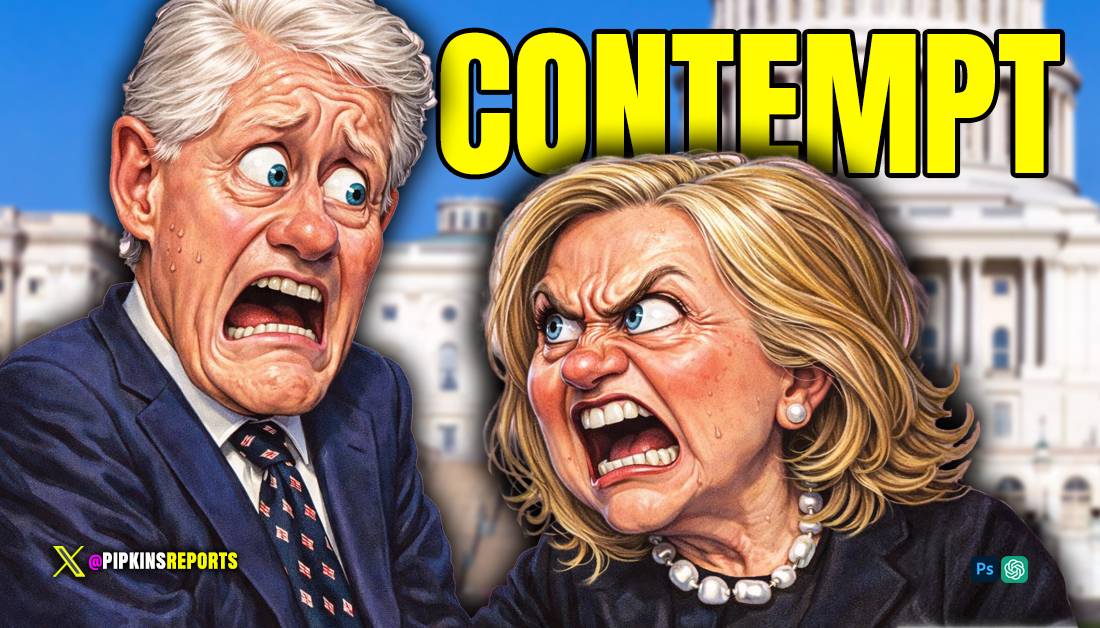
Clintons in Contempt
WASHINGTON, DC — The Clinton political machine, long accustomed to dictating the terms of engagement, ran headlong this week into an institution that does not negotiate its constitutional authority. In a rare and politically explosive move, the House Committee on Oversight and Government Reform voted on a bipartisan basis to advance contempt of Congress resolutions against former President Bill Clinton and former Secretary of State Hillary Clinton for defying lawful subpoenas tied to the Jeffrey Epstein investigation.
The January 21 vote clears the way for the full House to consider whether to formally hold the Clintons in contempt, a step that could result in criminal referrals to the Department of Justice. While neither Clinton has been accused of a crime related to Epstein, lawmakers framed the issue more narrowly and more starkly: whether elite political figures are subject to the same compulsory process as everyone else when Congress demands sworn testimony.
The subpoenas arise from Congress’s ongoing investigation into how Epstein operated a vast international sex trafficking network for years while avoiding meaningful accountability. Epstein allegedly died by suicide in a New York jail in 2019 as he awaited trial, but subsequent court filings and document releases revealed his deep and troubling access to political, financial, and cultural power centers. Bill Clinton, and numerous other influential figures appear in those records.
Oversight Committee Chairman James Comer, R-Ky., said the subpoenas issued to the Clintons were approved unanimously last summer by Republicans and Democrats alike. Bill Clinton’s deposition was initially scheduled for October 14, 2025, then moved to December 17, and later reset for January 13, 2026. Hillary Clinton followed a similar trajectory, declining multiple proposed dates before failing to appear for a January 14 deposition. In each instance, the committee said it offered flexibility if the Clintons would propose firm alternative dates. They did not.
Instead, the Clintons’ attorneys countered with what Comer described as an unacceptable proposal. Under that offer, Comer would travel to New York to speak with Bill Clinton alone, without placing him under oath, without producing an official transcript, and without allowing other members of Congress to participate. Comer rejected the proposal, arguing that it amounted to special treatment unavailable to any other witness.
“Subpoenas are not mere suggestions,” Comer said during the hearing. “They carry the force of law and require compliance.”
The committee emphasized that sworn, transcribed testimony is essential to transparency and accountability. Oversight investigators have already released transcripts of interviews with former Attorney General Bill Barr and former Labor Secretary Alex Acosta, both of whom had direct dealings with Epstein during earlier stages of his prosecution. Allowing the Clintons to substitute informal conversations or written statements, Comer argued, would erode the integrity of the investigation and leave the public dependent on competing recollections rather than a fixed record.
Democrats on the committee were divided. Some argued the subpoenas lacked a legitimate legislative purpose, while others conceded that Congress cannot selectively enforce its authority based on party loyalty. Rep. Robert Garcia of California said no current or former president should be categorically immune from oversight. Several Democrats stressed that full transparency in the Epstein case demands uniform standards, even when politically inconvenient.
Recent history undercuts claims that contempt powers are merely symbolic. Steve Bannon, former Trump campaign and White House strategist, was convicted in 2022 of contempt of Congress after defying a subpoena from the House January 6 committee. Peter Navarro, another former Trump White House adviser, was likewise charged and later imprisoned after refusing to provide testimony to the same panel. Both cases demonstrated that contempt citations can and do result in criminal penalties, including incarceration.
The Clintons have argued through counsel that the subpoenas are invalid and that they possess little relevant information. In a letter to the committee, they described Epstein’s crimes as “horrific” and said they had cooperated in good faith by offering written declarations outlining their limited interactions with him. The committee rejected that approach, noting that Hillary Clinton’s tenure as secretary of state gives her direct knowledge of federal anti trafficking initiatives and that both Clintons maintained documented personal and social ties to Epstein and his associate Ghislaine Maxwell.
Historically, contempt of Congress has been used sparingly, particularly against high profile political figures. No former president has ever been successfully compelled to testify before Congress. However, legal analysts note that the Clintons are private citizens and cannot claim executive privilege protections that might apply to a sitting president.
The contempt resolutions now move to the full House, where passage will require a majority vote. Even if approved, the Justice Department retains discretion over whether to pursue prosecution. That uncertainty has not dampened the broader significance of the moment.
At its core, the dispute is not about partisan score settling or retroactive guilt. It is about whether Congress’s investigative power means what the Constitution says it means. For decades, the Clintons operated within a political ecosystem that treated them as exceptions. The Oversight Committee’s vote suggests that era may be ending.
If subpoenas bind only the unfavored and the powerless, they bind no one at all. The House must now decide whether the rule of law applies equally, even when the names on the subpoena are Clinton.
Featured
UFO Files Released
Trump’s “UFO Files” Drop Lands With a Thud, Leaving Believers and Skeptics Equally Unsatisfied
Department of War – For years, UFO believers promised the truth was buried somewhere deep inside government vaults, hidden behind classified markings and decades of official denials. The long-awaited disclosure, they said, would prove humanity is not alone. So when the Trump administration released a major archive of UFO-related material this week, anticipation exploded across social media and conspiracy circles alike. The result, however, landed with all the excitement of opening a mystery safe only to discover it filled with newspaper clippings, hobby magazines, and blurry photos of distant lights in the sky.
The files were released through the federal archive portal at www.WAR.GOV/UFO Files and include videos, audio recordings, witness statements, correspondence, and archival documents connected to unidentified flying objects, now often called unidentified anomalous phenomena, or UAPs.
The website also prominently features a statement from Donald Trump posted from Truth Social:
“Based on the tremendous interest shown, I will be directing the Secretary of War, and other relevant Departments and Agencies, to begin the process of identifying and releasing Government files related to alien and extraterrestrial life, unidentified aerial phenomena (UAP), and unidentified flying objects (UFOs), and any and all other information connected to these highly complex, but extremely interesting and important, matters. GOD BLESS AMERICA!”
The Department of War website also states that additional material will continue to be released on a weekly basis, suggesting the current archive represents only the first phase of a broader disclosure effort. That announcement has kept many UFO enthusiasts hopeful that more substantial evidence could still emerge in future document dumps.
For now, however, the initial release appears to contain little that fundamentally changes the public understanding of UFO phenomena.
Despite years of sensational claims about craft performing maneuvers that supposedly “defy physics,” none of the videos included in the archive appear to show anything close to that. The objects captured on camera are consistently small, far away, and moving in mostly straight lines at what appear to be ordinary, subsonic speeds. There are no impossible right-angle turns, no instantaneous acceleration, no sudden stops, and no visible flight characteristics beyond what could plausibly be explained by conventional objects or optical effects.
File: DOD_111688964 – Taken 2024-06-01 – The United States Northern Command submitted a report of an unidentified anomalous phenomenon (UAP) to the All-domain Anomaly Resolution Office (AARO) consisting of 21 seconds of video footage from an infrared sensor aboard a U.S. military platform in 2024. An accompanying mission report, DoW-UAP-D8, described the UAP as consisting of an object with a vertical pole or bar attached to the bottom of the object. The observer also reported that the UAP may instead be a reflection from an object in the water.
Most of the footage consists of little more than bright shiny objects against the sky, filmed from such extreme distances that meaningful identification becomes nearly impossible. A few clips appear consistent with balloons or commercial drones. Others show glowing or reflective orbs with no discernible structure or detail. None of the material independently verifies the extraordinary claims often promoted by UFO media personalities and internet commentators.
The release arrives after years of mounting public fascination with UFOs. Congressional hearings, Pentagon acknowledgements of unexplained aerial sightings, and endless online speculation helped create expectations that the government might eventually reveal evidence of non human intelligence. Those expectations likely contributed to the enormous interest surrounding this document dump.
But much of the archive reads less like disclosure and more like an oversized collection of unresolved anecdotes and cultural memorabilia. Witness statements describe strange lights, odd movements, and unusual sightings, but almost none are supported by physical evidence, radar tracking, or technical analysis capable of independent verification. Some are handwritten personal accounts submitted decades ago by ordinary citizens reporting mysterious experiences investigators apparently could neither confirm nor explain.
A surprisingly large portion of the collection focuses on civilian UFO enthusiast organizations that published magazines and newsletters dedicated to sightings and theories about alien life. Rather than classified military revelations, many files simply document the activities of hobbyist groups fascinated by UFO culture during the Cold War era and beyond.
The archive also includes letters from school children asking the government whether flying saucers and aliens are real. While historically interesting as a reflection of American pop culture and public curiosity, the letters offer no evidentiary value regarding extraterrestrial life. Some of the material feels more appropriate for a museum exhibit on twentieth century UFO fascination than for a headline generating government disclosure project.
NASA related recordings and footage included in the release similarly failed to produce dramatic revelations. Most involve routine aerospace operations, ambiguous observations, or discussions about unidentified objects without any conclusion that they originated from beyond Earth. NASA has consistently maintained there is no confirmed evidence of alien visitation, and nothing in this release appears to alter that position.
Reaction online quickly shifted from excitement to frustration. Some UFO believers claimed the truly important files are still hidden behind classification barriers and that the public release was carefully sanitized before publication. Skeptics argued the archive merely reinforces what critics have long maintained, that UFO mythology survives largely because blurry footage and incomplete information allow people to project extraordinary conclusions onto ordinary phenomena.
Notably absent from the release are the kinds of materials long promised in sensational documentaries and conspiracy forums. There are no recovered alien craft, no biological specimens, no authenticated extraterrestrial communications, and no government memos admitting contact with non human intelligence. More importantly, there is no footage of any object displaying flight characteristics that genuinely challenge known physics.
That disconnect between public expectation and documented reality may ultimately be the biggest story.
For decades, UFO culture has operated on the assumption that earth shattering proof exists just beyond public reach. Every blurry light becomes a possible spacecraft. Every vague government statement fuels another round of speculation. Entire media industries now thrive on the promise that disclosure is always right around the corner.
Yet when the files finally arrived, they mostly revealed what Americans have seen for generations, distant lights, uncertain observations, stories without proof, and a government willing to catalog mystery without necessarily solving it.
Perhaps future weekly releases from the Department of War will contain something more compelling. But if this first archive is any indication, Americans waiting for undeniable proof of alien visitation may need to lower their expectations considerably.
Council
Ethics Fight Ends in Censure of Councilman Mark Hatley
FATE, TX — The Fate City Council voted last night to censure Councilman Mark Hatley following a contentious ethics hearing that exposed deep divisions among elected officials.
The censure stems from two ethics complaints alleging Hatley improperly disclosed confidential information tied to internal discussions about the potential firing of former Department of Public Safety Chief Lyle Lombard. According to testimony, Hatley shared details with local journalist Michael Pipkins of PipkinsReports.com, including references to recorded conversations with City Manager Michael Kovacs.
The complaint was filed by outgoing councilman Scott Kelley, who played a central role throughout the proceedings and ultimately did not recuse himself and voted in favor of censure.
Monday’s meeting included a formal evidentiary hearing where Hatley, represented by attorney David Dodd, presented a defense and attempted to question fellow council members. The process, however, was repeatedly constrained by legal warnings from City Attorney Jennifer Richie, who advised council members not to answer questions related to Lombard’s termination due to ongoing litigation. That guidance, issued numerous times during the hearing, limited testimony and narrowed the scope of cross-examination.
The council ultimately split along familiar lines. Kelley was joined by outgoing councilman Mark Harper and recalled councilwoman Codi Chinn in supporting the censure. Mayor Andrew Greenberg and Councilman Rick Maneval opposed it, creating a 3–2 divide before the deciding vote was cast. Councilwoman Martha Huffman ultimately sided with the majority, breaking what would have otherwise been a tie, and would have quashed the censure.
Under Texas municipal norms, a censure is a formal statement of disapproval by a governing body against one of its own members. It carries no direct legal penalty, meaning Hatley retains his elected position and voting authority. However, such a reprimand can damage political standing, limit influence within the council, and shape future electoral prospects…if the electorate so decides.
The underlying controversy traces back to the dismissal of Lombard, which has since evolved into a broader legal dispute involving claims of wrongful termination. During Monday’s hearing, repeated references to that litigation underscored the complexity of the case and the limits placed on public disclosure. Richie’s guidance, aimed at protecting the city’s legal position, effectively curtailed testimony that might have clarified key details. Critics argue this dynamic left Hatley unable to fully defend himself against the allegations.
The political context surrounding the vote is difficult to ignore. This was Chinn’s last meeting, as she was recalled from office by the voters, in part due to her involvement in the Lombard matter. Kelley, who initiated the ethics complaint, participated fully in the decision-making process knowing that this was his last meeting. Harper has also been linked in prior discussions about leadership conflicts within city administration, and for he as well, this was his last meeting. Meanwhile, all three have supported recall efforts targeting Hatley, Greenberg, Maneval, and Huffman, for additional recall, along with two new councilmen who will take their seats at the next meeting.
From a procedural standpoint, the meeting reflected a council operating under significant strain. Testimony was fragmented, legal cautions were frequent, and the final vote appeared to follow established political alliances rather than shifting based on evidence presented during the hearing. Even Hatley’s legal representation struggled to gain traction within the constraints imposed by the city’s legal posture.
Opinion
The battle for power in Fate is very real. What unfolded Monday night was not merely an ethics hearing; it was the visible culmination of an ongoing political battle inside Fate’s leadership. When a complainant votes on his own accusation; when key witnesses are effectively shielded from cross examination; when you have councilmen under recall by the very people bringing charges against their opponents; the process begins to look less like a search for truth and more like a managed outcome. It’s cut-throat politics at its worst.
What’s changed due to this Hearing? Essentially, nothing. Hatley gets a political black eye, but that’s about it. The sides were already defined, and the votes exactly as expected. Councilmen whose terms were ending anyway are now gone after delivering one last poke in the eye to their opponents. And the City Manager, who is at the heart of this debacle because of his employee decisions, and his inability to stand up to influence from Council Members… is still employed.
For residents of Fate, the final result is an up-close view into how dirty local politics can get. It diminishes the desirability of the city to new residents, hurts economic growth, and the entire process gives citizens the perspective that their city government is completely dysfunctional.
Disclosure
The author of this article was referenced during the hearing as a recipient of information discussed in the ethics complaints. The reporting above is based on observations of the public meeting and review of the proceedings.
Election
Fate Voters Go Familiar: Robbins Edges McCarthy in Tight Place 3 Race
FATE, TX — Allen Robbins defeated newcomer Melinda McCarthy for Place 3 on the Fate City Council in the May 2, 2026 election, signaling that a slim majority of voters preferred experience over change.
The seat, previously held by Scott Kelley, was open after Kelley declined to seek reelection, setting up a direct contest between Robbins’ prior service and McCarthy’s outsider campaign.
Unofficial results show Robbins winning with 52.22% of the vote, 883 votes, to McCarthy’s 47.78%, 808 votes, out of 1,691 ballots cast. The margin reflects a divided electorate, with nearly half backing a first-time candidate.
Robbins campaigned on experience, but his record on the council became a central issue. Public records show he supported a roughly 5.96 percent property tax rate increase, higher solid waste fees, and a $3 monthly road fee applied broadly to residents.
He also backed zoning changes and approved a 179-unit townhome development, decisions that critics argue contributed to rapid growth and increased density. Some residents have tied those policies to worsening traffic and a perceived decline in quality of life in Fate.
McCarthy’s campaign focused on transparency, responsiveness, and reevaluating growth decisions. Her message resonated with a significant share of voters but fell short against Robbins’ name recognition and governing background.
The results remain subject to canvassing, but Robbins is expected to return to the council as debates over growth, taxation, and infrastructure continue.
Analysis and Commentary
This race underscores a familiar tension in local politics. Voters often voice frustration with growth and rising costs, yet still choose candidates they believe understand the system.
Robbins’ win suggests that, for now, experience outweighs dissatisfaction. But the narrow margin tells a different story beneath the surface.
Nearly half the electorate signaled a desire for change, and those concerns are unlikely to fade. If anything, they will follow Robbins back into office, where the consequences of past decisions, and future ones, will be closely watched.
You must be logged in to post a comment Login